Cold calling isn’t dead, but the blanket version of it is in structural decline. In HubSpot’s 2025 State of Cold Calling report, 28% of respondents said the tactic wasn’t effective while 16% rated it very effective. That split raises a sharper question than whether the channel lives or dies: did the buyer give you a reason to call?
The standard debate treats cold calling as a channel to keep or kill. A more useful split runs between calls placed to accounts showing no buying signal and calls placed to buyers already evaluating a solution.
The number on the screen is identical; the buyer’s context is not.
Headline cold calling numbers, 2025
| Signal | Figure | Source |
|---|---|---|
| Reps who say cold calling is not effective | 28% | HubSpot State of Cold Calling 2025 |
| Reps who say cold calling is very effective | 16% | HubSpot State of Cold Calling 2025 |
| Reps who say phone calls generated the most leads | 37% (63% named other channels) | HubSpot sales statistics 2025 |
| Tracked meetings booked by phone | 85% (email 8%) | 2025 benchmark of 1.4 million emails, 500,000+ calls and 321,000 meetings |
Published averages put cold-call success low enough that skeptics write the channel off entirely. Yet a 2025 benchmark covering 1.4 million emails, more than 500,000 calls and 321,000 meetings attributes 85% of tracked meetings to phone, with email at 8%. The figures only appear to conflict. A broad success-rate average blends calls to accounts with no visible need into the same pool as calls that followed real interest; a meeting-source breakdown counts where booked meetings actually originated.
HubSpot’s separate sales statistics publication adds another wrinkle: 37% of sales representatives named phone calls as their top lead source during cold outreach, meaning 63% named another channel. Phone produces the most leads for a third of reps and loses for the rest, which is what you’d expect if outcomes track the buyer’s context rather than the dialer itself.
The test for any first touch is the presence of a signal: does the account look in-market, and what does a delayed call cost? Answer those two questions and the channel decision sorts itself account by account, with evidence replacing a rep’s preferred tactic.
Table of Contents
- Headline cold calling numbers, 2025
- What “Dead” Actually Means for Outbound Calling
- What Buyers Expect Before They Pick Up the Phone
- Where Cold Calling Still Earns Its Place
- How Many Attempts a Cold Account Deserves
- Replacing Delayed Calls With Live Engagement
- Run the Hybrid Playbook and Set Your Outbound Mix
What “Dead” Actually Means for Outbound Calling
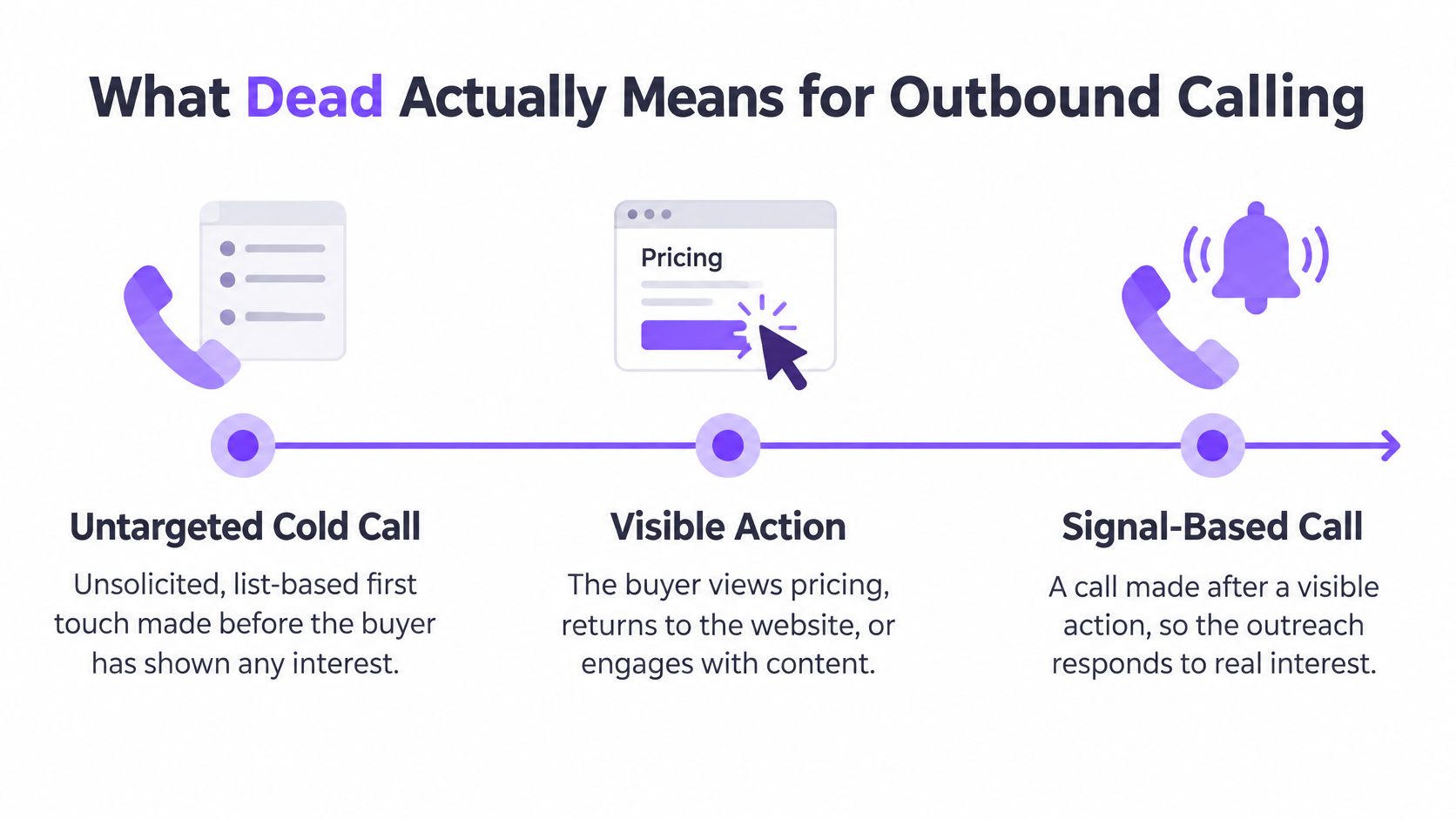
“Cold calling is dead” is too broad to guide an outbound team. An unsolicited call to an account with no visible interest is different from a call prompted by a pricing-page visit, a return visit, or a demo request. The first tries to create relevance from scratch; the second responds to a buyer signal.
The shift is away from treating an unsolicited call as the default. Phone outreach earns its place when its timing and context give the buyer a reason to engage.
A timeline of growing consumer resistance
The U.S. National Do Not Call Registry, established in 2003, gave consumers a formal way to reject most telemarketing calls. The FTC’s National Do Not Call Registry report records more than 253 million active registrations in FY2024, up from 249.5 million at the end of FY2023. In FY2024, the FTC received more than 2 million complaints about unwanted calls. Robocall complaints reached approximately 1.1 million, down from more than 3.4 million in FY2021.
These complaints are not a full count of calls or a survey of consumers. The FTC cautions that they are unverified and do not represent every unwanted call. They still indicate the conditions sales teams face: consumers can reject calls, caller identification can shape whether they answer, and spam filters can block outreach before a conversation starts.
For B2B teams, those barriers make blanket dialing less efficient. Reps spend time on calls that may never reach a buyer, let alone establish a reason to talk. Professional outreach also depends on clear, respectful communication across channels; the guide to email etiquette for financial advisors covers principles that apply to written follow-up, even though its audience is a different industry.
What Buyers Expect Before They Pick Up the Phone
A finance director opens a pricing page late in the afternoon and finds three questions the site doesn’t answer: whether the product fits their organization, how implementation works, and which option suits their team. That buyer may welcome help now. A call to the same person earlier in the day, based only on a name in a list, has no such context.
Gartner’s 2024 survey of 632 B2B buyers found that 61% preferred an overall rep-free buying experience. Buyers favored digital self-service for general information and learning, but preferred seller input for contextual tasks such as judging organizational fit, according to Gartner’s survey findings.
That preference isn’t a request to remove salespeople from every decision. It’s a reason to stop making buyers explain why an unsolicited interruption might be relevant. When the prospect hasn’t signaled a need, the rep must create context by interrupting. When the buyer is already weighing a fit question, a knowledgeable seller can help resolve uncertainty.
Where human input earns attention
Gartner found that buyers were 1.8 times more likely to complete a high-quality deal when they used supplier digital tools together with a sales representative. Self-service-only purchases were 1.65 times more likely to produce buyer regret. The useful division of labor is clear: let digital content support independent learning, then bring in a person when a decision needs context.
Three moments justify offering a live conversation:
- After a pricing or product-detail visit: Give the buyer a quick way to ask about options or product fit.
- After repeat visits from a target account: Treat the pattern as a reason to offer help, not proof that a specific individual is ready to buy.
- When content can’t answer a fit question: Route the buyer to someone who can discuss their organization’s requirements.
This requires the team to know which accounts fit before reacting to behavior. A practical guide to ICP design for outbound sales can help clarify that targeting foundation, while B2B intent data explains how behavior can help distinguish a signal from a guess.
Keep self-service available for education. Reserve human attention for moments when the buyer needs judgment, context, or a direct answer.
Where Cold Calling Still Earns Its Place
A phone call can work when the account fits the ideal customer profile and the buyer is actively evaluating a solution. A rep can adjust the pace, respond to objections in real time, and qualify a need without waiting through an email thread. But a call to the wrong person or at the wrong moment burns SDR time and can undermine trust in the caller’s number.
- The upside: Live conversation lets a rep clarify a buyer’s situation and tailor the discussion.
- The cost: Low average success, call blocking, compliance obligations, and repeated attempts make indiscriminate dialing hard to justify.
- The dividing line: The buyer’s signal matters more than a blanket preference for calls or digital.
A 2025 benchmark covering 1.4 million emails, more than 500,000 calls, and 321,000 meetings reported that 85% of tracked meetings were booked by phone, compared with 8% from email. The same benchmark found that 88% of buyers welcomed outreach during an active buying stage, according to the B2B Marketer’s benchmark summary. These figures don’t mean phone is the right first touch for every account. They make the case for directing phone effort toward buyers showing relevant intent.
Best first touch by account situation
| Situation | Signal present | Best first touch | Why it works |
|---|---|---|---|
| Cold account, no site activity | None | Research-led call or personalized email | Outbound can start context, so keep volume low and fit high. |
| Anonymous visitor on the pricing page | Pricing view or repeat visits | Live browser video or chat during the visit | The buyer is already evaluating; offer help while the page is open. |
| Known account with several stakeholders visiting | Account-level intent | Triggered call to a named contact, plus a meeting invite | The account may need answers coordinated across stakeholders. |
| Visitor outside business hours | Intent, no rep online | AI chat qualification, then calendar booking | The buyer can continue without waiting for a rep to return. |
| Lapsed prospect after a no-show | Past contact, no recent signal | Short email sequence, then one call | Re-establish context before asking for another live conversation. |
Read the table from the signal column, not from a rep’s preferred channel. When there’s no signal, a call is only justified if the fit is strong enough to make a carefully researched attempt worthwhile. When the buyer is actively showing intent, use the channel that can meet that interest with the least friction.
How Many Attempts a Cold Account Deserves
The right call cap depends on the account’s signal, not a universal rule. For a cold account with no activity, three calls over two weeks is a workable ceiling. More attempts should require a reason to believe the account is worth the added rep time.
A 2025 buyer-statistics summary reported that 69% of buyers had answered calls from new providers and buyers used an average of 2.5 B2B contact channels, according to Division 50’s B2B lead generation statistics. Those figures support using more than one channel, not dialing indefinitely. Teams should scrutinize a fourth or fifth attempt to a no-signal account before assigning it more rep time.
Set an effort limit you can measure
Calculate cost per conversation as:
SDR minutes per attempt × attempts per account ÷ live conversations
Compare the result across account tiers. If the no-signal tier consumes more rep time without producing relevant conversations, lower its priority or tighten the fit criteria.
A workable cadence for a no-signal account is:
- Call on day one.
- Send a specific, research-led email on day two.
- Call on day four.
- Use another appropriate channel on day seven.
- Make one final call on day ten, then stop.
Cap calls at three over two weeks, then pause until a new signal appears. The sequence includes email and another channel, so the remaining attempts do not repeat the same interruption. A guide to account-based selling can help teams align effort with account value.
A return visit, pricing-page view, or demo request changes the account’s status. Move it out of the cold queue and respond to the new signal rather than waiting for the next outbound sequence.
Replacing Delayed Calls With Live Engagement
A call made during a buyer’s active research can answer a question before the moment passes. A callback hours later competes with completed research, rival vendors, interruptions, and fading intent. Firms that contacted online leads within one hour were nearly seven times more likely to qualify them, according to a speed-to-lead guide summarizing Harvard Business Review’s lead-response analysis.

Match the response to the trigger
- Pricing or product page during a visit: Offer in-browser live video so a buyer can ask a question without leaving the page or waiting for a callback.
- After-hours traffic: Use AI chat to qualify the visitor and offer a calendar slot when a representative isn’t available.
- A product walkthrough request: Use co-browsing to guide the prospect through the experience without requiring a download.
- A recognized target account: Route the conversation to the account owner for that tier and territory. If no one is free, offer a booking option rather than letting the signal sit.
A website widget can turn an active visit into a live conversation or a scheduled meeting. The workflow is straightforward: detect a relevant signal, offer an immediate way to talk, and record the outcome. Whether that approach improves results depends on the quality of the traffic, the response process, and what happens after the first conversation.
Captiwate combines live browser video, AI chat, visitor identification, and CRM synchronization to qualify and route visitors, or offer a meeting when a representative isn’t available. Teams building an inbound lead generation process can use these interactions to connect a visitor’s signal with a timely sales response.
When response time matters, a workflow can show where time is lost:
Metrics for judging live engagement against cold calls
| Metric | What it measures | Why it matters |
|---|---|---|
| Signal-to-human-response time | Median minutes from intent event to first live contact | Shows how long the buyer waits after signaling interest. |
| Contact rate | Share of attempts that reach a live person | Separates reach from effort. |
| Qualified-conversation rate | Share of contacts that match ICP and have a real need | Measures relevance, not just activity. |
| Meeting-booking rate | Meetings booked per qualified conversation | Connects conversations to pipeline creation. |
| No-show rate | Booked meetings not attended | Shows whether scheduling friction is leaking demand. |
Set starting targets from the current baseline. Compare immediate contextual engagement with delayed generic outreach, separating results by intent level and business hours. These measures show whether faster contact reaches the right buyers and converts conversations into meetings; attempt volume alone does not.
Run the Hybrid Playbook and Set Your Outbound Mix
A productive outbound mix starts by separating accounts with no demonstrated interest from visitors who are actively evaluating. If those groups share one queue, SDRs can spend time calling cold accounts while a ready buyer waits for a response.
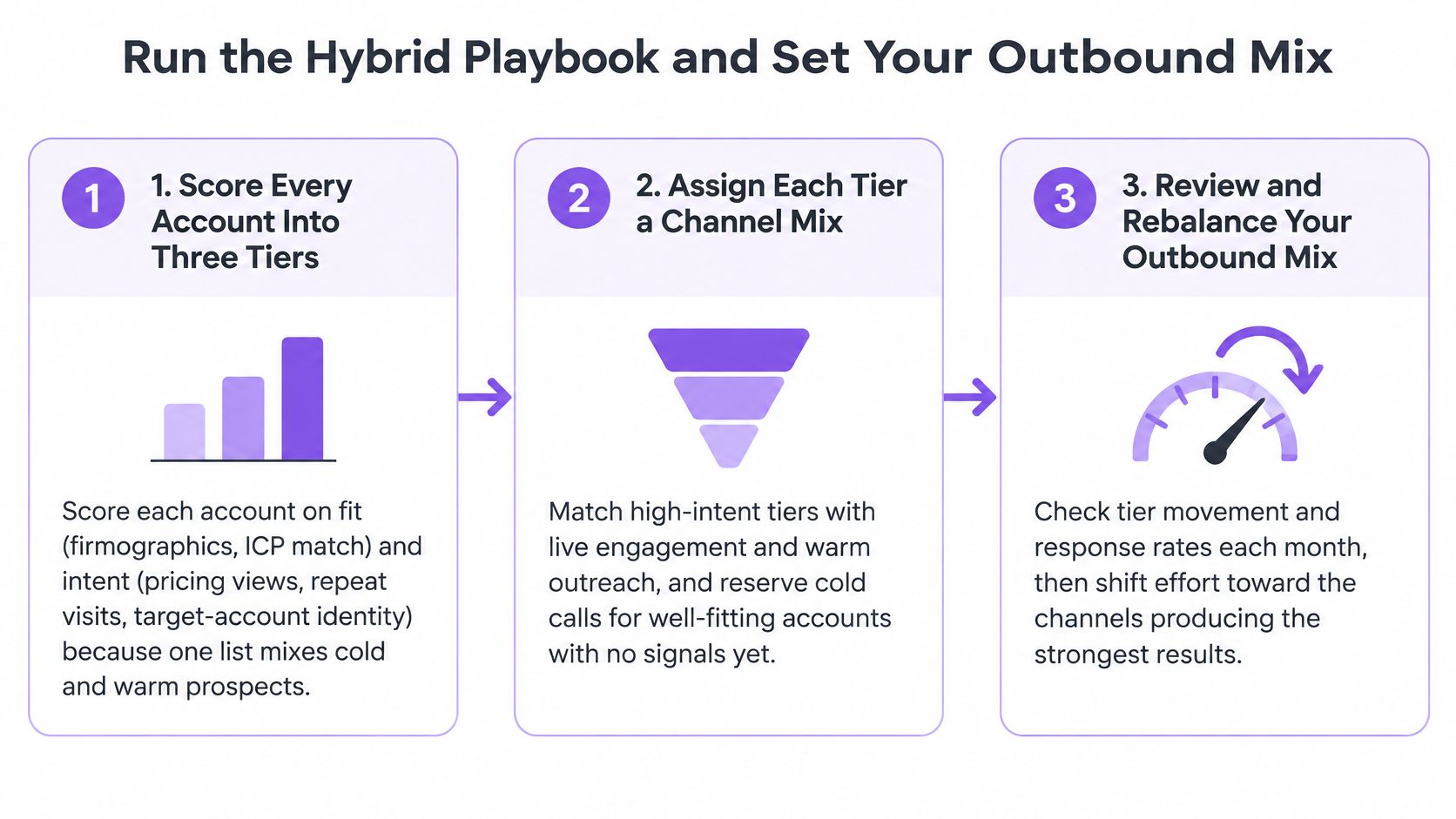
A six-step operating playbook
-
Score accounts by fit and intent. Use firmographics and ICP match to judge fit, then layer in behavior such as pricing views, repeat visits, or a visit from a target account. Keep cold, warming, and high-intent accounts in separate tiers.
-
Route high-intent visits to a live option. Offer chat or browser video and alert the account owner through Slack or Microsoft Teams. The operational failure to watch for is leaving an active buyer in a queue until the next batch of follow-up.
-
Cover demand when the team is offline. Let AI chat qualify the visitor and offer a calendar slot after hours. An unanswered chat shouldn’t automatically mark the lead lost; make it possible for the buyer to book or leave useful context.
-
Keep calls for well-fitting accounts with no signal. Use the capped, mixed-channel cadence rather than repeating the same call to an unresponsive list. When new intent appears, move the account into live engagement.
-
Record each outcome in the CRM. Capture the signal, response timestamp, channel, qualification, and meeting outcome so managers can distinguish speed from conversion.
-
Review account movement and channel results weekly. Move accounts between tiers as their behavior changes. Retire or revise an approach when it keeps generating effort without producing more live, relevant conversations.
To coordinate phone, email, and social touches without treating them as interchangeable, teams can consult guidance on email and LinkedIn prospecting tactics. Use the advice to support a reasoned sequence, not to add channels for their own sake.
A checklist for this quarter
- Define “cold” for your ICP. Specify what fit is required and what buyer behavior counts as a meaningful signal.
- Review response and conversion records. Pull your available history and compare phone results by signal tier rather than treating all dials as equal.
- Set an attempt ceiling. Choose a limit for no-signal accounts and document what triggers a pause or a change of channel.
- Name the events that trigger live contact. Make pricing visits, repeat sessions, and product-detail engagement usable routing rules.
- Confirm local calling and consent rules. U.S. teams should account for the FTC and National Do Not Call Registry; requirements differ in other markets.
- Pilot live engagement on high-intent pages. Compare the results with your baseline using response time, contact rate, qualified conversations, meetings, and no-shows.
The signs of progress are operational: buyers wait less after showing intent, meetings increase, and the team makes fewer calls without losing pipeline. Cold calling survives as a targeted tool, and the teams that win know which accounts to call.
Captiwate helps B2B teams turn website intent into live browser conversations, AI-qualified chats, and scheduled meetings, with visitor signals and outcomes synced to the CRM. If you’re replacing indiscriminate dialing with faster, signal-based engagement, visit Captiwate to explore how it fits your inbound sales workflow.