Contacting a web lead within five minutes produced approximately 100 times higher odds of contact and 21 times higher odds of qualification than waiting thirty minutes, according to the lead-response study summarized by Voiso. That’s a strong argument against leaving inquiries in a queue. It isn’t an argument for interrupting everyone who visits your website.
The hard part of generation lead sales is deciding whose behavior deserves immediate attention. A buyer comparing implementation options may welcome a conversation. Someone reading an introductory guide may want you to get out of the way.
Table of Contents
- What Generation Lead Sales Actually Means
- Speed Benchmarks That Decide Lead Value
- Core Channels Sales Teams Still Use
- Route Each Visitor to the Right Treatment
- What Real Inbound Conversations Produced
- Score Intent Before You Buy More Traffic
What Generation Lead Sales Actually Means
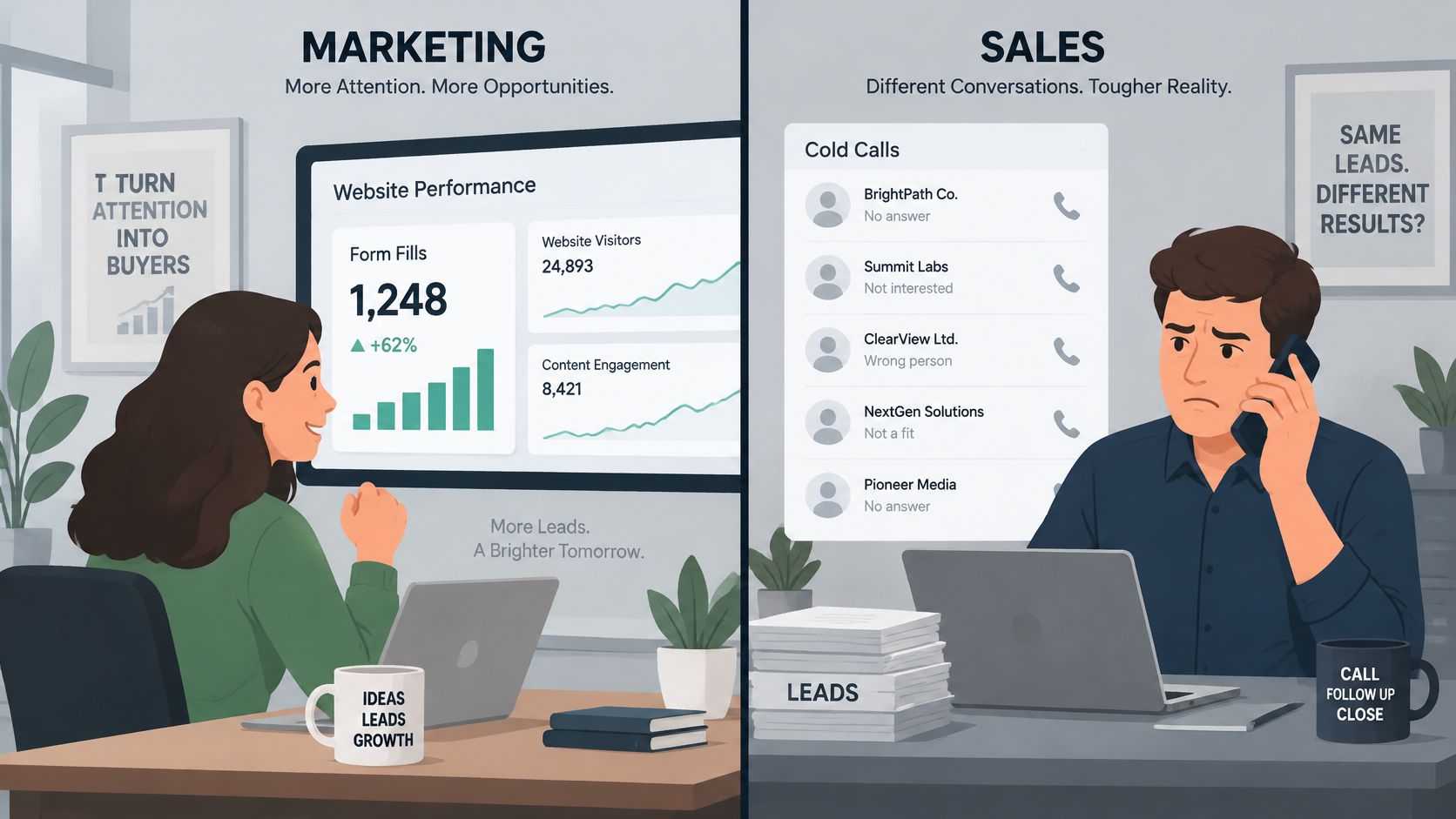
Marketing reports a healthy pile of form submissions. Sales opens the list, calls the contacts, and says the leads are cold. Both teams can be describing the same funnel accurately: marketing captured interest, but nobody established whether that interest justified a sales conversation.
Say a software buyer downloads a guide while researching a problem. Later, someone from the same company returns to compare product capabilities and pricing. Treating those actions as equivalent leaves the rep without the context needed to choose a useful opening.
That mismatch is what the marketing-versus-sales handoff needs to resolve.
Separate attraction, capture, and conversion
Generation lead sales means attracting suitable buyers and turning their attention into a qualified conversation while they’re still deciding. It combines distinct jobs, but those jobs shouldn’t share a single success metric.
- Demand generation brings relevant accounts to your website through useful content, search visibility, advertising, partnerships, and other discovery paths.
- Lead capture records a way back to an interested person through a form, call, chat, or meeting request.
- Sales conversion establishes whether there’s a real problem to solve and an agreed next step.
Think of a shop window. Traffic is people walking past, a lead is someone who slows down, and a sales conversation is a useful greeting while they’re examining the offer. A voicemail the next afternoon is a different interaction.
Practical rule: Don’t promote a contact to sales-ready merely because you finally know their email address.
Give each motion its own evidence
Marketing should know which accounts arrive and what attracts them. Revenue operations should know whether capture and routing work. Sales should know whether conversations produce qualified opportunities.
For the broader acquisition side, Data Hunters Agency’s a pipeline growth guide for B2B teams is a useful companion when connecting channel planning with pipeline goals.
Buyers may arrive with a shortlist assembled through search or a language model. Your job isn’t to restart their education from the beginning. It’s to recognize what they need next, whether that’s a clear answer, an implementation discussion, or uninterrupted access to the product information.
Speed Benchmarks That Decide Lead Value
A submitted inquiry is perishable, but the benchmarks measure different outcomes. Contact means reaching someone. Qualification means establishing that an opportunity meets the study’s criteria. Conversion uses the definition applied in the particular analysis.
James Oldroyd’s work with InsideSales.com, conducted from 2004 to 2007, examined more than 15,000 web-generated leads and 100,000 call attempts across six companies, according to Plura’s account of the lead-response studies. The same account describes a 2021 InsideSales analysis of about 5.7 million inbound leads and 55 million sales activities, reporting approximately eight times higher conversion when first contact occurred within five minutes rather than six minutes or later.
The broader timing gap appears in the 2011 Harvard Business Review study, which analyzed approximately 1.25 million web-generated leads, as summarized by Retell AI. That study associated contact within an hour with much better access to decision-makers and qualification outcomes than later follow-up.
Lead response bands and relative odds
These are relative outcomes, not guaranteed revenue multipliers. The historical studies support a response-time discipline, not a promise that shortening your timer will multiply closed revenue by the same amount.
| Response band | Relative outcome | What was measured |
|---|---|---|
| Within 5 minutes vs 6 minutes or later | About 8× higher conversion | 2021 InsideSales analysis, about 5.7 million inbound leads, summarized by Plura |
| Within 5 minutes vs 30 minutes | Contact odds about 100× higher; qualification odds about 21× higher | 2004–2007 study, 15,000+ web leads and 100,000+ call attempts across six companies, summarized by Plura |
| Within 1 hour vs one additional hour | Nearly 7× more likely to have a meaningful conversation with a decision-maker | 2011 HBR study, about 1.25 million web leads, summarized by Retell AI |
| Within 1 hour vs 24 hours or longer | More than 60× as likely to qualify | 2011 HBR study, about 1.25 million web leads, summarized by Retell AI |
The operational lesson isn’t that every inquiry deserves the same expensive treatment. It’s that manual waiting is a poor default for demonstrated buying intent. A rep who reviews a shared inbox between meetings can be conscientious and still arrive too late.
Don’t transfer these figures directly into a revenue forecast. Different lead sources, qualification definitions, staffing patterns, and customer profiles can produce different absolute results. Estimate your own improvement by comparing similar inquiries handled at different speeds.
Find the delay before adding automation
Trace an inquiry through the actual systems. Does the form event reach the CRM immediately? Does enrichment block assignment? Does an alert go to a named owner or a channel everyone assumes someone else watches?
A fast acknowledgment can conceal a slow handoff. An automated receipt confirms delivery, but it doesn’t answer a buying question or establish that a rep is available. Record those events separately.
For implementation decisions, use a speed-to-lead operating approach that distinguishes assignment, attempted engagement, and actual connection. A single response-time field can’t explain where the buyer waited.
Relevance also has to survive the rush. Netco Design LLC’s guidance on how to segment leads for more relevant outreach is useful when turning one inbound queue into distinct treatments for commercial inquiries, educational downloads, and existing customers.
A timer without an owner is a dashboard decoration. Assign the next action before celebrating the alert.
Track 0–1, 1–5, 5–30, and 30+ minute bands as operating categories. Compare qualification and meeting outcomes within them, separating business-hours traffic from off-hours arrivals. Use the results to fix the largest controllable delay rather than choosing software solely because it sends notifications quickly.
Core Channels Sales Teams Still Use
Forms haven’t disappeared. In 2025, 84% of marketers used form submissions to convert leads, 50.3% used phone calls, and 33.2% used live chat, according to Keywords Everywhere. Those shares describe channel usage, not which channel creates the best opportunities.
The useful question is what each channel asks the buyer to do and what your team must deliver afterward. A form promises a future response. A call or live-chat button implies someone can help now.
Lead channels by job and failure mode
The usage shares below come from the marketer figures above. There’s no equivalent in-browser-video adoption figure in that comparison.
| Channel | Share using it | Best job | Main failure |
|---|---|---|---|
| Form submissions | 84% of marketers | Record a way back | Replies can sit in a queue for hours |
| Phone calls | 50.3% of marketers | A live, high-intent conversation | No answer, or a callback after intent cools |
| Live chat | 33.2% of marketers | Answer a question in the moment | Queues and bot dead ends |
| In-browser video | Not reported in the channel comparison | A human conversation on pricing or product pages | Damages trust if offered intrusively on low-intent pages |
Forms work well for asynchronous requests. Keep the fields tied to what the next owner needs. If your team doesn’t use a field for qualification, preparation, or routing, reconsider making it mandatory.
A form doesn’t have to be slow. The failure is the workflow behind it: delayed assignment, missing availability, or an inbox with no accountable owner.
Phone calls make availability nonnegotiable. Publish a number only with an answer path, overflow treatment, and a clear expectation outside staffed hours. Don’t invite a live conversation and then force the buyer into an unexplained voicemail loop.
Match the interface to the buyer’s question
Live chat suits questions a buyer wants answered while staying on the page. Automation should answer directly where it can and hand over the conversation history where it can’t. Requiring the buyer to repeat everything to a rep wastes the advantage of the channel.
In-browser video is a more substantial invitation. Offer it where a demonstration, screen share, or detailed discussion would help, and let the buyer choose whether to accept. Don’t make a camera interaction the price of viewing basic product information.
For context, Unbounce reported a 2025 median conversion rate of 6.6% across industries. That’s not a target for your particular commercial page or a reason to classify everyone who doesn’t convert as a lost lead.
Paid acquisition needs the same downstream discipline. Excellorix’s PPC strategies that support revenue growth provide useful context for connecting campaign intent with landing-page treatment instead of optimizing only for cheap submissions.
A 2025 ClickZ survey cited by Salesgenie found that 59% of respondents named increasing sales opportunities as their top lead-nurturing priority. Make that distinction operational: marketing owns capture and nurture quality, while sales owns the availability and usefulness of live conversations. Revenue operations connects both to opportunity records.
Route Each Visitor to the Right Treatment
Contacting every visitor faster is the wrong objective for buyers who want to research alone. The 6sense guide to AI-assisted B2B buyer research describes buyers completing roughly 70% of evaluation independently before contacting a vendor and 94% using large language models during the journey. It also discusses separate buyer findings that 61% prefer a rep-free experience and 73% avoid suppliers sending irrelevant outreach.
Those findings argue for progressive engagement, not universal silence. Make useful information available, recognize commercial context, and offer assistance without making it compulsory.
The treatment should follow the signal, not the sales team’s appetite for more conversations.
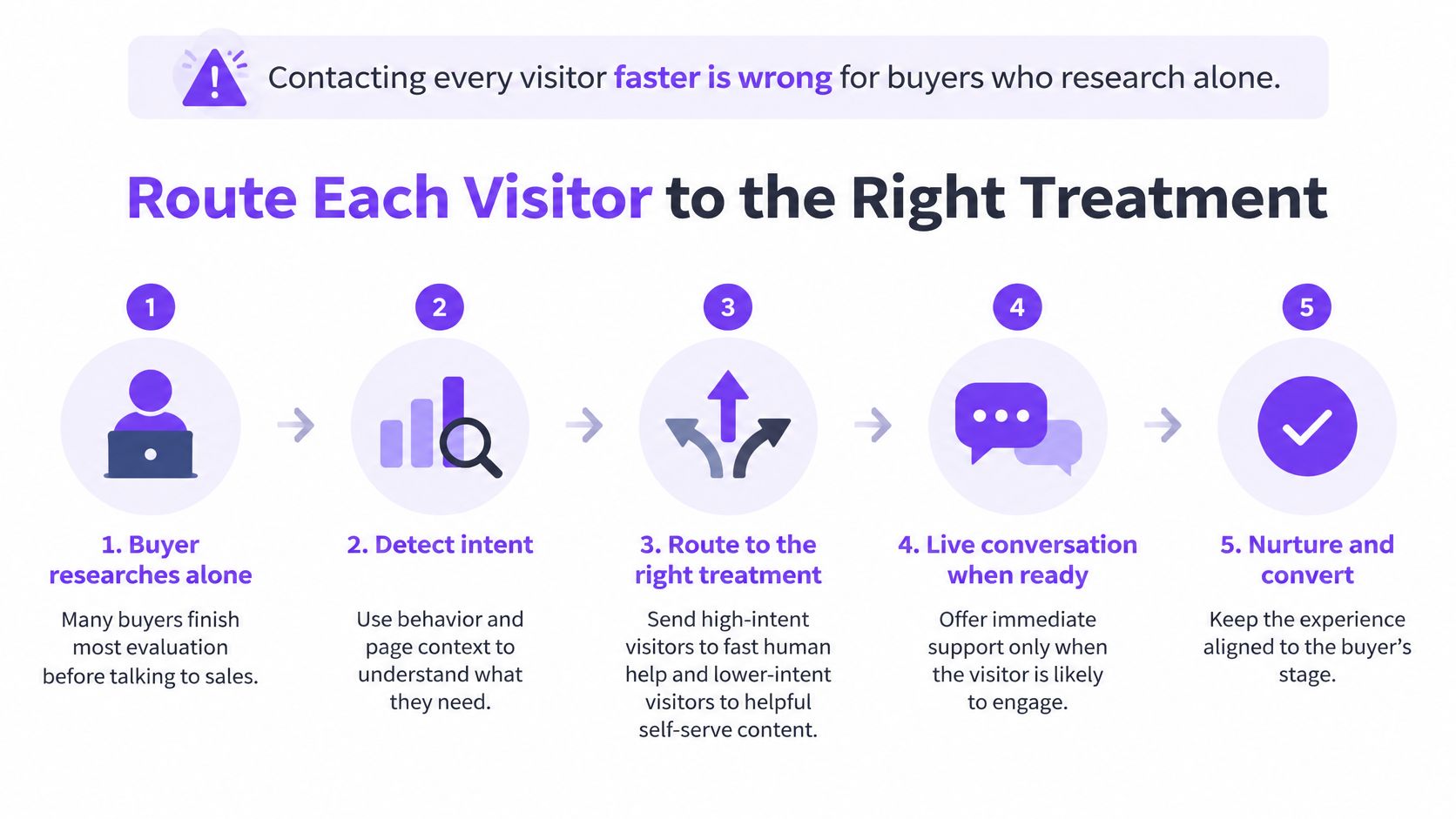
When to engage a website visitor
Treat this as an initial routing policy to test, not proof that any page view establishes purchase readiness. An ideal customer profile, or ICP, describes account fit; it doesn’t establish permission to interrupt.
| Signal | Treatment | Why |
|---|---|---|
| First visit to a blog or guide | No interruption; answer in place | The visitor may be researching independently |
| Pricing, product, demo, or repeat ICP visit | Offer live help or a meeting | Commercial context makes assistance more relevant |
| A question automation can answer | Answer first, then offer a person | Buyers shouldn’t need a rep for straightforward information |
| Prompt dismissed | Suppress further prompts | Refusal is a preference signal, not a challenge |
| High intent outside business hours | Qualify and offer booking without waiting for morning | The buyer needs a usable next step while engaged |
A pricing visit can justify an invitation, but not a forced call. A repeat visit from a target account strengthens the context, but it doesn’t tell you who is browsing or whether they control the purchase.
Use role, geography, page context, prior consent, and available account information together. Where identity is uncertain, preserve that uncertainty in the record rather than inventing confidence.
Run the routing loop
-
Mark the commercial events. Label pricing, product, demo, and comparison pages separately from educational content. Exclude internal visits, job seekers, and support traffic where you can identify them reliably.
-
Attach useful context without demanding a form. Record pages viewed, repeat behavior, and content depth. Add company information where available, but don’t represent company identification as verified personal identity. Keep collection and outreach aligned with your privacy settings and consent requirements.
-
Combine recency with intensity. A recent commercial action should outrank an old accumulation of content reads. Reduce the influence of stale activity so a previously engaged account doesn’t remain permanently urgent.
-
Choose an available destination. Route eligible visitors to a rep who can cover their region and question. When nobody is available, offer automated qualification and calendar booking instead of displaying a misleading live status. A lead distribution software workflow should make ownership and fallback behavior explicit.
-
Offer something the buyer can accept. A specific invitation to discuss implementation is more useful than a generic demand to connect. Give the visitor an easy way to decline, keep researching, or choose a later meeting. Timestamp the attempt even if they don’t respond.
-
Write outcomes to the CRM. Preserve distinct stages for the intent event, first engagement, human connection, qualification, meeting booked, and opportunity created. Store the conversation context with the record so the next person doesn’t start from scratch.
Test the buyer experience as well as the plumbing
Walk through the site as an unknown visitor, a returning account, and someone who has already dismissed help. Check whether prompts respect those differences. Also test unavailable reps, calendar gaps, and a failed CRM write.
Sketch test: Draw the pricing-page event on a whiteboard. If nobody can name the recipient, fallback, and recorded outcome, the routing loop isn’t live.
Measure assisted pipeline, meeting attendance, and whether visitors continue their research after receiving an invitation. Collect feedback about usefulness, not just whether someone clicked.
Keep business-hours and off-hours reporting separate. Automated coverage should fill a staffing gap, not conceal a broken daytime handoff. And leave unknown visitors anonymous when they haven’t asked for help: a completed research session can be a good outcome even without a new contact record.
What Real Inbound Conversations Produced
An outbound motion can work while the website still leaves commercial interest unattended. The Salesforge case illustrates that distinction: the opportunity wasn’t to attract more visitors, but to give people already researching sales tools a real-time path to a conversation.
The journey below shows where that path belongs, between independent exploration and a sales discussion the visitor chooses.
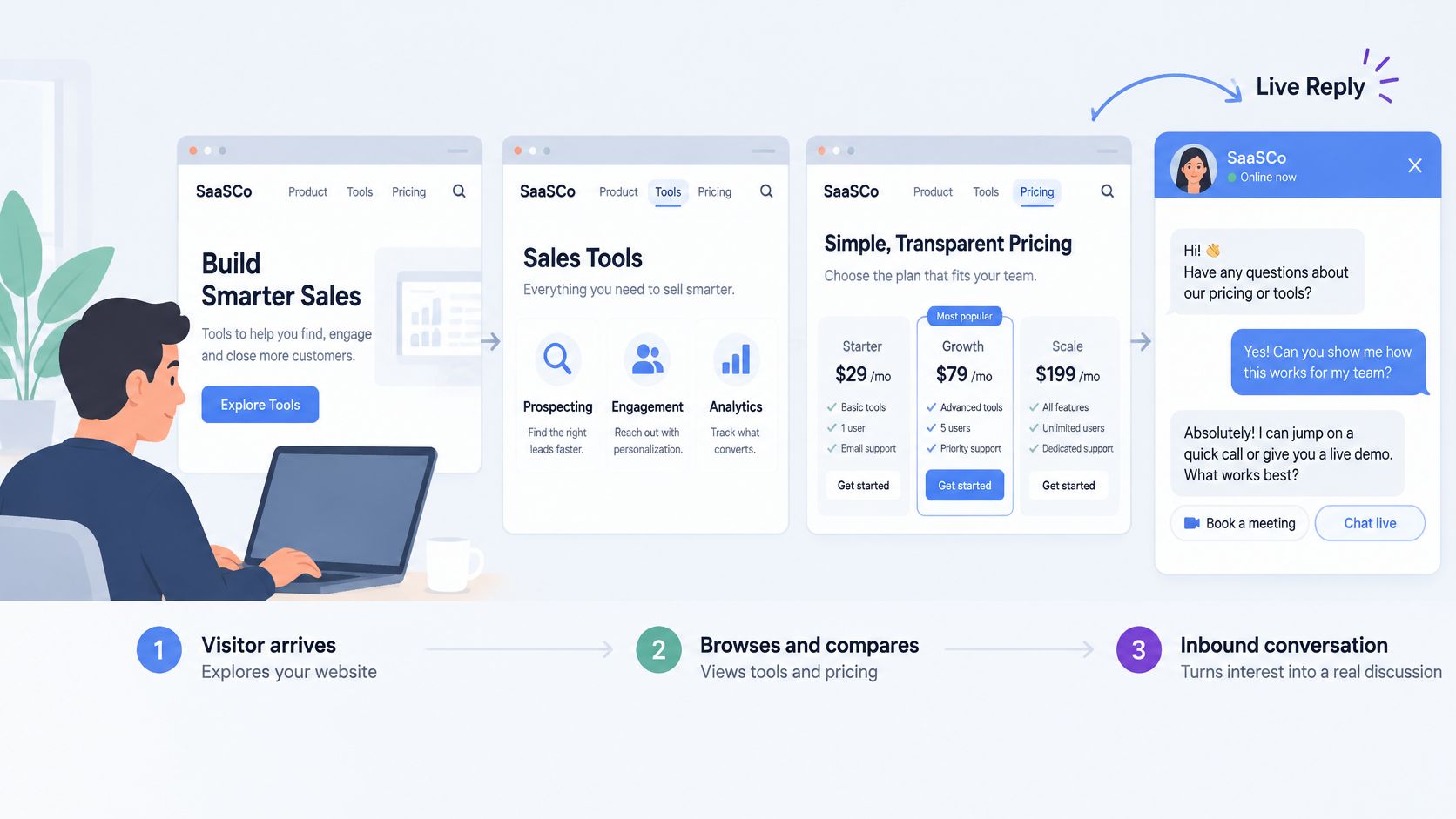
Read the outcome without overextending it
In our Salesforge case study, widget-triggered conversations produce 200+ inbound calls a month and about 10 opportunities a month. Demos booked rose 30% from the same website traffic.
These are attributed customer outcomes, not a general conversion forecast. They show that an existing audience can contain commercially useful demand that a form-only path doesn’t capture. They don’t establish that every additional conversation is qualified or that another business will reproduce the result.
Frank’s account captures why visitor-initiated contact feels different from another outbound task:
“One thing that should get any business excited about Captiwate is when there is a call coming from a visitor. A user is calling the website, that is pretty cool, and that is the dopamine hit.”
The customer discussion gives context to the reported outcomes.
Copy the conditions, not the headline
The transferable decision is to place assistance where visitors are evaluating an offer. Before copying the setup, establish that your site has that pattern: meaningful commercial-page activity, unanswered buying questions, and a team capable of handling the resulting conversations.
A sales-tool buyer examining pricing isn’t equivalent to a student reading a definition or an existing customer searching for support. Mixing those sessions into the same treatment would make the case look more broadly applicable than it is.
- Inspect the starting point. Identify the commercial pages where buyers have no useful live path.
- Protect conversation quality. Route support requests and poor-fit inquiries appropriately instead of counting every interaction as sales demand.
- Audit opportunity attribution. Distinguish a new opportunity created after a conversation from an existing opportunity whose participants happened to return.
Keep campaign source, page context, and conversation outcome together in the CRM. That lets a revenue leader ask whether the interaction helped create a genuine opportunity, rather than awarding credit to whichever interface captured the last click.
The practical lesson is narrower, and more useful, than adding a widget everywhere. Find a commercial question your website leaves unanswered, then make a qualified person available at that point.
Score Intent Before You Buy More Traffic
Fix the response path before increasing acquisition spend. If commercial inquiries wait without an owner, additional traffic sends more buyers into the same unresolved process. If you don’t distinguish research from buying intent, more notifications create work rather than useful sales conversations.
Start with a commercial page and examine the decisions around it. Who gets alerted? What makes the visitor eligible for assistance? What happens when that person is unavailable, and where does the outcome appear?
Make the next investment earn its place
Use B2B intent data to prioritize a decision, not to decorate a contact record. A useful signal changes the treatment: who responds, what they offer, or whether they stay quiet.
- Repair ownership first. Replace shared responsibility with an accountable destination and fallback.
- Check measurement separately. Make sure staffed and unstaffed periods don’t disappear into a blended average.
- Preserve buyer choice. Keep product information accessible and make declining assistance easy.
Choose a test with a clear hypothesis. For example, offering implementation help on a commercial page may produce more useful conversations than a generic greeting. Judge the result by qualified next steps and pipeline, while checking whether the invitation disrupts visitors who decline.
Put the commercial terms beside the operating decision
For teams choosing our platform, getting started means booking a demo and integrating the script, revealing and scoring visitors by intent, then turning suitable visits into pipeline. Most customers are live the same day after implementation, and no engineering team is required.
Captiwate is priced on funnel size, not team size: $15,000 a year covers up to 20,000 monthly visitors, with unlimited seats and unlimited conversations included. That removes a per-seat trade-off, but your team still needs an engagement policy and accountable follow-through.
Bring your own commercial page to the walkthrough. The useful test is whether your traffic, staffing, and buyer questions support the proposed treatment, not whether a polished generic demonstration looks convincing.
Captiwate connects visitor intent with live video, chat, AI qualification, and meeting booking, so buyers can get help when they’re ready. Visit Captiwate to book a walkthrough on your own website with your own traffic and test which signals should lead to a conversation.