BANT is a sales qualification framework covering Budget, Authority, Need, and Timeline. Sales teams use these four criteria to decide how strongly to prioritize and pursue an opportunity.
You might be looking at a demo request right now from someone who clearly wants help but can’t name an approved budget. The useful question isn’t whether they pass a test. It’s whether you have enough evidence to justify the next conversation, and what you should learn during it.
Table of Contents
- Why Lead Qualification Matters in Inbound Sales
- How the BANT Framework Works
- How to Evaluate BANT Evidence
- BANT Qualification Examples for B2B Sales
- BANT Limitations and Modern Alternatives
- Applying BANT to Inbound Sales Workflows
- Choosing Between BANT and Modern Sales Frameworks
- A Practical Model for Using BANT Well
Why Lead Qualification Matters in Inbound Sales
Consider a hypothetical prospect who repeatedly visits your pricing page, attends a product event, and requests a demo. When your SDR asks about funding, the prospect explains that their manager hasn’t approved a project yet. Afterward, they disappear without completing the detailed qualification form.
Should the SDR close the inquiry, keep chasing, or send educational material? Each action could be reasonable, but the team needs a reason beyond an empty budget field.
Treating every inquiry alike creates conflicting workloads. Reps can spend discovery time with curious researchers while overlooking buyers who have a pressing problem but incomplete purchasing plans. Conversely, treating every pricing-page visit as purchase readiness can fill calendars with conversations that lack a useful next step.
Separate engagement from purchase evidence
Engagement tells you where to investigate. Qualification tells you what you’ve learned. A demo request establishes interest in a conversation, not necessarily funding, approval, or urgency.
Make that distinction explicit in your handoff:
- Observed activity: Record the demo request and relevant website behavior.
- Buyer explanation: Capture why the person started researching.
- Unresolved question: Identify what prevents a sensible next action.
- Follow-up purpose: Specify what the next conversation should establish.
The same distinction applies upstream. If your team uses LinkedIn activity to attract attention, Linkboost pod management tips offer a separate resource for managing that engagement activity. Keep those channel activities distinct from evidence about whether an account can and wants to buy.
Practical rule: Don’t turn a missing answer into a negative answer without investigating what’s missing.
In the hypothetical demo request, the SDR should clarify the business problem and how projects receive approval. That produces a defensible action: continue discovery, nurture around a future event, or deprioritize because the product doesn’t address the need. Qualification should make the decision explainable to the next person handling the account.
How the BANT Framework Works
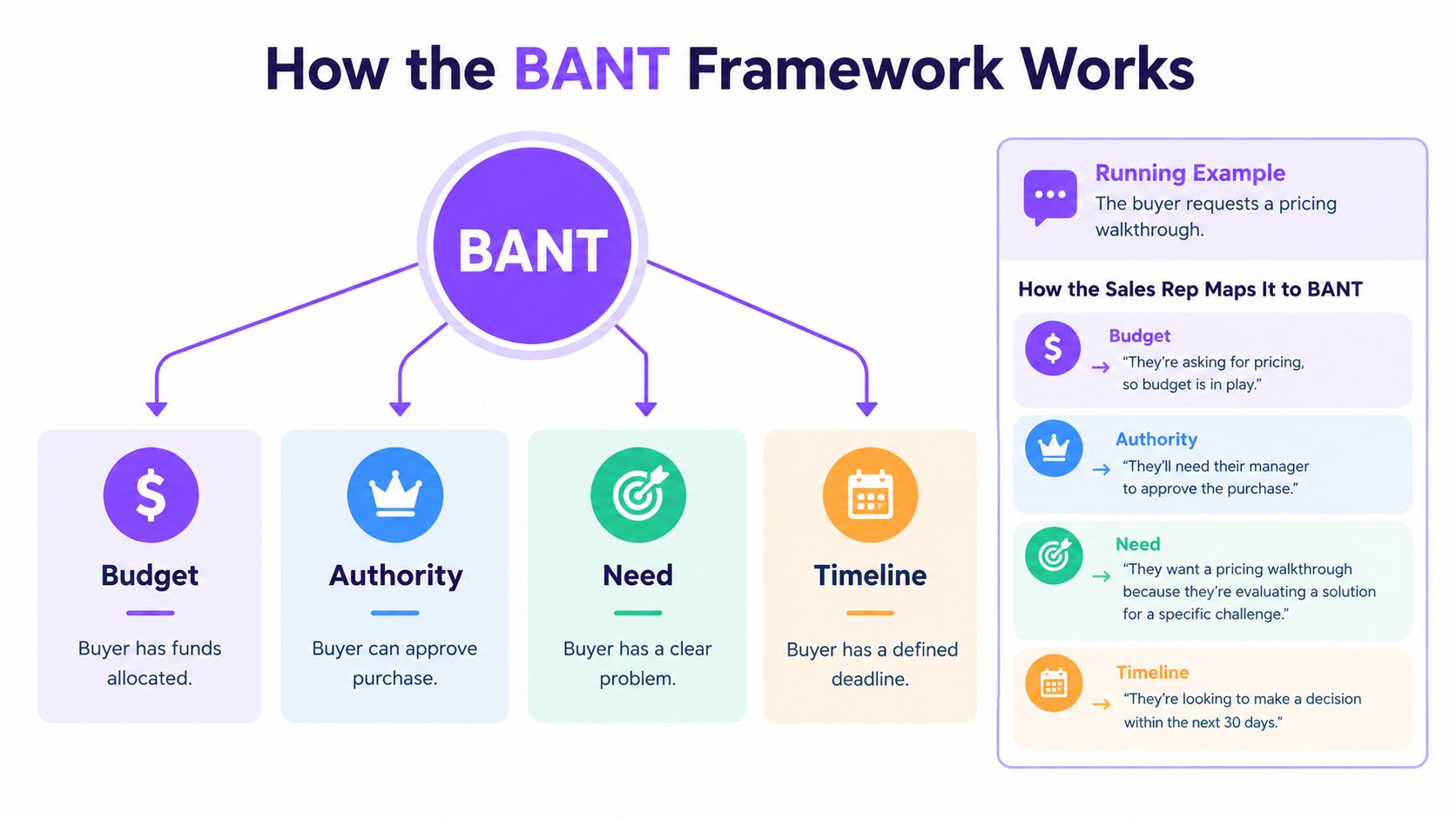
For someone asking “What is BANT in sales?”, the practical answer starts with the evidence behind each letter. Consider a buyer requesting a pricing walkthrough. Your job is to understand what prompted that request, not just complete fields.
Use the diagram to orient the conversation, while treating its short labels as starting points rather than strict requirements.
Understand what each criterion asks
Budget concerns the ability to fund a purchase. In the walkthrough, ask whether the buyer is evaluating an approved investment or building a proposal. A credible funding path is different from an allocated budget, but both deserve accurate documentation.
Authority concerns who participates in approval. Your contact might investigate products, recommend a vendor, approve spending, or assess technical suitability. Ask how a purchase like this gets approved rather than assuming a senior title settles the question.
For Need, move beyond the requested feature. If the buyer wants automated routing, investigate what happens under the current process and who experiences the consequences. Interest becomes more useful qualification evidence when the buyer connects it to a business problem.
Timeline concerns the reason for acting within a particular window. Ask what event makes the timing matter and what must happen before deployment. A desired launch date and a purchasing decision date aren’t interchangeable.
Use the framework without importing its history as a rule
BANT is generally credited to IBM and associated with mid-century enterprise technology selling, but its precise origin date isn’t established by a surviving IBM primary document. The historical review of BANT’s IBM association identifies a reseller template from November 2008 as the earliest IBM BANT-related document found in that review.
That history doesn’t require a budget-first interview today. For an adjacent qualification context, Franchise Foundry’s franchise lead qualification process provides a useful comparison point when considering how qualification questions fit a particular buying situation.
Use this video alongside the framework as another learning aid.
The criteria work together. A pricing walkthrough should reveal which questions deserve attention next, not force the buyer to resolve their entire purchasing process before receiving help.
How to Evaluate BANT Evidence
A completed field isn’t necessarily reliable evidence. An SDR can enter “budget available” after hearing that the project is important, even though the buyer never described funding. Another SDR might leave the field blank after learning exactly how approval would work.
Assess both the substance and the confidence of each conclusion. Strong evidence is specific enough to support an action. Developing evidence points toward a plausible opportunity but needs validation. Unknown evidence means you haven’t established the answer.
BANT evidence guide for inbound sales
| BANT criterion | Strong evidence | Developing or unknown evidence | Recommended response |
|---|---|---|---|
| Budget | Buyer confirms allocated funding and its approval conditions | Funding could be requested, or the funding path hasn’t been discussed | Establish how investment approval works before recording financial readiness |
| Authority | Relevant approval roles and participants are identified | A potential champion is engaged, but the economic buyer is unclear | Help the contact map who needs to participate |
| Need | Buyer describes a specific problem and its business impact | General interest, an untested assumption, or an unexplained feature request | Investigate consequences and suitability before advancing |
| Timeline | A credible decision event and dependencies are understood | A planning window exists, or timing hasn’t been explored | Identify what would trigger action and what could delay it |
Don’t average these judgments into false certainty. A specific business problem may warrant discovery despite unclear funding; confirmed spending authority doesn’t compensate for a problem your product can’t solve.
Match the next question to the gap
Suppose a buyer describes an operational bottleneck but says purchasing decisions belong to another department. The useful follow-up concerns how that department evaluates requests. Asking repeatedly whether the contact is “the decision-maker” won’t uncover much.
Use discovery questions in sales to develop prompts around the actual uncertainty. Choose questions that help the buyer explain their situation rather than questions designed to produce a preferred CRM answer.
- Confirmed: The buyer directly established the relevant fact.
- Plausible: You have a reasoned hypothesis that still needs validation.
- Unknown: You don’t yet have enough information.
- Contradicted: The buyer supplied evidence against the assumption.
These labels make coaching more useful. A manager can ask what would validate a plausible funding path instead of debating whether the SDR was optimistic. They also make it easier to distinguish a promising account with unfinished discovery from an account with clear reasons not to proceed.
BANT Qualification Examples for B2B Sales
The following scenarios are hypothetical teaching examples, not customer case studies. They show why the pattern of evidence matters more than the number of completed fields.
A compelling project without approved funding
An operations manager describes recurring handoff failures that require manual correction. They have a target rollout tied to an internal process change, know which executive approves spending, and want help preparing the investment request.
Budget is unresolved, but the rep has a concrete discovery purpose: validate whether the product addresses the failure and understand what the executive needs to approve funding. The appropriate next step could be a focused walkthrough followed by a business-case discussion.
Record that funding requires approval. Don’t rewrite “we can submit a request” as “budget confirmed.”
A spending conversation without a business problem
Another contact opens by discussing a generous potential investment. However, they can’t explain what needs to change, who owns the initiative, or how anyone would select a solution.
The rep shouldn’t equate willingness to discuss money with a viable opportunity. Ask what prompted the research and whose work would improve. If the contact remains unable to identify a relevant problem, educational follow-up is more appropriate than a lengthy custom demonstration.
A buyer’s willingness to name a budget and their readiness to buy are different things.
This distinction matters when interpreting silence, too. Avoma’s BANT analysis reports that only 11% of prospects in its call sample volunteered a budget figure. That sample-specific observation doesn’t establish a universal rate, but it illustrates why missing budget information shouldn’t automatically become disqualification.
An inbound visitor with an approaching decision event
A visitor returns to product and pricing pages, then asks through chat whether implementation could support an upcoming internal launch. Their role and funding remain unclear.
The rep can offer a short conversation about the launch requirements. Website activity supplies context; the buyer’s explanation establishes whether the deadline is meaningful.
The handoff should distinguish those sources. “Returned to pricing” is observed behavior. “Needs deployment before the internal launch” is buyer-reported timing. Keeping them separate helps the next rep test assumptions instead of inheriting them as established facts.
BANT Limitations and Modern Alternatives
The assumption that a fully completed BANT record means a fully understood deal is unsafe. You can know that funding exists, identify an approver, confirm a problem, and establish a target date while still misunderstanding how the organization will choose a vendor.
As the earlier analysis notes, BANT gives limited attention to buying committees, decision criteria, competition, and procurement. Those gaps matter when the next obstacle isn’t willingness to buy but the process required to complete a purchase.
Look beyond the contact and the target date
An enthusiastic sponsor might need technical approval before recommending a product. Procurement might require steps that the sponsor hasn’t considered. A competing option could be an incumbent system or a decision to retain the current process.
Build additional discovery around the uncertainty:
- Decision criteria: What must the selected solution demonstrate?
- Technical approval: Who evaluates feasibility, integration, and security?
- Procurement requirements: What needs to happen after a vendor is preferred?
- Alternatives: What other approaches could the buyer choose?
These questions extend qualification without pretending BANT itself answers them. They’re particularly useful when a positive initial conversation creates pressure to advance an opportunity prematurely.
Respect independent research
Gartner reports that 61% of B2B buyers prefer a rep-free buying experience. Don’t interpret that as permission to infer their entire buying process from browsing activity.
Instead, offer relevant assistance and let the buyer explain where help would be useful. A contact researching independently might welcome an implementation answer while resisting a broad qualification interview.
The same caution applies to AI lead qualification. Use automated conversations to capture information and highlight unanswered questions, not to manufacture certainty about undisclosed purchasing plans.
A sensible alternative isn’t always a replacement framework. Sometimes the right adjustment is to retain BANT for initial prioritization and require deeper decision-process discovery before advancing a complex opportunity.
Applying BANT to Inbound Sales Workflows
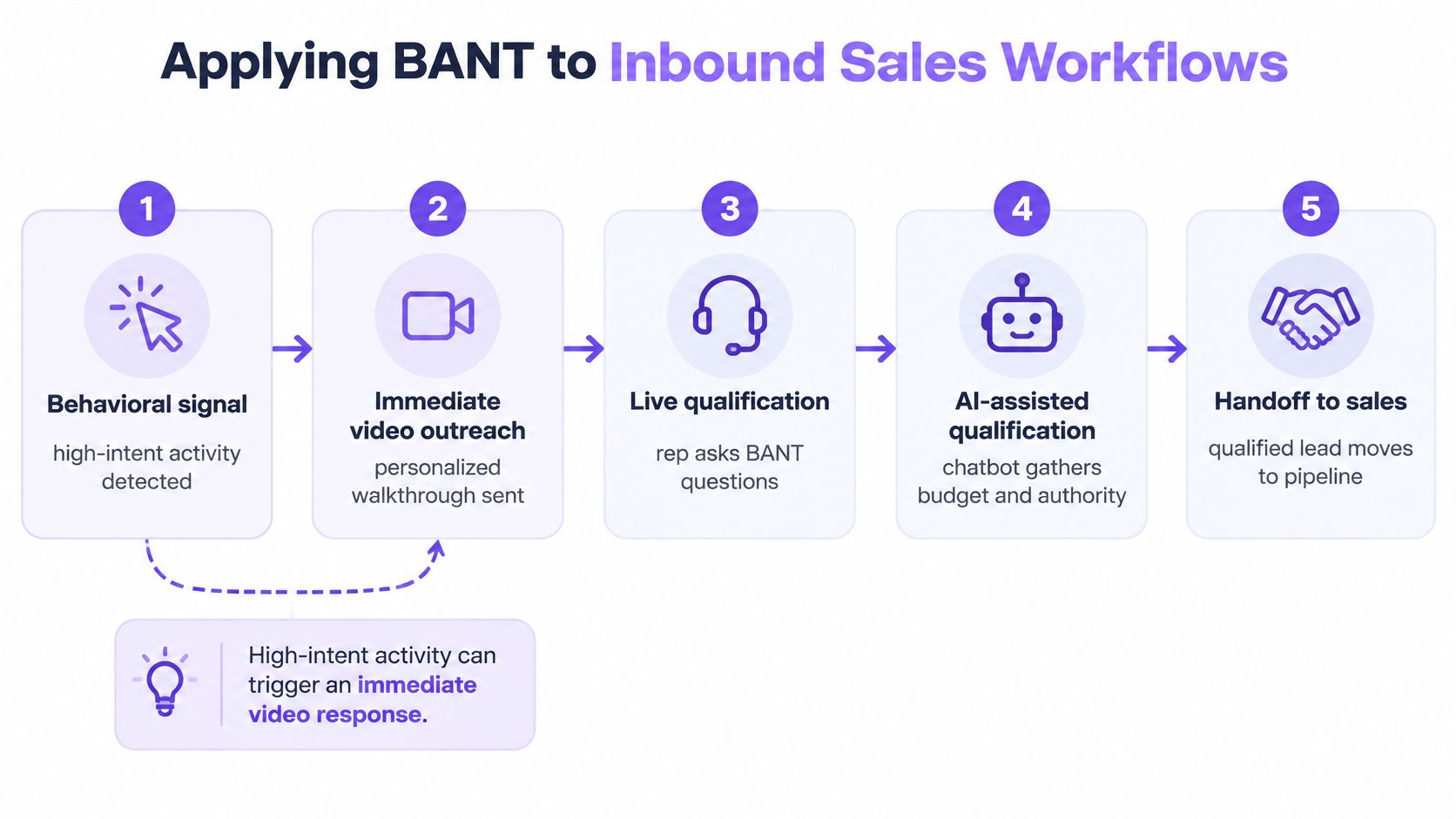
Start by defining what should prompt engagement and what that engagement should accomplish. A behavioral trigger should open a helpful conversation, not on its own certify an opportunity.
The workflow below connects initial interest with qualification and handoff. Live and AI-assisted conversations can be alternative paths rather than mandatory consecutive stages.
Begin with a relevant invitation
Connect your inbound lead generation process to explicit engagement rules. For example, product and pricing research could prompt an offer to answer implementation questions through in-browser video or chat. Visitors should be able to decline or schedule instead.
Start discovery with the buyer’s reason for visiting and the event behind their timing. Once the problem is understood, ask how investment approval works and who else needs to participate. This sequence lets the rep explain why a funding or stakeholder question is relevant.
If a live rep isn’t available, AI chat can collect context and offer scheduling. Don’t make buyers repeat the same discovery when they subsequently meet a person.
Preserve the evidence in the CRM
Configure CRM records so another rep can understand both the conclusion and its basis.
- Evidence content: Store the buyer’s explanation, not just a qualification label.
- Evidence source: Identify whether it came from chat, a live conversation, a form, or observed activity.
- Capture timestamp: Record when the information was collected.
- Confidence and gaps: Distinguish confirmed information from assumptions awaiting validation.
- Next action: Assign an owner and a purpose for follow-up.
In HubSpot or Salesforce, a short summary plus structured fields can keep the record usable. Conversation records provide context, while fields support routing and review.
Handoff standard: The next rep should know what’s established, what’s uncertain, and what the buyer agreed to do next.
Routing rules can escalate an account with strong Need and Timeline even when Budget is unconfirmed. Nurture accounts whose problem is relevant but whose action depends on a future event. Re-qualify when a stakeholder changes, a deadline slips, or the original evidence no longer describes the project.
Visitor identification, intent detection, live engagement, AI qualification, scheduling, and native CRM synchronization can support this process. A manual chat-and-CRM workflow is another option. In either case, people must define fit, inspect exceptions, and ensure that automated handoffs preserve context.
Choosing Between BANT and Modern Sales Frameworks
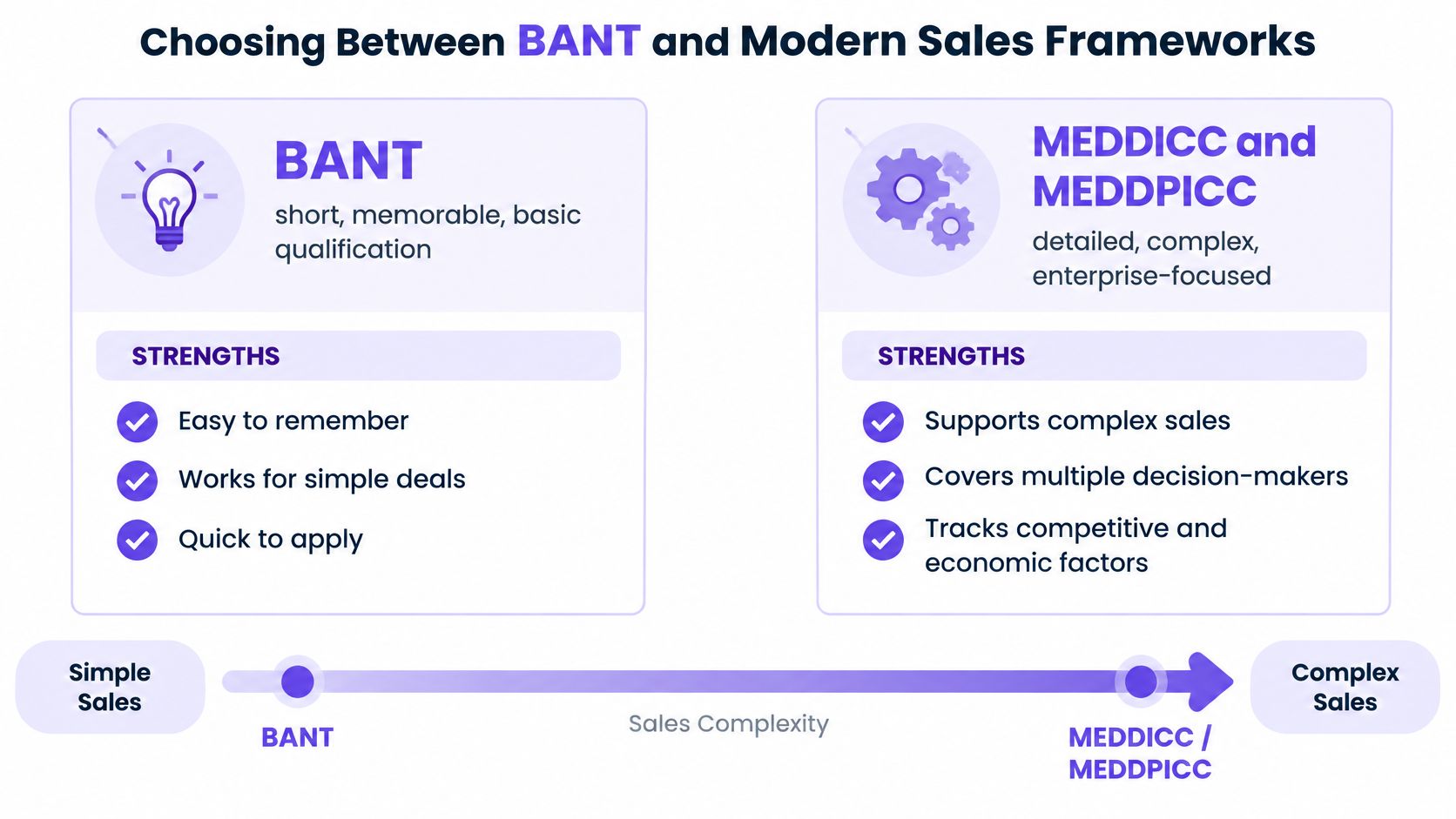
Choose a framework according to the decisions your sellers need to make, not how impressive its acronym sounds. Initial response prioritization and late-stage deal inspection require different levels of understanding.
Use this comparison as a guide to the depth of discovery your process may need.
Use BANT for a focused initial decision
For an inbound team deciding whom to contact and what to investigate, BANT offers a manageable starting point. I’d favor it when the immediate decision is whether to offer discovery, arrange a relevant demonstration, or continue nurturing.
The trade-off is limited depth. A compact record is easy to inspect, but managers must resist treating completeness as proof that the deal is understood.
Add depth when the buying process demands it
For opportunities involving complex approval and selection processes, consider richer approaches such as MEDDICC or MEDDPICC. Rather than choosing by acronym alone, define the discovery work you expect the framework to support.
Your evaluation checklist might include:
- Business value: Can the team explain the consequences of solving or retaining the problem?
- Buyer alignment: Does an internal advocate understand who controls the investment?
- Selection process: Are evaluation criteria and approval steps clear?
- Execution risk: Have sellers investigated procurement dependencies and alternatives?
Those are useful requirements for assessing a richer method, not a substitute for learning its terminology and implementation properly. More fields won’t help if reps lack the access or conversation skills needed to validate them.
For broader thinking about matching a model to a decision, explore the strategic frameworks from Intonetic. Apply the same discipline to sales operations: specify the problem before selecting the framework.
A layered approach is a reasonable choice. Use BANT at inbound entry, then deepen discovery as the opportunity warrants more investment. Don’t require enterprise-level deal documentation merely to answer a visitor’s initial product question.
A Practical Model for Using BANT Well
Use BANT to connect priority, discovery, and action. Priority determines where the team should spend attention. Discovery tests the important assumptions. The next action should reflect what the buyer and seller know.
That operating model avoids treating qualification as a permanent label. A useful opportunity review ends with a justified decision, not a cleaner-looking record.
Review the evidence before advancing
Use this checklist during handoffs and pipeline discussions:
- Problem clarity: Can the rep describe the buyer’s problem and why addressing it matters?
- Buying-group mapping: Are the relevant participants known, with unresolved roles clearly identified?
- Funding evidence: Is investment approved, plausibly obtainable, unavailable, or still unexplored?
- Decision timing: Is there a credible reason to act, with important dependencies understood?
- Evidence freshness: Does the information still reflect the buyer’s situation?
- CRM capture: Can another person trace the conclusion to its source?
- Follow-up alignment: Does the proposed next step address an unresolved question the buyer recognizes?
Strong evidence can justify immediate attention. Mixed evidence should produce targeted discovery. Unknowns require judgment about whether another conversation is worthwhile, while explicit evidence of poor fit should support a clear decision to step back.
Coach the reasoning, not the completion rate
Ask reps to explain why they chose the next action. A thoughtful answer might identify an important unanswered question and a buyer who has agreed to help resolve it.
That’s more useful than rewarding fully populated fields regardless of their quality. Good qualification improves decisions without pretending uncertainty has disappeared.
Captiwate offers visitor intent detection, in-browser video, AI chat, scheduling, and CRM synchronization to support evidence-based inbound qualification. Visit Captiwate to explore how your team could capture BANT context during website conversations and carry it into the next sales action.