You’re on the pricing page again, and the form is doing exactly what forms do. It asks for a name, a work email, a company, a phone number maybe, then it promises someone will reach out soon. Meanwhile, the visitor who was ready to compare plans or book a demo has already opened another tab.
That gap between peak intent and delayed follow-up is where conversational marketing earns its keep. A useful starting point is this guide to Prompt Builder chatbot overview, which helps frame how assistant-style experiences work before you think about revenue workflows. If you’ve already been thinking in terms of intent-based marketing, conversational marketing is the moment that intent gets answered in real time instead of captured and parked.
The simplest way to think about it is this. A form is a suggestion box. Conversational marketing is the associate who walks up, asks what you need, and helps you move forward while interest is still warm.
Table of Contents
- Introduction Why Conversations Beat Forms When Intent Is Highest
- What Conversational Marketing Really Means Today
- Why Real Time Engagement Converts Better
- Core Channels and How to Choose the Right Mix
- How Real Time Workflows Work From Trigger to Meeting
- Real World Examples of Conversational Workflows in Action
- Measuring Success and Getting Started With Confidence
Introduction Why Conversations Beat Forms When Intent Is Highest
The first version of this problem is easy to recognize. Someone lands on a product page, skims features, clicks into pricing, and has one real question before they buy or book a meeting. If the site only offers a form, the buyer has to stop, type, wait, and hope someone replies before their attention breaks.
That delay is expensive because buyer intent isn’t stable. In practice, the moment a person signals interest is the moment you have the most influence, and the least patience from them. Conversational marketing is the discipline of responding inside that moment, using chat, routing, scheduling, or a live handoff so the page doesn’t just collect interest, it advances it.
This is why the category matters most in B2B, e-commerce, and any motion where the deal or order starts with a question. High-intent traffic rarely needs more nurturing content. It usually needs a fast answer, a qualified next step, or a way to talk to the right person without friction.
A lot of teams confuse this with adding a chatbot to the site and calling it done. That’s too narrow. The useful frame is a revenue system that connects marketing, sales, and service around the visitor’s next best action, not a widget sitting in the corner of the page.
A visitor who is asking about fit, price, or timing is already in a conversation. The only question is whether your site joins it quickly enough.
What Conversational Marketing Really Means Today
Conversational marketing is a buyer-journey system built around real-time dialogue. It can include AI chat, live agent handoff, voice or video, scheduling, and unified inboxes that keep the thread alive across channels, not just on one web page. A recent overview points out that the term has expanded beyond basic website chat into a broader system that blends conversational commerce and omnichannel messaging, while many explainers still define it too narrowly as a website widget alone, which misses the strategy behind it (formzz coverage on conversational marketing).
That distinction matters. Basic chatbot deployment tries to answer questions. Conversational marketing tries to move a buyer forward, qualify demand, and hand the conversation to the right owner at the right moment. In other words, the focus isn’t “Can a bot talk?” It’s “Can the system create revenue movement without dropping context?”
The boundary between marketing, sales, and service
Marketing owns the trigger and the intent capture. Sales owns the qualification and meeting conversion. Service owns post-sale continuity, support, and expansion. In a good conversational system, those lines stay visible even when the customer experience feels fluid.
That’s where teams get tripped up. If marketing runs the tool but sales ignores the handoff, the system turns into a lead inbox. If service gets dragged into pre-sale qualification, response quality drops. Conversational marketing works when each team sees its lane and the conversation passes cleanly from one owner to the next.
Practical rule: if the conversation needs product fit, pricing, or buying authority, it belongs in revenue motion, not generic support.
The category now stretches into adjacent channels too. Teams using conversational ad targeting with AI are trying to bring the same real-time logic into paid acquisition, where ad response and page response should feel connected instead of separate.
Why Real Time Engagement Converts Better
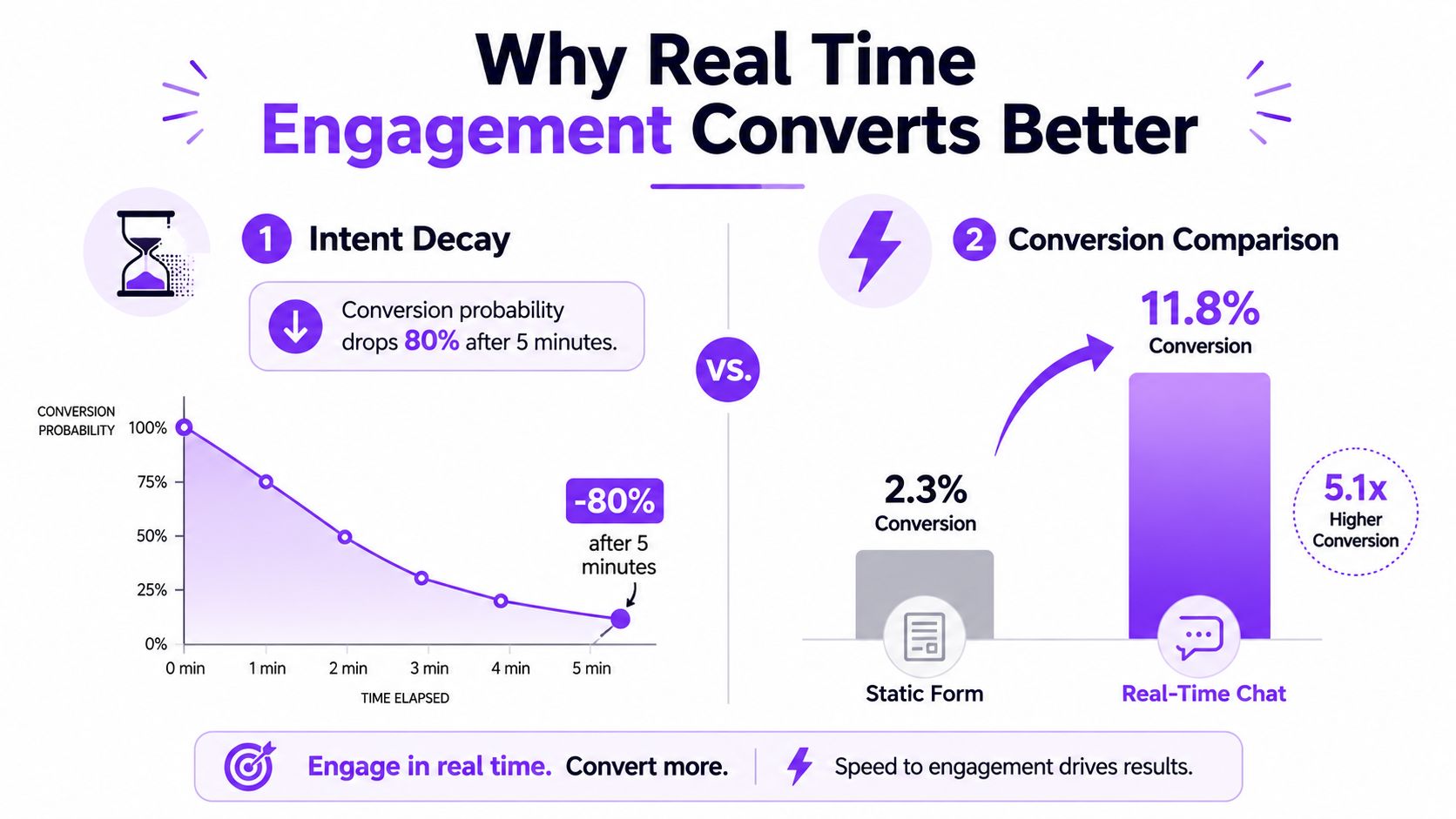
Speed changes outcomes because intent decays fast. A widely cited benchmark says B2B teams that respond within 5 minutes are 21x more likely to qualify a lead than teams that wait 30 minutes, while responding within 1 hour is about 7x better than waiting even one more hour (speed to lead benchmark). The point isn’t that every team can answer in five minutes, the point is that the first minutes matter more than the rest of the hour.
That’s why chat-led workflows tend to beat static capture in matched-intent contexts. Benchmark summaries report that chat can convert about 4.3x better than traditional forms, and top-quartile B2B AI chat deployments have been reported at roughly 17.4% chat-to-meeting conversion versus 4.8% for form-based landing pages (AI response gap benchmarks). Even without copying those numbers into every team plan, the pattern is clear, real-time qualification reduces the distance between curiosity and action.
Why the friction disappears
Forms ask for patience before value. Conversation gives value first. A buyer can ask about integrations, pricing, security, or timing and get an answer while they’re still on the page, which means fewer abandoned sessions and fewer stale handoffs.
The mechanics are simple. A good conversation shortens the path from question to next step, whether that next step is a meeting, a demo, or a routed follow-up. The best systems use AI to absorb routine questions and human reps for high-stakes moments where nuance, objection handling, or trust building matters.
That last point is the boundary teams should care about. AI-only messaging works well for coverage, triage, and repetitive qualification. Human conversation wins when the buyer is comparing vendors, negotiating scope, or signaling strong purchase intent that needs a live decision-maker.
If the visitor is asking one clarifying question and can self-serve, AI is usually enough. If they’re signaling readiness to buy, a human should enter fast.
The business case isn’t only conversion. Independent compilations also note that customers expect real-time communication, that many prefer live chat, and that companies using conversational marketing have reported stronger sales opportunity creation, order value, and retention in some studies (business case compilation). Those numbers explain why teams keep moving from slow forms toward live, routed dialogue.
Core Channels and How to Choose the Right Mix
The right channel depends on the visitor’s intent, the account value, and the staffing model you can sustain. A pricing-page visitor on an enterprise account needs a different experience than an anonymous top-of-funnel browser. That’s why the channel mix should be chosen by moment, not by preference.
Live chat is the default for fast qualification. In-browser video is stronger when trust, technical complexity, or enterprise buying committees are involved. AI chat is the coverage layer that keeps nights and weekends from going dark. Scheduling becomes the clean exit when the buyer is ready to book but not ready to talk immediately.
Choosing your conversational channel mix
| Channel and Model | Best For | Trade Off to Manage |
|---|---|---|
| AI-only chat | After-hours coverage, basic qualification, FAQ handling | Can miss nuance if handoff rules are weak |
| Live chat with human reps | High-intent pages, pricing questions, urgent buying signals | Requires staffing discipline and routing |
| In-browser video or co-browsing | Complex demos, enterprise evaluation, high-trust sales motions | More operational overhead and tighter rep readiness |
| Scheduling with calendar sync | Buyers who want a meeting but not a live call | Can become a delay if the booking path is too long |
| Hybrid AI plus human handoff | Most revenue pages, especially when intent is mixed | Needs clear thresholds so bots don’t stall hot leads |
The smartest teams don’t choose one channel forever. They define the threshold for each one. If a visitor is anonymous and low intent, AI can qualify. If the account is in a target list and the page path signals deep interest, a human should be ready. If the buyer is mid-evaluation but not free to talk, booking should be one click away.
Good routing is less about being available everywhere and more about being available at the right intensity.
For teams shopping tools, a useful reference is the conversational marketing software list, because the category now includes more than just chat widgets and the feature gaps matter once you try to operationalize handoff, routing, and measurement.
The same logic applies to outbound follow-up. Practical Otter A/B lead generation tips are helpful if you want to think about conversation as part of lead creation, not only as a website support layer.
How Real Time Workflows Work From Trigger to Meeting
A working conversational system starts with a trigger, not with a homepage chat bubble. The trigger can be a pricing visit, repeated product-page behavior, an identified account, or a return visit from a target company. Once the trigger fires, the workflow should decide in seconds what happens next, who owns it, and what gets written back to the CRM.
That’s the difference between a tool and a system. A tool waits for a click. A system notices intent, routes it, and preserves context all the way to the meeting outcome.
The workflow in plain terms
- Detect the moment. Behavioral signals show who’s on a high-intent page and what they’re doing.
- Qualify in the channel. AI handles the first questions, captures context, and decides whether the lead fits a human handoff.
- Route to the right owner. Traffic segmenting and ABM tiering tell the system whether to send the lead to sales, SDR, or another queue.
- Convert the interest. The visitor gets live chat, video, co-browsing, or one-click scheduling depending on the intent level.
- Record and alert. CRM sync, Slack or Teams notifications, and meeting outcomes keep the revenue team aligned.
That workflow should feel continuous to the buyer. They shouldn’t repeat basic context, re-enter the same data, or wonder whether anyone saw their request. The internal side can be complex, but the visitor side should feel like one clean conversation.
If you’re wiring this up, the underlying automation matters as much as the surface experience. The automation flows inside a platform should mirror the way your team qualifies, routes, and follows up, otherwise the conversation ends up trapped between marketing and sales.
The fastest teams don’t optimize the chat itself first, they optimize the handoff logic behind it.
The operational pieces also need continuity. Native CRM sync to tools like HubSpot or Salesforce keeps identified accounts, conversations, and meetings attached to the record, while collaboration alerts make sure reps don’t miss hot activity. Without that loop, the workflow is just a prettier front end on the same slow follow-up problem.
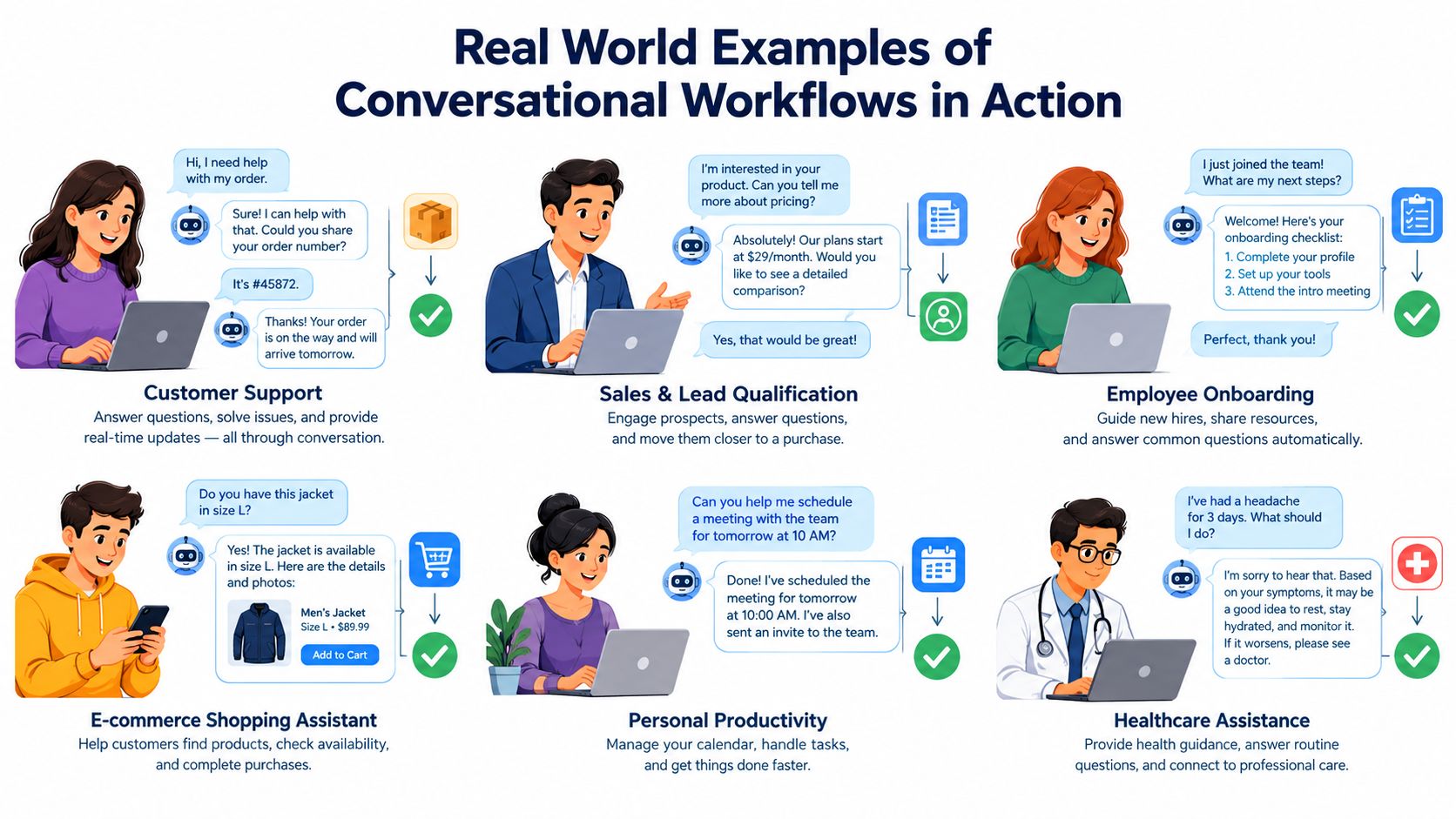
Real World Examples of Conversational Workflows in Action
An enterprise account hits the pricing page three times in a week. Instead of sending them to a form, a rep gets alerted and opens a live video conversation in the browser. The buyer asks about implementation timing, the rep answers in real time, and the meeting gets booked without another round of email.
A different team leaves the site open after hours, where AI chat takes over. The bot answers the common questions, qualifies the visitor, and books a meeting automatically if the fit looks strong. By morning, sales doesn’t just have a name, it has context and a scheduled next step.
A third example is co-browsing on a product walkthrough. The prospect is already interested, but they want to see a workflow mapped to their use case. Instead of forcing them into a demo request form, the rep guides the page with them, points to the right feature, and removes enough friction to keep the deal moving.
What changes across these examples
The trigger differs. The channel differs. The handoff differs. The logic is the same, answer the visitor in the moment that matters most, then write the result back into the pipeline. That’s why conversational marketing feels different from generic chat support, it’s built around revenue movement, not just responsiveness.
One useful way to think about it is by ownership. Marketing creates the opportunity, sales converts the opportunity, and service protects the relationship after the sale. A buyer may touch all three, but the experience works only when the transition between them is smooth.
The best teams treat every conversation as a record, not a one-off event. That means the rep sees the page path, the AI sees the prior exchange, and the CRM holds the meeting outcome. When that happens, the system can improve instead of resetting after every interaction.
Measuring Success and Getting Started With Confidence
The metrics that matter are simple, but they need to be tracked together. Speed to lead tells you whether the conversation starts fast enough. Chat-to-meeting conversion shows whether the workflow advances demand. Show rate, pipeline attribution, and retention impact tell you whether the system is helping revenue, not just generating activity.
That’s also where governance matters. If live conversation creates extra work for humans, or if AI routes too much low-quality traffic to reps, the program can look busy while adding little value. The point is to set a threshold where live conversation is justified, then keep the rest of the path automated and clean.
A practical launch checklist is usually enough for the first pilot:
- Pick one high-intent page. Pricing or product detail pages usually tell the clearest story.
- Define the handoff rule. Decide when AI handles it, when a human enters, and who gets notified.
- Connect the record. Make sure CRM sync captures the conversation, account, and meeting outcome.
- Set privacy controls. Enterprise teams should check SOC 2 Type II, GDPR, and related controls before rollout.
- Review the queue weekly. Look for missed handoffs, slow replies, and patterns in objections.
A small pilot is better than a broad launch with fuzzy ownership. Once the team can prove that one page, one routing rule, and one meeting path work, the rest of the site becomes easier to expand.
If you want to turn high-intent traffic into live sales conversations without building the workflow from scratch, take a look at Captiwate. It connects chat, in-browser video, AI qualification, scheduling, and CRM continuity so your team can handle intent while it’s still live.