
If your analytics already shows which pages attract attention, why do revenue teams still know so little about the companies behind that activity?
That question exposes the weakness in conventional reporting. Website visitor identification can turn an anonymous session into a company-level account signal, but it can’t magically prove who sat behind the screen, whether that person has buying authority, or whether outreach is welcome. The practical challenge is therefore not maximizing identification volume. It’s building a system that is accurate enough to guide action, transparent enough to earn trust, and governed tightly enough to survive privacy review.
Table of Contents
- Why Most of Your Traffic Is a Black Box
- How Website Visitor Identification Works
- Accuracy Limits and What the Numbers Really Mean
- Privacy Rules That Shape Identification
- Implementation Patterns for Compliant Identification
- From Identified Accounts to Live Conversations
- Fewer Identifications, Better Pipeline
Why Most of Your Traffic Is a Black Box
A familiar B2B scene plays out every week. The dashboard shows visitors moving through product pages, returning to pricing, and arriving from a campaign your team paid to create. Forms remain empty. Sales sees no new contact record, while marketing can only report aggregate sessions and page views.
That gap is why website visitor identification became a revenue capability rather than a reporting add-on. The technology can infer which organizations are behind some visits and combine that account signal with behavior, giving teams a way to prioritize demand that otherwise disappears into anonymous analytics.
The word infer matters. An identified account isn’t automatically an identified employee. An office network can represent many people, and a remote worker may appear through a residential provider, VPN, or shared gateway. Treating a company match as a named buyer creates the exact kind of false confidence that sends sales teams after the wrong prospect.
The useful promise
Used carefully, identification answers practical questions:
- Which target accounts are visiting? Compare observed companies with your ICP or ABM watchlist.
- What are they researching? Review product, pricing, comparison, and support-page activity.
- Is interest recurring? Repeated sessions and recent visits are more informative than one isolated page view.
- Who should act? Route a qualified account to the correct owner instead of sending every alert to a shared channel.
The output becomes valuable only when those signals lead to an appropriate next step. A pricing visit from a high-fit account might justify a live invitation or prompt research by an account executive. A single blog visit from an unknown network probably shouldn’t trigger personal outreach.
Practical rule: An identification event is evidence for a decision, not permission to skip the decision.
The rest of the operating model follows three tests. First, can the system explain how it reached the account match? Second, does the data use respect consent, regional rules, and the distinction between an organization and an individual? Third, does the workflow reserve human attention for signals that are strong enough to support a useful conversation?
How Website Visitor Identification Works
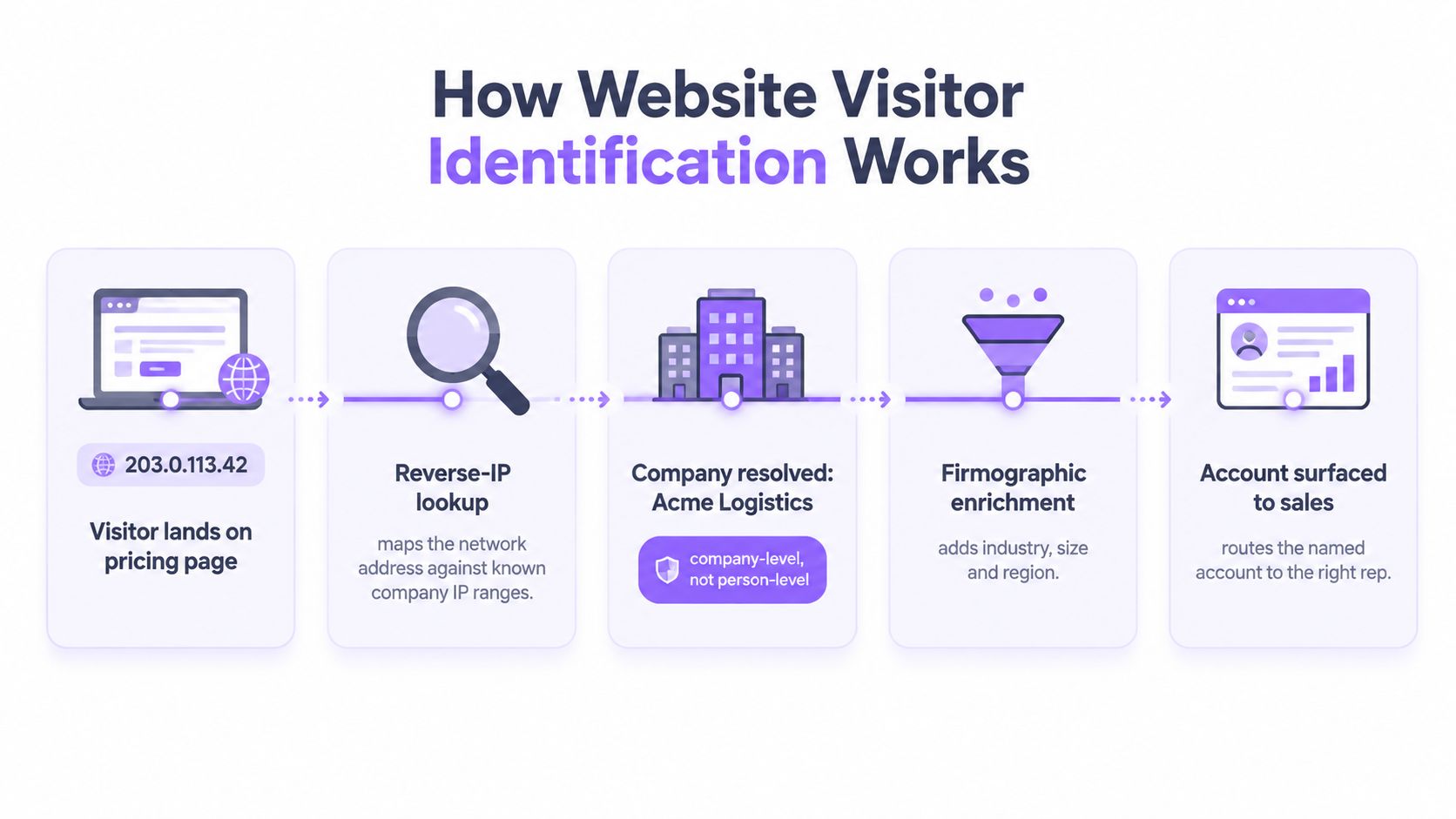
Start with one hypothetical visit. Someone reaches a pricing page from a corporate network. A platform captures technical and behavioral signals, then adds context in layers. Each layer answers a different question, and none should be treated as complete identity on its own.
Start with network resolution
Reverse-IP resolution maps a visitor’s network address against known corporate IP ranges. If the range is associated with Acme Logistics, the system may return the organization and available firmographic context, such as industry, size, or region.
That result is company-level resolution. It doesn’t establish that a particular Acme employee visited, and it doesn’t identify the person who opened the pricing page. Corporate gateways make this distinction especially important because many employees can browse through the same public address.
Add returning-visitor recognition
A first-party cookie can help recognize a browser when it returns, subject to the applicable consent requirements. Recognition lets the platform connect sessions into a behavioral timeline, such as a first visit to a product page followed by a later pricing visit.
Cookies don’t solve the identity problem by themselves. They recognize a browser or device context, not necessarily a person, and deletion, shared devices, browser restrictions, and consent choices can break continuity.
Interpret behavior
The system can then add signals such as:
- Page depth, including whether the visitor explored multiple product pages.
- Referral source, which helps distinguish campaign traffic from direct research.
- Session timing, useful for understanding recency and sequence.
- Repeat visits, which may indicate continued evaluation.
- Pricing-page activity, often more commercially relevant than a generic content visit.
An analogy helps. Company resolution tells you which store entered the mall. Behavioral signals show which shop window that visitor kept stopping at. You need both before deciding whether to approach.
Enrich without overclaiming
Firmographic enrichment can support segmentation and routing. A team might send an account to a regional owner, place it into an ABM tier, or compare the company with existing CRM records.
The final layer is orchestration. A high-fit account with recent repeat visits and meaningful product depth can enter a review queue or trigger a carefully designed live engagement. A weak match should remain an observation, not become an automated sales message.
The technical foundation has limits. Dynamic addresses change, multiple users share networks, and remote employees may browse through residential ISPs or VPNs. Strong implementations therefore preserve the difference between observed signal, inferred company, and verified person.
Accuracy Limits and What the Numbers Really Mean
How much identification is enough to justify action?
The practical answer is not a headline match rate. It is whether the match is reliable enough to change routing, trigger outreach, or add weight to account prioritization without creating avoidable false positives.
For U.S. B2B traffic, company-level match rates are commonly reported around 30–65%, while person-level resolution is much lower, approximately 5–20%, according to industry discussion of B2B visitor identification coverage. Those ranges are directional, not universal. Traffic mix, geography, network type, and provider coverage all change the outcome. A vendor can post a strong company-resolution number and still give a sales team many records that are too weak to act on.
That is why wider industry claims, approximately 35–40% to 65–85% for company matching, need context before they mean anything. The useful question is what was matched, under which conditions, and how validation was done. The analysis of cookieless web-traffic identification makes that variation clear, and a layer of intent data helps explain why two accounts with the same match confidence can deserve very different follow-up.
Why matches fail
| Signal | What It Reveals | Main Limitation |
|---|---|---|
| Reverse IP | Likely organization and network context | Dynamic addresses, shared gateways, VPNs, and mobile networks weaken the inference |
| First-party cookie | Returning browser or session continuity | It doesn’t prove a person, and consent or deletion can interrupt recognition |
| Behavioral signals | Depth, recency, repeat activity, and possible intent | Interest can come from research, support, competitors, or low-authority visitors |
| Form or authenticated event | A person-associated first-party identity | Coverage is limited to visitors who voluntarily identify themselves |
| CRM context | Account ownership, stage, and known relationships | Existing records can be stale or incorrectly matched |
The biggest operating mistake is treating all identifications as equal.
Carrier-Grade NAT, proxies, and remote work make company resolution messy. One public IP can stand in for many users. An employee researching from home may resolve to an ISP or VPN, not the employer. In production, that means company identification should usually be handled as an account clue, not proof that a specific buyer visited.
A workable standard is simple. Require a confidence score. Label the result “identified company” unless a first-party event supports a person association. Fewer high-confidence matches usually produce better pipeline outcomes than broad, low-confidence coverage that floods reps with noise.
Measure that. Track how many identified accounts survive suppression, reach manual review, become qualified conversations, and influence opportunities or revenue. Raw match volume belongs in diagnostics, not in the performance headline.
Privacy Rules That Shape Identification
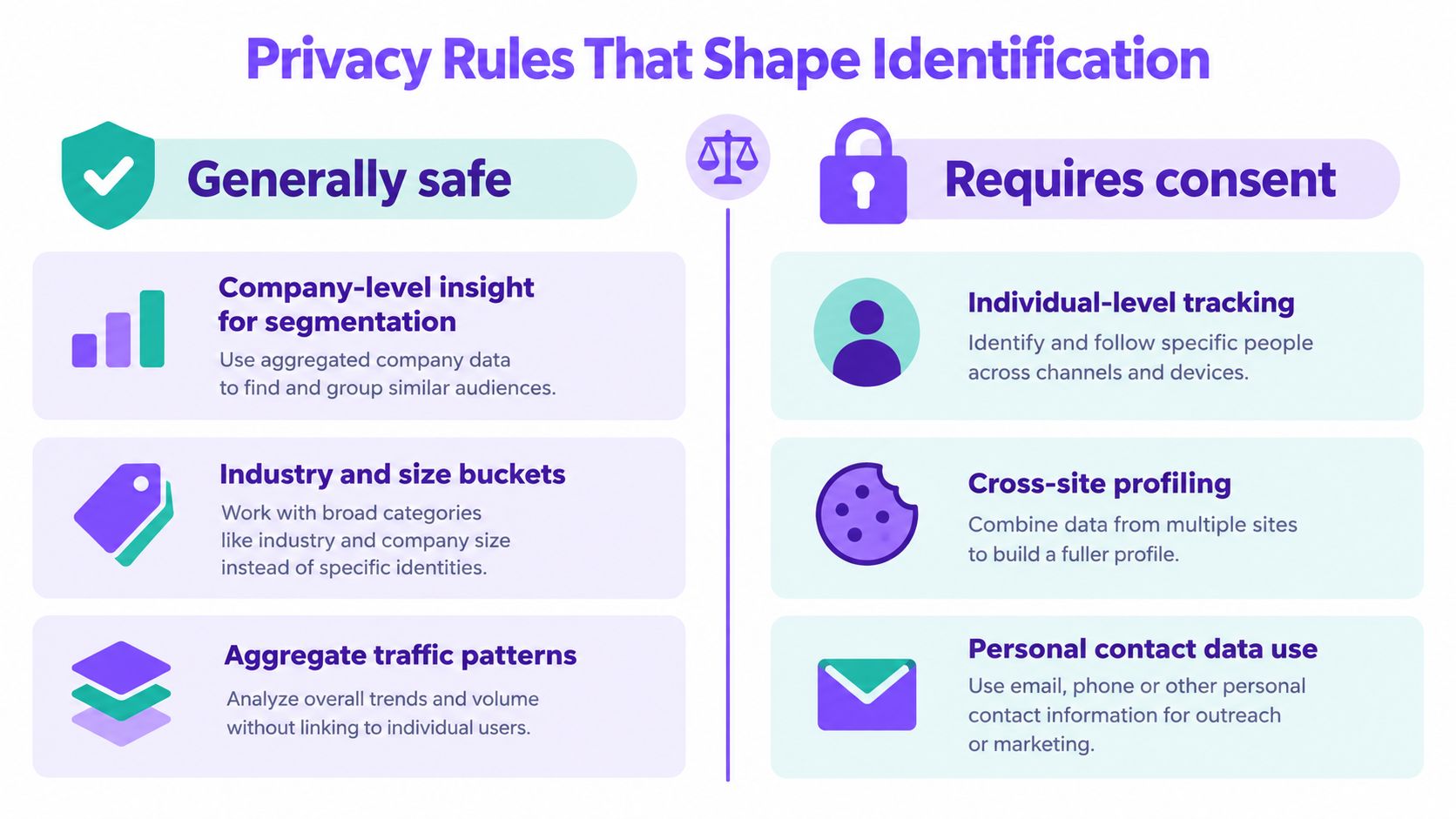
A privacy-safe architecture starts by separating company insight from individual profiling. A coarse account signal used for segmentation is materially different from linking a browser to a named employee, building a cross-site profile, or using personal contact data for outreach.
Under the GDPR, online identifiers that can single out users may qualify as personal data. Cookies and analogous technologies, including fingerprinting, generally require informed consent where consent is the applicable legal basis. The European Data Protection Supervisor’s guidance on web services and identifiers supports a conservative design: minimize raw IP retention, pseudonymize where possible, restrict access, document purpose and lawful basis, and delete or anonymize data when the purpose ends.
The rules can become highly specific. France’s CNIL describes a narrow audience-measurement exemption under conditions including single-site measurement, truncating the last byte of the IP address, avoiding cross-site combination, and limiting tracker lifetime to 13 months. Ireland’s Data Protection Commission states that analytics, targeting, and marketing cookies generally require consent under the GDPR standard, which must be freely given, specific, informed, and unambiguous.
A practical comparison
Generally safer uses include aggregate traffic patterns, industry or size buckets, and company-level segmentation with appropriate disclosure and controls. Consent-dependent uses can include non-essential cookies, fingerprinting, cross-site profiling, and connecting activity to an individual.
California requirements add their own disclosure and opt-out considerations. Teams serving multiple regions shouldn’t assume that a workflow acceptable in one market transfers unchanged to another. Privacy counsel should review the actual data flows, vendor roles, lawful basis, retention schedule, and rights handling.
Fingerprinting deserves particular caution. Recent Texas A&M reporting found that browser fingerprinting can continue across sessions after cookies are deleted and may persist after users opt out under GDPR or CCPA, as described in this report on browser fingerprinting persistence. A higher technical identification rate can therefore create legal, reputational, and procurement risk.
Enterprise buyers may examine these practices during security reviews. Certifications such as SOC 2 Type II and ISO 27001, configurable data residency, access controls, and clear deletion processes are practical evidence for that conversation, not decorative badges. Teams evaluating alternatives can also consult experts in advertising without cookies for a broader privacy-aware perspective.
For an implementation-oriented explanation of the tracking choices, see how to track website visitors responsibly.
Implementation Patterns for Compliant Identification
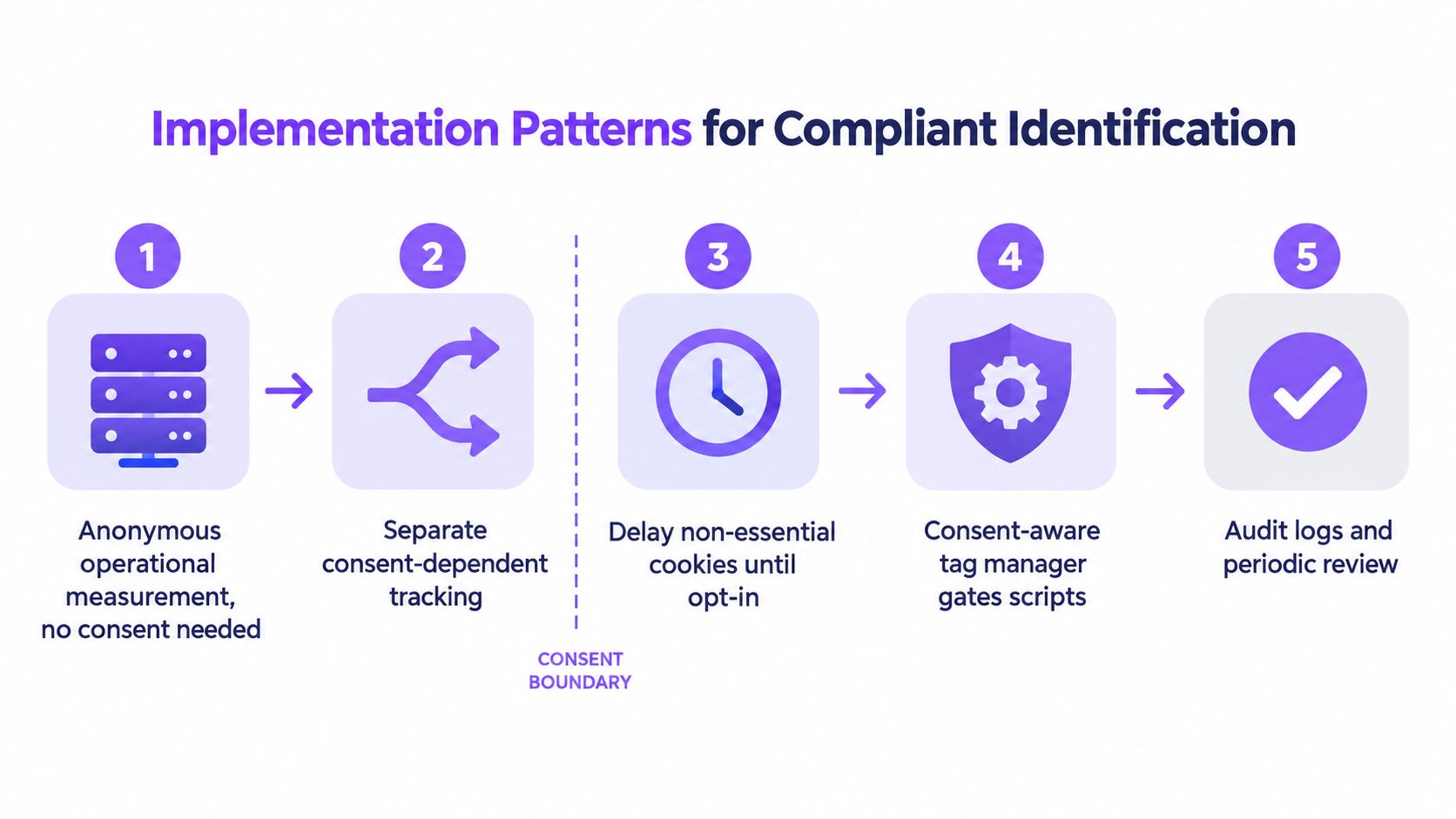
A workable deployment separates two pipelines from the start. The first handles anonymous operational measurement that doesn’t require non-essential tracking. The second contains consent-dependent cookies, fingerprinting, and any processing that needs an affirmative choice.
Build the boundary before installing tags
A lightweight JavaScript snippet can support same-day deployment, but speed of installation shouldn’t replace governance. Before activating the platform, document:
- Purpose, such as account segmentation, routing, or aggregate measurement.
- Lawful basis, by region and processing activity.
- Retention, including when raw IP data is removed or anonymized.
- Access, with permissions for marketing, sales, security, and vendors.
- Refusal and withdrawal, including how opt-outs propagate to downstream systems.
Delay non-essential cookies and fingerprinting until the consent-management platform records the required opt-in. Keep raw technical data to the minimum needed for the declared purpose, use pseudonymous identifiers where possible, and prevent downstream systems from treating an inferred account as a verified individual.
Use progressive identification
Progressive identification keeps the commercial workflow useful without making the first anonymous signal more personal than necessary.
- Segment coarsely. Use account, industry, region, and behavioral context for prioritization.
- Apply confidence rules. Suppress weak matches, competitors, service providers, and ambiguous networks.
- Wait for an explicit event. A submitted form, authenticated session, booked meeting, or other voluntary first-party interaction can support a person association.
- Sync selectively. Send reviewed account activity to HubSpot or Salesforce, and route alerts through Slack or Teams only when the action is defined.
- Review continuously. Audit consent logs, vendor changes, suppression lists, retention behavior, and false-positive feedback.
This pattern avoids a common failure mode: exporting every inferred contact into the CRM and forcing sellers to clean up uncertain data. It also gives legal, security, marketing, and sales teams a shared operating model.
The implementation should fit existing workflows. Native CRM synchronization can preserve identified accounts, intent signals, conversations, and meetings in the account record, while collaboration alerts can deliver only the events that meet the agreed threshold.
For a product-focused overview of deployment options, compare website visitor identification software against the consent and routing requirements your team has already documented.
From Identified Accounts to Live Conversations
An account match isn’t the outcome. It becomes useful when a team knows what to do next, who should do it, and which behavior justifies the interruption.
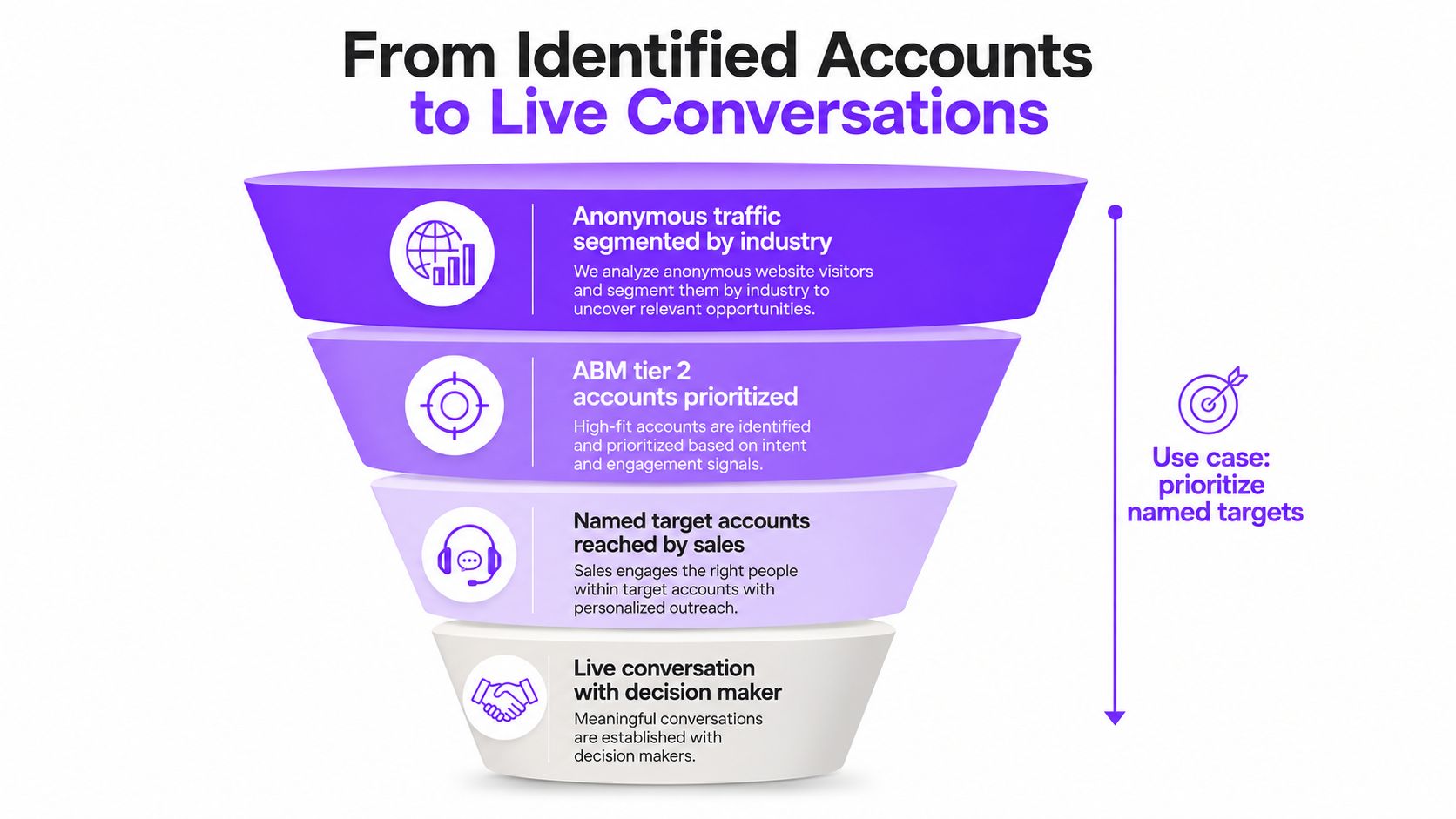
ABM teams can use company-level identification to sort traffic against named-account tiers. Marketing may group visitors by industry or region, while revenue operations maps the account to an owner and applies suppression rules. Sales then sees a smaller queue containing context, not an undifferentiated stream of company names.
Use behavior to set the threshold
Captiwate’s model illustrates the kind of intent layer that makes identification actionable. It can combine company resolution with pricing-page visits, repeat sessions, product-page depth, and recency, then use those signals to decide whether to offer live video, AI chat, or scheduling.
A sensible routing sequence looks like this:
- Low evidence: Record the visit for segmentation, without personal outreach.
- Moderate evidence: Add the account to a nurture or watchlist and wait for another meaningful signal.
- High-confidence evidence: Route to the owner or present a live engagement option while interest is active.
- High-impact action: Require human review when the match, intent, or account context remains uncertain.
A pricing-page visit alone isn’t enough. The same page may be opened by a competitor, a student, a consultant, an existing customer, or someone performing routine research. Multiple aligned signals reduce false positives, especially when the system suppresses competitors and service providers.
Make the conversation easy to accept
Live video can work when the visitor is already evaluating a product and the invitation is relevant. AI chat provides coverage outside staffed hours, qualifies the request, and routes a suitable conversation. Click-to-meet scheduling removes unnecessary form steps, while calendar synchronization and reminders preserve continuity after the visitor leaves.
The message should reference the problem the page addresses, not reveal hidden tracking. “Can we help compare the plans you’re reviewing?” is more credible than telling someone that the system watched their session. Transparency still matters even when the platform can technically see more.
Some teams need execution capacity as well as signal quality. If alerts create more qualified conversations than the internal SDR team can handle, an external option such as SDRs for hire may help cover defined segments, provided the same privacy, suppression, and review rules apply.
Measure the workflow at each handoff. Review accepted conversations, qualified meetings, opportunities, and revenue influence. If a trigger generates activity but not useful conversations, lower its priority or remove it.
Fewer Identifications, Better Pipeline
Maximum coverage sounds attractive until sellers spend their time correcting false positives. A smaller set of high-confidence company matches, supported by meaningful behavior and reviewed before personal outreach, can produce a healthier pipeline than a large feed of uncertain identities.
Use confidence bands, suppress competitors and service providers, separate office-network evidence from individual intent, and require human review for high-impact actions. Measure qualified conversations and revenue, not just the number of records a vendor returns. For teams comparing adjacent revenue tools, a dreach comparison page can provide additional context, but the decision should still rest on your traffic, privacy model, and workflow capacity.
Start with four checks:
- Audit the signals your current system collects.
- Define the confidence threshold that earns outreach.
- Align consent, retention, and deletion controls before scaling.
- Choose tooling whose security posture and pricing fit your traffic model.
The black box only creates value when your team can trust what comes out of it and act without damaging the buyer relationship.
Captiwate combines website visitor identification and intent detection with live video, AI chat, click-to-meet scheduling, CRM sync, and Slack or Teams alerts, so high-confidence account activity can move into a relevant conversation without waiting for a form fill. Visit Captiwate to see how a consent-aware, behavior-led workflow can help your team prioritize fewer visitors and engage them at the right moment.