
A sales leader opens the dashboard and sees plenty of leads, but almost none became pipeline. Marketing is celebrating MQL volume while sales is routinely discarding most of it. An SDR is spending hours researching companies that were never a realistic fit, while a promising account waits in a queue because nobody recognized its buying signal.
That gap usually isn’t a lead-volume problem. It’s a prioritization problem. An Ideal Customer Profile, or ICP, is a shared, data-backed description of the type of account most likely to buy, receive meaningful value, remain a customer, and expand. It gives marketing, sales, revenue operations, and customer success the same answer to a practical question: which accounts deserve our limited attention?
Table of Contents
- The Moment You Realize You Need an ICP
- What an ICP and What It Is Not
- The Three Building Blocks of a Strong ICP
- From Static Document to Live Routing Engine
- Scoring and Validating Your ICP With Real Data
- The Account, Buying Group, and Person Inside One ICP
- Common ICP Mistakes That Keep Teams Stuck
- Putting Your ICP to Work and Next Steps
The Moment You Realize You Need an ICP
Without an ICP, teams often treat every visitor, form fill, and target account as equally valuable. They create broad campaigns, hand leads to SDRs in arrival order, and rely on individual judgment to decide whether an opportunity is worth pursuing. That approach feels flexible, but it makes performance difficult to explain and even harder to improve.
The cost appears in several places:
- Marketing spends budget broadly: Campaigns attract people who may be interested but lack the need, authority, budget, or operating environment to become successful customers.
- SDRs prioritize noise: Reps follow up on activity rather than expected account value, so an active but unsuitable visitor can outrank a quiet account with strong commercial fit.
- Sales conversations start without context: A rep knows that someone downloaded a resource, but not whether the company matches the customers the product serves best.
- Customer success inherits poor fit: A deal can close and still create implementation friction, weak adoption, low retention, or limited expansion potential.
An ICP replaces that guesswork with an operating definition. It describes the organization itself, including its industry, size, geography, business model, technology environment, growth stage, use case, and buying triggers. It can also include behavioral evidence, such as repeated product research, pricing-page engagement, competitor evaluation, or a return visit.
Practical rule: A good ICP doesn’t describe every company you could sell to. It identifies the companies you can serve successfully and repeatedly.
The distinction matters because the highest-value account isn’t always the one showing the loudest activity. Fit and timing are separate questions. A company may match your market but have no active project, while another may show strong intent but lack the technical or economic conditions required for success.
The rest of the process is about turning that definition into action. Your ICP should determine which accounts enter an ABM program, which visitors receive immediate engagement, which leads go to nurture, and which opportunities receive scarce human selling time.
What an ICP and What It Is Not
The phrase “ideal customer profile” is often confused with buyer personas and demographic targeting. They overlap, but they answer different questions.
- ICP: Which organizations are most likely to buy, succeed, renew, and expand?
- Buyer persona: Which individual roles influence the purchase, and what motivates each person?
- Demographic targeting: Which surface characteristics describe or group an audience?
A useful ICP is defined at the account level, not the individual level. It commonly combines firmographic attributes, technographic compatibility, and behavioral or intent signals. A buyer persona sits inside that account and informs messaging, discovery, objection handling, and content choices. Demographic targeting can help a team reach an audience, but it doesn’t prove that the audience has a commercially valuable problem.
ICP vs. Buyer Persona vs. Demographic Targeting
| Dimension | ICP | Buyer Persona | Demographic Targeting |
|---|---|---|---|
| Primary unit | Company or account | Individual decision-maker or influencer | Audience segment or individual attribute group |
| Main question | Is this account worth pursuing? | How does this person think and decide? | Who appears to share a relevant characteristic? |
| Typical inputs | Industry, employee count, revenue, geography, technology stack, use case, intent | Role, seniority, goals, objections, risk, preferred information | Age, location, job title, or other surface traits |
| Main use | Account selection, scoring, routing, ABM tiering | Messaging, content, sales conversations | Reach, audience building, and campaign setup |
| Timing signal | Repeat visits, pricing research, competitor evaluation, trigger events | Personal urgency, priorities, and internal influence | Usually limited unless combined with behavior |
| Ownership | Shared by marketing, sales, revenue operations, and customer success | Usually marketing and sales enablement | Often marketing or advertising teams |
The ICP acts as the umbrella. It decides whether an account should enter the funnel and how much effort the account deserves. Personas then help the team communicate with the people inside that account.
For example, a B2B software company might define its ICP as organizations with meaningful inbound demand, a compatible CRM, high-value product pages, and an inbound sales motion. Its personas could include a revenue leader focused on pipeline, a marketing operations manager concerned with routing, and a sales development leader responsible for response time.
That distinction is central to identify your best-fit customers because “best fit” isn’t just the person who clicks an ad. It means identifying the account conditions that support a productive customer relationship, then adapting the conversation to the people involved.
A demographic may correlate with interest, but correlation doesn’t establish fit. An account-level ICP should connect observable characteristics to commercial outcomes such as conversion, implementation effort, retention, and expansion.
The Three Building Blocks of a Strong ICP
A usable ICP has three connected layers. Firmographic data describes who the company is. Technographic data describes what the company runs. Behavioral data describes what the company is doing now.
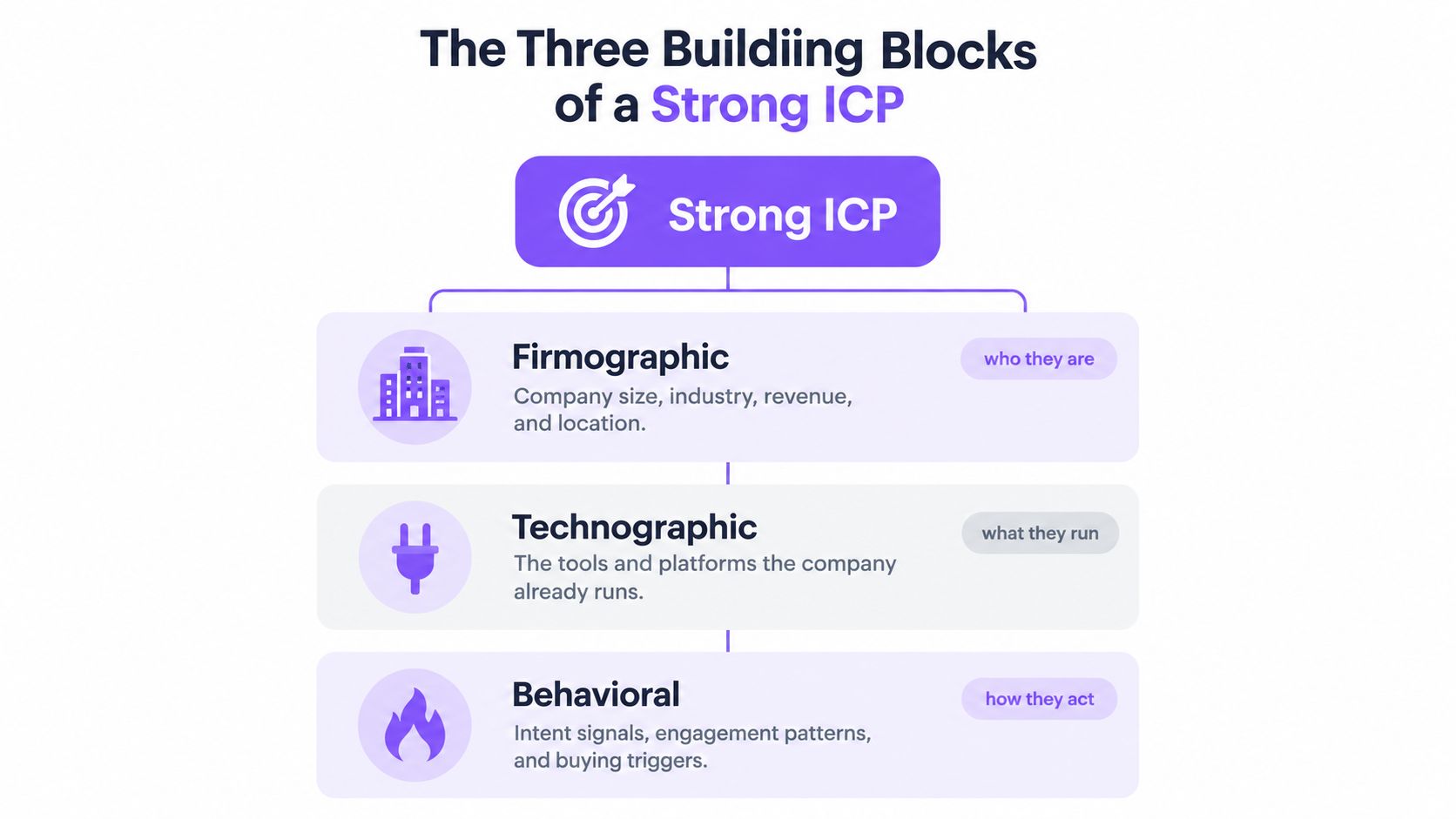
Firmographic fit defines the account universe
Firmographics narrow the market to companies with a plausible structural fit. Common fields include:
- Industry: Which sectors face the problem your product solves?
- Company size: What organizational scale can adopt and support the product?
- Revenue and business model: Does the account have a commercial model that makes the use case valuable?
- Geography: Can your team sell, implement, support, and comply in that market?
- Growth stage and funding: Is the company investing in the category or expanding the team that owns the problem?
These fields don’t prove intent. They stop your team from treating the entire market as one undifferentiated list.
Technographic fit tests feasibility
A company can look perfect on paper and still be difficult to serve if its systems, processes, or security requirements don’t match your product. Technographic criteria can include CRM, marketing automation, analytics, cloud infrastructure, sales tools, integration dependencies, and operational maturity.
For a B2B SaaS team selling to revenue operations leaders, a practical profile might describe mid-market organizations with a dedicated sales and marketing function, a CRM such as HubSpot or Salesforce, meaningful inbound demand, and a need to improve lead qualification or meeting conversion. The profile could also exclude accounts without the required integration environment or with service requirements the team can’t support.
Behavioral fit adds timing
Behavioral signals turn a static description into a live view of demand. Useful signals include repeated visits, pricing-page engagement, deeper product research, integration-page views, competitor comparisons, return sessions, relevant hiring, and engagement spikes.
A visitor who matches the firmographic and technographic profile but shows no current activity may belong in an account program without immediate SDR intervention. A visitor from the same type of company who repeatedly evaluates pricing and implementation content deserves a different response.
A practical B2B target customer framework can help teams organize these inputs before they turn them into CRM fields, scoring rules, and routing conditions. Keep each criterion testable. If the team can’t find the data or act on the result, it doesn’t belong in the operational version of the ICP.
From Static Document to Live Routing Engine
An ICP sitting in a strategy document doesn’t prioritize anything. It becomes useful only when systems can read its conditions and trigger a different action.
Consider a SaaS company in financial services that matches your target market. The account returns to the pricing page, reads a compliance datasheet, and later returns from a visit associated with a finance executive. No single event proves that the company is ready to buy. Together, the signals create a stronger timing case than a generic form fill.
The routing sequence
The workflow can operate like this:
- Match the account: Enrich the visitor or lead with available company details and compare those details with the firmographic and technographic ICP.
- Add intent: Record the relevant browsing behavior, including repeat pricing visits, compliance research, product engagement, or competitor evaluation.
- Apply the score: Combine fit and timing rather than allowing either one to stand in for the other.
- Choose the action: Route a high-fit, high-intent account to the named ABM owner, invite an immediate conversation, or trigger an alert with relevant context.
- Preserve the evidence: Sync the interaction and outcome to the CRM so future scoring can use actual revenue and customer data.
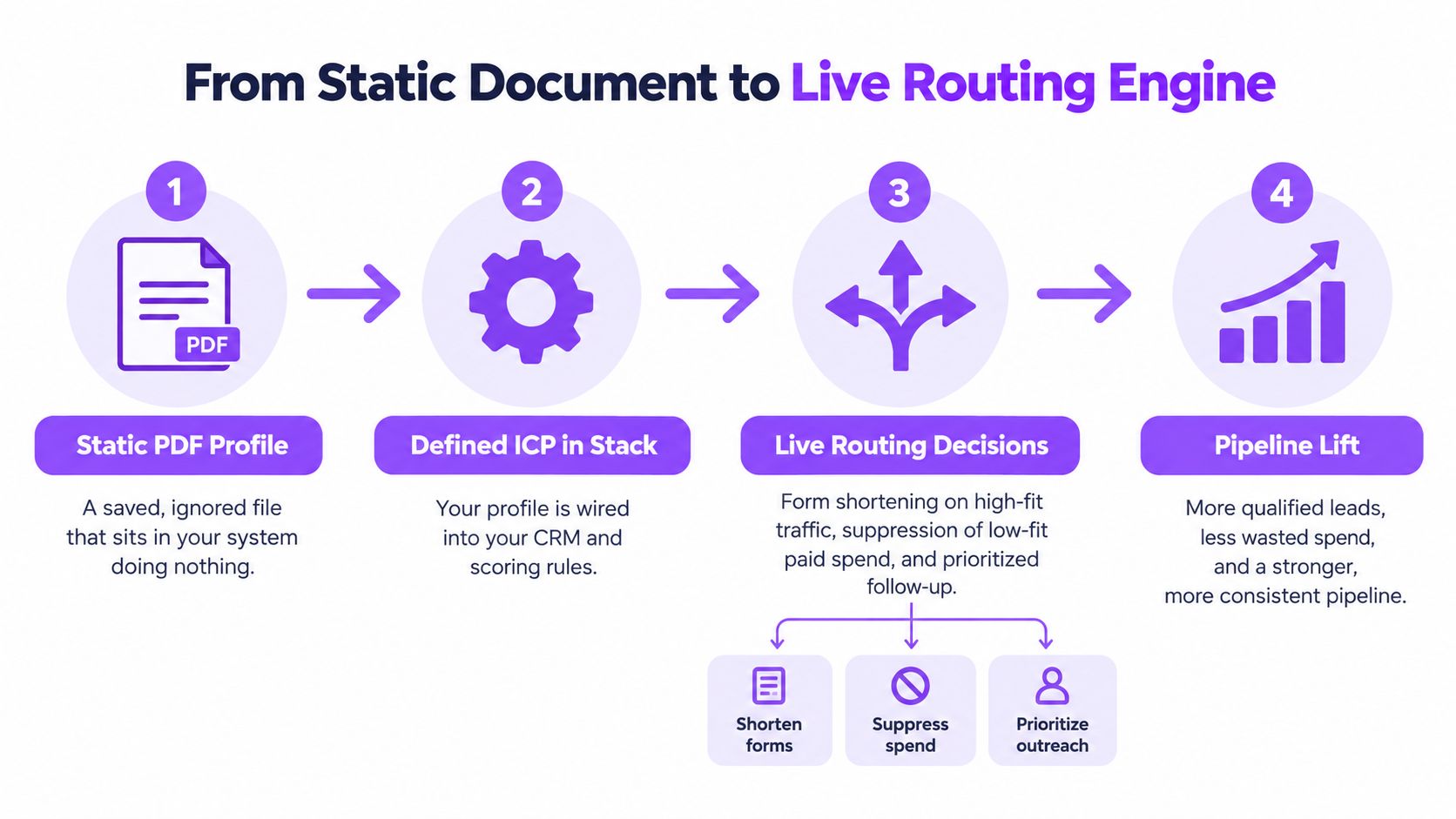
This same logic can change the website experience. High-fit traffic might receive a shorter form or a click-to-meet option. Low-fit traffic might see educational content instead of consuming SDR capacity. Paid campaigns can suppress accounts that repeatedly fail qualification, while sales can prioritize accounts whose expected value justifies immediate attention.
Captiwate identifies website visitors and layers company details and browsing behavior onto ICP criteria. It can support live video, AI qualification, scheduling, alerts, traffic segmentation, and CRM continuity, so a visitor’s activity can inform the next sales action rather than remain an isolated analytics event.
For the wider operational design, teams can also review lead routing tools and decide which rules belong in the CRM, marketing automation platform, website engagement layer, or collaboration system.
Use the embedded walkthrough below as a practical prompt for your team. Ask where an account is identified, where its intent is scored, and where the next owner is notified.
The important shift is conceptual. The ICP is no longer a description that people consult occasionally. It becomes the rule set governing form friction, advertising eligibility, engagement, routing, follow-up, and measurement.
Scoring and Validating Your ICP With Real Data
Scoring makes an ICP usable when several accounts compete for attention. Start by separating fit from timing. Fit can include industry, company scale, geography, business model, CRM, and integration compatibility. Timing can include repeat visits, pricing research, content depth, competitor comparisons, and other signals of active evaluation.
Use weights that reflect your own customer and revenue data. Don’t assign a high score merely because a field sounds strategically important. A criterion deserves weight when successful accounts consistently show it and when the team can act on it.
A simple scoring model
| Signal Category | Weight | Example Account A | Example Account B | Example Account C |
|---|---|---|---|---|
| Firmographic fit | High | Strong industry and company profile match | Partial market match | Outside target segment |
| Technographic fit | High | Required CRM and integrations present | Compatible with some work required | Unsupported environment |
| Behavioral intent | High | Repeated pricing and product research | One meaningful visit | No active buying behavior |
| Serviceability | Medium | Clear owner and support path | Requires specialist review | Poor implementation fit |
| Routing outcome | Nurture or human follow-up based on timing | Immediate named-owner follow-up | Sales review or monitored nurture | Automated nurture or suppression |
These are example outcomes, not universal thresholds. Your team should set the actual rules from its own evidence. A high-fit account without current intent may belong in ABM coverage, while a lower-fit visitor with intense activity may require qualification before a seller invests time.
Validate against outcomes
Pull closed-won, closed-lost, activation, expansion, and churn cohorts from the CRM. Score those accounts as though the current model had existed at the time, then compare the predicted tier with the observed outcomes.
Review the differences:
- High-scoring lost accounts: Did the model reward a superficial match while missing a disqualifier?
- Low-scoring won accounts: Did the ICP exclude a segment that can succeed?
- Fast-moving opportunities: Which intent signals appeared before the opportunity was created?
- Churned customers: Did the account fit the market but lack serviceability, adoption conditions, or durable value?
Research on ICP construction frequently treats intent data as the timing layer that makes account profiles more actionable. That layer should become more influential when a visitor repeatedly researches pricing, integrations, or alternatives, but it shouldn’t override a fundamental mismatch.
Run a regular fit-versus-revenue review, collect SDR feedback on misclassified accounts, and include customer success in the discussion. An ICP is healthy when it helps the company win the right customers, not merely more customers.
The Account, Buying Group, and Person Inside One ICP
A company can match your ICP and still produce no deal. The missing piece is often the buying group.
Account fit answers whether the organization is commercially and technically suitable. Buying-group fit answers whether the people required for consensus are involved. Persona fit explains how each individual experiences the problem and what they need to move forward.
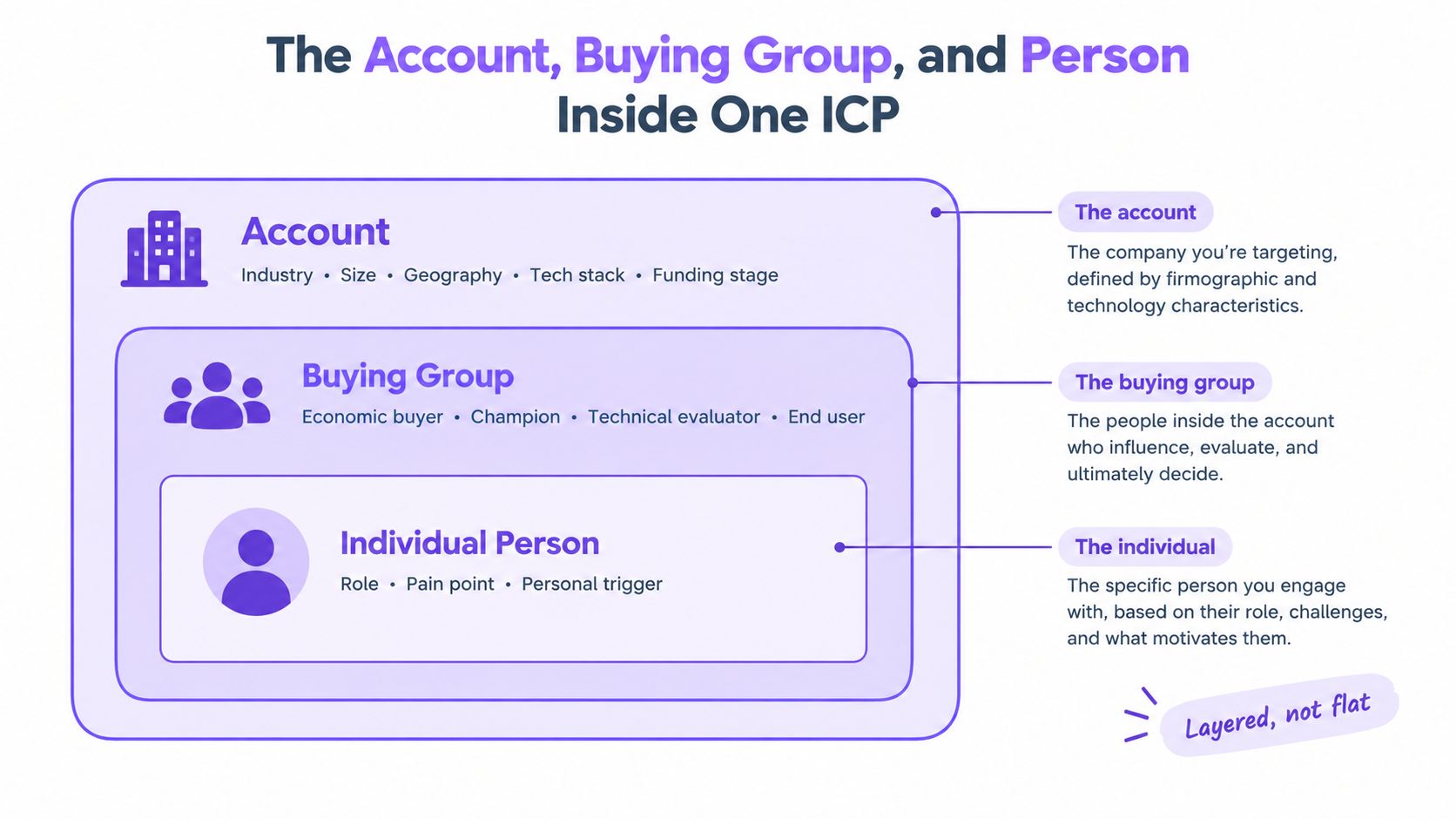
The outer layer is the account
Define the structural conditions first. These can include industry, company scale, geography, business model, technology stack, growth stage, and funding context. This layer tells marketing and sales whether the organization belongs in the target universe.
It also establishes disqualifiers. An unsupported region, incompatible CRM, insufficient demand, or service model mismatch can prevent an otherwise attractive company from becoming a viable customer.
The middle layer is the buying group
A B2B purchase may involve an economic buyer, an internal champion, a technical evaluator, an end user, procurement, legal, finance, or a blocker. Verified research reports that 72% of B2B purchases involve complex, multi-stakeholder buying groups, and that committees can span as many as 10 decision-maker functions according to Demandbase’s buyer research.
That means one engaged visitor shouldn’t automatically represent the whole opportunity. A pricing-page visit could come from an evaluator, an end user, or someone gathering information for a committee. Qualification should uncover who else must approve the purchase and whether the account has a credible path to consensus.
The center is the person
Person-level detail includes title, seniority, responsibilities, pain language, risk tolerance, authority, and content preferences. A revenue leader may care about pipeline visibility, while a technical evaluator may focus on integrations, security, and implementation effort.
Visitor intent can help sellers see which stakeholders are researching and what they care about. The seller’s job is then to confirm the role, identify missing participants, and tailor the next step. The strongest ICP model is therefore layered, not flat. It connects the right company to the right group and then to the right conversation.
Common ICP Mistakes That Keep Teams Stuck
Many teams have an ICP but don’t have an ICP program. The difference is whether the profile changes decisions.
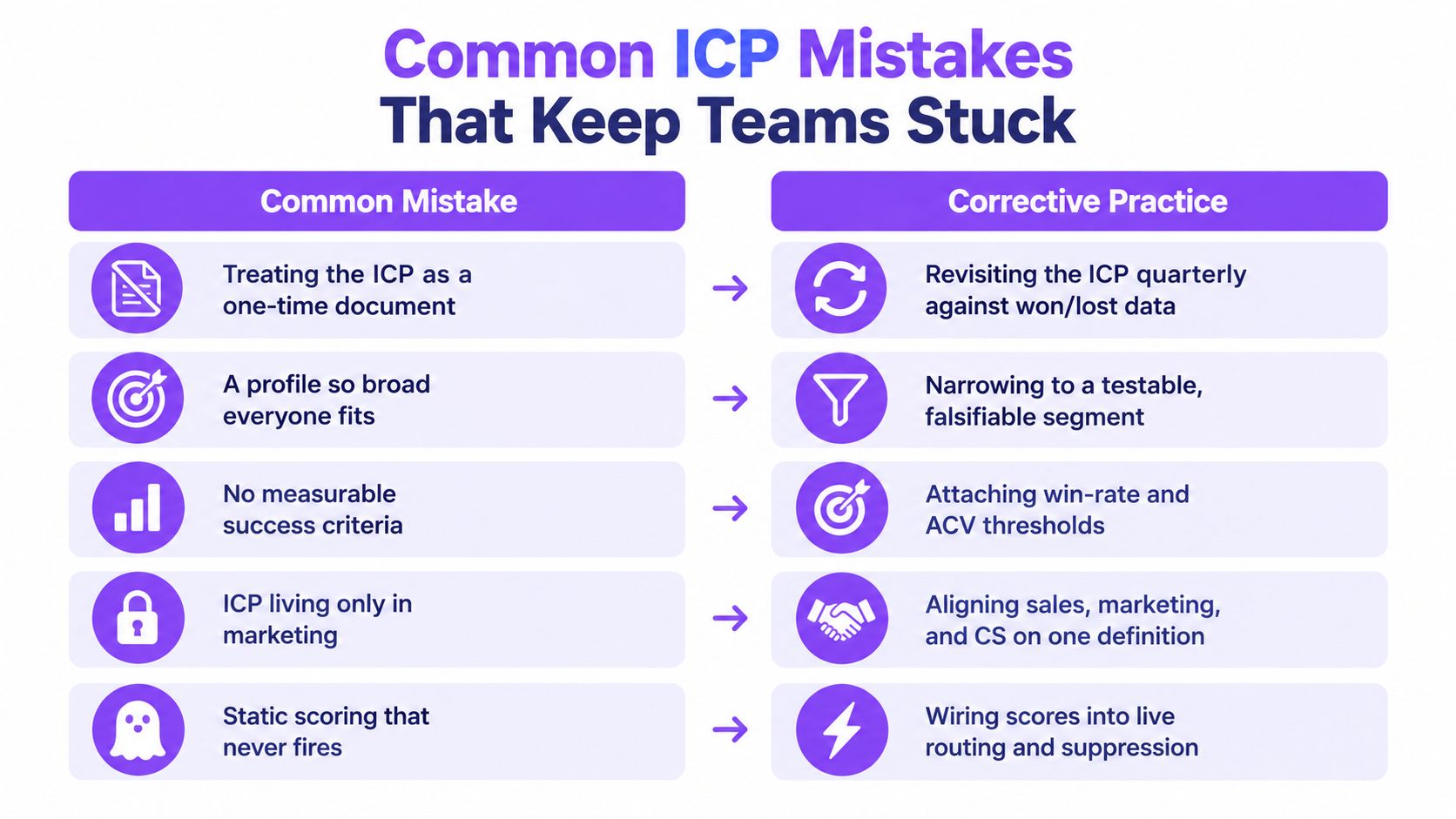
- Treating the ICP as a one-time spreadsheet: A profile becomes stale as the product, market, customer base, and sales motion change. Ask: when did you last compare the definition with won, lost, and churned accounts?
- Overweighting firmographics: Industry and company size can narrow the market, but they don’t show technical compatibility or active need. Ask: which technographic and behavioral fields change routing?
- Scoring fans instead of buying groups: One enthusiastic stakeholder may not have authority or access to the people who approve the purchase. Ask: can your team name the economic buyer, champion, evaluator, and likely blocker?
- Ignoring negative signals: A page visit isn’t automatically positive. A quick exit, unsupported geography, missing integration, or repeated low-quality activity may indicate that sales follow-up is premature. Ask: what behavior lowers a score?
- Never closing the loop: If closed-lost and churn data never reach the model, the team keeps rewarding the same bad assumptions. Ask: which failed accounts would your current ICP still prioritize?
Mature teams refresh the profile against revenue outcomes, connect scoring to live workflows, and route mismatched accounts to nurture instead of forcing every lead into a sales cadence.
Putting Your ICP to Work and Next Steps
Start with one segment and make the definition visible to everyone who acts on demand. Store the criteria in a shared workspace, assign owners for each field, and write the disqualifiers as clearly as the positive signals.
Then wire the profile into routing and ABM tooling. High-fit accounts should reach the right rep quickly, while low-fit or incomplete accounts receive an appropriate nurture path. Add visitor-level intent to reveal when anonymous traffic is actively researching, and trigger alerts or real-time engagement only when fit and timing justify it.
Review the model against closed-won, closed-lost, activation, expansion, and churn data on a recurring basis. Your team can use the account-based marketing use case as a practical reference for connecting account selection with coordinated engagement.
ICP questions teams ask
Is an ICP the same as a target account list? No. The ICP defines the traits of a strong-fit account. A target account list names the specific companies selected for action.
How often should we refresh it? Review it regularly against revenue and customer outcomes, and update it whenever the product, market, or service model changes.
Can a startup build an ICP with limited data? Yes. Begin with informed hypotheses, label them as assumptions, and replace them with observed customer and pipeline evidence as the business learns.
Where does visitor intent fit? Firmographic enrichment tells you who the account is. Visitor intent helps indicate what the account is doing now, so routing can reflect both fit and timing.
Captiwate helps B2B teams identify visitor intent, qualify website traffic, and connect high-fit prospects to live video, AI chat, or scheduled sales conversations. Visit Captiwate to see how its engagement and routing capabilities can turn your ICP into an active revenue workflow.