The most popular advice about AI SDR software is also the least useful: choose the platform with the longest feature list. That approach treats a website visitor, a cold prospect, a CRM record, and a recorded sales call as if they were the same operational problem. They aren’t.
The better question is which part of your sales motion is leaking pipeline. Real-time inbound conversion needs a different system from outbound sequencing. Data enrichment solves a different problem from autonomous outreach, while conversation intelligence helps teams prioritize and coach from sales interactions rather than create first-touch demand.
This comparison separates those motions instead of flattening them into a checklist. Each platform is assessed by its primary use case, AI role, integrations, pricing model, setup burden, governance requirements, and limitations. Teams should also test outbound deliverability with an email inbox placement test before assuming that more automated sending will produce more pipeline.
The AI SDR market is forecast to grow from USD 4.12 billion in 2025 to USD 15.01 billion by 2030, representing a projected 29.5% CAGR, according to MarketsandMarkets’ AI SDR market forecast. That growth makes platform fit more important, not less. Spending is moving into sales automation, but implementation quality will determine whether a tool creates net-new pipeline or just moves work into inbox management, data cleanup, and exception handling.
Table of Contents
- 1. Captiwate
- 2. Outreach
- 3. Salesloft
- 4. Apollo.io
- 5. Reply.io and Jason AI SDR
- 6. Amplemarket
- 7. Regie.ai and RegieGO
- 8. Gong Engage
- 9. Qualified and Piper AI SDR
- 10. Clay
- Top 10 AI SDR Software: Feature Comparison
- Choose the Platform That Matches the Bottleneck
1. Captiwate
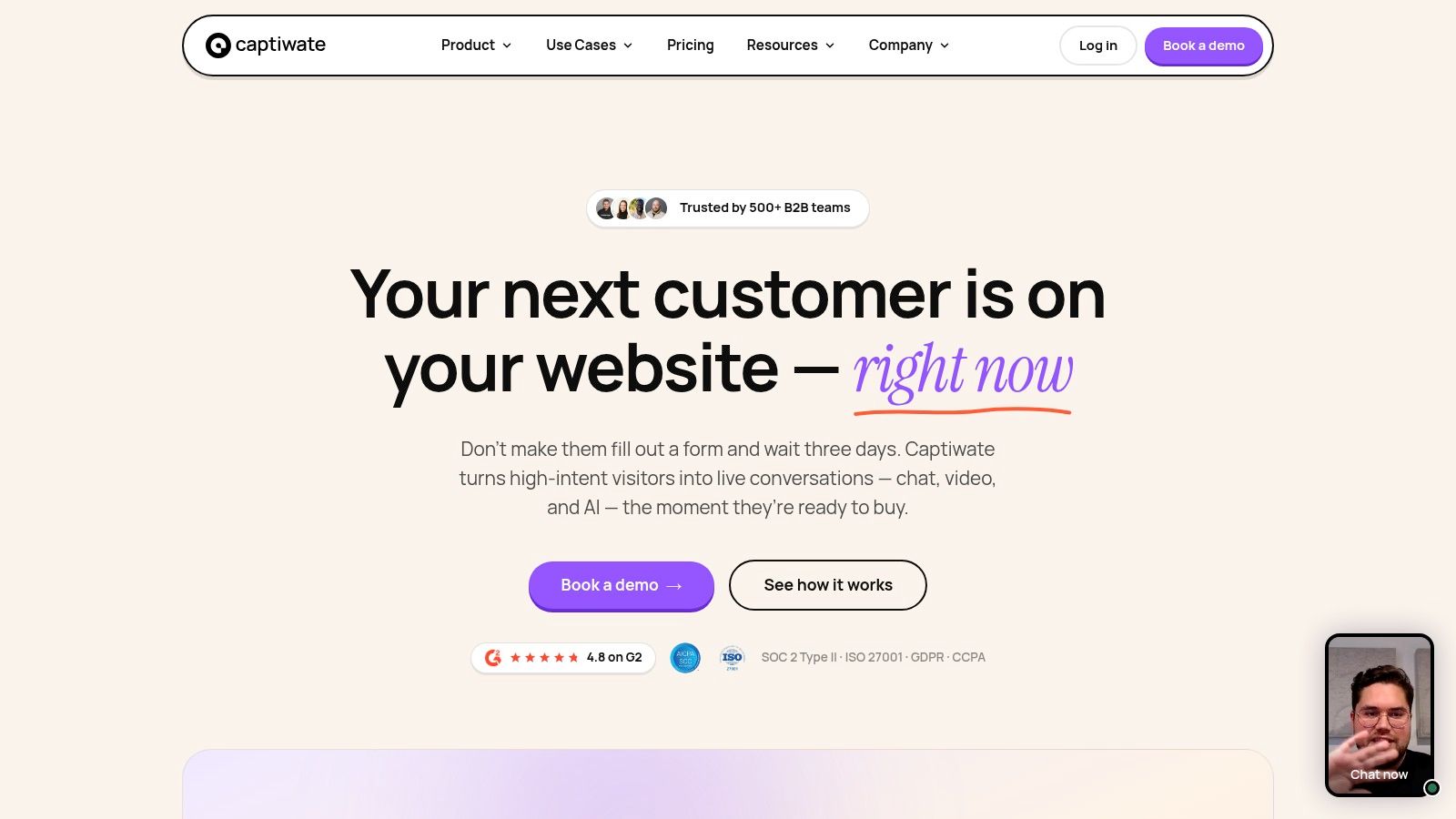
Captiwate is the strongest fit when the bottleneck is high-intent website conversion, not outbound list building. It turns a pricing-page or product-page visit into an immediate sales interaction through in-browser video, AI chat, visitor identification, intent scoring, routing, and scheduling. Visitors don’t need to download software, wait for a form response, or move through a long email handoff before speaking with sales.
The platform combines live video with 24/7 AI qualification. When a visitor matches the ideal customer profile or shows meaningful behavioral intent, Captiwate can alert a rep, start qualification automatically, or offer one-click scheduling connected to Google Calendar, Outlook, HubSpot, and Salesforce. Co-browsing and screen sharing give reps a way to explain a product inside the browser rather than forcing a separate meeting workflow.
Why the operating model matters
Captiwate’s value sits between inbound conversion and sales engagement. It doesn’t try to replace a full outbound sequencer. Instead, it reduces the delay between buyer intent and human contact, while preserving conversation, meeting, intent, and account context in the CRM.
Pricing is based on monthly website visitors and starts at $15,000 per year for the Grow plan (up to 20,000 monthly visitors), with Scale at $30,000 per year for 20,000 to 100,000 visitors and custom Unlimited pricing above that, as listed on Captiwate’s pricing page. Because the price follows traffic rather than headcount, the plans include unlimited seats, which may be attractive where many marketers, SDRs, and account executives need visibility.
Practical rule: Don’t compare Captiwate with an outbound sequencer on email volume. Compare it with the cost of losing a high-intent visitor between page activity, form submission, qualification, and rep follow-up.
Implementation is deliberately light. A single JavaScript snippet is designed to support same-day go-live, while enterprise controls include SOC 2 Type II, ISO 27001, SSO, data residency options, and GDPR and CCPA alignment. The main limitation is that visitor consent and intent accuracy still matter. Regulated teams need to configure privacy settings, consent flows, routing rules, and CRM write-back before expanding coverage.
Captiwate is best for B2B teams with meaningful inbound intent, ABM or product-led growth programs, and a clear need to connect visitors to sales immediately. It isn’t the best choice if the primary problem is cold outbound research, multichannel cadence execution, or call coaching.
2. Outreach
Outreach is built for organizations that need governed enterprise sales engagement. Its core strength is orchestrating sequences, tasks, calling, analytics, and seller workflows across SDR and account executive teams. The platform is less about discovering one anonymous website visitor and more about creating a repeatable operating system for outbound execution.
Kaia adds conversation intelligence through real-time coaching, post-call summaries, action items, and content cards. Outreach also packages AI agents across workflows, giving revenue operations teams a way to introduce automation without abandoning governance, permissions, or established CRM processes.
That makes Outreach a strong fit where managers care about more than message generation. They can standardize plays, monitor execution, connect call outcomes to follow-up work, and give reps a shared environment for email, phone, and task management.
The trade-off
The same breadth creates implementation work. Outreach usually requires careful administration around sequences, activity capture, ownership, permissions, reporting, and integration design. Smaller teams may find quote-based pricing and the operational overhead difficult to justify when their sales motion is simple.
Its best use case is a mature outbound organization with RevOps ownership, a defined sales process, and a need for conversation intelligence tied to execution. It isn’t a substitute for a data enrichment layer or a website conversion platform. Teams may still need separate systems for account discovery, visitor identification, consent management, and inbound qualification.
3. Salesloft
Salesloft improves the daily workflow of SDRs by deciding what deserves attention next. Its Conductor AI and Rhythm experience ingest signals from Salesloft, the CRM, and connected tools, then organize those signals into a prioritized task queue. That distinction matters because many teams don’t lack tasks. They lack a reliable way to rank them.
Salesloft supports cadences across email, phone, and social activity, alongside conversation intelligence and coaching. It can also use signals from systems such as DocuSign, G2, Vidyard, Highspot, and Seismic. The result is a workflow centered on next-best action rather than a static sequence that treats every contact identically.
The best sequencing platform isn’t necessarily the one that sends the most touches. It’s the one that helps reps spend their limited human attention on the most defensible opportunities.
Salesloft suits enterprise and mid-market teams that want AI assistance inside an established engagement process. It can help coordinate outbound activity, conversation review, and signal-based prioritization without forcing managers to build a separate workspace for every activity type.
List pricing isn’t published, so buyers need to model user costs, modules, implementation, integrations, and administration together. The platform can also be heavy for a small team that only needs basic sequencing. For a deeper view of how this category differs from inbound conversion and enrichment workflows, review these sales engagement platforms.
4. Apollo.io
Apollo.io combines B2B data and outbound execution in one workspace. Its database, sequencing, dialer, AI-assisted research, message drafting, personalization, and CRM synchronization make it appealing to teams that don’t want to assemble a separate data provider, engagement platform, and calling tool.
The operational advantage is activation speed. A small or mid-sized sales team can search for contacts, create a list, draft outreach, launch a sequence, and synchronize activity with HubSpot or Salesforce without stitching together several systems first. Apollo also offers a free tier, which gives teams a way to test data and sequence workflows before committing to a broader deployment.
Where Apollo needs scrutiny
Apollo’s data coverage can vary by region, industry, and target segment. A record that looks complete in the interface still needs validation against the team’s ICP, consent requirements, role accuracy, and CRM history. That makes Apollo accessible, but not automatically reliable.
Its governance and reporting depth may also be lighter than enterprise-first platforms such as Outreach or Salesloft. Buyers should ask whether the all-in-one convenience outweighs the need for specialist enrichment, stricter administration, or more advanced attribution later.
Apollo is a practical choice when the problem is basic data-to-outreach execution. It is not designed primarily for live website conversion, deep conversation intelligence, or complex inbound routing.
5. Reply.io and Jason AI SDR
Reply.io packages Jason as an AI SDR agent for teams testing supervised autonomous outreach. Jason can research contacts, personalize messages, send and manage replies, and move qualified conversations toward meetings. The platform supports email and LinkedIn automation, with optional dialer and SMS capabilities, intent signals, contact search, and mailbox management.
This is a different proposition from a conventional cadence tool. The team isn’t only asking AI to draft a message. It’s asking the system to participate in the conversation and handle defined parts of the follow-up process. Human supervision remains important because the quality of autonomous replies depends on ICP clarity, approved messaging, data accuracy, and escalation rules.
Reply.io’s control layer is useful for teams that want to test autonomy without handing over the entire sales motion. Managers can combine agent workflows with standard engagement features and decide where human review is required.
Cost and control considerations
The entry price can be competitive with adding headcount, but buyers should model more than the base subscription. LinkedIn automation is billed per account and can increase total cost, while mailbox management introduces its own operational requirements around sender health, permissions, and campaign design.
Teams should also define what the agent can answer, when it must stop, how it escalates objections, and how every interaction writes back to the CRM. For practical guidance on the broader category, see this AI sales assistant perspective. Reply.io is strongest when the organization wants a controlled experiment with agentic outbound, not a fully unattended replacement for sales judgment.
6. Amplemarket
Amplemarket targets teams that want to consolidate data, enrichment, intent, engagement, and AI guidance in one outbound platform. Its value is less about a single breakthrough feature and more about reducing the number of handoffs between finding a prospect, understanding the account, creating a message, and launching a sequence.
Duo Copilot supports SDR research and outreach, while intent signals and prioritization help teams decide which accounts deserve attention. CRM integrations and analytics keep the activity connected to pipeline operations. For lean teams, this can be simpler than managing separate data, personalization, sequencing, and reporting tools.
Implementation test: Ask whether the platform removes operational work or merely hides it inside credits, user permissions, enrichment failures, and CRM exceptions.
Amplemarket’s plan-based structure gives buyers a clearer framework than fully opaque enterprise pricing, but total cost can still scale with users and credits. Teams should map expected enrichment, contact discovery, sequence, and AI usage before comparing plans.
The platform is a good fit for a lean outbound team that wants an end-to-end motion without engineering a custom stack. It may be less suitable when data operations are highly specialized, when account research requires unusual sources, or when enterprise governance demands a dedicated system for each workflow. Its strongest role is outbound consolidation, not website-based inbound conversion. Teams evaluating qualification logic can also use this AI lead qualification guide as a complementary reference.
7. Regie.ai and RegieGO
Regie.ai is best understood as an AI workbench for SDR preparation and personalized engagement. RegieGO brings research, enrichment, drafting, dialing, and agent workflows into one workspace, helping reps move from an unstructured target list to a usable outreach plan.
That upstream focus sets it apart from platforms whose main job is to execute a prebuilt cadence. Regie.ai helps teams gather context, generate personalized sequences, and test messaging before sending. CRM synchronization and analytics support more structured enterprise workflows, while the free tier and practical credit model can make a pilot easier to control.
The administrative trade-off
Credits introduce a second planning layer. A team must understand which research, enrichment, drafting, and execution actions consume credits, then monitor usage as campaigns expand. Enterprise features and dedicated support require a sales conversation, and plan availability can change.
Regie.ai fits organizations where poor personalization is the main constraint and SDRs spend too much time preparing lists or writing first touches. It isn’t necessarily the simplest option for a team that only needs a lightweight sequencer. Nor does it eliminate the need for a clean CRM, clear ICP definitions, and human review of generated messages.
8. Gong Engage
Gong takes a conversation-led approach to sales engagement. Gong Engage layers AI prioritization, personalization, and tasking on top of Gong’s conversation and deal intelligence, allowing teams already invested in the platform to use call and email insights when deciding what to do next.
That creates a meaningful advantage for Gong-centered organizations. The platform can connect conversation context, enablement, forecasting, and engagement rather than sending those signals into separate systems. A rep may be able to prioritize follow-up based on what a buyer discussed, not only on a generic activity score.
The fit is strongest when Gong is already a strategic part of the revenue stack. Consolidation can reduce vendor sprawl and data silos, but buyers evaluating Gong Engage as a new system should look carefully at the maturity of the engagement layer and the operating cost of a broader bundle.
Pricing isn’t public and is typically quoted or bundled. That makes total-cost modeling essential. Teams should separate the value of conversation intelligence from the incremental value of Engage, then test Salesforce or HubSpot synchronization, task ownership, reporting, and manager workflows during a pilot.
Gong Engage isn’t the first choice for website-based inbound response or standalone enrichment orchestration. It’s a strong option for sales organizations that want conversation data to inform outbound prioritization.
9. Qualified and Piper AI SDR
Qualified is purpose-built for inbound website conversion, particularly in Salesforce-centered organizations. Piper greets visitors, qualifies them, and books meetings through chat, video, or voice. When a live rep is needed, Qualified can route the interaction according to account, intent, or sales logic.
The platform is especially relevant to ABM and product-led growth teams. A visitor arriving from a target account or engaging with a high-intent page can receive an immediate conversation instead of entering a form queue. Salesforce integration supports routing, account context, and operational control.
Where the boundary sits
Qualified focuses primarily on inbound, not full outbound sequencing. That focus is an advantage for teams with website conversion leakage, but a limitation for buyers seeking one system for prospect research, cold outreach, and autonomous follow-up.
Pricing is sales-led and not publicly listed, so buyers should evaluate traffic assumptions, routing complexity, Salesforce administration, compliance controls, and the cost of maintaining playbooks. Qualified is a strong fit when Salesforce alignment and high-intent inbound conversion are more important than broad outbound coverage.
The central comparison with Captiwate is not a feature contest. It is an operating decision about how much the organization values Salesforce-centered control, website engagement, live handoff, and the preferred balance between AI qualification and human intervention.
10. Clay
Clay is the most flexible option in this list for data enrichment and SDR workflow orchestration. It helps teams build prospect lists, enrich records through a large catalog of connectors, research accounts, generate personalized messages, and push structured outputs into CRMs or sequencing platforms.
Clay’s AI agents are useful when the team has a specific research problem that packaged sales engagement software can’t model cleanly. Revenue operators can create conditional workflows for firmographic, technographic, behavioral, and account-level data, then route the results into tools such as Outreach, Salesloft, HubSpot, and others.
The flexibility is also the main cost. Reps may find build-your-own workflows harder to operate than a fixed cadence interface, and pricing depends on credits, selected enrichments, and actions. Someone must own workflow design, data validation, error handling, and ongoing maintenance.
Governance question: If a Clay workflow enriches the wrong account or writes an incorrect field, who notices, who fixes it, and how quickly does the correction reach the CRM?
Clay is best for teams with strong RevOps or growth operations capability that want an adaptable data layer without building custom engineering infrastructure. It isn’t a website conversion tool, a conversation intelligence platform, or a complete autonomous SDR by itself. Its role is to make downstream outreach more informed and more programmable.
Top 10 AI SDR Software: Feature Comparison
| Product | Core features ✨ | UX / Quality ★ | Value & Price 💰 | Target audience 👥 | Key differentiator 🏆 |
|---|---|---|---|---|---|
| Captiwate 🏆 | In‑browser live video, 24/7 AI chat, intent detection, CRM & calendar sync | ★ 4.8 (G2), fast speed‑to‑lead, fewer no‑shows | 💰 Traffic‑based; from $15,000/yr, unlimited seats | 👥 B2B SaaS, inbound & ABM teams | ✨ Instant in‑tab video + always‑on AI; single‑snippet go‑live; SOC2/ISO |
| Outreach | AI sequencing, dialer, Kaia convo intelligence, analytics | ★ Enterprise‑grade, mature coaching | 💰 Quote‑based (enterprise) | 👥 SDRs/AEs, large RevOps teams | ✨ Deep coaching & workflow AI |
| Salesloft | Cadences, Rhythm (Conductor AI), convo intelligence | ★ Strong AI‑assisted daily workflows | 💰 Sales‑led pricing | 👥 SDR teams needing orchestration | ✨ Prioritized task queue (Rhythm) |
| Apollo.io | Large contact DB + sequencer, AI drafting, dialer, CRM sync | ★ Easy activation; cost‑effective | 💰 Free tier; affordable plans | 👥 Small/mid teams wanting data+outreach | ✨ All‑in‑one data + engagement stack |
| Reply.io (Jason) | Jason AI agent, email/LinkedIn automation, dialer, intent | ★ Good for autonomous outreach pilots | 💰 Competitive entry price; LinkedIn add‑ons | 👥 Teams testing AI SDR autonomy | ✨ Packaged AI SDR agent (Jason) |
| Amplemarket | Data & enrichment, multichannel sequences, AI intent, Copilot | ★ Consolidated outbound UX | 💰 Plan‑based; scales with users/credits | 👥 Lean outbound teams replacing point tools | ✨ End‑to‑end outbound consolidation |
| Regie.ai (RegieGO) | AI research/enrichment, personalized sequences, dialer | ★ Strong prep/workbench for personalization | 💰 Credit model; free pilot tier | 👥 Teams focused on high‑personalization outreach | ✨ Upstream workbench for SDR prep |
| Gong Engage | AI sequencing + tasking, uses Gong convo & deal intel | ★ Enterprise maturity when paired with Gong | 💰 Quote/bundled with Gong | 👥 Orgs using Gong wanting consolidation | ✨ Leverages Gong conversation intelligence |
| Qualified | On‑site AI SDR (Piper), chat/video/voice handoffs, Salesforce routing | ★ Purpose‑built for inbound conversion | 💰 Sales‑led pricing | 👥 Inbound/ABM teams, Salesforce‑centric orgs | ✨ On‑site AI SDR optimized for high‑intent pages |
| Clay | AI prospecting, 70+ enrichment connectors, workflows & agents | ★ Exceptional data/personalization; steeper learning | 💰 Credit/pricing varies by enrichments/actions | 👥 Teams needing deep enrichment & custom flows | ✨ Best‑in‑class enrichment + buildable SDR workflows |
Choose the Platform That Matches the Bottleneck
The category is expanding because sales teams are applying AI to different constraints, not because every business needs the same type of digital SDR. One industry summary reports that 87% of sales organizations use AI for prospecting, lead scoring, forecasting, or email drafting, while 54% of sales teams have adopted AI agents and 34% expect to deploy them within two years, according to GlobeMarketResearch’s AI SDR market summary. Those figures indicate broad adoption, but they don’t prove that every workflow benefits from the same level of autonomy.
Start with the bottleneck. Choose Captiwate or Qualified when high-intent website visitors wait too long, abandon forms, or need immediate routing to the right human. Captiwate is particularly compelling when in-browser video, AI chat, visitor identification, collaboration alerts, CRM continuity, and traffic-based pricing fit the operating model. Qualified deserves closer attention when Salesforce-native control and inbound ABM workflows dominate the requirements.
Choose Outreach or Salesloft when the organization needs governed enterprise engagement. Outreach is well suited to teams that want sequencing, calling, workflow administration, and Kaia conversation intelligence in one mature environment. Salesloft is a strong choice when AI-prioritized daily work, Rhythm, cadences, and signal ingestion should guide the rep’s next action.
Choose Apollo when accessibility matters and the team wants data and outreach in one stack. It can shorten activation for small and mid-sized teams, but list quality and regional coverage still require validation. Choose Reply.io when the goal is supervised AI-agent testing, especially where the team wants Jason to handle research, outreach, and replies while retaining control over escalation and mailbox operations.
Choose Amplemarket for outbound consolidation, particularly when a lean team wants data, enrichment, intent, engagement, and AI guidance without stitching together multiple point tools. Choose Regie.ai when the upstream problem is research and personalization. It can improve the preparation layer before a sequence launches, but credits, plan structure, and workflow ownership need active management.
Choose Gong Engage when Gong already contains the conversation intelligence that sales leaders trust. Its differentiator is the connection between what buyers said and what reps should do next. Choose Clay when enrichment orchestration is the strategic requirement and the team has enough RevOps maturity to manage flexible workflows.
The practical risk is adoption without operational readiness. Independent market reporting identifies data governance, privacy, data quality, and implementation cost as recurring barriers, particularly when systems handle sensitive email, phone, and behavioral data. That means the actual investment may include legal review, consent design, CRM cleanup, routing rules, training, monitoring, and process redesign, not only the software subscription. See the Fortune Business Insights analysis of the AI SDR market for background on those adoption constraints.
Before standardizing a platform, run a pilot using real workflows. Validate data quality, CRM write-back, consent requirements, AI supervision, routing exceptions, mailbox health, credit consumption, and total pricing mechanics. Assign implementation ownership to a named RevOps, marketing operations, or sales operations lead, and measure whether the system creates qualified pipeline or merely increases activity.
For organizations that need broader coverage than an internal pilot can provide, compare the platform cost and governance burden with best outsourced SDR services 2026. Outsourcing won’t solve weak data or unclear positioning automatically, but it can clarify whether the actual constraint is software, process capacity, or sales execution.
Captiwate helps B2B teams convert high-intent website visitors into live conversations through in-browser video, AI chat, intent detection, routing, scheduling, and CRM-connected follow-up. If your pipeline is leaking between website interest and sales contact, visit Captiwate to see how instant engagement and always-on qualification can fit your inbound motion.