More inbound leads won’t automatically produce more pipeline. That assumption has driven years of investment in blogs, SEO, landing pages, and form optimization, while the harder operational question gets ignored: what happens in the first few minutes after intent appears?
A prospect who requests pricing, opens a product comparison, or starts a demo flow isn’t merely becoming a record in your CRM. They’re entering a short window in which questions are fresh, urgency is high, and competing vendors are one browser tab away. Inbound lead generation works best when teams optimize for engagement velocity, not just capture volume.
Table of Contents
- The Hidden Bottleneck in Inbound Lead Generation
- What Drives Inbound Lead Generation Beyond Content
- Why Most Inbound Leads Never Convert
- Real-Time Engagement Strategies for High-Intent Visitors
- Measuring Inbound Performance Like a Revenue Team
- Handing Off Inbound Leads to Sales Without Friction
- What to Prioritize First in Inbound Lead Generation
The Hidden Bottleneck in Inbound Lead Generation
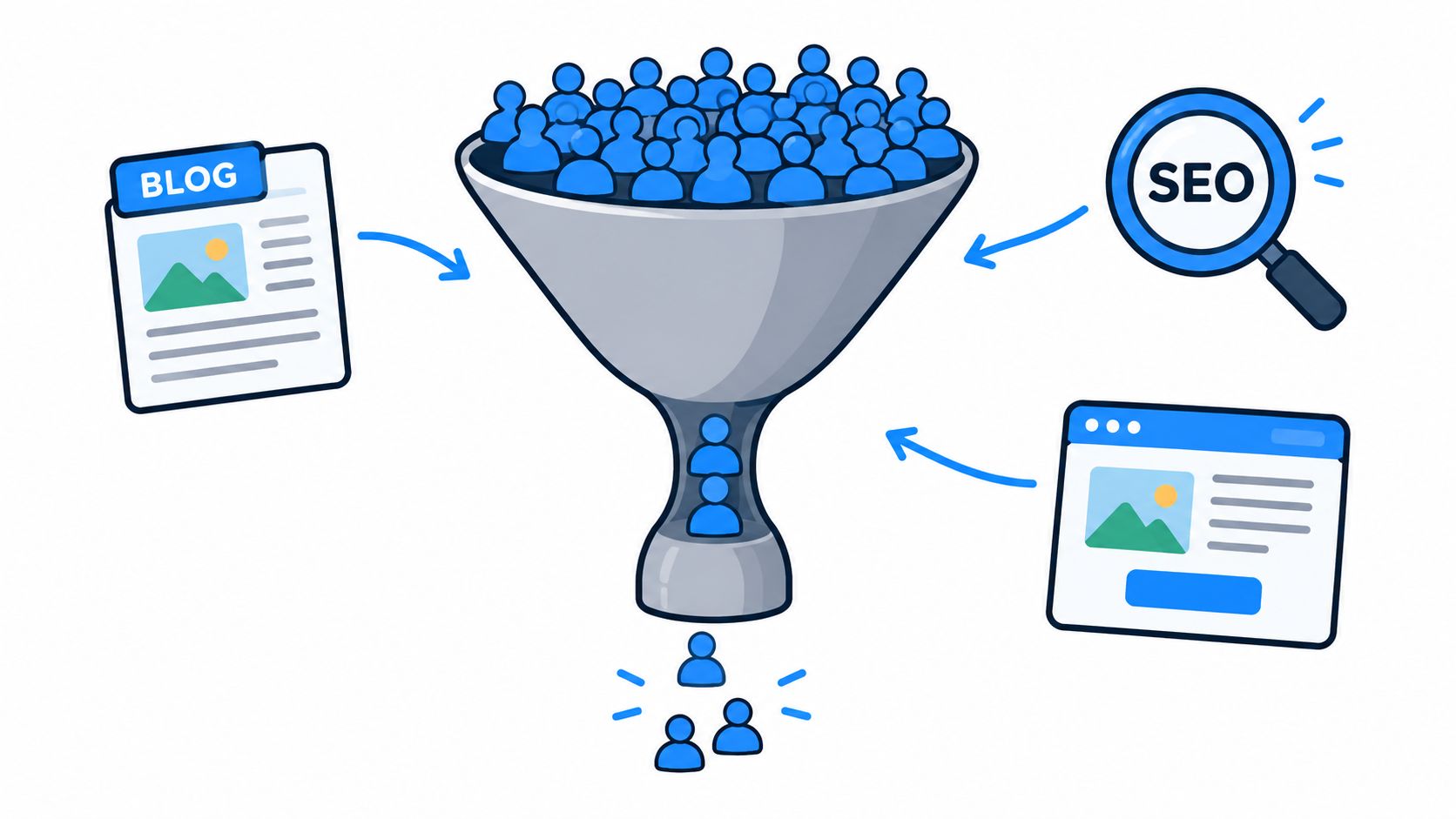
A rising form-fill rate can hide a failing inbound motion. Marketing teams may celebrate more submissions while high-intent buyers wait for a response, compare vendors, or lose urgency. A captured lead becomes valuable only when the business converts that signal into a live conversation, a qualified opportunity, or a useful next step.
The response gap is substantial. Inbound lead generation benchmarks for 2026 put median B2B response time at about 42 to 47 hours, while only 7% to 23% of companies respond within five minutes, according to Plura’s lead response time benchmarks. A buyer who requests a demo in the morning may hear back after the buying group has raised new questions, reviewed alternatives, or pushed the project down its priority list.
Capture is a moment, not an outcome
Research covering 5.7 million inbound leads found that companies contacting prospects within five minutes were about 21 times more likely to qualify them than companies waiting 30 minutes. The likelihood of reaching a lead also fell about 100 times between minute five and minute 30, according to the InsideSales response-time analysis.
An immediate call is not the right response for every visitor. A pricing request, demo submission, and casual blog visit carry different signals, so each needs its own response standard and routing logic.
Practical rule: Treat the first five minutes after a high-intent action as a revenue workflow, not a notification problem.
Fix the SLA before adding traffic
More traffic increases waste when sales receives alerts late, checks forms manually, or works from an unprioritized queue. Marketing can generate demand efficiently while operations let the most valuable signals cool.
Audit the route from visitor action to conversation:
- Signal detection: Can the CRM distinguish a pricing request, demo request, and general information inquiry?
- Routing: Does the appropriate representative receive the lead based on account, territory, segment, or availability?
- First action: Can that representative call, chat, or offer a meeting without rebuilding the visitor’s context?
- Outcome recording: Does the system record whether contact occurred and what happened afterward?
The analysis of why lead response time costs businesses opportunities frames the operational risk clearly. Content and SEO still create demand, but capture is only the handoff point. Volume creates potential. Speed determines whether that potential survives long enough to become pipeline.
What Drives Inbound Lead Generation Beyond Content
Content attracts attention, but lead capture is not the finish line. Revenue depends on what happens after a visitor shows interest. A useful article can answer a research question and build trust. It cannot resolve a technical objection from a buying committee, identify the right account context, or create a timely conversation with an available seller.
Publishing consistently still supports discovery. Businesses publishing 11 or more blog posts per month generate three times more inbound leads than businesses publishing only zero to one post per month, according to CIENCE’s lead generation statistics. The practical lesson is narrower than “publish more.” A neglected content program can restrict demand, while increasing content will not fix high-intent visitors receiving no response.
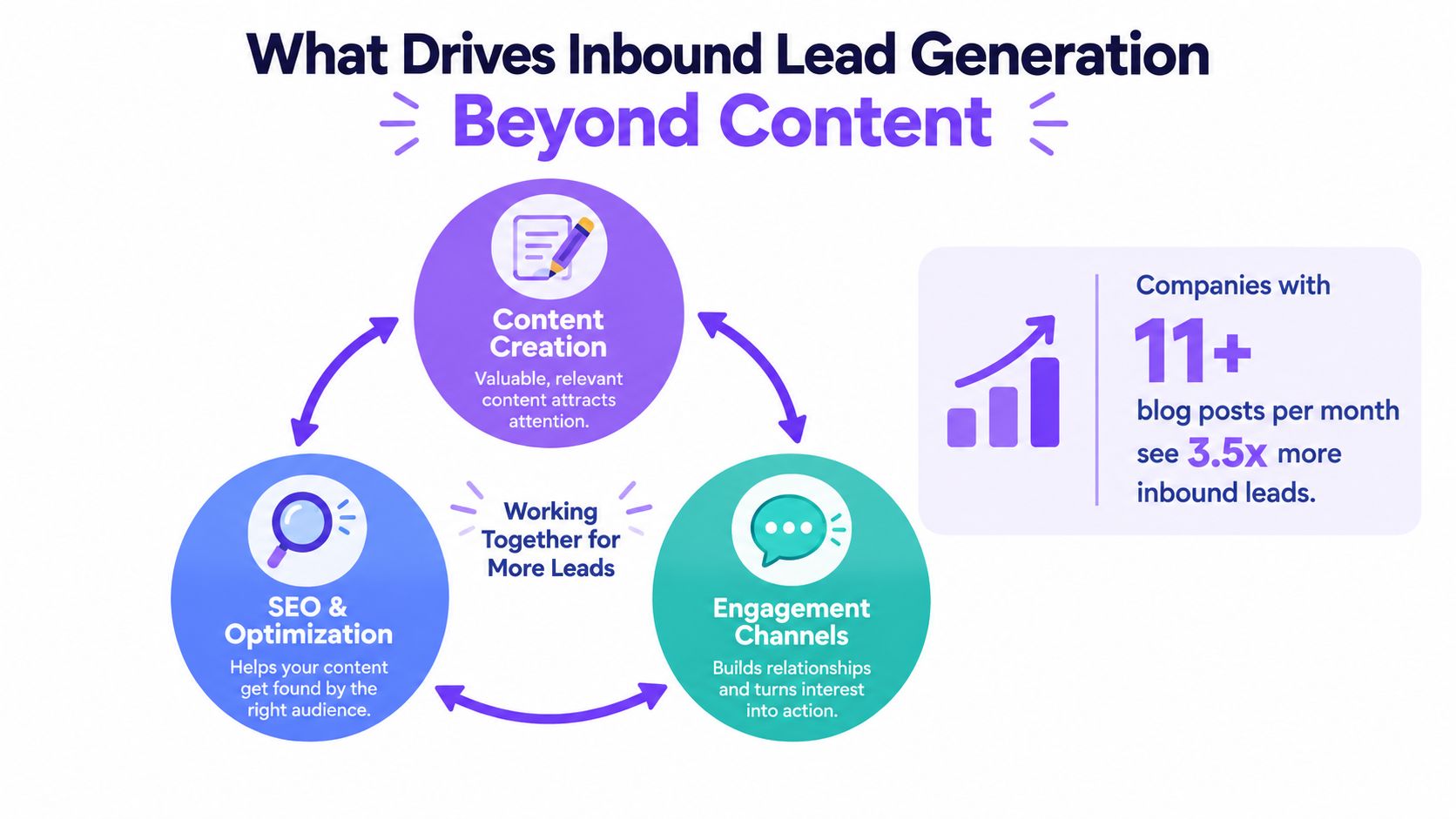
Three engines with different jobs
Content creation earns attention and helps buyers define a problem. Blog posts, comparison pages, webinars, implementation guides, and product education support different levels of intent. Ungated education can expand reach. Decision-stage resources should make the next action clear, without forcing every visitor through one generic form.
SEO and optimization connect that content to active demand. Search intent, internal links, page clarity, technical accessibility, and conversion paths determine whether a visitor can move from an answer to a commercial action. Teams building authority can review backlink building sites when assessing link acquisition options, while still judging links by relevance rather than volume.
Engagement channels convert interest into interaction. Live chat, AI qualification, product trials, in-browser video, scheduling, and contextual prompts are most useful beside a clear buying signal. They should not interrupt every visitor. Someone researching a broad topic may need education, while a buyer comparing implementation details may need a person who can answer a specific question.
A 2026 inbound study reported that organic traffic fell 33.6% year over year, while direct MQLs rose 6% and self-reported attribution from AI and LLM sources increased 9.25%. Some respondents also reported a 345% increase in LLMs as a last-touch MQL source, according to Cognism’s Inside Inbound 2026 report. These findings reinforce a practical concern: buyers often move across channels and may be difficult to identify through one analytics session.
The operating model should connect the engines:
- Attract with useful content and discoverable pages.
- Interpret behavior and declared intent.
- Engage while the visitor remains active.
- Route the conversation with context.
- Measure the commercial outcome, not only the acquisition event.
Content supplies demand. Engagement velocity determines how much of that demand reaches a conversation.
Why Most Inbound Leads Never Convert
Lead capture is often treated as the finish line. In practice, it is where the revenue risk begins.
A high-intent visitor reaches the pricing page after researching the category. They review plans, check implementation details, and open the demo form. The form requests a work email, company, role, phone number, and several qualification fields. After submitting, the visitor sees a confirmation page and waits.
No one appears in the browser. No one answers the question that prompted the form. The first human response arrives much later, often as a generic email written without the context of the visitor’s research. By then, the prospect may have selected another vendor, postponed the project, or concluded that getting help from the company takes too much effort.
The issue is often routing failure, not poor traffic quality.
Capture workflows versus conversation workflows
A capture workflow records information. It may send an email, create a task, and assign an owner. A conversation workflow identifies the relevant signal, provides an immediate path to help, preserves context, and gives sales an opportunity to respond while the buyer remains engaged.
Many B2B teams optimize the first workflow and assume the second will follow automatically. It does not. A form can be easy to complete yet still create commercial friction if follow-up depends on someone noticing an alert, opening the CRM, interpreting page history, and choosing the next action.
The form tells you who raised a hand. The conversation tells you why they raised it.
The response-time gap reflects an operating problem. As noted earlier, median response times remain above 40 hours, while only a minority of companies respond within five minutes. Acquisition programs may be well funded and carefully managed, yet the moments immediately after conversion receive weaker coverage. Engagement velocity, not lead volume alone, determines how much demand reaches a real conversation.
Design around intent peaks
Start with actions that indicate active evaluation:
- A pricing or plan page visit
- A demo or consultation request
- A product comparison interaction
- A trial or implementation question
- Repeated visits from an identified account
Assign each signal a defined response path. A visitor ready for a product conversation might receive a click-to-meet option. Someone with a technical question might enter live chat. A visitor arriving outside business hours might receive AI qualification and a clear scheduling route.
The trade-off is operational discipline. Real-time options only help when routing rules, ownership, availability, and follow-up context are clear. Otherwise, they add another form of capture without shortening the path to a person.
Nurture still serves lower-intent contacts. It should not become the default destination for every submission. A nurture sequence is a safety net, not a substitute for timely engagement.
Real-Time Engagement Strategies for High-Intent Visitors
Real-time engagement should match the visitor’s signal, account value, and need for explanation. The objective isn’t to place a chat widget on every page. It’s to remove delay at the points where a buyer is already asking, implicitly or explicitly, for help.
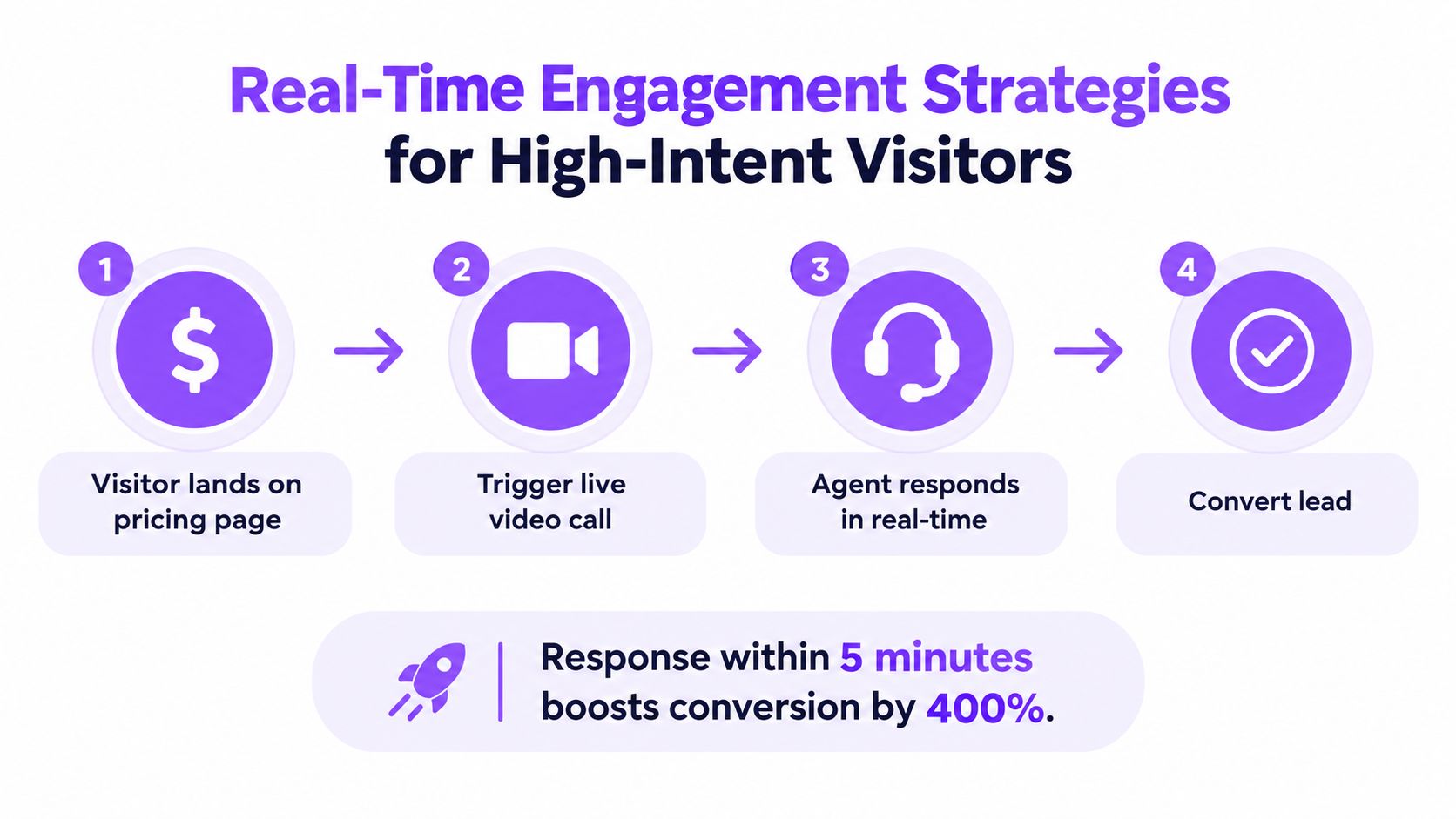
Use live video where uncertainty blocks action
An in-browser live video invitation can work well on pricing, product, and implementation pages. It gives a prospect a direct route to a person without requiring a download or a separate application. The trade-off is operational: someone must be available, and the invitation must feel relevant rather than intrusive.
For strategic accounts, pair the trigger with account context. Route an identified target company to the appropriate representative, while sending smaller or less qualified accounts through a shared queue. ABM tiering helps prevent a single high-value visitor from receiving the same treatment as anonymous, low-intent traffic.
Use AI chat for coverage, not imagination
AI chat can qualify visitors outside business hours, answer repeat questions, collect essential context, and offer scheduling. It provides consistency when no representative is online. It also reduces the risk that a visitor submits a form and disappears into an unattended queue.
AI shouldn’t pretend to replace a complex discovery conversation. Give it clear boundaries, escalation rules, approved answers, and a direct handoff path. A useful qualification flow asks what the visitor is trying to solve, what kind of help they need, and whether they want to speak with someone now.
Remove friction from guided evaluation
Co-browsing and screen sharing can help a representative explain a workflow on the prospect’s own screen. This is valuable when the obstacle is confusion rather than lack of interest. The trade-off is consent and comfort, so make participation optional and explain what the representative can see.
One-click scheduling serves a different need. It helps buyers who aren’t ready for an instant conversation but want control over timing. Calendar sync and reminders reduce the administrative back-and-forth that often turns a qualified action into an uncompleted meeting.
A practical channel map looks like this:
- Pricing intent: live video or click-to-meet
- After-hours evaluation: AI chat with scheduling
- Technical uncertainty: co-browsing or screen sharing
- Lower-intent research: helpful content and measured nurture
- Priority account activity: named-owner routing and rapid alerts
Inbound marketing has historically been an efficiency play. A foundational benchmark summary reports that inbound generates 54% more leads than traditional outbound while costing 62% less per lead, with related benchmarks placing inbound at roughly three times more leads per dollar spent, according to Revenue Memo’s inbound marketing statistics. Those economics make fast engagement more important, not less. When acquisition is efficient, the next question is whether your operating system can monetize the demand it creates.
For a deeper look at the operating model, see why real-time sales is the future of customer acquisition.
Here is a practical walkthrough of how a live engagement flow can work:
Measuring Inbound Performance Like a Revenue Team
Average response time is a comforting metric because fast responses can offset very slow ones. A team might answer some leads quickly while leaving evenings, weekends, or high-value accounts untouched, yet the average still looks acceptable.
Revenue teams need a time series that exposes the tail. Track time to first attempt, time to first contact, and time to first qualification. Report the median and P95, then segment performance into SLA bands of zero to five, five to fifteen, fifteen to sixty, and sixty-plus minutes, following the KPI structure recommended in Prospeo’s speed-to-lead metrics guidance.
What to measure and why
| Metric | What It Reveals | Pipeline Signal |
|---|---|---|
| Time to first attempt | How quickly the team acts after capture | Operational readiness |
| Time to first contact | Whether prospects can actually be reached | Conversation access |
| Time to first qualification | How quickly intent becomes sales context | Opportunity quality |
| Median response time | The experience most leads receive | Normal operating performance |
| P95 response time | The slow tail hidden by averages | After-hours and routing leakage |
| SLA-band distribution | Where delays accumulate | Priority for process repair |
Compare these measures by page, source, account tier, representative, and time of day. A strong business-hours median can hide a weak weekend experience. A healthy overall P95 can conceal a critical segment that never receives a timely response.
Measurement discipline: Every inbound action should connect to a timestamped attempt, a contact outcome, a qualification state, and a later pipeline result.
Connect speed to commercial outcomes
Don’t report response time in a marketing dashboard disconnected from sales. Join the event to meeting creation, qualification, opportunity progression, and closed revenue where your systems allow it. If fast responses don’t correlate with better outcomes, investigate lead quality, routing logic, message relevance, and representative availability before abandoning the SLA.
This is also where SEO analysis becomes more useful. A resource on B2B companies’ SEO strategy can help teams assess acquisition foundations, but search performance should ultimately be evaluated alongside the quality and speed of the conversations generated.
For the full handoff from initial interest to outcome, use lead-to-conversion tracking as an operational reference. The objective isn’t to make every lead move at the same pace. It’s to ensure the fastest route is reserved for the clearest buying signals, and that slow paths are visible enough to fix.
Handing Off Inbound Leads to Sales Without Friction
Lead capture is not the handoff. It is the point where the handoff should begin. Inbound lead generation often loses value because the form, chat tool, scheduler, and CRM each hold part of the buyer’s story. Sales receives a notification, then spends time reconstructing the visit instead of continuing the conversation.
That delay creates practical failure points:
- Unassigned alerts: A lead waits because nobody owns the next action.
- Duplicate follow-up: More than one representative contacts the same person.
- Missing intent history: Sales cannot see the page, question, or trigger behind the request.
- Disconnected records: Meetings and conversations fail to attach to the correct account.
- Unclear outcomes: Marketing cannot connect an interaction to pipeline or revenue.
Automation helps only when the process is already defined. Set routing rules for account, territory, segment, product interest, and representative availability. Send a concise alert through the team’s existing collaboration channel, then write the conversation, intent signal, owner, and meeting details into the CRM. The goal is engagement velocity, not another notification in an already crowded queue.
Manual and routed workflows
A static form is easy to launch, but it treats every submission as the same task. That can work for a low-intent resource. It creates avoidable delay when a prospect requests immediate help.
A routed workflow assigns a different action to each signal:
| Static form workflow | Routed engagement workflow |
|---|---|
| Creates a generic task | Assigns an owner based on rules |
| Sends a confirmation email | Offers a live or scheduled path |
| Stores limited form fields | Preserves page and conversation context |
| Depends on manual checking | Sends alerts and escalations |
| Follows up after the visit | Engages during the active session |
The operating design should include calendar synchronization, automated reminders, and a fallback when the assigned representative is unavailable. Account-based programs also need tiered rules. Priority accounts can receive live coverage, while other visitors enter a shared queue or an automated qualification flow.
As noted earlier, content scale correlates with lead volume. That makes handoff quality more important as the content engine grows. More demand without clear ownership produces a larger backlog, not necessarily more revenue.
Teams reviewing downstream economics can use SaaS pipeline benchmarks and formulas to connect lead stages with broader pipeline reporting. Audit each handoff with five questions: who owns it, what context transfers, how quickly does the first action occur, what happens if nobody responds, and where is the final outcome recorded? A complete answer to each question gives sales a usable starting point and gives marketing a clear operating standard.
What to Prioritize First in Inbound Lead Generation
Teams frequently try to improve inbound lead generation in the wrong order. They commission more content, redesign forms, add a chatbot, rebuild attribution, launch ABM, and expand reporting at the same time. The result is activity without a clear answer to the most expensive question: which high-intent visitors are still waiting?
Prioritize the system in this sequence:
Start with high-intent response velocity
Measure the path from pricing, demo, trial, and consultation actions to the first human or automated engagement. Set an explicit sub-five-minute target for the signals that justify it, then inspect the P95 and SLA-band distribution rather than relying on a single average.
This is the fastest way to determine whether your current demand is being monetized. If visitors wait, new traffic is not the first fix.
Build routing before adding complexity
Define ownership rules for account tier, territory, product, and time of day. Add escalation when the first owner is unavailable. Connect CRM records, calendar availability, and team alerts so the representative doesn’t need to assemble the context manually.
A lightweight routing system with clear accountability usually beats an elaborate stack that no one monitors.
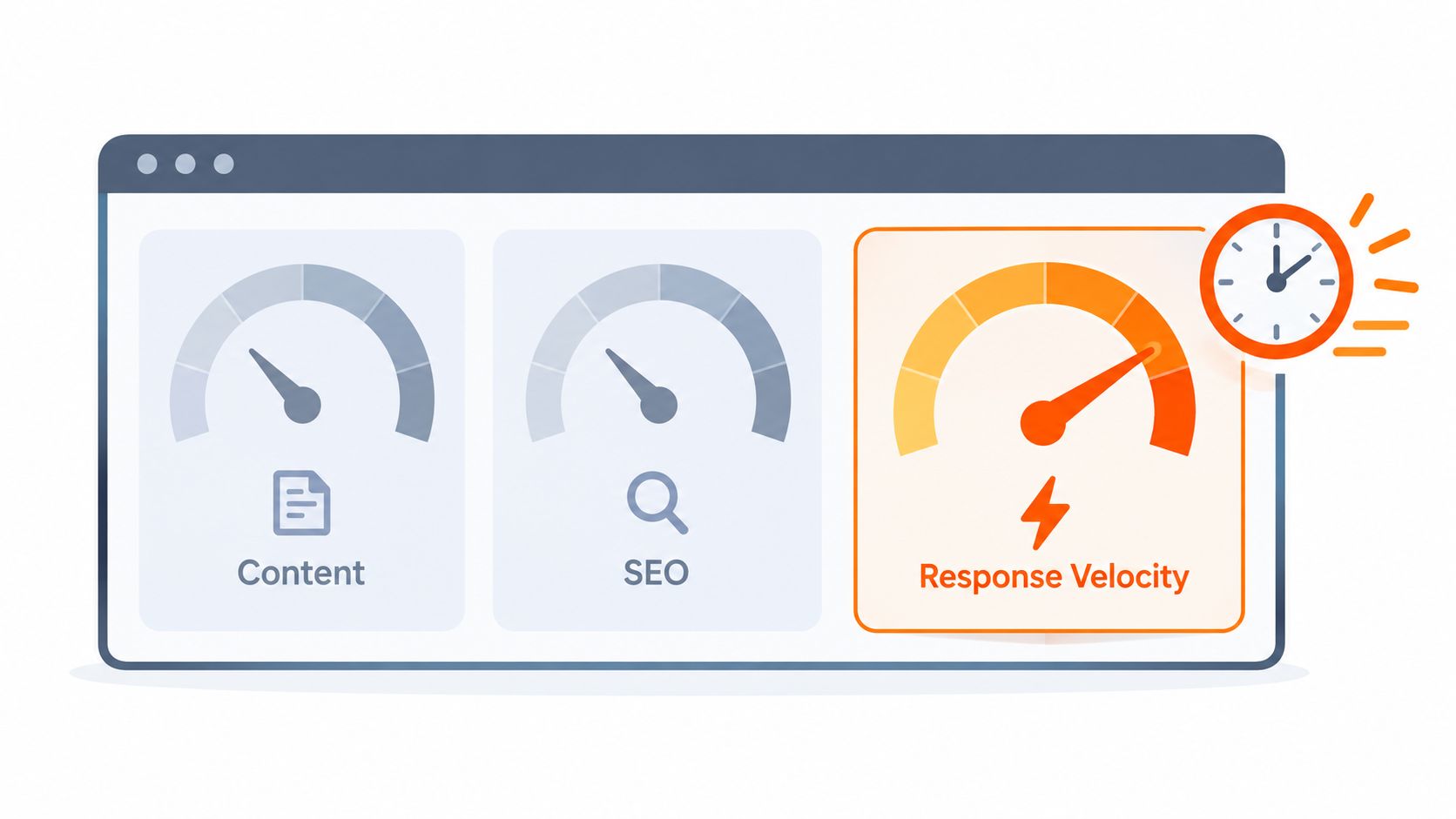
Choose the channel by signal
Use live video when the buyer needs a person now. Use AI chat for qualification and coverage outside staffed hours. Use co-browsing when product understanding is the obstacle. Use scheduling when the buyer wants control over timing. Don’t force every visitor into the same experience.
Once these foundations work, invest in content scale and SEO depth. Consistent publishing has a documented relationship with inbound lead volume, but content expansion should follow operational readiness. Otherwise, the team creates more opportunities for delayed follow-up.
For B2B teams with limited resources, the first sprint should produce a working response SLA, a routing map, and a report covering attempt, contact, qualification, median, P95, and SLA bands. Scaled organizations should add account tiering, after-hours coverage, channel-level attribution, and representative performance visibility.
Captiwate is one option for this operating layer. It uses in-browser video, chat, AI qualification, intent detection, scheduling, co-browsing, and CRM or collaboration integrations to connect active website visitors with sales while preserving conversation and meeting context.
The recommendation is straightforward: fix speed-to-conversation before chasing more volume. A smaller flow of well-routed, promptly engaged visitors can teach you more about revenue performance than a larger database of leads waiting for a follow-up task.
If your team is losing high-intent visitors between form submission and first conversation, Captiwate can help add in-browser video, chat, AI qualification, routing, scheduling, and CRM continuity to that path. Visit Captiwate to evaluate how real-time engagement can fit your inbound lead generation workflow, then audit your first-response SLA before investing in more traffic.