The popular advice to build stronger relationships and monitor a health score leaves out the hard part: deciding who acts when the relationship and the score disagree. A friendly champion can’t approve a budget they don’t control, and a green dashboard won’t resolve an open contract dispute. Effective B2B account management gives someone authority to make that call, records the evidence, and turns it into a dated action.
Table of Contents
- What B2B Account Management Covers
- Lifecycle Stages from Signal to Renewal
- Roles That Keep an Account from Going Stale
- Health Metrics Worth Acting On
- Expansion and Renewal Plays by Trigger
- Shared Handoffs with SDR and Marketing
- Put Live Intent on the Account Record
What B2B Account Management Covers
B2B account management is a relationship-marketing practice for managing strategically important customers profitably. A 2023 systematic literature review of key account management, examining 104 academic papers published between 1990 and 2022, describes a discipline built around strategic relationships rather than assigning sales representatives to large accounts.
Say a software supplier serves a manufacturer whose deployment influences its product roadmap, support staffing, and access to related businesses. Ordinary coverage might assign incoming requests round-robin and depend on a helpful operations manager. Strategic coverage gives that manufacturer a deliberate tier, a named relationship owner, and a plan that sales, implementation, and customer success can all use.
The difference isn’t friendliness. It’s whether the supplier can coordinate its commitments.
Strategic coverage preserves context
Think of a restaurant host who remembers the table, its guests, and what the kitchen has promised. A counter resets with every order. Strategic account management works like the host: each interaction should carry forward what the customer needs and what your team has agreed to deliver.
- Ordinary coverage completes individual tasks without necessarily connecting them.
- Strategic coverage allocates resources according to customer value and relationship potential.
- Account planning connects customer outcomes to commercial decisions and delivery responsibilities.
Account-based marketing supports that work, but it isn’t the same discipline. In N.Rich’s 2025 State of ABM report, 67% of surveyed B2B companies treated ABM as a strategic go-to-market alignment motion, while only 26% described their program as successful. Agreement on target accounts doesn’t, by itself, establish adoption, resolve delivery problems, or secure renewal.
Practical rule: Strategic treatment means a different operating commitment, not merely a different label in the CRM.
Adapt that commitment to the account’s potential and your team’s capacity. A smaller portfolio may need concise plans and clear escalation rules rather than elaborate presentations.
Lifecycle Stages from Signal to Renewal
B2B account lifecycle ownership and exit tests
| Stage | Owner | Entry trigger | Exit evidence | Usual failure |
|---|---|---|---|---|
| Tier | Account owner with RevOps | Revenue, expansion, or reference value justifies strategic treatment | Tier, owner, and next action on the account | Every logo treated as strategic |
| Engage | Account manager | Tier set and a first live contact | More than one function engaged and roles tagged | Single-thread champion |
| Mutual plan | Account manager with the customer sponsor | Buying group identified | Joint outcomes, resources, and a decision date | Generic success plan nobody uses |
| Adopt | Customer success with the account owner | Contract or go-live started | Paid workflow used by more than one team; last interaction verified | Seat count mistaken for value |
| Expand | Account owner with sales | Adoption and sponsorship both confirmed | Commercial offer tied to a witnessed use case | Upsell before the product is in use |
| Renew | Account owner with customer success | Renewal window or a risk signal | Gross-retention risks and blockers resolved with executive access | Calendar reminder with no risk review |
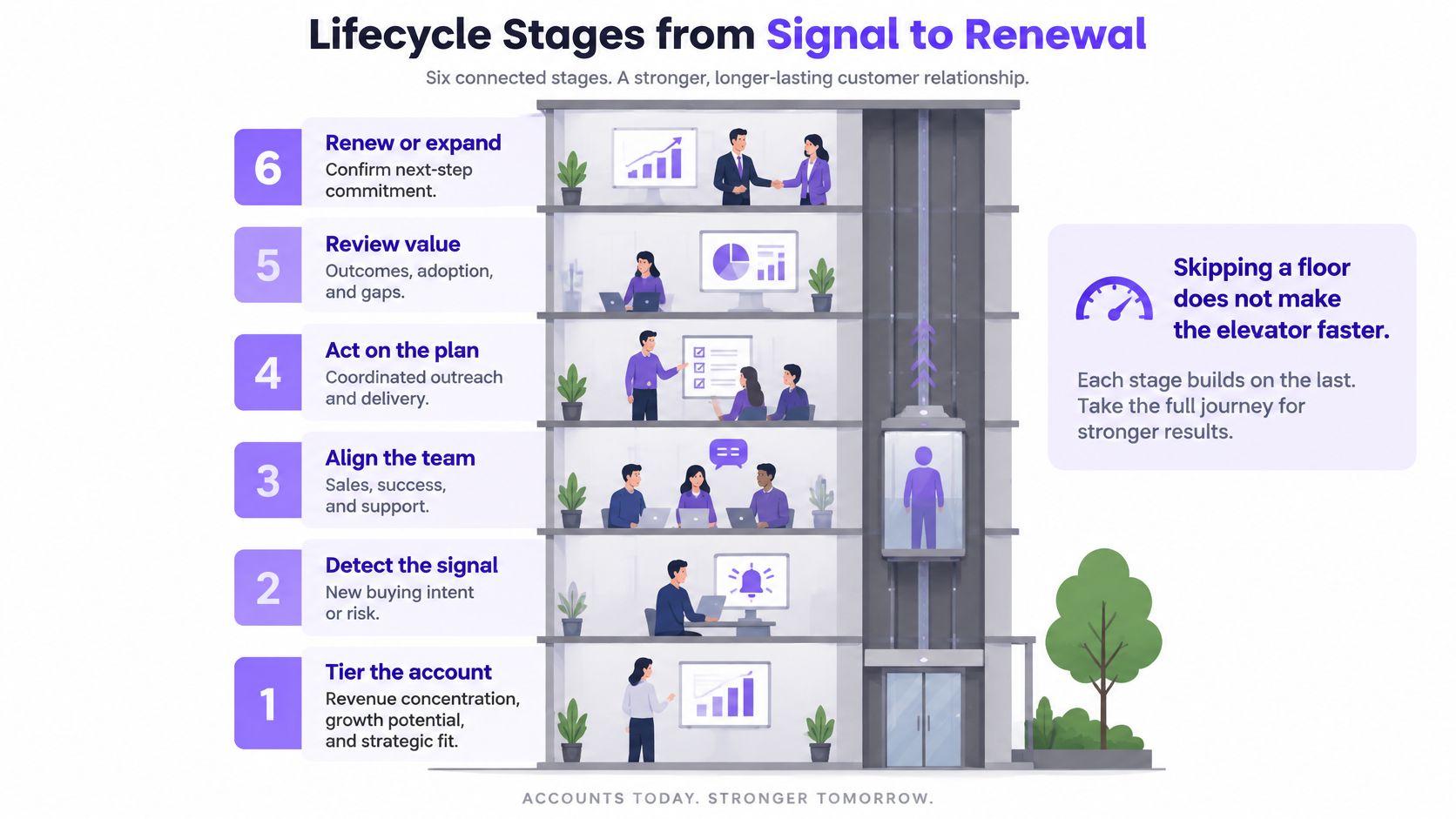
Treat these stages as floors in a building. Skipping a floor doesn’t make the elevator faster. Moving an account directly from enthusiasm to an expansion proposal only leaves unanswered questions about adoption and authority.
The lifecycle illustration connects those stages to the supporting work of detecting signals, aligning contributors, and reviewing value.
Start with a reason to invest
Tiering should explain why an account merits dedicated attention. Current revenue matters, but so can a credible expansion path or reference value within a market you serve. Name the owner before inviting more colleagues into the relationship.
For teams selling into government, account preparation can include understanding purchasing history before choosing an engagement strategy. FederalPipeline’s guide to research federal awards and incumbent contractors provides a useful starting point for that account context. Procurement context informs a plan; it doesn’t replace a conversation with the buyer.
During engagement, establish who experiences the problem, who evaluates the solution, and who can authorize change. Then write a mutual plan that names the customer outcome, the internal resources required, and the next decision date. A plan is not mutual just because your team emailed it.
Require evidence before promotion
Adoption means the customer uses the workflow they paid for, not merely that someone activated seats. For a cross-functional deployment, check whether the participating teams use it and whether the customer can describe the result.
Expansion requires an additional business case. Renewal requires unresolved retention risks to be addressed, even when nobody has requested a cancellation.
These aren’t rigid gates that prevent urgent action. A risk signal can reopen earlier work at any point. A meeting is activity; exit evidence is progress.
Roles That Keep an Account from Going Stale
An account becomes stale when everyone can contribute but nobody can decide. Assign authority by decision, not by who attended the most recent call.
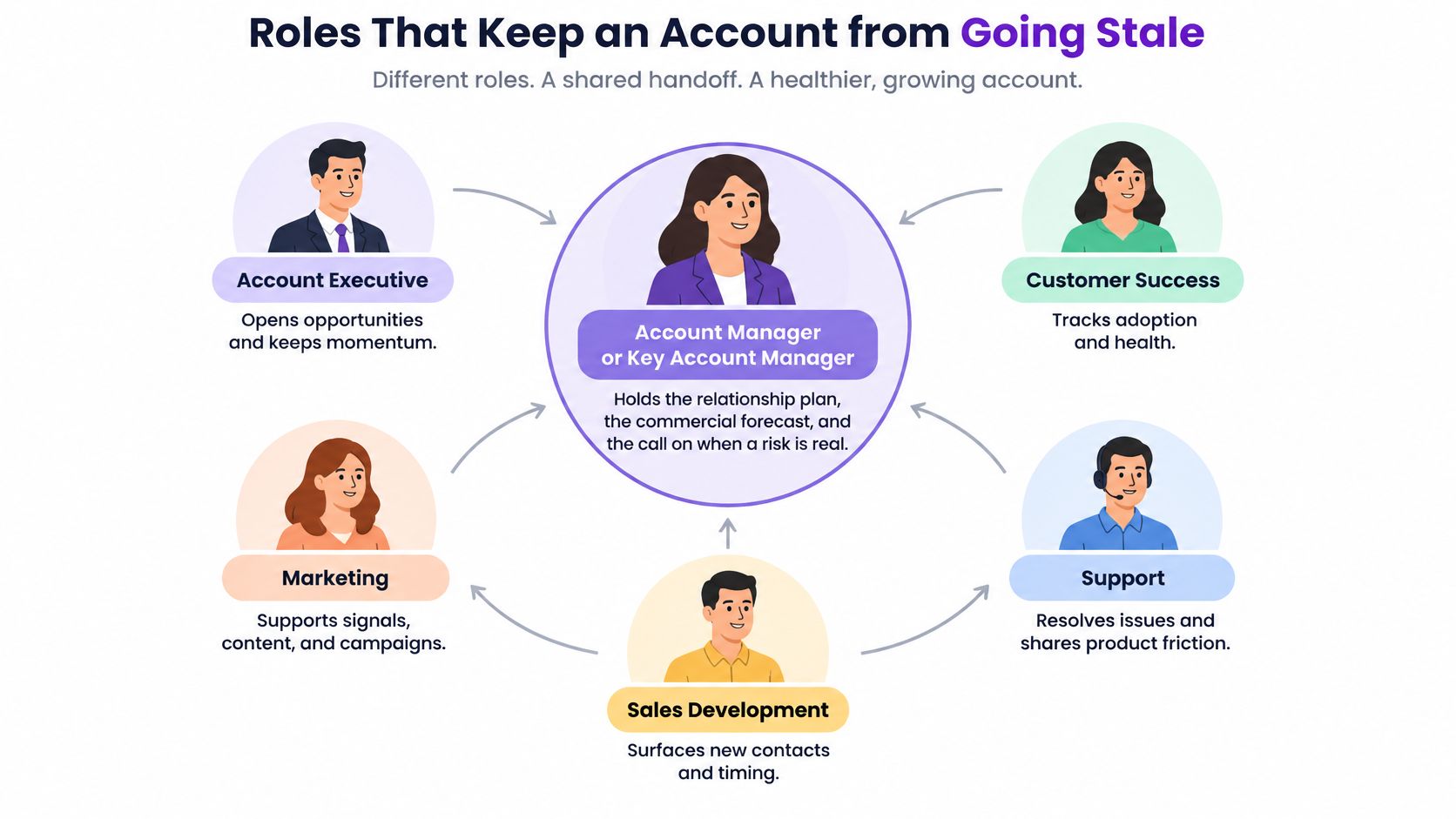
The account manager or key account manager holds the relationship plan, commercial forecast, and responsibility for declaring account risk. That doesn’t make them the owner of every task. It makes them accountable for connecting the tasks to the customer’s priorities.
The supporting roles form a relay around that accountable owner.
Give contributors clear decision rights
- Account executive: Owns new-logo or expansion commercial execution when assigned. They prepare terms and negotiate within agreed boundaries, rather than introducing a competing account narrative.
- Sales development: Qualifies inbound or named-account interest. The SDR captures the buyer’s question, originating page or campaign, and contact role, then transfers responsibility rather than continuing parallel outreach.
- Marketing: Shapes account-relevant proof and campaigns for missing stakeholders. It shouldn’t reset the customer story every campaign cycle.
- Customer success: Owns adoption evidence and the renewal risk list. Executive silence deserves attention even when product activity looks strong.
- Support: Resolves technical issues and identifies recurring friction that affects the promised workflow.
- RevOps: Controls fields, routing, ownership rules, and the operational exception queue.
A disagreement needs a resolution path. If customer success believes the account is at risk but sales expects expansion, the account manager records both positions and determines what evidence must be obtained before either commercial motion proceeds.
Design for absence and regional differences
Continuity can’t depend on the current representative staying indefinitely. Blossom Street Ventures’ survey of 172 B2B SaaS companies reported a 30% median annual sales-representative turnover rate in 2024. Keep a handover note with outstanding promises, stakeholder relationships, commercial constraints, and a named backup who can resume the plan within days.
Global coverage also needs local judgment. In research on global account management, 58.9% of companies considered cultural differences among global customers, clients, and business partners important to success. Decide who adapts communication and decision processes locally, while preserving shared commitments.
If someone wears both account management and customer success hats, keep the relationship plan separate from the adoption note. Otherwise, urgent commercial work can erase delivery evidence from the record.
One commercial voice to the customer, many contributors behind it.
Health Metrics Worth Acting On
Benchmarkit’s 2025 SaaS benchmarks report median gross revenue retention of 91% and median net revenue retention of 101% across more than 1,000 private B2B SaaS companies. The distinction matters: expansion can coexist with meaningful revenue loss from existing customers.
A blended health score is a decision aid, not a prediction you should accept without checking. Keep gross retention and expansion in separate columns so a growing account doesn’t obscure contraction elsewhere.
Account metrics, how they lie, and the override
| Metric | Reference point | How it misleads | Human override |
|---|---|---|---|
| Gross revenue retention | Existing revenue retained before expansion | Invisible if only NRR is reviewed | Always report beside NRR, by segment |
| Net revenue retention | Existing revenue after contraction, churn, and expansion | Expansion hides customer and contraction losses | Don’t call a book healthy on NRR alone |
| Signal freshness | Age of usage, relationship, and commercial inputs documented | Stale green data looks current | Drop inputs older than the review cycle |
| False positives | Renewals scored safe that churned | Opaque models create false confidence | Audit by segment and remove weak signals |
| False negatives | Churn or contraction the score missed | Late flags cannot change the outcome | Escalate sponsorship and dispute risk earlier than the model |
Give the score an accountable owner
The account manager owns the account-level decision. Customer success supplies adoption evidence, RevOps maintains scoring logic and timestamps, and commercial leadership resolves disputed escalations.
Define what a score means before testing its accuracy. A model that predicts successful renewal and a model that predicts churn reverse the meanings of positive and negative. The table uses safe renewal as the positive prediction; a missed churn event therefore also deserves inspection as a missed risk, regardless of the label in your software.
Weight inputs according to the contract’s value mechanism. Usage breadth deserves more attention in seat-based software; delivery milestones, executive sponsorship, and unresolved service tickets may carry more weight in services-heavy relationships. Vight’s weekly MSP service desk scorecard is a useful companion when operational service measures feed the account review, but ticket activity shouldn’t substitute for customer outcomes.
Make human overrides auditable
Require a logged override when the account looks green but:
- Sponsorship is weak: The executive sponsor has disengaged or lost influence.
- Adoption is concentrated: A power user carries the workflow while intended participants remain absent.
- Commercial risk is unresolved: Billing, procurement, or contractual disputes could block renewal.
Record the original score, contrary evidence, decision owner, intervention, and review date. An override isn’t permission to change a color because someone feels optimistic. It’s a reasoned decision another manager can inspect.
A customer success operations process should connect each risk state to an intervention, not a dashboard notification. If the only remaining lever is a discount in the final month, detection came too late.
Before trusting the current forecast, test the score against the previous quarter’s renewal outcomes by segment. Examine both unexpected churn and accounts flagged at risk that renewed without intervention. Adding more signals won’t repair a model nobody can explain.
Expansion and Renewal Plays by Trigger
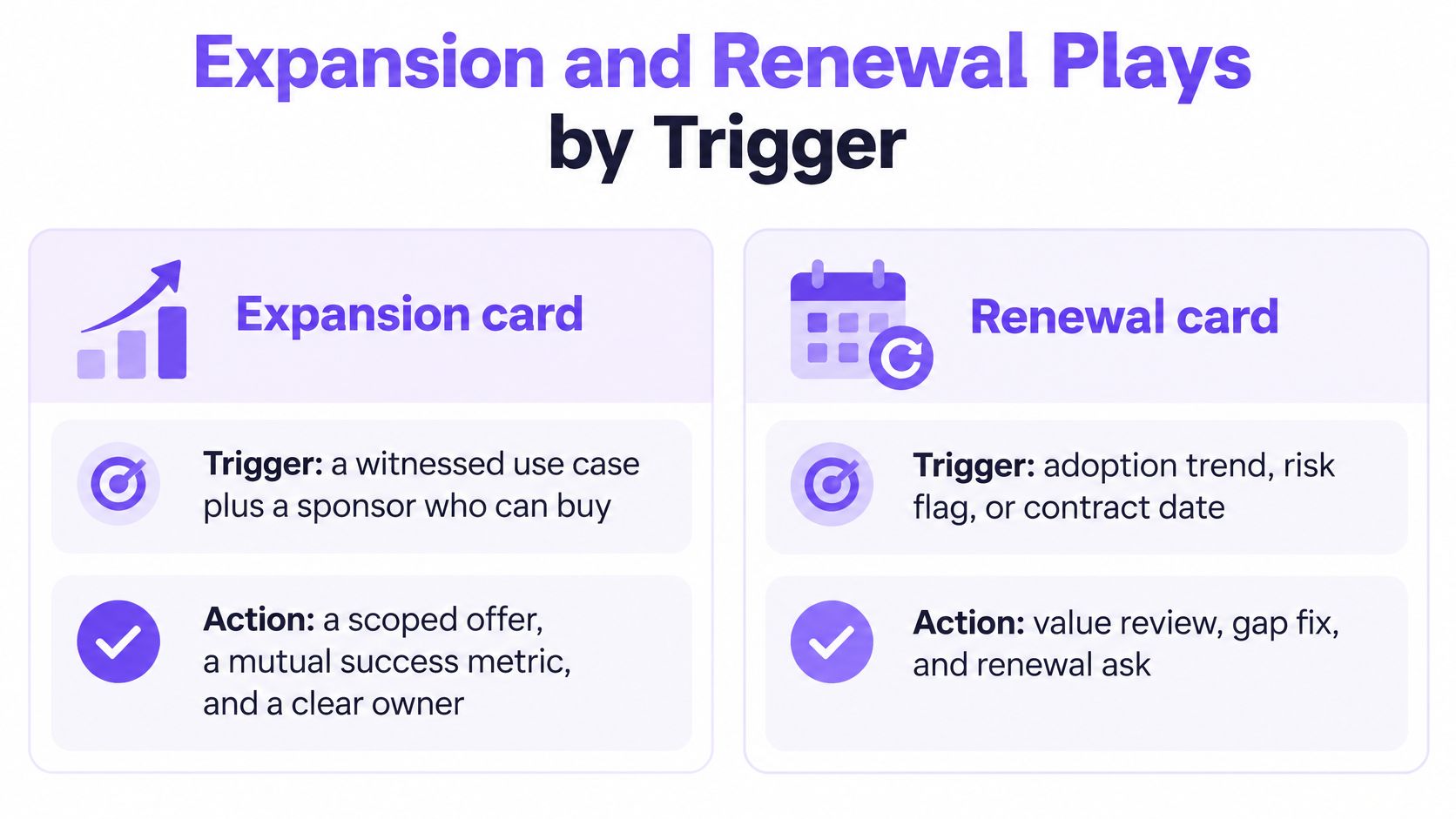
A quarterly review isn’t a trigger. A customer demonstrating an additional use case, losing an executive sponsor, or raising a procurement blocker is.
Use separate play cards so retention work doesn’t become an excuse to propose more products.
Expansion starts with witnessed value
If the customer demonstrates an additional use case and a sponsor can support a purchasing decision, then the account owner opens an expansion assessment.
Say a customer’s operations team has embedded a reporting workflow, and its finance lead asks to apply the same process to another business unit. Document the demonstrated workflow, the proposed scope, and the outcome the additional team expects. Ask the account executive to prepare an offer only after the customer confirms those assumptions.
Before sending the proposal, establish another route into finance or technical evaluation. Don’t treat a usage spike from an administrator testing settings as proof of demand.
Renewal starts with a blocker list
If renewal enters the planning horizon, adoption falls, an executive meeting is missed, or a commercial issue remains open, then the account owner convenes a risk review.
The output should be concrete: blocker, responsible person, required movement, and deadline. Build the save plan from that list. A general promise to provide more attention won’t resolve a security objection or a disputed invoice.
If expansion is also possible, keep its business case separate. A buyer shouldn’t have to buy something else to receive the value already promised.
Check buying-group coverage before advancing
Lusha’s B2B sales intelligence benchmarks recommend at least three relevant contacts per active deal and CRM record currency of 90% or better. Apply the coverage recommendation as an operating check, not a guarantee of consensus:
- Map decision roles. Include a business sponsor or champion, an economic buyer, and a technical evaluator.
- Record influence. Tag each contact’s role and validate whether they advise, approve, or block.
- Repair fragile coverage. Prioritize the missing stakeholder when the opportunity depends on a lone contact, rather than scheduling another identical demo.
- Verify before review. Use confirmed conversations to validate contact details and role tags, not email delivery alone.
- Investigate disagreement. When enrichment suggests a stakeholder has moved but activity suggests otherwise, assign a short stakeholder check.
For global accounts, include these roles in regions that can independently block the purchase. Headquarters coverage won’t settle a local implementation objection.
Contributors can propose either play. The account owner authorizes it, names the commercial lead, and records the reason before outreach begins.
Shared Handoffs with SDR and Marketing
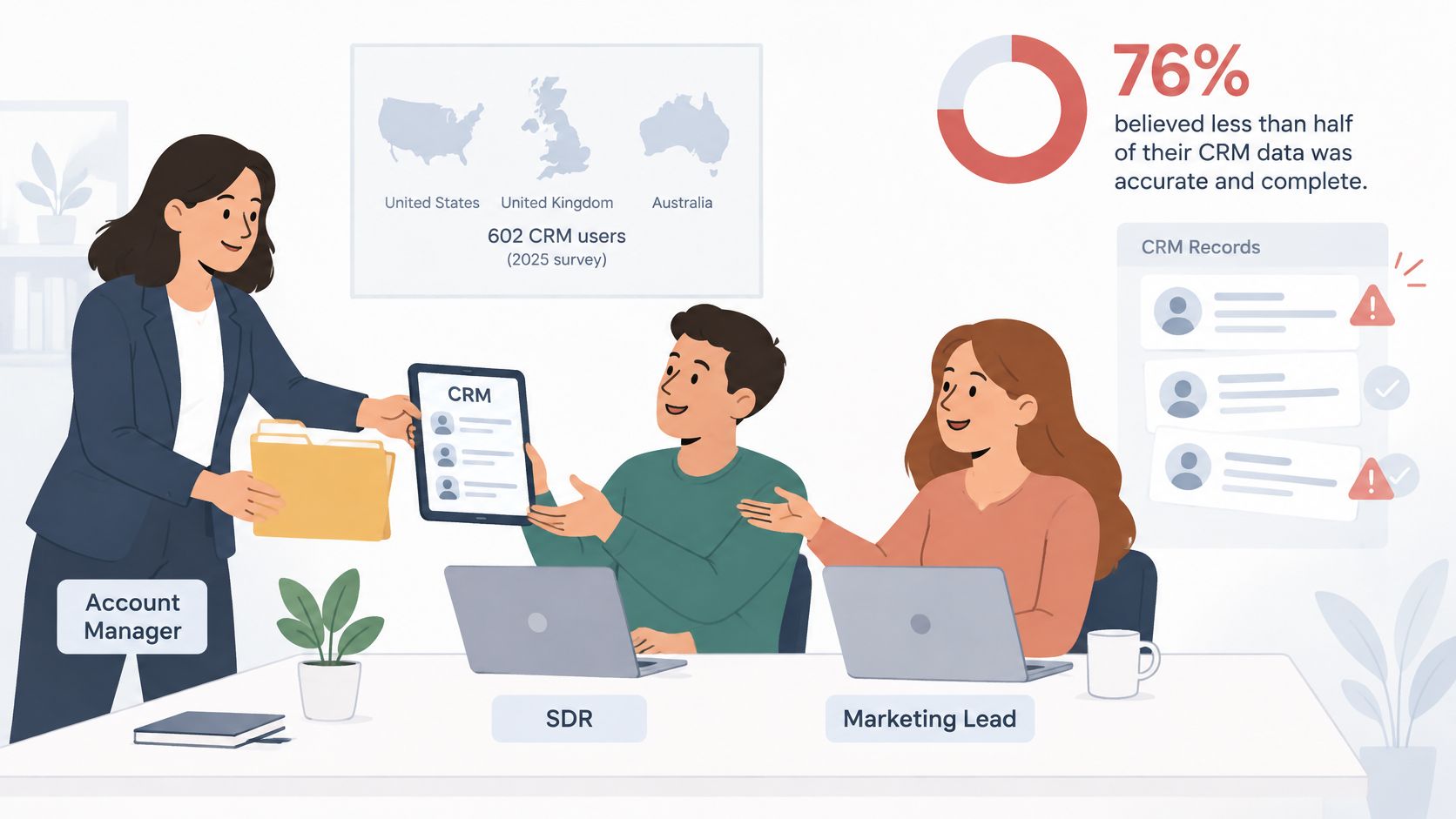
Say a named account visits the pricing page on Tuesday. Marketing places it in a campaign, an SDR calls a stale contact, and customer success holds a renewal concern neither colleague sees. The buyer receives incompatible messages because the team acted from separate records.
The risk isn’t merely untidy administration. A 2025 survey summarized by MaxIQ, covering 602 CRM users and administrators in the United States, United Kingdom, and Australia, found that 76% believed less than half their organization’s CRM data was accurate and complete; 37% reported revenue loss directly associated with poor data quality.
Build the handoff around shared account context rather than separate activity logs.
Rebuild the interaction as an account record
Combine company identity, the page and behavior that prompted attention, the last conversation, and any open renewal issue. Route the resulting task to the existing owner. In an account-based selling workflow, a new signal should enrich the shared narrative, not restart it.
Mandatory account record fields
| Field | Kept current by | Rule |
|---|---|---|
| Account tier | Account owner with RevOps | Set at tiering and reviewed each cycle |
| Buying-group role | SDR or account manager | Tag each contact; cover sponsor, economic buyer, and technical evaluator on active deals |
| Last verified interaction | Account owner | Date of last confirmed conversation, not last email sent |
| Intent status | Marketing with RevOps | Fresh or expired based on latest signal |
| Next action | Account owner | Dated task on every high-intent record |
| Owner | RevOps | Named accountable owner; conflicts enter the exception queue |
Make completeness and currency visible separately. A populated job-title field can still be wrong. Require validation when records are created or updated, and reconcile website, scheduling, conversation, and CRM events against the account.
Use the accompanying video alongside a review of your own routing and handoff process.
Work the exception queue
RevOps should review unowned accounts, stale opportunities, conflicting ownership, and high-intent activity without a task. Each exception needs a responsible person and a resolution, not just a dashboard count.
Marketing may attach relevant proof or run a campaign toward a missing role. It shouldn’t reassign an active account mid-conversation. The SDR records the question the visitor asked and stops parallel outreach when the account owner accepts the handoff.
Handoff test: Could the receiving owner continue the conversation without asking the buyer to repeat their question?
After-hours engagement still needs a dated task before the next working day begins. Otherwise, a timely signal becomes an unexplained cold call.
Put Live Intent on the Account Record
AI-assisted activity is exploration until a verified conversation confirms buying-group consensus. MarketSplash’s compilation of B2B buyer research reports that 94% of B2B buyers used AI during purchasing, while 94% of AI users fact-checked AI-generated information at least sometimes. Neither AI use nor subsequent fact-checking establishes purchase authority.
Start with a strategic account and inspect the evidence rather than its activity volume. A useful B2B intent data practice preserves the source and timing of a signal alongside the conversation that confirms or contradicts it.
Audit the path to a real conversation
- Owner present: Who is accountable when the account returns?
- Intent fresh: What happened, when, and what interpretation remains unverified?
- Role missing: Whose approval or evaluation hasn’t been established?
- Live path ready: Can the visitor reach the appropriate person or book a relevant conversation?
Judge the motion by qualified conversations and stage movement, not click counts or chatbot volume. Ask what changed in the buying process: a stakeholder confirmed the problem, an evaluator accepted the requirements, or a sponsor committed to a decision.
For active evaluation or expansion, guide the buyer through the product instead of sending another deck. Our co-browsing lets a rep guide buyers live in their browser without downloads, and our two-way HubSpot and Salesforce sync automatically carries conversations, companies, and bookings into the CRM.
Make proof checkable and collection transparent
Give buyers sourced claims, relevant reference material, and a named person who can answer follow-up questions. If your team maintains evidence from public, dynamically rendered vendor pages, Context.dev’s API for scraping rendered web pages is one technical option for collecting those pages. Preserve source context and review permissions; collection doesn’t establish accuracy.
Design consent before activating identification or recording. Document what is identified, on which pages, under which consent basis, and how recording is disclosed. Have the appropriate privacy owner review market-specific requirements rather than assuming a single notice covers every jurisdiction.
Captiwate connects website visitors to live sales conversations through in-browser video, chat, AI qualification, and scheduling, while keeping account context in your CRM. Visit Captiwate to evaluate a live engagement path for a strategic account, with a named owner, clear routing, and a measurable next step.