Lead qualification is the structured process of deciding whether a prospect deserves sales time, based on fit, intent and readiness.
Your campaign is bringing in visitors, people are downloading your guide, and sales wants to know which contacts to call. You can see activity, but you can’t yet tell who’s comparing solutions for an approved project and who’s collecting ideas for later. Qualification gives marketing and sales a shared way to make that distinction without pressuring every visitor into a conversation.
Table of Contents
- What Lead Qualification Means in Plain Terms
- Fit, Intent and Readiness Signals to Weigh
- How BANT and Similar Frameworks Test a Lead
- From Visitor to Sales-Ready Lead
- Behaviors and Answers That Signal a Real Buyer
- Why Lead Scoring Alone Misses Good Buyers
- Automating Qualification Without Losing Buyer Trust
- Set Up Qualification Before Your Next Campaign
What Lead Qualification Means in Plain Terms
Think of a hospital triage nurse deciding who needs a doctor now, who can wait, and who needs a different kind of care. Lead qualification serves a similar sorting function, although the stakes are commercial rather than medical. You’re choosing the right next action, not deciding whether someone matters.
Say you market scheduling software. An operations manager arrives on your website because missed appointments are disrupting their team. A student arrives to research scheduling technology for an assignment. Both might download the same guide, but only the manager has described a problem your business could solve.
The evidence behind the decision
The Adobe guide to revenue alignment describes qualification through four evidence categories: demographic and firmographic fit, buying criteria, engagement behavior, and purchase intent.
In plain language, those inputs tell you about the person and company, what they need from a purchase, how they’re engaging, and whether they’re considering buying. None is a verdict by itself.
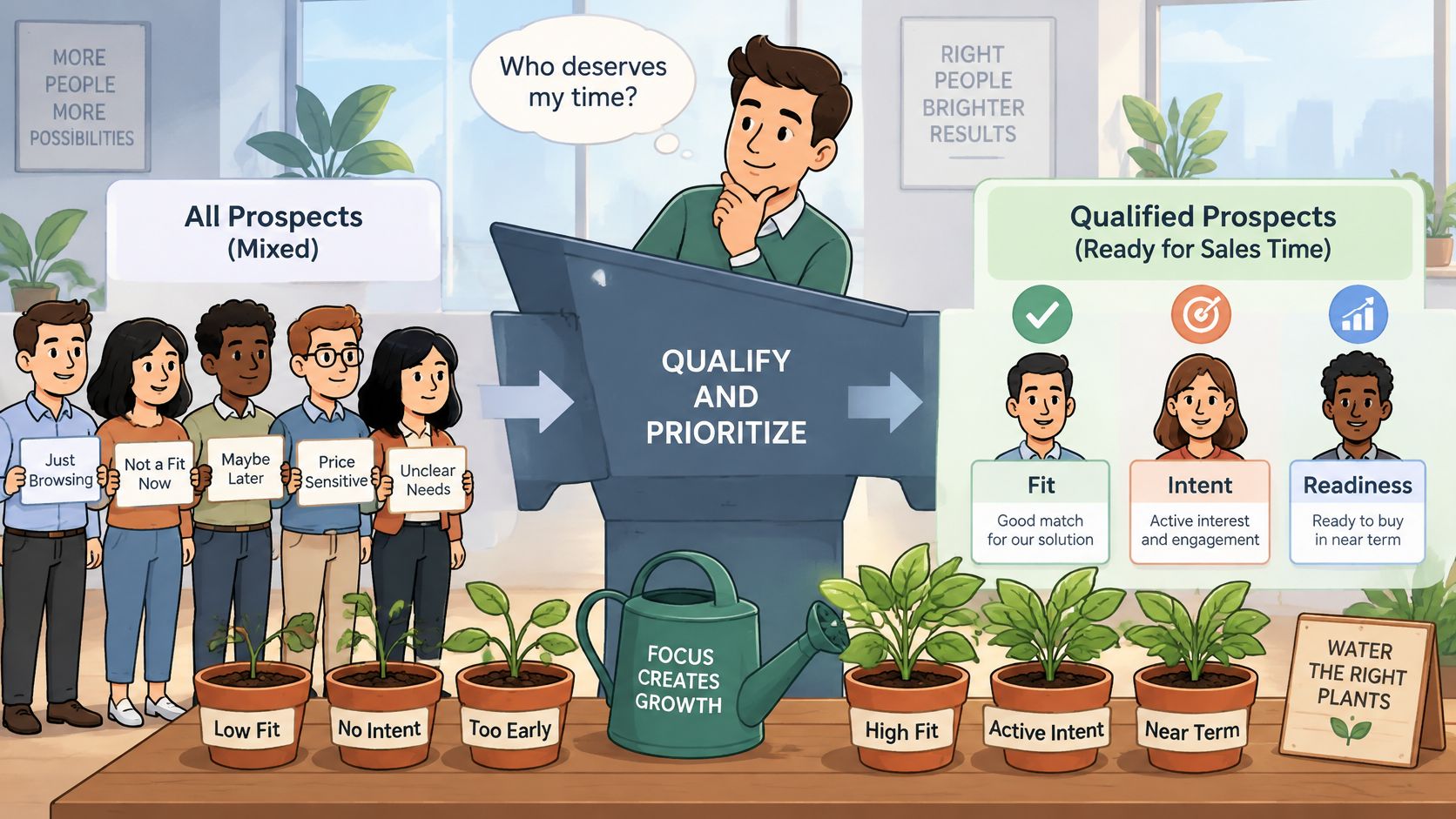
Without a qualification process, reps can spend their day chasing downloads rather than understanding potential buyers. For a useful companion on avoiding that wasted effort, CleanMyList explains prospecting mistakes that drain your pipeline.
Practical rule: Record the evidence that supports the next action, not just a label saying the lead is qualified.
A useful decision might be to offer a conversation, answer a question, or leave the visitor to research. Qualification turns uncertain traffic into a manageable set of appropriate next steps.
Fit, Intent and Readiness Signals to Weigh
Four qualification signals and their framework weights
| Signal | Question It Answers | Example Evidence | Framework Weight |
|---|---|---|---|
| Fit | Does the account match our ideal customer profile? | Industry, company size, revenue, geography, job role | 25% |
| Behavioral engagement | Is the contact actively exploring us? | Repeat visits, content engagement, return sessions | 30% |
| Validated intent | Is there a recent, corroborated buying signal? | Pricing-page activity, demo request, evaluation questions | 25% |
| Buying-group coverage | Are the people who influence the decision involved? | Number and seniority of engaged stakeholders | 20% |
The framework described in Apollo’s guide to high-value B2B leads assigns 25% to fit, 30% to behavioral engagement, 25% to validated intent, and 20% to buying-group coverage, with intent required to be recent, reliably sourced, and corroborated by another signal.
Treat these weights as a starting point, not a universal standard. Your own conversion outcomes should determine whether they deserve a place in your process.
Why a perfect company match isn’t enough
Static fit is easy to overvalue because it looks reassuring. A company in your preferred industry, with the right employee profile and familiar technology, resembles a customer. That doesn’t tell you whether anyone there wants to change anything.
An ideal customer profile, or ICP, describes the kind of account your business can serve well. If you haven’t defined yours, start with this explanation of what an ICP is before assigning points to company attributes.
Intent concerns observable actions: a return visit, a demo request, or a question about implementation. Readiness concerns the practical situation behind those actions, including timing, funding, and the ability to move a purchase forward.
A smaller account actively evaluating a solution may deserve attention before a perfect-fit account with no recent engagement. Keep those differences visible rather than collapsing everything into an impressive-looking total.
- Fit score: Track relatively stable account and contact characteristics.
- Intent score: Track current activity, its recency, and how confidently it indicates evaluation.
- Readiness notes: Record what the buyer has confirmed about purchasing.
High fit with little current intent usually calls for relevant nurture, not an automatic assignment to a sales development representative, or SDR.
How BANT and Similar Frameworks Test a Lead
BANT means Budget, Authority, Need, and Timeline. It’s a widely used qualification framework, but it isn’t the only option, and it shouldn’t turn a conversation into an interrogation.
Use it to identify what’s known, what’s missing, and what needs clarification.
BANT criteria, qualifying answers and warning signs
| Criterion | Question to Ask | Qualifying Answer | Warning Sign |
|---|---|---|---|
| Budget | Can the organization fund the purchase? | Approved budget line or defined spend range | Budget owner unknown or no funding source |
| Authority | Can this contact influence or approve the purchase? | Contact owns the decision or sits on the buying committee | Researching for someone else with no access to the decision |
| Need | Is there a relevant business problem? | Named problem tied to a measurable goal, such as low demo volume | Interest in features with no problem behind them |
| Timeline | Is there a realistic buying window? | Decision expected within the quarter | No date, or a vague someday |
Budget doesn’t require opening with a demand for financial details. Ask how the team plans to fund the project. For a lower-cost, self-serve product, checking whether a suitable plan fits their spending limits may be sufficient.
Authority isn’t synonymous with senior job title. Ask who else would help evaluate or approve the purchase. In a product-led business, an engaged user who can invite colleagues may be a useful starting contact.
Ask naturally, then record the answer
For need, ask what the team wants to improve and what happens if nothing changes. For timeline, ask what event or commitment makes the change important. Save the answers in your CRM, distinguishing the buyer’s statements from your interpretation.
Consider a marketing manager who likes the product but can’t identify who approves spending. Offer useful information and ask about the approval path rather than forcing a sales meeting. A finance lead with a named project and an agreed implementation deadline deserves a more direct invitation to speak with an SDR.
Set a minimum evidence requirement for a substantial discovery call: a confirmed need plus a credible decision path or buying window.
For straightforward deals, BANT can provide enough structure. CHAMP, meaning Challenges, Authority, Money, and Prioritization, starts with the buyer’s problem and can help with complex B2B conversations. MEDDIC, meaning Metrics, Economic buyer, Decision criteria, Decision process, Identify pain, and Champion, gives enterprise teams a more detailed way to examine a large buying group and lengthy approval process.
From Visitor to Sales-Ready Lead
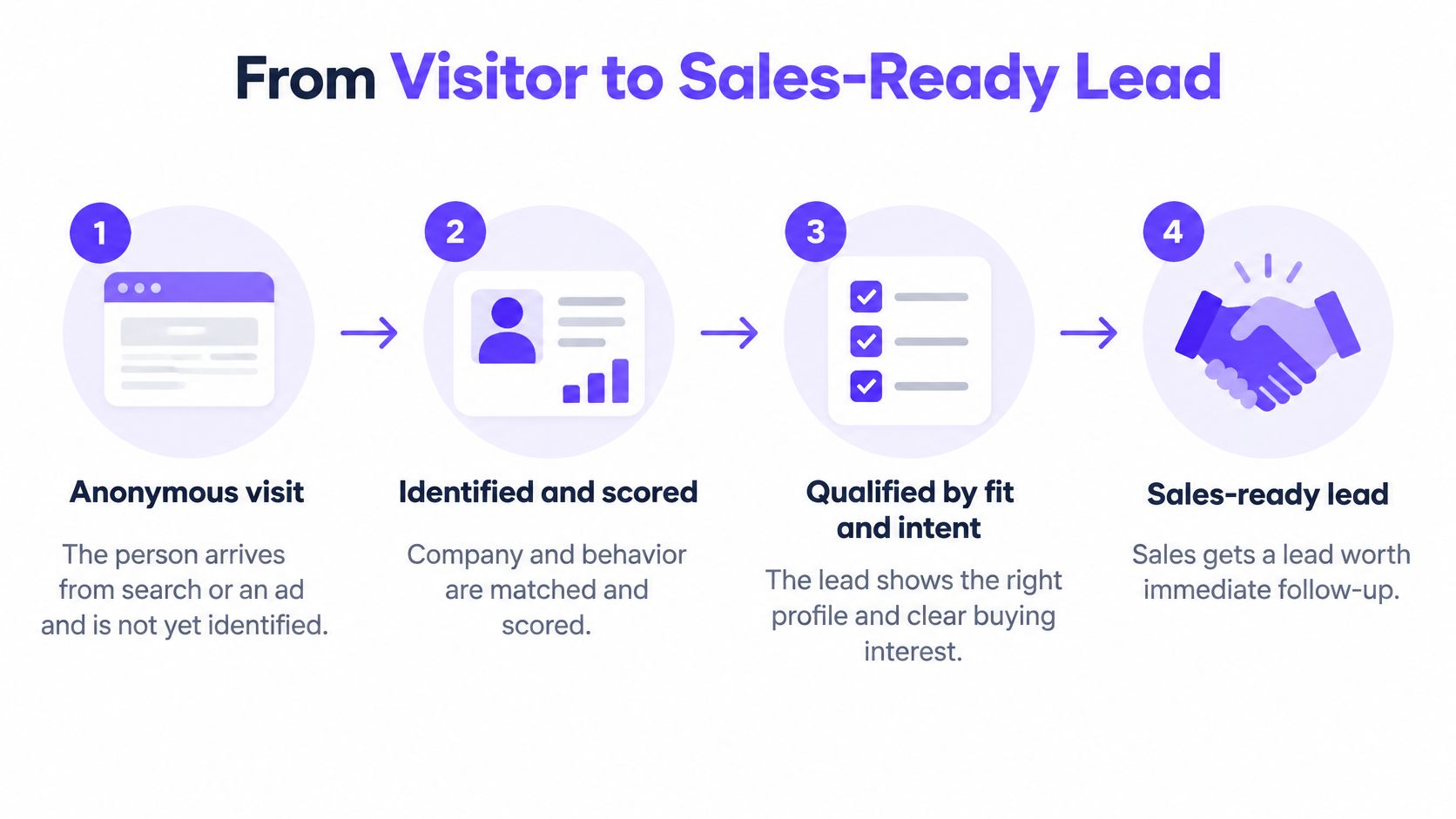
The visitor journey is easier to manage when each stage has a clear purpose. This diagram summarizes the main progression, while the operating process also needs verification, handoff, and recycling.
-
Anonymous visit. Someone arrives from search or an ad without identifying themselves. Provide useful information rather than treating their arrival as permission to contact them.
-
Identified and assessed. Available company details and behavior are checked against your criteria. A marketing-qualified lead, or MQL, has shown enough fit or engagement to merit attention, but may not be ready for direct selling.
-
Verification. Optional chat or a short conversation clarifies the business problem, buying involvement, and timing. A self-serve route should remain available when the visitor only needs an answer.
-
Sales-qualified lead. A sales-qualified lead, or SQL, has been reviewed and judged ready for active sales engagement. The decision should include a reason, not merely a changed CRM field.
-
Handoff. A named owner receives the relevant context and offers the agreed next step. Include the buyer’s question so they don’t have to repeat it.
-
Recycle. A lead that isn’t ready returns to appropriate nurture or self-serve support. Reconsider the decision when meaningful new evidence appears.
Make the labels useful
MQL means worth attention. SQL means worth a rep’s time. Neither label means the prospect has committed to buying.
For teams adapting this process to an Australian market, Truespeak’s guide to qualifying Australian leads offers a companion resource.
Use the following video alongside your team’s handoff discussion.
The process prevents a common category error: recording a form submission or download as an SQL before anyone has established sales readiness.
Behaviors and Answers That Signal a Real Buyer
Repeated pricing-page visits combined with a stated buying window deserve more attention than an isolated content download. What people do and what they say together provide a stronger basis for action than either alone.
The following are example routing rules to test, not proven thresholds that apply to every business.
Buyer behaviors, what they suggest and the next action
| Behavior or Answer | What It Suggests | Next Action |
|---|---|---|
| Visits pricing page on separate days | Active evaluation | Route to SDR with a live chat offer |
| Answers a timing question with next quarter | Timing is real | Offer to book a meeting now |
| Asks how the product connects to the current CRM | Technical fit being checked | Route to a specialist or AI chat for details |
| Several contacts from a company view product pages | Buying group forming | Prioritize the account and alert the owner |
| Downloads a guide and shows no other activity | Early research | Nurture with relevant content |
| Says they’re just browsing or cannot be matched to a company | Low or unverified readiness | Keep in nurture or self-serve support without automatic SDR outreach |
The Consensus B2B Buyer Behavior Report found that prospects viewing a demo nine or more times reportedly closed at rates 8–10 times higher than less-engaged buyers. That finding supports paying attention to repeated product engagement, but it doesn’t prove that frequent viewing causes a purchase.
Turn an observation into a useful question
Start by recording the behavior without adding a conclusion. A CRM integration question suggests a technical requirement; it doesn’t establish an approved project. Answer it first, then ask whether compatibility is part of an active evaluation.
A useful verification question is what would make this a priority this quarter. If the buyer describes an expiring contract and an assigned project owner, offer a sales conversation. If they’re collecting ideas for an unspecified future initiative, provide material they can use independently.
Use relevant sales discovery questions to clarify the situation rather than asking everything your CRM can store.
Choose the lowest-effort next step that tests your interpretation of the buyer’s behavior.
Check company match and recency before escalating an alert. A competitor researching your pricing or a student studying your product can resemble an active buyer. An unidentified visitor may still be serious, so let them request help without forcing identification prematurely.
Why Lead Scoring Alone Misses Good Buyers
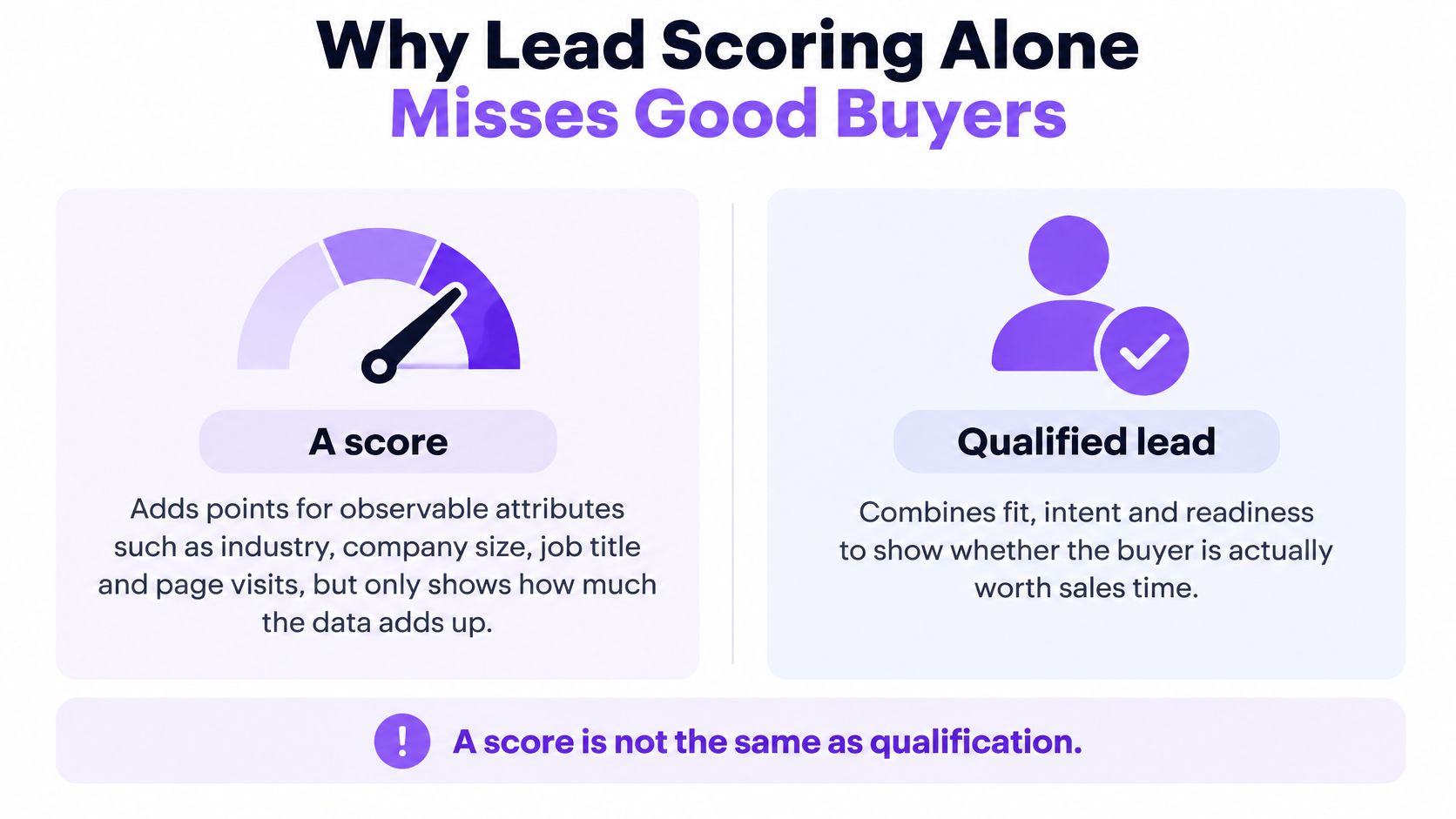
A high score isn’t a qualified lead. Scoring assigns value to observable attributes and activity. Qualification requires judgment about whether a useful sales conversation should happen now.
The distinction is simple: a score summarizes available evidence; a qualification decision combines that evidence with a confirmed situation and an appropriate next action.
Predict an outcome, not an arbitrary total
Predictive qualification uses historical CRM outcomes to estimate the likelihood of a defined event, such as sales acceptance, opportunity creation, or closed-won revenue within a specified window. Inputs can include company attributes, acquisition source, page types, activity recency, responses, and stakeholder involvement.
The paper on supervised machine learning for B2B lead scoring describes stronger results from combining profile and behavioral information, and summarizes a CRM case study in which gradient boosting performed strongest among 15 tested classification algorithms.
That doesn’t make a particular algorithm the right choice for your CRM. Evaluate the model against your own outcomes using:
- Precision: How often the leads flagged as qualified meet the target.
- Recall: How many qualified leads the model finds.
- ROC-AUC: How well it distinguishes positive from negative outcomes across thresholds.
- Calibration: Whether predicted probabilities resemble observed results.
Overall accuracy can be misleading when qualified leads are uncommon. Also exclude information that only becomes available after the outcome you’re trying to predict.
Send high-probability, high-value cases to a person; give uncertain cases optional chat or scheduled follow-up; keep low-probability cases in appropriate nurture. Recalibrate thresholds against actual conversion and revenue rather than leaving them fixed.
Automating Qualification Without Losing Buyer Trust
A buyer can be interested without wanting a salesperson involved yet. Martal’s lead qualification guide cites a Gartner survey in which 67% of B2B buyers preferred a rep-free buying experience. Treat that preference as a reason to offer choice, not a reason to remove human help.
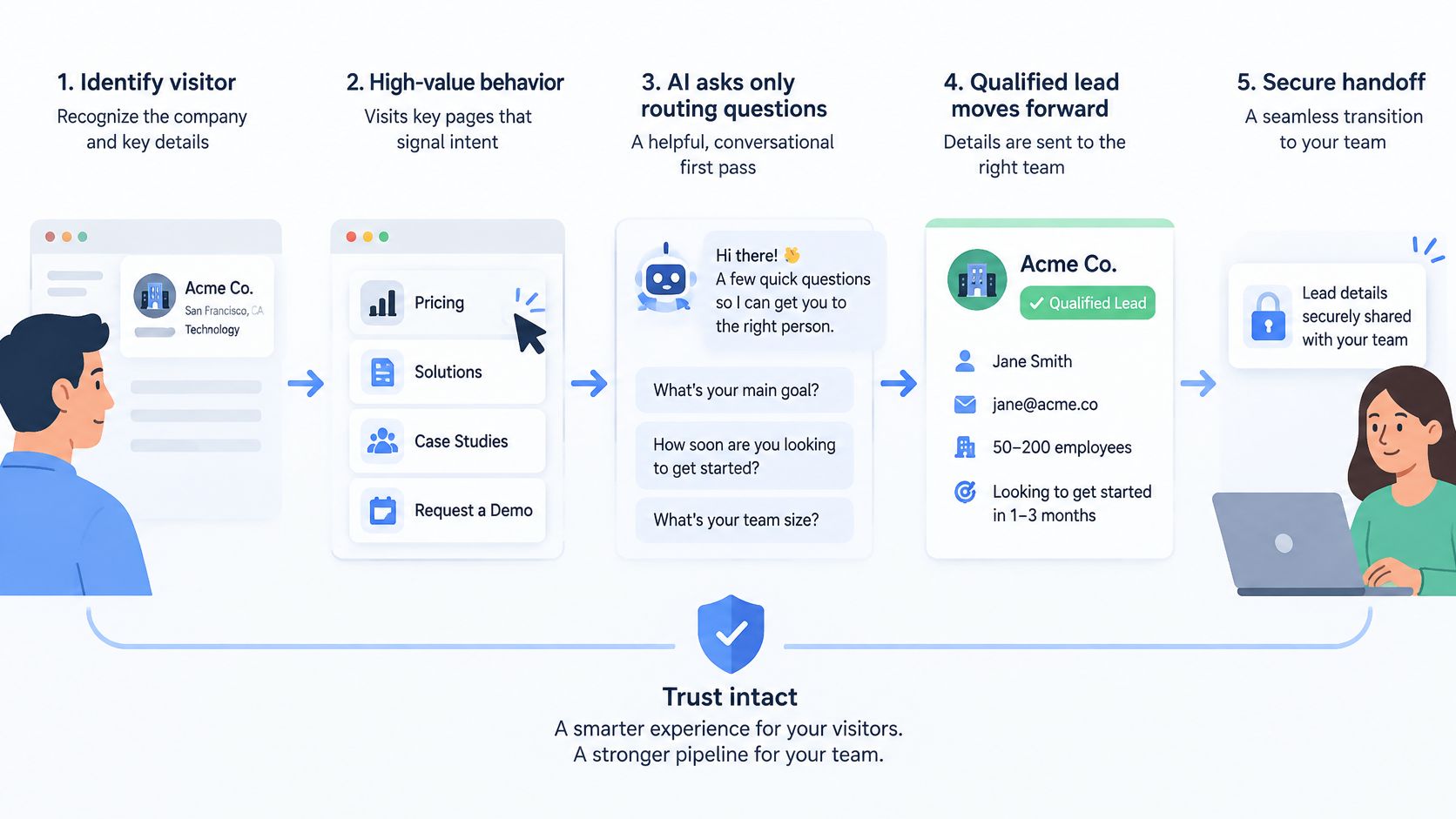
Automation should reduce the buyer’s effort, not make them feel observed. Company identification, high-value page signals, and routing can support an efficient first pass, but they shouldn’t become an excuse to announce someone’s browsing history.
Use progressive consent
- Offer self-serve answers first. Make product, integration, and purchasing information accessible without requiring a meeting.
- Ask only what’s needed for routing. A visitor asking about an integration may need technical help, not a full budget interview.
- Explain the request. Tell the visitor that their region helps you connect them with an appropriate teammate.
- Keep human help accessible. Let the visitor request a person without restarting the conversation.
A practical AI lead qualification workflow separates routine sorting from questions that need judgment. Automate initial assessment, basic routing questions, and context transfer. Keep nuanced objections, complex requirements, and negotiated pricing conversations with people.
Before launch, check the buyer-facing controls:
- Privacy notice: Explain what information is collected and how it’s used.
- Easy dismissal: Let visitors close or opt out of chat without blocking their research.
- Human fallback: Assign coverage during business hours and explain what happens outside them.
Fast routing is useful only when the visitor wants the next step. Respecting a decision to continue independently is part of good qualification.
Set Up Qualification Before Your Next Campaign
Start with the handoff between marketing and sales. Map your current criteria against the signal categories and BANT questions, then fix the most consequential gap.
- Write shared definitions. Document what evidence your MQL and SQL labels require, including who verifies it.
- Choose meaningful behaviors. Select actions that reflect evaluation in your sales cycle, such as returning to pricing, asking about integrations, or involving colleagues.
- Assign a route. Decide which behaviors justify an offered human conversation, optional AI chat, or nurture. If follow-up includes email, run a quick deliverability test with Mailwarm before interpreting silence as lack of interest.
- Review outcomes monthly. Compare accepted leads, meetings, and closed deals, then adjust criteria where the evidence supports a change.
Test a focused handoff rule
Choose a pricing-page visitor segment and route it to a named rep. Include the company, relevant pages, and volunteered chat answers in the alert.
Compare its meeting rate with the same segment before routing over a fixed review period, keeping traffic sources comparable. Record whether to retain the rule, change the threshold, or return the segment to nurture. Report only response times and outcomes you’ve measured.
Captiwate combines visitor identification, intent detection, AI chat, and live conversations to help teams verify interest and connect willing buyers with sales. Visit Captiwate to arrange a 30-minute walkthrough on your own website with your own traffic, and examine where qualification and handoffs could work better.