A prospect from one of your target accounts lands on your pricing page at 9:12 a.m. They click to a product page, back to pricing, then into an integration page. Another person from the same company shows up before lunch. No one fills out a form. Your team sees none of it, or sees it too late, and the first outreach goes out the next day with a generic “just checking in” message.
That’s how teams miss revenue while believing they have an inbound process.
Most missed pipeline doesn’t come from a lack of traffic or effort. It comes from slow interpretation. The signal was there, but it was treated like background noise. In buying signals in sales, timing changes the value of the event itself. A pricing-page visit is not just a page view. It’s a moment. If nobody acts while that moment is still live, the signal weakens fast.
Teams also get stuck because they treat signals like a checklist. They track demo requests, maybe a few product-page visits, maybe a content download, and call it intent. But buyers rarely announce themselves through one clean action. They leave a trail. The job is to read that trail the way a strong SDR reads tone on a call. Not as a single cue, but as a pattern.
Table of Contents
- Introduction Why Most Teams Miss Buying Signals Until It Is Too Late
- What Buying Signals Really Mean and How They Behave
- The Complete Catalogue of Buying Signals You Should Track
- How to Detect Score and Prioritize Signals Without Guesswork
- Trigger Actions That Turn Signals Into Live Conversations
- Real World Use Cases and Metrics That Prove Signal Based Selling Works
- Putting Your Buying Signal System Into Action
Introduction Why Most Teams Miss Buying Signals Until It Is Too Late
The usual workflow still looks like this. Marketing drives traffic. Sales waits for a form. RevOps builds a score that piles up points over time. Then a rep reaches out when the lead finally looks “qualified.”
That sounds sensible until you watch how buying behavior happens.
Forms catch hands raised. Signals catch buying motion
A lot of high-intent activity happens before a buyer wants to talk. Someone compares feature pages. A second stakeholder returns later from the same company. An executive browses pricing. A chat opens, then closes. None of those actions alone guarantee a deal. Together, they often mean the account is moving.
A structured discipline has started to form around this. A 2024 Forrester report formalized the B2B Buying Signals Framework, and industry reporting notes that most organizations still use only five to six signal types out of 23 surveyed in the 6sense benchmark, which shows how narrow most early programs still are (industry reporting on buying-signal maturity).
That gap matters because many teams are trying to read intent with only a few clues.
Practical rule: If your system only notices form fills and email opens, you’re not tracking buying signals. You’re tracking leftovers.
The hidden problem is delay
Strong intent doesn’t sit still. Independent sales guidance points to a 5-minute response target for demo requests, pricing-page visits, and RFP-level intent because interest fades quickly and competitors can step in first (speed-to-lead guidance).
That’s why buying signals in sales aren’t mainly a data problem. They’re an operating problem. Who sees the signal? How quickly? What counts as urgent? Which signals need a rep now, and which belong in nurture?
What good teams do differently
The best revenue teams don’t ask, “Was that a signal?” They ask three sharper questions:
- What happened together: Was this one isolated action or a cluster?
- How recent is it: Did it happen right now, today, or last week?
- What buying stage does it suggest: Awareness, evaluation, or decision?
Once you think that way, intent stops looking random. It starts reading like a language.
What Buying Signals Really Mean and How They Behave
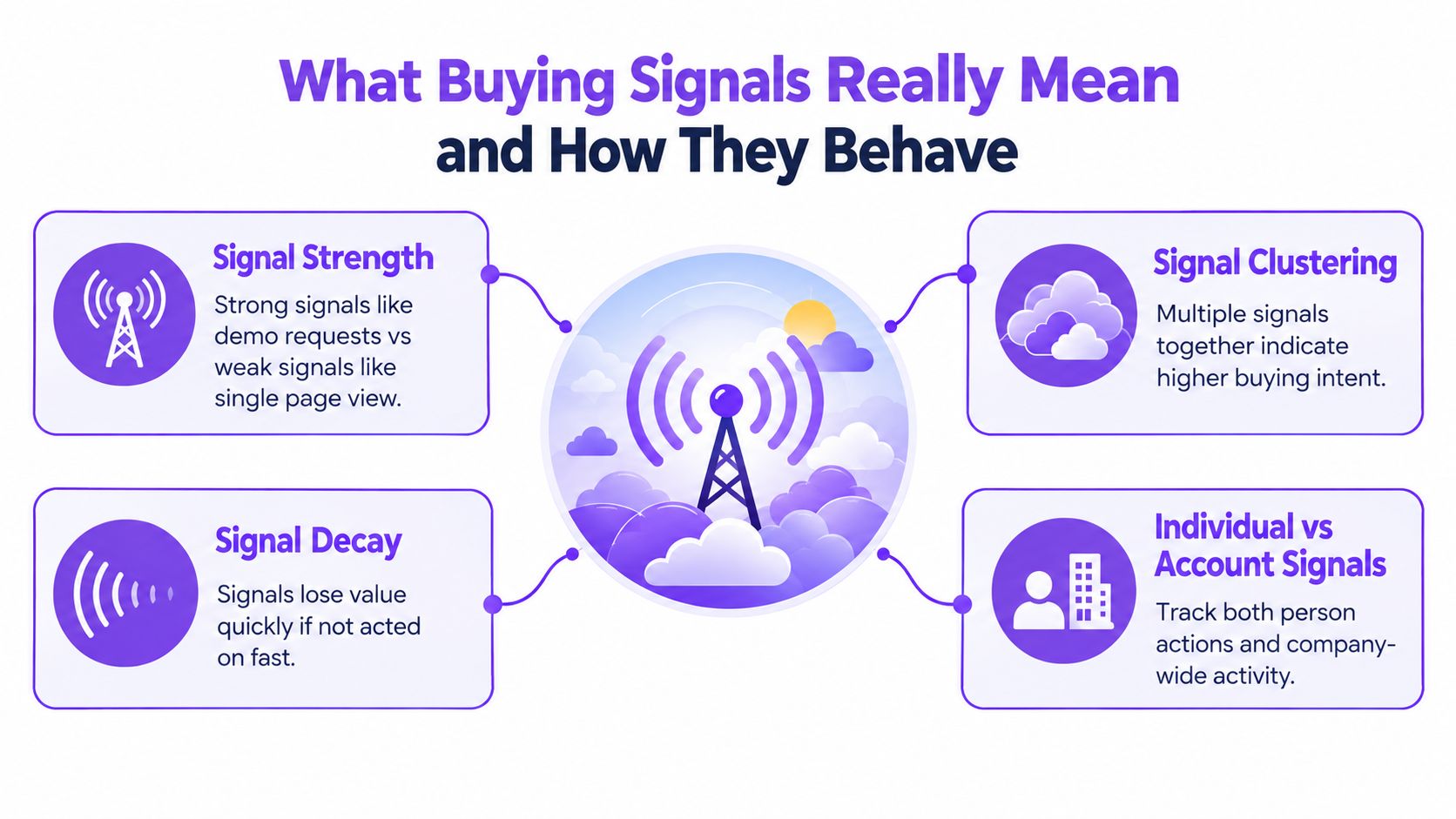
A single signal is like hearing one sound through static. You notice it, but you can’t trust it yet. A cluster of signals is different. It’s like a radio station coming into focus.
That’s the easiest way to understand buying signals in sales. Don’t think of them as isolated events. Think of them as patterns with strength, timing, and context.
Signal strength is about meaning, not activity
A demo request is usually stronger than a homepage visit. A second visit to pricing is stronger than a social click. But signal strength also depends on what else is happening around it.
A single content download might mean casual research. The same download becomes more meaningful when the same account also shows repeat product-page views and a recent leadership change. That’s why simple lead scoring often fails. It counts actions but misses combinations.
If your team also tracks market movement outside your own site, a broader competitive signal monitoring strategy can help separate routine browsing from accounts that are actively changing direction.
Signals cluster before they convert
The strongest intent usually doesn’t sit inside one person. It spreads across people, pages, and channels. Industry guidance notes that behavioral intent is strongest when signals stack across stakeholders and channels, and that multi-stakeholder pricing activity should be acted on within about an hour, while softer actions can follow a same-day or 24-hour rhythm (guidance on timing by signal strength).
That gives you a practical distinction:
- Individual curiosity: One person browses once.
- Account-level intent: Multiple people engage, or one person returns repeatedly across bottom-of-funnel pages.
- Organizational momentum: The account shows web behavior plus an external change, such as hiring, funding, or new leadership.
If you need a primer on the broader category before building your own model, this overview of intent data basics is useful because it separates raw activity from actionable intent.
The mistake isn’t watching for signals. It’s acting on weak signals as if they all mean the same thing.
Signals decay like weather fronts
Signals also expire. A storm system that mattered this morning may have moved by tomorrow. Buying intent behaves the same way. Fresh activity creates urgency. Old activity creates noise.
That’s why you should read every signal through three lenses:
-
Behavior
What did the buyer do? -
Context
Who did it, and what’s happening in the account? -
Timing
How long ago did it happen, and how fast should someone respond?
Once those three lenses are in place, the rest of the system gets much easier to build.
The Complete Catalogue of Buying Signals You Should Track
Track too little. They watch a few website behaviors, maybe a form fill, and then wonder why the pipeline feels unpredictable.
Industry reporting tied to the 6sense benchmark notes that most organizations use only five to six signal types out of 23 surveyed, which means many teams are trying to infer buying readiness from a very small slice of what buyers reveal (reporting on signal-stack breadth).
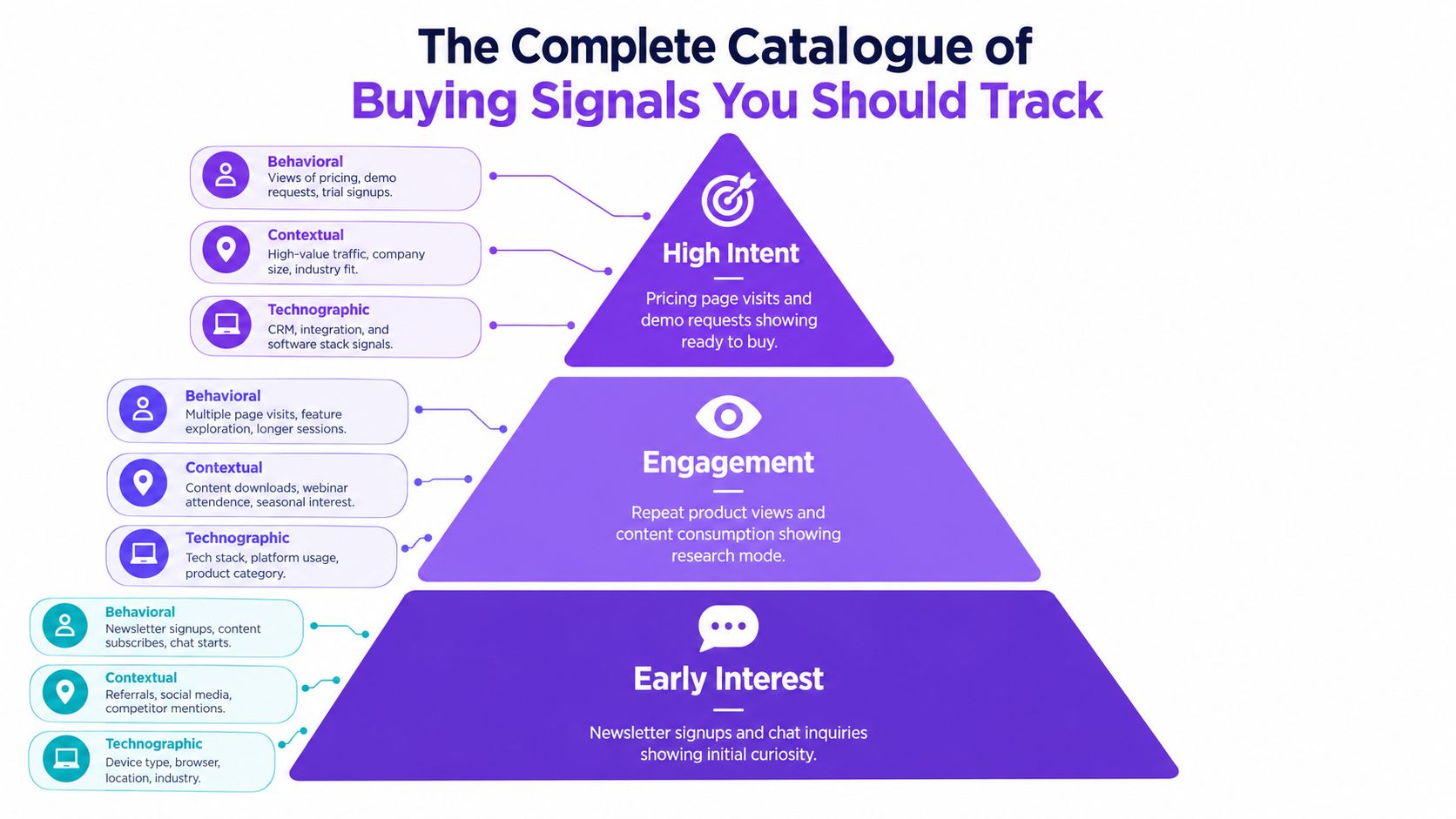
First party behavior signals
These are the signals on your own properties. They’re usually the easiest to capture and the fastest to act on.
-
Pricing-page visits
This is one of the clearest signs that a buyer is moving from learning to evaluating. -
Repeat product-page views
Repetition matters more than a single visit. It often means the buyer is checking fit, not just browsing. -
Content consumption with depth
Product comparisons, implementation content, and customer stories usually mean more than top-of-funnel blog traffic. -
Demo requests and chat interactions
These are explicit signals. They deserve immediate ownership, not a queue. -
Return visits from the same account
One revisit is interesting. Multiple revisits from different people at the same company often signal active internal discussion.
Conversation signals your team already has
Buying signals don’t only live in web analytics. They also show up in what prospects ask and how they ask it.
If you record calls, tools that support transcription and sentiment analysis for calls can help teams review recurring themes such as pricing questions, implementation concerns, or stakeholder hesitation.
Look for cues like:
- Questions about pricing, rollout, or procurement
- Requests for specific integrations
- Mentions of timing or internal review
- Requests to involve another stakeholder
These are often stronger than passive website engagement because they show the buyer is imagining a real purchase process.
Structural signals outside your site
Many teams underinvest. Buying readiness often starts with a company change, not a click.
Recent industry reporting says campaigns with strong buyability signals had a 63% higher likelihood of increased ROI, and a practitioner analysis of 1 million B2B software purchases found stronger correlations for AI tool adoption (+46%), headcount growth (+38%), recent software purchases (+38%), VP-level hires (+28%), and recent funding (+25%) than for job posting increases (+7%) or SOC compliance (0%) (industry reporting on higher-value non-web signals).
That’s a useful corrective. Not all external signals deserve equal weight.
Prioritize these structural changes
-
AI tool adoption
This often points to active process change and a willingness to rework workflows. -
Headcount growth in relevant teams
Growth can indicate budget, urgency, and operational strain. -
Recent software purchases
Companies already changing systems may be more open to adjacent tools. -
VP-level hires
New leaders often evaluate the stack they inherit. -
Funding events
Funding can create a window for new initiatives, especially when paired with on-site engagement.
Deprioritize noisy proxies
- Broad hiring spikes with no role relevance
- Generic compliance activity
- Isolated job postings
- Single-page sessions with no follow-up behavior
A long list of signals doesn’t make a mature program. A well-ranked list does.
The goal isn’t to collect every possible event. It’s to build a signal stack that reflects how your buyers move from curiosity to evaluation.
How to Detect Score and Prioritize Signals Without Guesswork
Most scoring models break because they reward volume instead of urgency. A lead that opened emails over weeks can outrank an account that visited pricing twice this morning, added a second stakeholder, and just hired a new VP.
That’s backwards.
Good buying-signal systems don’t just assign points. They combine signal type, recency, and clustering into a response decision.
Start with response windows, not point totals
A lot of published advice still collapses all signals into one bucket. That misses how buying behavior changes by stage. Recent industry coverage shows that first-party website engagement is often a same-day trigger, while job changes, funding, and project-initiative news usually fit a 3-14 day response window. It also argues that a single pricing-page visit can be less useful than a cluster of weaker but correlated actions (stage-dependent timing guidance).
That’s the shift. Stop asking, “How many points is this worth?” Start asking, “What clock did this start?”
Score at the account level
An individual lead score misses the reality of B2B buying. Committees buy. Stakeholders compare notes. The account, not the person, should be your core unit.
Use a simple logic chain:
- Fresh high-intent behavior outranks old engagement
- Multi-stakeholder activity outranks single-contact activity
- Behavior plus structural change outranks behavior alone
- Weak actions repeated in a tight window can outrank one isolated strong action
The point isn’t mathematical perfection. It’s operational consistency.
Signal Strength and Response Priority Matrix
| Signal Cluster | Strength Level | Recommended Response Window |
|---|---|---|
| Demo request or direct pricing inquiry | Very high | Immediate |
| Repeat pricing-page visits plus product-page returns from one stakeholder | High | Within the hour |
| Multi-stakeholder pricing or product activity from the same account | Very high | About an hour |
| Content consumption plus repeat site engagement | Medium | Same day |
| Job change, funding, or project news with no on-site engagement yet | Medium | Within 3-14 days |
| Broad hiring activity or single low-depth visit | Low | Monitor until another signal appears |
If your team is building automated workflows, this guide to AI lead qualification is useful because it shows how teams can route and prioritize inbound activity without treating every visitor the same.
Operator note: The best matrix is the one reps actually trust. If the routing logic feels arbitrary, they’ll ignore it.
What to avoid in scoring
A few traps show up over and over:
-
Overvaluing vanity activity
Email opens, short visits, and generic blog traffic create motion without meaning. -
Ignoring recency
A strong signal from last week may already be stale. -
Mixing urgency with fit
A perfect-fit account with no live intent still shouldn’t jump the queue over an in-market account. -
Treating all external triggers as equal
As covered earlier, some structural shifts carry more predictive value than others.
A workable model should help a rep answer one practical question fast: who needs action now, and who needs watchful patience?
Trigger Actions That Turn Signals Into Live Conversations
A signal only matters if someone acts on it. That sounds obvious, but many teams still create elegant scoring models that end in a dashboard nobody checks.
The handoff matters more than the score.
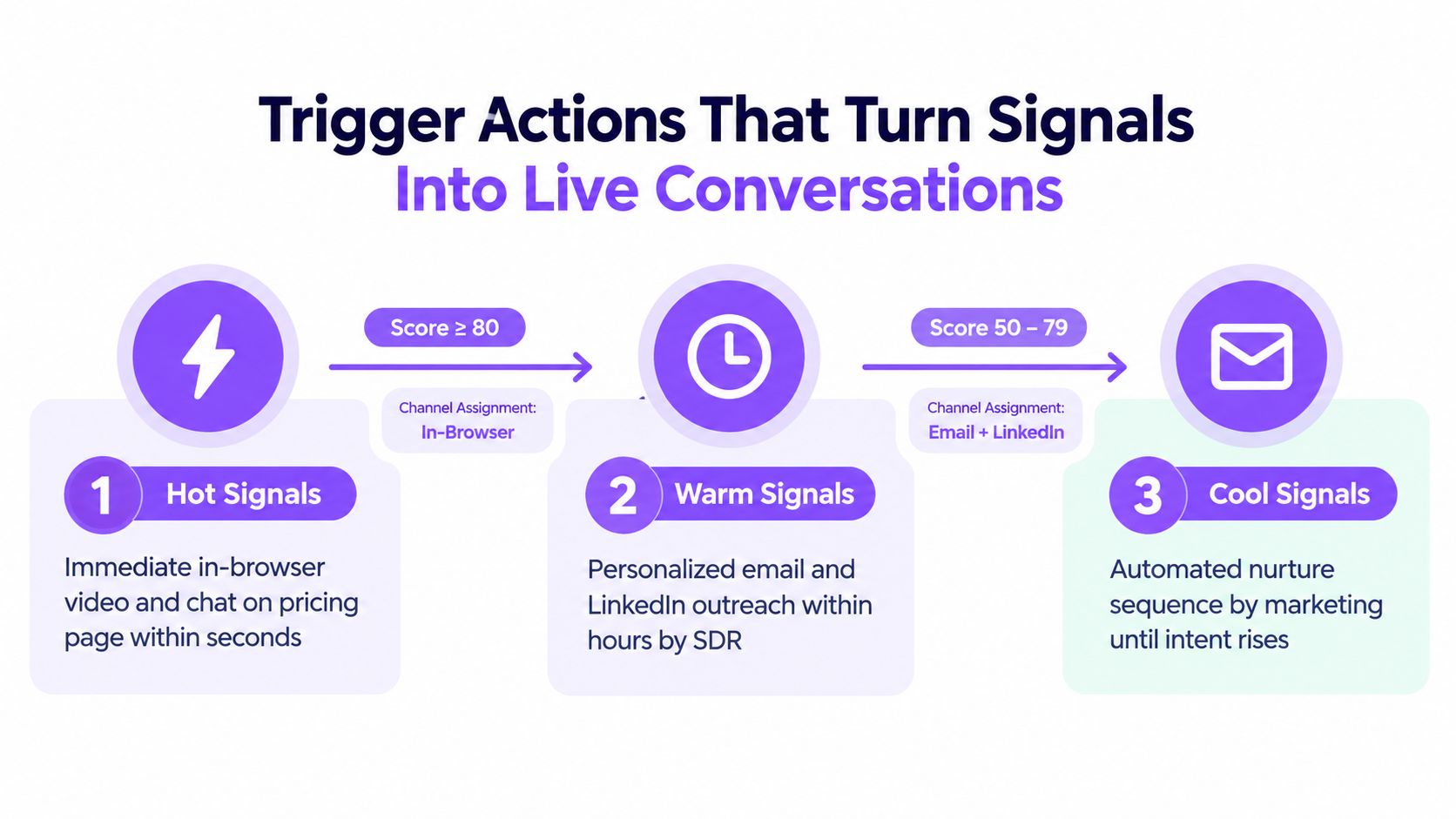
Hot signals need interruption, not nurture
If someone is on pricing, requesting a demo, or showing clustered bottom-of-funnel behavior, don’t route them into a delayed sequence. Give them a chance to talk now.
That can mean:
- In-browser chat on high-intent pages
- Instant meeting offers with calendar sync
- Live video prompts when a visitor hits pricing or product pages
- Immediate SDR or AE alerts in Slack or Microsoft Teams
One option in this category is Captiwate, which uses in-browser video, chat, AI qualification, visitor identification, routing rules, and CRM sync so teams can engage visitors while intent is still active rather than waiting for a form submission.
Warm signals need context-rich outreach
A warm cluster might be repeat product views, content consumption, and a second stakeholder from the same account. That usually calls for same-day SDR action.
The message should reference the signal pattern, not just the account name. “Saw your team looking at pricing” is weaker than “noticed repeat visits to pricing and integrations from your team today.”
A practical workflow looks like this:
- Marketing captures the event cluster
- RevOps routes by account owner and urgency
- SDR sends personalized outreach the same day
- AE gets pulled in if the account replies or returns
Cooler structural signals need account plays
Leadership changes, funding, and initiative news usually deserve a different motion. These are less about instant interception and more about targeted account entry.
Use them for:
- ABM ad and email alignment
- Named-account research and sequencing
- Exec-to-exec outreach when leadership changes
- Customer expansion plays when an existing account restructures
This is also where off-hours coverage matters. If a buyer visits at night or over a weekend, AI qualification and scheduling can keep the momentum alive instead of forcing the account back into an unanswered form queue.
A short walkthrough helps make the difference clear:
Fast action doesn’t mean aggressive action. It means removing the time gap between buyer interest and seller availability.
The best trigger systems are boring in a good way. Everyone knows who owns what. Hot means now. Warm means today. Cool means coordinated follow-up, not neglect.
Real World Use Cases and Metrics That Prove Signal Based Selling Works
Theory gets clearer when you can see the motion.

A 2026 industry benchmark reported that accounts with a single signal closed at 6.2% and averaged 104 days, while accounts with two signals within 30 days closed at 14.7% and averaged 76 days. The same analysis reported that high-strength accounts with three or more signals can produce 15% to 25% signal-to-meeting conversion when teams respond within 24 to 48 hours, and that signals lose 15% to 20% of their predictive value every seven days (buyer identification benchmark figures).
Those numbers support something reps already feel in practice. Clusters beat isolated actions. Speed protects value.
Use case one: pricing-page intent captured while live
An account visits pricing, then returns to product details. A second stakeholder appears later the same day. That’s not a lead-score story. It’s a live-conversation opportunity.
If the team responds while the account is still evaluating, they can turn passive browsing into a booked meeting. If they wait until the next day, the same account may still be “in CRM,” but the moment is gone.
When two people from the same company touch pricing and product pages close together, treat it like a conversation that has already started.
Use case two: ABM routing gets sharper with clustered signals
Named-account teams often struggle with prioritization. Too many target accounts look active if you judge them by surface activity alone.
Cluster logic changes that. A target account that shows repeat engagement plus a meaningful company trigger deserves AE time. Another account with one blog session and broad hiring noise does not. That’s where intent-based account selection becomes much more useful than static tiering. For teams thinking about this from a campaign perspective, this breakdown of intent-based marketing is a good complement to the sales workflow.
Use case three: expansion opportunities inside existing customers
Buying signals in sales aren’t just for net-new pipeline. Existing accounts show intent too.
A customer adds headcount, brings in a new VP, or starts researching adjacent product areas on your site. Those are often the first visible clues that a team is changing shape internally. If customer success and sales share these signals, expansion becomes less reactive and more deliberate.
The common thread across all three cases is simple. The signal itself didn’t create revenue. The cluster created confidence, and the response speed created the opportunity.
Putting Your Buying Signal System Into Action
Monday morning, an SDR sees three alerts from one account. A pricing visit at 9:12. A second product-page session from a different person at 9:26. A demo request at 11:03. If those alerts sit in three different tools, the team treats them like separate events. If they are grouped into one cluster with a response window, the rep knows what to do before lunch.
That is the operating shift. Your system should not collect interesting activity. It should answer four questions fast: what counts as one buying moment, who owns it, how quickly they respond, and when the signal has gone stale.
Start with a 7-day audit. One week is long enough to find patterns and short enough to finish.
Use this simple audit template:
| What to review | Owner | Question to answer | Response window |
|---|---|---|---|
| Pricing page visits, demo requests, return product views | SDR manager | Which actions show live evaluation, not casual research? | Immediate to 1 hour |
| Multi-person activity from the same account | RevOps | What combination counts as one cluster instead of separate alerts? | Immediate to same day |
| Sales-owned target accounts with meaningful activity | AE manager | Which accounts deserve direct outreach today? | Same day |
| Structural changes, such as leadership hires or new tools | Marketing or RevOps | Which triggers should open a planned account play instead of a fast inbound-style follow-up? | 3 to 14 days |
| Closed won and closed lost opportunities from the last quarter | RevOps and sales leadership | Which signal clusters showed up before meetings, pipeline creation, and expansion conversations? | End of the 7-day audit |
The key field to define is the cluster. Without it, teams overreact to noise and underreact to timing.
A practical starting definition is simple: a cluster is two or more meaningful signals from the same account within a short window, with at least one high-intent action. For example, a pricing visit plus a second visitor from the same company on product pages within 24 hours. Or a demo request plus repeat return visits from that account within 7 days. The exact rules will vary by sales cycle, but the job stays the same. Group related behavior into one buying moment your team can act on.
Then set response windows by signal type, not by one generic score:
- Immediate: hand-raise actions and high-intent clusters already tied to an account
- Within 1 hour: repeat evaluation behavior that likely means active comparison
- Same day: target-account clusters that need personalization from an AE or SDR
- Within 3 to 14 days: structural triggers that suggest a planned play, not urgency
This works like triage in an emergency room. A broken arm and a paper cut both matter. They do not get the same response speed.
One more rule helps prevent wasted effort. Deprioritize proxies that look busy but rarely predict conversation on their own. Single blog visits, broad hiring growth with no product interest, and one-off anonymous sessions often create queue clutter. Keep them in the model, but give them little weight until they stack with stronger behavior from the same account.
By the end of the week, your team should have five outputs: a written cluster definition, response windows, clear owners, CRM fields for cluster tracking, and a short list of weak signals to downgrade. That gives reps a system they can trust instead of a stream of disconnected alerts.
Captiwate helps teams act on buying signals while they’re still live by turning high-intent website visits into in-browser video, chat, AI qualification, routing, and booked meetings. If you want a way to connect pricing-page interest and account-level intent to faster sales conversations, visit Captiwate.