A prospect lands on your pricing page, compares two plans, and submits a demo request. The signal is strong, but the form enters a queue that someone reviews later. By the time a salesperson responds, the visitor may have moved to another vendor, returned to a different project, or lost interest.
That gap is the problem AI lead qualification is designed to solve. It doesn’t replace sales judgment. It creates an always-on layer that detects intent, checks fit, makes a priority decision, and starts the right handoff while the prospect is still engaged.
The timing matters. One benchmark summary reports that organizations contacting leads within five minutes see a 21x qualification lift compared with delayed outreach, while qualification rates in the same source fall from 41% within five minutes to 1.9% after 24 hours. Those figures come from a benchmark on AI lead qualification and response timing, and they point to a practical RevOps lesson: scoring has limited value if the workflow doesn’t act quickly.
This guide treats qualification as a real-time revenue routing system, not merely a score attached to a CRM record. You’ll see how the process works, which signals and models matter, how conversational qualification differs from batch scoring, how to connect the workflow to HubSpot and Salesforce, and which scorecard measures quality instead of rewarding lead volume.
Table of Contents
- Introduction Why Speed Decides Whether Leads Convert
- How AI Lead Qualification Actually Works
- Models and Signals That Power Accurate Scoring
- From Rules to Real Time Conversational Qualification
- Integrating AI Qualification With CRM and Engagement Platforms
- Measuring Success KPIs Privacy and Trust
- Putting AI Qualification to Work for Your Pipeline
Introduction Why Speed Decides Whether Leads Convert
A high-intent inbound lead creates a short operating window. The prospect has already done some research, found your site, and chosen to raise a hand. Yet many teams still ask that person to wait for enrichment, manual review, ownership assignment, and a salesperson’s first response.
That sequence creates pipeline leakage even when marketing is generating enough demand. A rep may eventually contact the lead, but the conversation starts after the most useful moment has passed. The issue isn’t only staffing. It’s the absence of a system that can recognize urgency and coordinate the next action immediately.
Why lead response time costs businesses opportunities is a useful way to frame the operational problem. A lead record isn’t the opportunity itself. The opportunity is the live buying context around that record, and context decays when nobody responds.
Qualification has moved closer to the buyer
By 2024, AI lead qualification had become a mainstream B2B marketing and sales practice. One benchmark summary reported that 67% of B2B marketers used AI for lead qualification and scoring, while 91% of marketing-qualified leads met sales criteria when AI handled first-pass qualification. The same summary reported a 73% average increase in qualified leads within six months of implementation and a 78% accuracy rate for AI lead-scoring models in enterprise B2B environments. These figures are provided in AI lead generation benchmarks for 2025.
The important change isn’t that software produces another number. AI can now connect a behavioral event to an operational response. A pricing-page visit can trigger enrichment, a score, an ownership rule, and a live conversation or meeting option without waiting for a daily queue review.
Practical rule: Treat every high-intent event as a routing problem. Ask what should happen next, who owns it, and how quickly the system can complete the handoff.
The rest of the workflow follows from that question. The model should identify likely fit and intent, the orchestration layer should preserve the moment, and RevOps should verify that the resulting conversations become useful pipeline.
How AI Lead Qualification Actually Works
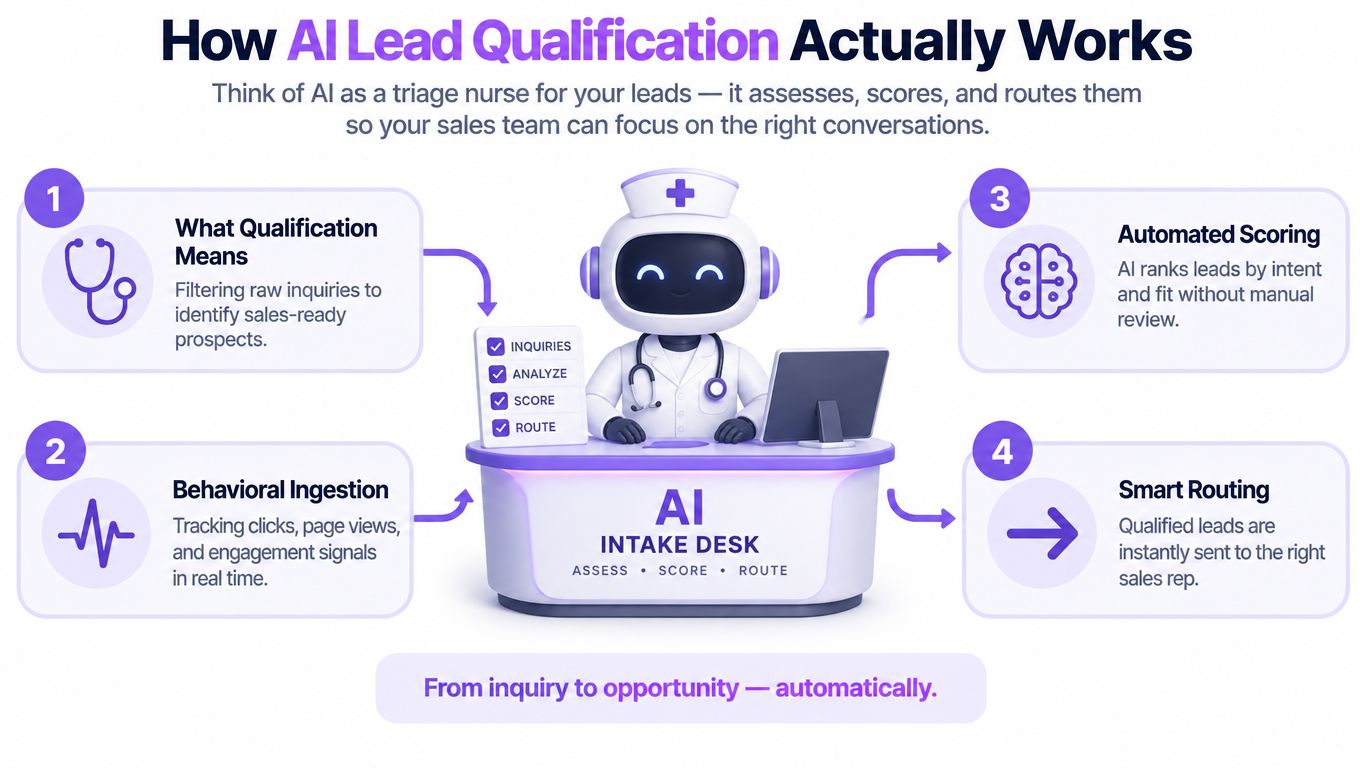
A buyer submits a pricing form while a sales rep is in another meeting. The system has a short window to interpret that activity, choose a response, and preserve the buying moment. AI lead qualification works like a digital triage nurse: it gathers initial information, estimates urgency, and sends each case to an appropriate path. A human still handles discovery, judgment, relationship building, and commercial decisions.
Step one starts with intake
The system collects form responses, website activity, chat messages, campaign interactions, CRM history, and other connected touchpoints. It can combine firmographic signals, such as company type or account segment, with behavioral signals, such as page visits, content engagement, and recency.
Identity resolution keeps these signals attached to the right person and account. An anonymous visitor who later submits a form should not create a second, disconnected decision when the platform can associate the activity with an existing record. Enrichment adds context, but the workflow should distinguish verified fields from inferred attributes.
Step two separates fit from intent
Fit measures how closely an account resembles the target customer profile. Intent reflects whether a person is showing signs of an active problem or buying process. A small company in the right industry may fit well but show little current interest. A visitor returning to a pricing page may show strong intent while falling outside the target segment.
The model combines these dimensions into a priority estimate. Qualification applies the business definition, such as the minimum conditions for sales attention. Routing converts that outcome into an assignment, alert, sequence, chat prompt, or calendar handoff.
These decisions should remain distinct. A high score can still require review, while an account with a lower score may receive priority under an account-based sales rule.
Step three makes the decision useful
Traditional batch scoring evaluates records on a schedule. Real-time inference evaluates new activity as it happens, so the system can respond while the visitor remains active. The useful output is not the score alone. It is a completed route within the operating window your team has set, ideally within minutes rather than after a queue review.
That route may include enrichment, ownership assignment, an AI conversation, a live video prompt, or a scheduling option. For a broader example of the conversational layer, see AI sales assistant workflows.
Step four completes the handoff
A high-priority lead might go to a named rep or a scheduling flow. A lower-priority lead might enter nurturing, while an unsuitable record is suppressed or marked for later review. RevOps should track whether each route produces useful conversations, not whether the model assigns a high score.
The score is one component of a real-time revenue routing system. Model output, response speed, ownership rules, and CRM outcomes must work together. A scorecard in HubSpot or Salesforce can then compare qualification decisions with accepted leads, meetings, opportunities, and later pipeline quality.
Models and Signals That Power Accurate Scoring
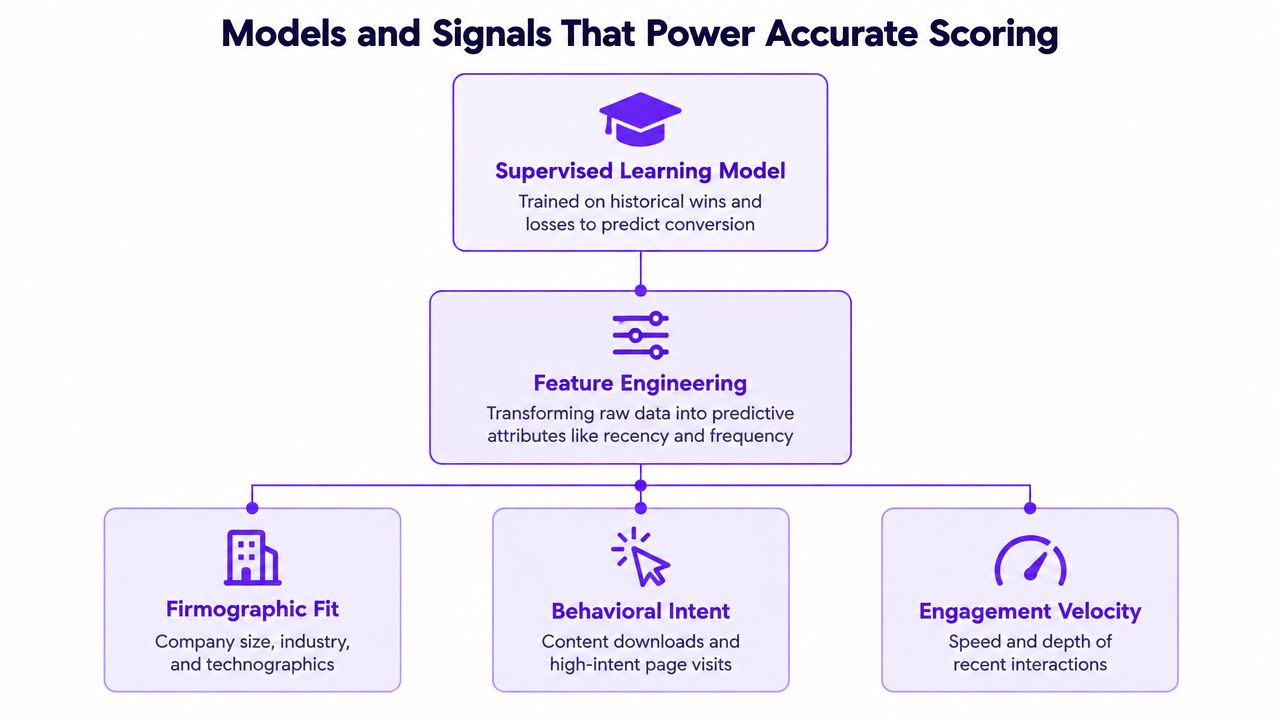
The algorithm gets attention, but training data and feature quality usually matter more than model hype. A scoring system learns from the outcomes your CRM records. If opportunities are inconsistently defined, closed-lost reasons are missing, or marketing and sales use different qualification standards, the model will learn from noisy labels.
A real-lead study using company CRM data from January 2020 through April 2024 tested 15 algorithms and found that a Gradient Boosting Classifier performed best overall, with 98.39% accuracy and a 0.9891 ROC AUC. The related results also reported 0.9586 recall and 0.9106 precision in the study published through the National Library of Medicine. Those results don’t mean every business should expect the same performance. They show why model evaluation must use a relevant dataset and clearly defined outcomes.
Feature engineering turns activity into evidence
Raw events rarely make good predictors by themselves. A single page view says little. A sequence that includes a recent pricing visit, repeated sessions, and interaction with implementation content says more because it captures recency, frequency, and progression.
Useful CRM features can include:
- Lead source: Distinguish channel context rather than treating every inbound record equally.
- Account type: Compare the account with your ideal customer profile and territory rules.
- Interest level: Represent declared needs, product area, or stated urgency.
- Interaction history: Combine prior emails, meetings, conversations, and website activity.
- Engagement velocity: Identify whether activity is increasing quickly or fading over time.
Behavioral signals often deserve careful attention because they show what a person is doing now. Demographic or firmographic data helps establish fit, but it doesn’t always indicate purchase readiness. Teams working on attribution should also learn how to score leads with attribution data, particularly when channel performance influences routing or budget decisions.
Model selection is only half the work
Gradient boosting is useful for structured CRM data because it can capture interactions between features that a simple linear rule might miss. Other classifiers may be easier to explain or maintain. The right choice depends on data volume, label quality, interpretability requirements, and how often the market changes.
Calibration matters as well. A score should support a decision that sales understands, not create false confidence through excessive precision. RevOps teams should inspect which features drive a result, compare predictions with actual outcomes, and adjust thresholds when sales feedback reveals systematic misses.
A model that ranks leads well but routes them badly is still a failed revenue system.
From Rules to Real Time Conversational Qualification
A pricing-page visitor arrives while the sales team is in another meeting. A static rule may wait for a scheduled workflow, and a batch model may not score the record until later. Real-time conversational qualification can ask a focused question, clarify the need, and route the visitor while buying intent is still active.
Each approach solves a different operational problem. Rule-based qualification is transparent and quick to launch, but fixed conditions become brittle as buyer behavior changes. Machine learning recognizes combinations of signals that rules can miss, although scheduled processing can delay action. Conversational qualification adds an interaction layer that gathers context and starts the next step during the session.
The important shift is from scoring records to routing revenue opportunities. A score is useful only when it produces the right response, within the right time, through the right channel. That orchestration may include a qualifying question, a meeting option, an alert to an available rep, or a lower-touch follow-up when human coverage is unavailable.
Choosing your qualification approach
| Approach | Best For | Speed and Coverage | Limitation |
|---|---|---|---|
| Manual or rule-based scoring | Teams with simple criteria and limited inbound complexity | Transparent decisions, but dependent on human review or static triggers | Rules miss nuanced combinations and require ongoing maintenance |
| Batch machine-learning scoring | Organizations with usable CRM history and enough volume for pattern analysis | More adaptive prioritization, but often delayed by scheduled processing | A strong score may arrive after the buying moment |
| Real-time conversational qualification | High-intent inbound teams that need immediate engagement | Continuous coverage, including periods when reps aren’t available | Requires careful prompts, routing logic, governance, and human escalation |
A smaller team can use rules for firmographic disqualification, then apply AI to rank behavior. A larger inbound operation may layer the systems: machine learning ranks records, while conversational AI handles basic questions and escalates qualified visitors.
Set a response target of less than five minutes for high-intent activity, then measure whether routing meets it. The model, prompt, threshold, rep availability, and escalation path should appear together on the RevOps scorecard. That view exposes a common failure: accurate scoring with slow or unsuitable follow-up.
For background on conversational marketing and its interaction model, connect the conversation to a clear business decision. Choose the approach according to inbound volume, sales coverage, deal complexity, privacy requirements, and the cost of delayed response.
Integrating AI Qualification With CRM and Engagement Platforms
An AI score becomes operational only when the data moves through the systems where teams already work. In a HubSpot or Salesforce environment, the workflow should preserve the full path from event to outcome instead of creating a separate AI dashboard that sales rarely opens.
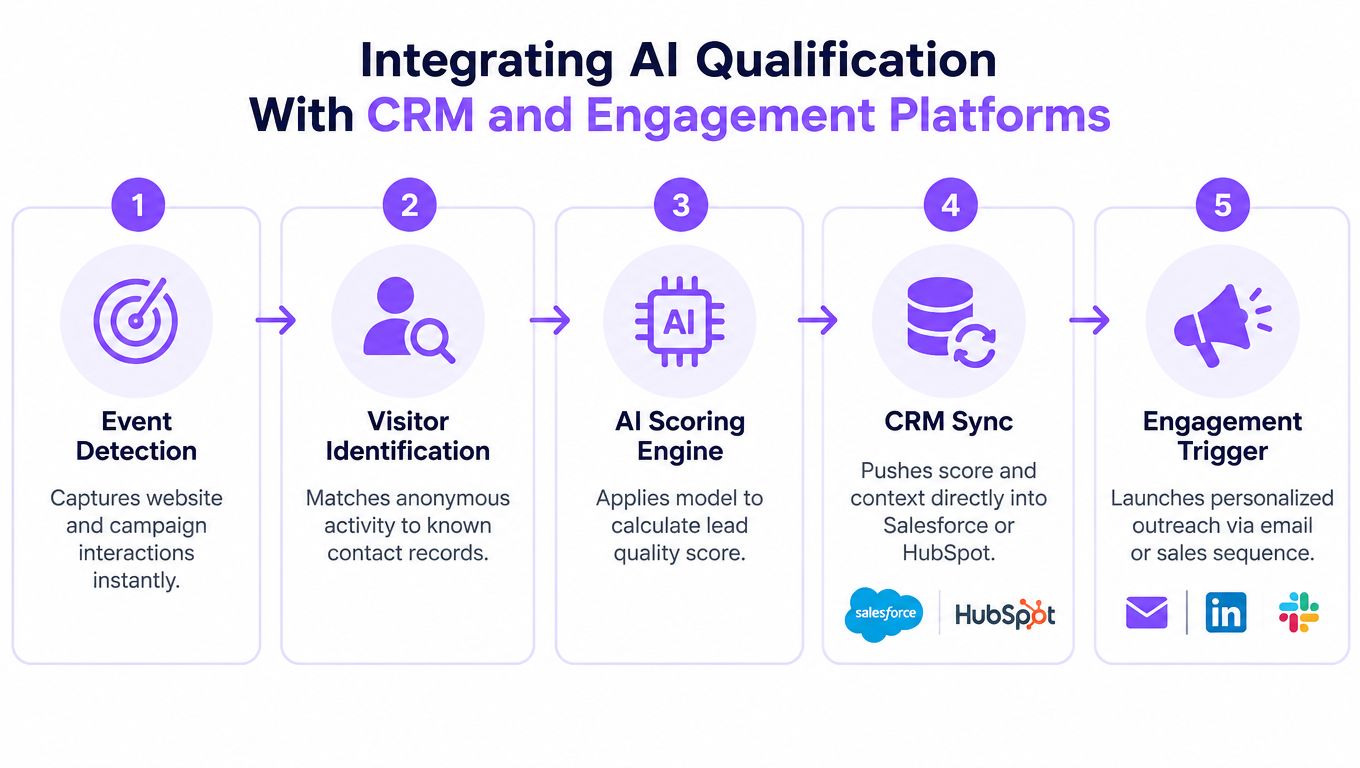
The architecture can be understood as a connected chain:
- Event detection: Capture a meaningful interaction, such as a form submission, pricing-page visit, repeat session, or chat request.
- Visitor identification: Associate the activity with a contact, company, account, or anonymous profile where permitted.
- Enrichment: Add relevant account and contact context, while recording which fields are observed, verified, or inferred.
- Model inference: Calculate fit, intent, priority, and confidence using the available history.
- Decision logic: Apply thresholds, territories, account tiers, rep availability, and escalation rules.
- CRM synchronization: Write the score, reason codes, activity context, and next action to Salesforce or HubSpot.
- Engagement handoff: Trigger chat, live video, email, Slack or Teams notification, sequence enrollment, or calendar scheduling.
Design the handoff before the score
Start with the action. If a lead qualifies, should the system notify the account owner, open a chat invitation, offer a meeting, or create a task with a strict response requirement? If the lead is an existing customer, should the record go to customer success rather than new business sales?
This prevents the common mistake of building a scoring model with no operational destination. Routing rules should be explicit, especially for strategic accounts, regional ownership, partner-sourced leads, and opportunities already in progress.
The orchestration layer also needs reliable timing. The benchmark on response latency describes the strongest qualification window as under five minutes, so model inference, identity resolution, routing, and calendar or chat handoff must complete within that operating window. A fast model won’t preserve conversion opportunity if a CRM workflow waits for a delayed sync.
Keep context intact across tools
Salesforce or HubSpot should receive more than a score. Store the triggering event, important recent activity, account tier, qualification reason, and recommended next action. Alerts in Slack or Microsoft Teams should link back to the CRM record and include enough context for the rep to begin a relevant conversation.
Calendar integration should use current availability, while chat and live engagement tools should respect consent and regional privacy settings. The system should also write the eventual outcome back to the CRM, because closed-won, closed-lost, disqualified, and no-response results become feedback for the next model review.
Measuring Success KPIs Privacy and Trust
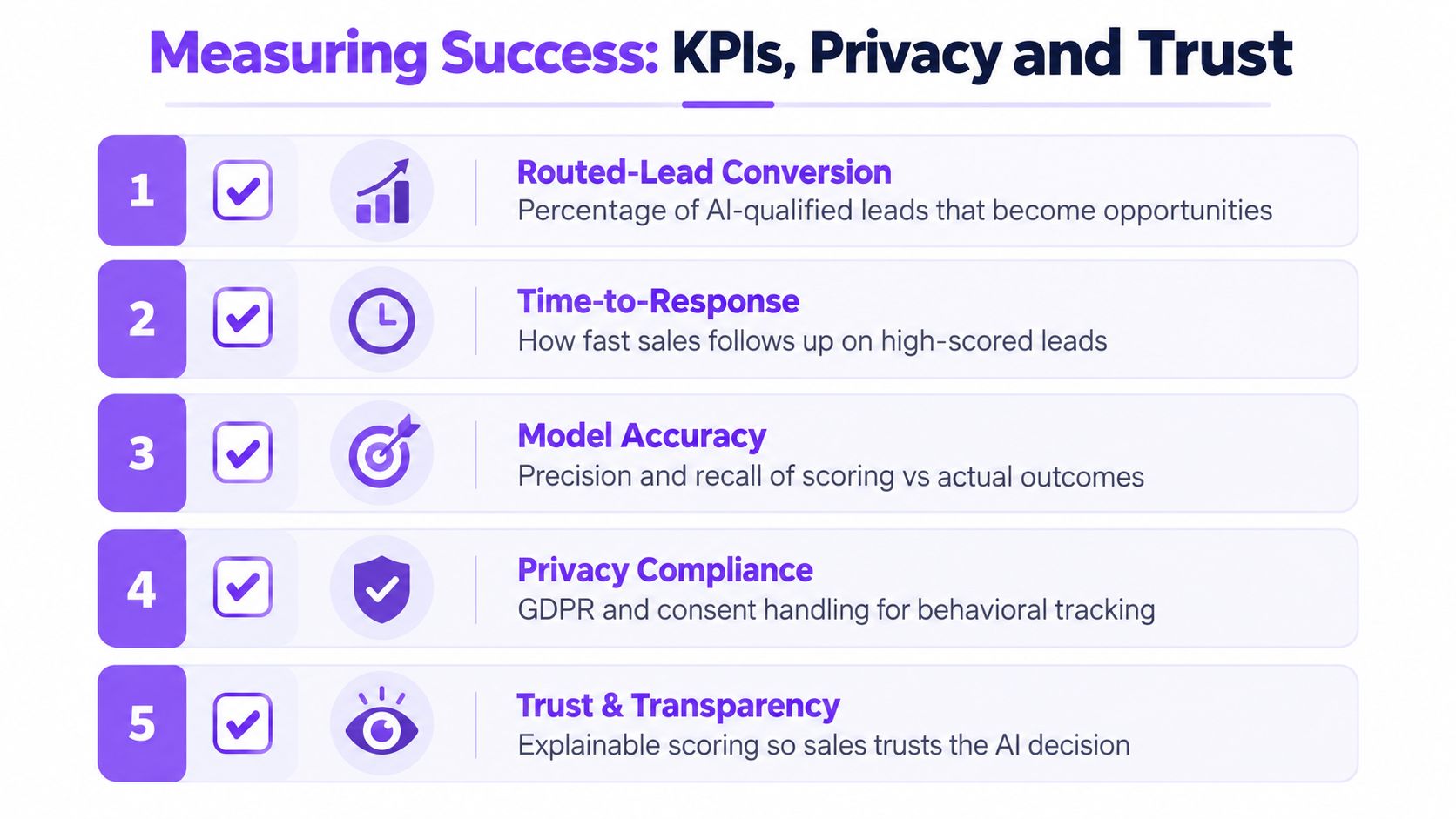
Lead volume is an easy metric to inflate. A qualification workflow can route more records while sending sales more low-fit conversations, increasing activity without improving pipeline. RevOps should evaluate AI qualification as a revenue system, with measures that connect model decisions to downstream outcomes.
The most useful scorecard combines quality, timing, data reliability, and governance:
- Routed-lead conversion: Track how many AI-routed leads become opportunities and later sales outcomes.
- Speed-to-lead SLA: Measure the time from qualifying event to alert, contact, chat, or scheduled handoff.
- False-positive rate: Review how often high-priority leads fail basic fit or intent criteria.
- Enriched-field match rate: Compare enrichment against verified CRM or account information.
- Score calibration: Check whether higher score bands produce stronger outcomes over time.
Separate precision from coverage
A system with high coverage touches many leads. A system with high precision sends the right leads to sales. Neither metric is sufficient alone.
If the false-positive rate rises, SDRs may stop trusting the score and begin checking every record manually. If coverage falls too far, the system may miss valuable accounts that don’t match historical patterns. Review results by source, segment, account tier, and sales motion instead of relying on one blended number.
RevOps test: If the model generates more sales tasks but the opportunity rate doesn’t improve, you’ve automated workload, not qualification.
Privacy is part of qualification quality
Behavioral tracking and identity resolution require clear governance. Teams should define the lawful basis for processing, collect consent where required, document retention rules, and limit data collection to what the workflow needs. GDPR and CCPA considerations should be addressed before activating cross-channel identification or conversational tracking.
Enterprise buyers may also ask about SOC 2 Type II, ISO 27001, SSO, data residency, access controls, and auditability. Those controls don’t prove that a score is accurate, but they help establish whether the system can operate responsibly inside a governed revenue environment.
Transparency supports adoption. Salespeople should be able to see why a lead received priority, which events influenced the decision, and how to correct an incorrect record. Human review remains important for strategic accounts, unusual buying committees, sensitive industries, and cases where the model’s confidence is low.
Putting AI Qualification to Work for Your Pipeline
A practical pilot starts with one clearly defined revenue motion, not every inbound path at once. Choose a high-intent event, agree on what sales-qualified means, and map the exact action that should follow.
Use this implementation checklist:
- Align definitions: Marketing, sales, and RevOps should agree on fit, intent, qualification, opportunity, and disqualification.
- Audit the data: Review CRM fields, lifecycle stages, ownership, outcome labels, and missing activity history.
- Select signals: Begin with observable behavior and account context, then test whether each signal improves prioritization.
- Set the response path: Define alerts, routing, AI conversation, human escalation, and scheduling behavior.
- Pilot with review: Let sales inspect decisions, correct errors, and record outcomes without hiding exceptions.
- Measure downstream quality: Watch routed-lead conversion, response SLA, false positives, enrichment accuracy, and model calibration.
- Iterate thresholds: Adjust routing boundaries as the team learns which scores and signals correspond to useful conversations.
The best operating model keeps people in the loop where judgment carries the most value. AI handles continuous observation, first-pass qualification, and repetitive routing. Reps handle discovery, trust, complex stakeholders, and commercial strategy.
That combination turns inbound demand into a coordinated workflow. The model identifies priority, orchestration protects the moment, the CRM preserves context, and the scorecard proves whether the system is improving pipeline quality.
Captiwate helps B2B teams identify buying intent, qualify visitors through AI chat, and connect high-intent prospects to live video conversations or scheduled meetings. Visit Captiwate to see how its CRM integrations and always-on engagement workflows can support faster, more accountable lead routing.