Most advice on demand generation campaigns starts with the wrong question: how can marketing generate more leads? That question assumes every buyer will identify themselves, complete a form, and enter a nurture sequence. In B2B, many serious buyers do none of those things. They research anonymously, return across multiple sessions, involve colleagues, and reveal intent through behavior long before they request a demo.
The practical advantage goes to teams that treat the website as an active revenue channel rather than a brochure. They identify account-level activity where possible, interpret page behavior, and give sales a way to engage while interest is still visible. Forms and nurture still have a role, but they shouldn’t be the operating system.
Table of Contents
- The Shift From Lead Capture to Account Orchestration
- The Evolution of Signal-Driven Demand Generation
- Blending ABM and PLG for Hidden Buying Committees
- Converting Peak Intent Into Live Conversations
- Operationalizing Intent Across Revenue Teams
- Fixing the Attribution Gap in Demand Creation
- Your Launch Checklist for Real-Time Demand Generation
The Shift From Lead Capture to Account Orchestration
The traditional MQL playbook is attractive because it’s easy to count. A visitor downloads an asset, marketing creates a lead, scoring rules assign a status, and sales receives a notification. The problem is that the process measures the moment a person becomes visible, not the full buying activity taking place inside an account.
A buying group can research a category without filling out a form. One stakeholder may read a comparison page, another may study security documentation, and a third may return to pricing. A contact database sees disconnected interactions, if it sees them at all. An account orchestration motion connects those signals and asks a more useful question: which account is showing enough coordinated interest to deserve action now?
This shift doesn’t mean abandoning lead capture. It means putting forms in their proper place. A valuable technical guide may justify an exchange of information, while a pricing-page visitor may need an immediate conversation instead of another email sequence. Treating both visitors identically creates friction precisely when intent is strongest. Teams reviewing their process can also use this practical guide to avoid B2B demand gen pitfalls, particularly where targeting, follow-up, and measurement break down.
What changes in practice
Account orchestration combines several motions that used to sit in separate systems:
- Account recognition: Connect anonymous activity to a company or target-account segment where privacy rules and available data allow it.
- Behavioral interpretation: Distinguish a casual research visit from repeated engagement with product, pricing, integration, or implementation content.
- Contextual activation: Change the website experience or route an alert based on the visitor’s apparent needs.
- Buying-group coverage: Build engagement across relevant roles instead of treating the first known contact as the whole opportunity.
- Revenue handoff: Give sales the account, page context, timing, and prior conversation details needed for a relevant response.
The central trade-off is control versus reach. Gated assets provide cleaner records, but anonymous engagement often provides a truer picture of early demand. A modern approach should preserve high-value capture points while removing unnecessary barriers from high-intent moments. The argument for this change is laid out well in why lead capture is broken and how to fix it.
Practical rule: Don’t ask a visitor to identify themselves before you’ve earned the interruption. First match the experience to the strength and context of the signal.
The Evolution of Signal-Driven Demand Generation
Demand generation became an operational discipline by making marketing activity repeatable. Industry histories identify the Demand Waterfall, created by SiriusDecisions in 2002, as an influential framework for connecting marketing stages with measurement. Marketing automation platforms launched during the 2006 to 2012 period then helped standardize inbound nurture sequences, gated content, and MQL-based reporting. These developments gave B2B teams a scalable system, but they also encouraged an overreliance on the form fill as the cleanest expression of intent. (Industry history and framework background)
The operating environment has changed. A widely cited 2026 benchmark view reports that 56% of CMOs said their budget couldn’t support their strategy, while 87% of B2B sales and marketing decision-makers said they use intent signals. Yet fewer than half act on those signals, which exposes the difference between buying data and operational readiness. The same findings report that 45% of B2B marketers named ABX as a leading investment priority, 58% used multiple outreach channels, and only 21% coordinated those channels. (2026 demand generation benchmark context)
The implication is direct. Teams can’t afford to collect more disconnected signals and leave them in another dashboard. They need a system that translates behavior into a coordinated action across the website, marketing automation, SDR workflows, and account teams. That requires clear definitions for what counts as meaningful activity, who owns the next move, and how quickly the handoff happens.
From automation to orchestration
Automation sends a predefined message after a predefined event. Orchestration uses the event as context and chooses the next action based on account priority, behavior, role, and timing. Machine learning can support that work by detecting patterns across large volumes of activity, but it shouldn’t replace commercial judgment. A practical introduction to machine learning for marketing helps clarify where predictive systems can assist with prioritization and personalization.
An effective signal stack might combine intent-platform activity, CRM history, paid-media engagement, repeat website visits, and in-browser conversations. The value doesn’t come from any single source. It comes from making those signals available to the person who can act on them while the buying context remains fresh. The broader operating model is described in intent-based marketing, especially its emphasis on activating behavior rather than merely recording it.
The video below provides additional visual context for how a signal-led motion can connect marketing activity with sales action.
Blending ABM and PLG for Hidden Buying Committees
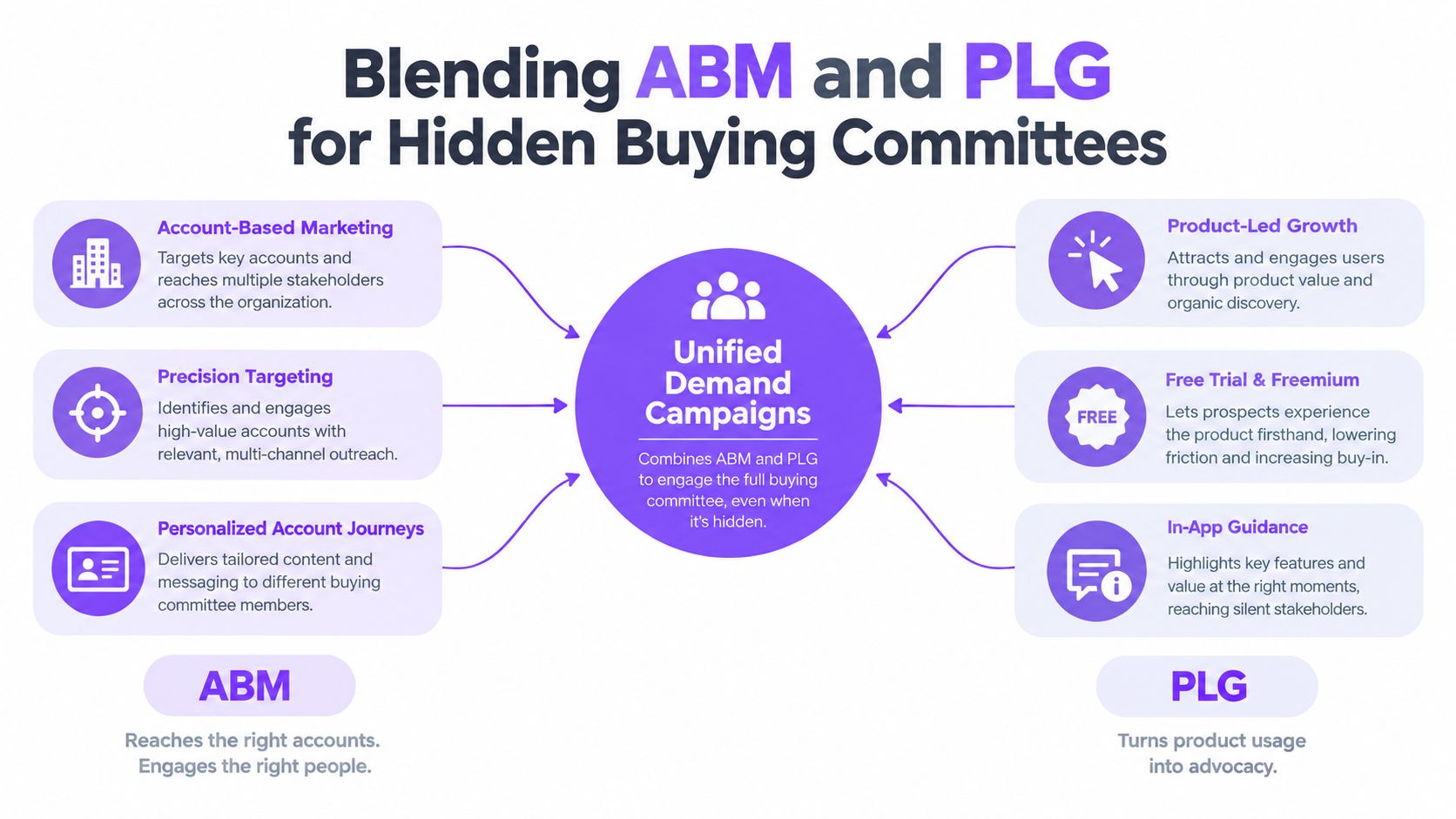
ABM and PLG often appear to compete. ABM starts with named accounts and planned relevance. PLG starts with the user’s experience and lets product engagement reveal interest. For fragmented buying groups, combining them is more useful than choosing one.
ABM supplies the who. PLG supplies the what happens next. The account list defines priority, while the website and product experience respond to the behavior of people who may never appear in the CRM.
Build the motion in four layers
Start with account tiers. Create a small group of high-priority accounts, a broader group that fits the ICP, and a segment that should receive scalable education. The tiers should determine the level of personalization, human coverage, and sales attention. Don’t give every anonymous visitor the same treatment, and don’t force every account into a high-touch sequence.
Map signals to commercial context. A visit to an educational article indicates a different need from repeated engagement with pricing, product comparison, implementation, or integration pages. The page alone isn’t proof of a buying decision, but it gives the team a useful starting point. Combine it with recency, repeat visits, account fit, and activity from other known stakeholders.
Design the experience around the signal. A high-fit account visiting a product page may receive an invitation to speak with an expert or use co-browsing. A visitor exploring educational content may see a relevant guide, webinar, or self-service explanation. PLG works when the experience reduces uncertainty rather than pushing every visitor toward a sales form.
Route the account, not just the person. If several anonymous sessions appear to come from one target account, preserve that context for the account owner. Sales should see the pages and themes attracting attention, along with any known contacts and prior interactions. The handoff should make a conversation more relevant, not merely create another task.
Use intent to decide the level of interruption
High-intent pages deserve a different operating model from broad-reach content. Benchmark guidance places visitor-to-demo conversion at 0.5% to 2.0% overall, while pricing and product pages can reach 3% to 8% when intent is captured at peak interest. (B2B demand generation conversion benchmarks) Those ranges aren’t a promise for every business. They show why page context should influence both the call to action and the response process.
A useful rule is to make the interruption proportional to the evidence. Offer immediate human help when the visitor is evaluating a specific capability. Keep the experience lighter when the visitor is still learning. This approach blends account precision with product-led usefulness, without pretending that every session reveals a complete buying committee.
For teams aligning the account list with sales execution, the operating principles in account-based selling provide a useful commercial counterpart to website-based activation.
Converting Peak Intent Into Live Conversations
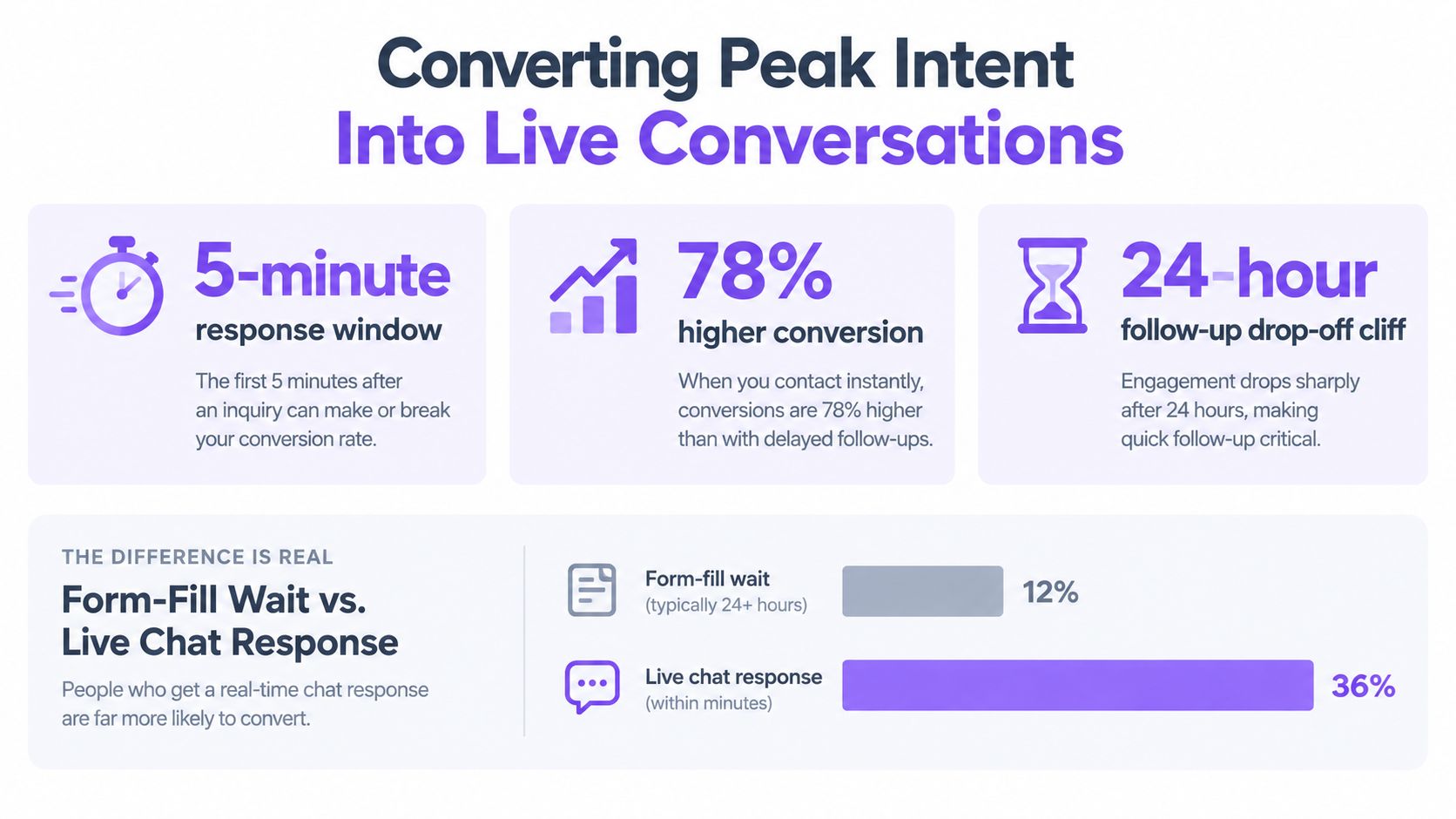
A high-intent website visit has a short commercial half-life. If someone is comparing pricing or evaluating a product capability, a delayed response asks them to restart the process later, possibly with a competitor that made it easier to speak with someone.
Benchmark research places the target for high-intent requests at under five minutes. The same source states that leads contacted in under five minutes qualify at 21 times the rate of leads contacted between one and 24 hours, while other datasets report that many companies still respond in roughly 42 to 47 hours. (Lead response time benchmarks for 2026) The exact performance depends on offer, market, routing quality, and buyer readiness, but the operational lesson is clear: speed is part of conversion design.
Replace waiting with choice
A visitor shouldn’t have to choose between a long form and a calendar several days away. On a high-intent page, give them several low-friction options:
- Live video: Let a ready buyer start a browser-based conversation with an available representative.
- AI chat: Qualify the question, provide an immediate answer, and route the interaction when a human should take over.
- One-click scheduling: Show relevant calendar availability without forcing the visitor through a lengthy qualification process.
- Co-browsing: Let the representative guide the visitor through a product or page without requiring a download.
- Useful fallback: If nobody is available, capture the context and offer a precise scheduling path rather than a generic “contact us” form.
This doesn’t mean every visitor should be pushed into live sales. It means the page should recognize when the cost of delay is higher than the cost of offering help. Human coverage handles the most valuable conversations, while AI maintains continuity outside business hours and gathers the information a representative needs.
Design the trigger carefully
A trigger should combine account fit, behavior, and timing. A single page view rarely justifies an interruption. Repeated visits from an ICP account, interaction with a comparison element, and a return to pricing create a stronger basis for action. Set exclusions for existing customers, active opportunities, employees, support traffic, and visitors who have already declined help.
Response speed isn’t a service-level ornament. It determines whether the buyer speaks with your team while the problem is active or continues researching without you.
Measure the motion by qualified conversations, accepted meetings, opportunity progression, and revenue influence. A chat count can tell you whether the widget is being used, but it can’t tell you whether the experience is producing commercial value. The test is whether sales receives better-timed conversations with enough context to continue the buyer’s journey.
Operationalizing Intent Across Revenue Teams
Intent becomes valuable only when it changes what a revenue team does. A dashboard that shows a target account on the pricing page may be interesting, but it isn’t a workflow. Someone must own the alert, know the acceptable response, and record the outcome where marketing, sales development, and account executives can find it.
Start by defining the handoff contract. Marketing owns signal quality and experience design. SDRs own the first response and qualification. Account executives own opportunity context and progression. Revenue operations owns routing, field mapping, governance, and reporting. These responsibilities should be explicit before automation is switched on.
Connect the systems that already run the business
A practical flow looks like this:
- Detect: Capture company-level activity, page context, known-contact history, and in-browser engagement.
- Score: Apply account tier, behavioral intensity, opportunity status, and exclusions.
- Route: Send the event to the correct SDR or account owner, not to a generic queue.
- Alert: Use Slack or Microsoft Teams for urgent activity, with links to the CRM record and relevant context.
- Record: Sync conversations, meetings, identified accounts, and outcomes into HubSpot or Salesforce.
- Learn: Review accepted meetings, disqualified accounts, opportunity progression, and revenue outcomes to improve the rules.
The alert should answer five questions without requiring research: who is active, which account they belong to, what they viewed, why it matters, and what the rep should do next. “Account visited website” is too vague to support good outreach. “Priority account returned to pricing after reviewing implementation content, with no open opportunity” is actionable.
Protect the buyer experience
Automation can create its own failure mode. Overly aggressive triggers generate repetitive pop-ups, duplicate alerts, and awkward outreach from several reps. Use suppression rules, frequency limits, ownership checks, and clear escalation paths. A visitor who starts a conversation should not receive a separate generic nurture email immediately afterward.
The technical setup should also respect privacy and consent requirements. Company identification is not a license to expose personal browsing behavior indiscriminately. Limit visibility to the teams that need it, document the purpose of each signal, and give visitors appropriate choices.
Revenue teams should review the workflow with real conversation transcripts, not only dashboard totals. The transcript reveals whether the trigger caught a genuine question, a support request, a competitor, or an employee. That feedback is what turns a collection of alerts into a dependable demand generation campaign.
Fixing the Attribution Gap in Demand Creation
Last-click attribution is useful for answering a narrow question: which tracked interaction happened immediately before a conversion? It becomes misleading when teams use that answer to decide which demand creation activities deserve investment.
Google notes that only 40% of conversions from Demand Gen campaigns are captured within the 30-day click and three-day engaged-view windows. A 2025 Fospha analysis cited by Google says last-click can undervalue Demand Gen by an average of 14 times. (Google’s analysis of Demand Gen measurement) These figures don’t prove that every early-funnel campaign works. They show that a narrow attribution window can miss the work that creates future preference and assists later conversion.
A buyer may first encounter a category explanation, return through an executive post, read implementation content, and later arrive directly at pricing. Last click gives most of the credit to the final visit, even though earlier interactions may have shaped the shortlist. If the team cuts the earlier channel because it appears inefficient, it can weaken the conditions that make bottom-funnel conversion possible.
Build a measurement stack, not a single verdict
Use different measurement layers for different decisions:
| Measurement layer | What it helps answer |
|---|---|
| Early engagement | Are priority accounts consuming and returning to relevant content? |
| Account progression | Are more stakeholders engaging, and is the account moving toward active evaluation? |
| Conversation quality | Do website conversations produce qualified questions and useful sales handoffs? |
| Pipeline influence | Which campaigns appear in the journey of created or progressed opportunities? |
| Revenue outcome | Which account motions contribute to closed business and expansion? |
The 2025 6sense survey of more than 600 B2B marketers found that MQLs remain the dominant metric, while closed-won deals and influenced pipeline are tracked less consistently. It also found that multi-touch models often depend on narrow visible interactions, while statistical methods remain underused. (State of B2B marketing metrics in 2025)
Don’t solve this by giving brand every conversion or by declaring every touch equally valuable. Use controlled comparisons where possible, compare account progression against a credible baseline, and connect campaign exposure to opportunity records. The reporting conversation should move from “how many MQLs did this generate?” to “which accounts became more reachable, more engaged, and more commercially active?”
Attribution should improve investment decisions, not create a false sense of precision.
Your Launch Checklist for Real-Time Demand Generation
A signal-driven motion doesn’t require a new operating philosophy every quarter. It requires a narrow first use case, dependable routing, and a measurement plan that sales accepts. Start with one audience and one high-intent journey, then expand after the handoff works in practice.
Establish the foundation
- Choose the commercial objective: Decide whether the first campaign will create category demand, activate named accounts, accelerate active opportunities, or convert high-intent website traffic.
- Define the account tiers: Document the firmographic fit, priority level, excluded accounts, ownership rules, and buying roles that matter.
- Select the pages: Begin with pricing, product, comparison, integration, security, or implementation pages where a visitor is more likely to need an answer.
- Install visitor intelligence: Use a privacy-conscious JavaScript implementation to identify relevant company activity where available and connect it with behavioral context.
- Set the trigger logic: Combine account fit with repeat or meaningful actions. Don’t trigger a sales invitation on a single low-context page view.
The team should write the trigger rules in plain language before building them. If a rep can’t understand why an alert fired, the rule is probably too opaque or too broad.
Make response operational
- Assign a named owner: Route each qualified signal to an SDR, account executive, or customer team based on account status.
- Set the response target: High-intent requests need an agreed response window, coverage plan, and escalation path.
- Offer live and asynchronous paths: Provide browser-based video or chat when someone is available, scheduling when they aren’t, and AI qualification for off-hours coverage.
- Sync the record: Send conversation details, meeting information, account identity, and intent context into the CRM.
- Alert without duplicating work: Use Slack or Microsoft Teams for urgent events, but suppress alerts when an opportunity owner is already engaged.
- Review the transcript: Inspect conversations for false positives, recurring objections, missing content, and routing errors.
A platform such as Captiwate can support this motion with visitor identification, intent detection, in-browser video, AI chat, scheduling, co-browsing, CRM synchronization, and real-time collaboration alerts. Its traffic-based pricing is organized around monthly website visitor volume rather than seats or conversation counts, which is a relevant commercial consideration for teams comparing demand generation infrastructure.
Measure the first operating cycle
Track account engagement, qualified conversations, accepted meetings, opportunity progression, and revenue outcomes. Keep MQLs as a diagnostic measure if the organization still uses them, but don’t let them become the campaign’s definition of success.
Finally, schedule a review with marketing, SDR leadership, sales, and revenue operations. Remove triggers that create noise, strengthen the ones that produce useful conversations, and update the page experience based on buyer questions. A website becomes a pipeline engine through that feedback loop, not through the installation of a widget alone.
Captiwate helps B2B teams turn high-intent website activity into live video conversations, AI-qualified chats, and scheduled meetings, with intent and outcomes connected to the CRM. Visit Captiwate to see how real-time engagement can fit into your ABM or PLG demand generation motion.