Only 25% of marketing-generated leads are sales-ready when they first reach sales, while just 13% of MQLs become SQLs. That means most SDR activity starts with records that aren’t ready for active pursuit, not with genuine opportunities (lead quality benchmark). Learning how to qualify leads in sales isn’t mainly about memorizing BANT questions. It’s about protecting response speed, verifying evidence, and making sure marketing and sales mean the same thing by “qualified.”
Table of Contents
- Why Most Leads Are Not Worth Your Time Yet
- Building a Lead Qualification Workflow That Holds Up
- Choosing Between BANT, MEDDIC, and Intent-Based Scoring
- Speed Is a Qualification Criterion Nobody Talks About
- Qualification Questions and Scripts for Live Conversations
- Fixing the Handoff Between Marketing and Sales
- Your Lead Qualification Checklist to Start This Week
Why Most Leads Are Not Worth Your Time Yet
A lead can be interested without being ready. Someone may download a guide, visit a product page, or submit a form because they’re researching a problem, comparing vendors, or just collecting information. Treating every action as buying intent forces SDRs to spend time proving that a conversation should never have been routed to them.
The funnel makes that waste visible. Only 31% of leads typically become MQLs in B2B, and only 13% of MQLs convert into SQLs (B2B lead quality statistics). Qualification is therefore the bottleneck between demand generation and revenue, not an administrative step after marketing has finished its work.
A qualified lead has enough evidence to justify a sales conversation. That evidence usually combines:
- Account fit: The organization resembles the ICP and can plausibly benefit from the offer.
- Relevant intent: The person or buying group has shown behavior connected to a current problem.
- Usable data: Contact and company details are accurate enough for responsible routing.
- Conversation readiness: The prospect can explain what they’re trying to change, why it matters, or what happens next.
The key distinction is between interest and pursuit. A lead might deserve nurture, monitoring, or a targeted follow-up without deserving an SDR’s immediate calendar time. Teams that skip this distinction chase volume, inflate activity reports, and make pipeline quality harder to judge. A practical explanation of the difference appears in this qualified lead guide.
Practical rule: A lead earns sales attention when fit and intent support each other. Neither one is reliable alone.
Building a Lead Qualification Workflow That Holds Up
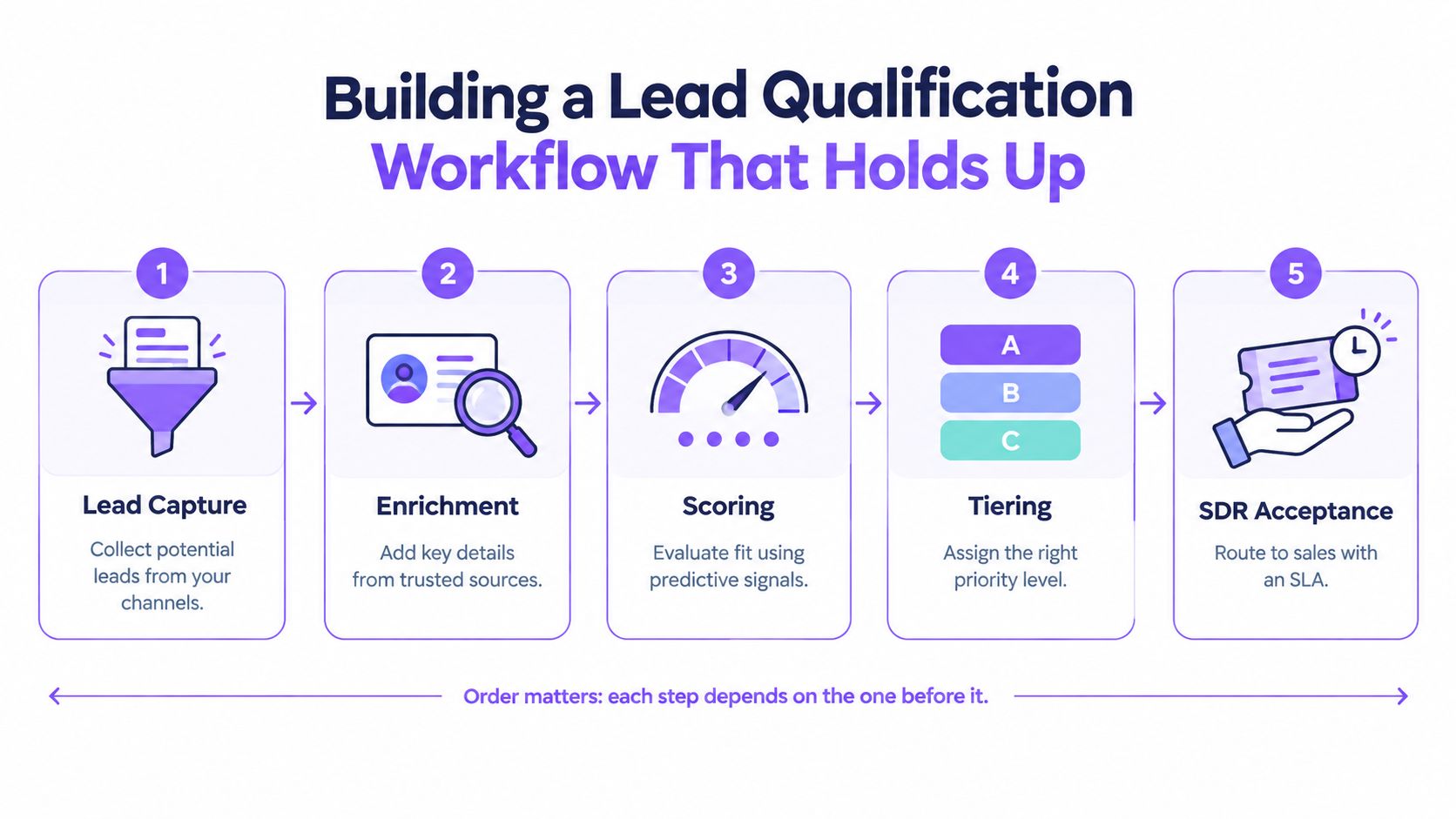
Good qualification is a sequence of gates. If the team changes the order, weak data enters scoring, scoring triggers premature routing, and sales receives records nobody can confidently accept.
Start with capture, then verify the record
1. Capture the lead. Record the source, page or campaign, submitted information, account association, and the action that created the record. A pricing request and a newsletter signup shouldn’t enter the same queue without context.
2. Enrich missing information. Check company identity, role, contactability, and other firmographic fields before routing. Enrichment isn’t cosmetic. It prevents an SDR from spending time on an incomplete record or contacting the wrong person. Teams working across regions can also use this practical overview of lead management for Australian businesses to think through ownership, data flow, and follow-up discipline.
Score evidence instead of rewarding noise
3. Score fit, intent, and data quality together. Fit answers, “Could this account benefit?” Intent asks, “Why might it be looking now?” Data quality asks, “Can we trust what we know?” A large account with no relevant behavior shouldn’t automatically outrank a smaller but highly engaged account, and repeated activity from a poor-fit organization shouldn’t trigger action by itself.
The model should also make negative signals visible. Missing contact data, an unsupported location, a role with no buying influence, or activity unrelated to the product can reduce priority. Keep the rules understandable enough that marketing and sales can challenge individual fields without disputing the entire system.
Tier, route, and accept with reasons
4. Assign a clear disposition. Use practical categories such as top-tier sales review, nurture, or disqualify. Each category needs an entry condition and an owner. “Send to sales” isn’t a disposition. “Top-tier account, verified contact, current product intent, route to inbound SDR” is.
5. Require SDR acceptance. Sales should accept or reject the lead within a defined SLA. For top-tier leads, a 1-business-day SDR acceptance SLA is a practical benchmark from a structured qualification methodology (B2B lead qualification workflow). Acceptance doesn’t mean the lead is already an SQL. It means an SDR has reviewed the evidence and owns the next qualification action.
Every rejection should carry a reason code, such as poor fit, invalid data, no active need, duplicate, or timing mismatch. Reason codes show whether the scoring model is wrong, enrichment is incomplete, or routing rules are sending the wrong cohort. They also stop sales from rejecting leads with free-text comments that nobody can analyze.
The order matters because each step depends on the previous one. Don’t route unverified data, don’t score activity without fit, and don’t label a lead sales-qualified until a conversation confirms the opportunity.
Choosing Between BANT, MEDDIC, and Intent-Based Scoring
No qualification framework is universally correct. The right choice depends on deal complexity, buying-group size, inbound behavior, and how much information a prospect is likely to share early.
| Framework | Best For | Speed | Key Signals |
|---|---|---|---|
| BANT | Transactional or familiar purchases | Fast | Budget, authority, need, timeline |
| MEDDIC | Complex enterprise opportunities | Deliberate | Metrics, economic buyer, decision criteria, decision process, pain, champion, competition |
| Intent-based scoring | Inbound, website, and account-led demand | Fast when connected to live signals | High-intent pages, repeated engagement, buying-group activity, account fit |
BANT works when the buying path is simple
BANT gives an SDR a compact conversational structure. It helps surface whether the prospect has a meaningful need, access to decision-makers, a realistic timeframe, and financial capacity or an approved budget. It works best when the buyer already understands the category and expects a fairly direct purchase.
Its weakness is rigidity. Asking about budget too early can make a capable prospect look unqualified only because the purchase hasn’t been formally planned. BANT should guide discovery, not become a script that blocks useful conversations.
MEDDIC earns its complexity in enterprise sales
MEDDIC is designed for opportunities where several stakeholders influence the outcome. It pushes the team to understand measurable value, the economic buyer, decision criteria, decision process, pain, an internal champion, and competitive alternatives.
That depth improves deal inspection, but it can be excessive for a short inbound conversation. An SDR shouldn’t demand a complete MEDDIC record before confirming whether a real problem exists. For teams selling through technical validation and value-based discovery, this guide to presales in value selling provides useful context on where presales belongs.
Intent-based scoring captures timing
Intent-based scoring prioritizes what the account is doing now. A visit to a pricing or product page, interaction with a buying guide, return visits from several people at one company, or a direct request for help can all add context. The model becomes stronger when it combines those signals with account fit rather than treating behavior as proof of readiness.
This approach reflects a wider shift away from treating the MQL label as the final qualification decision. Recent guidance emphasizes buying-group engagement and intent signals as more useful indicators for fast-moving inbound demand. A concise explanation of the underlying concept is available in this intent data guide.
Use BANT when the sales motion is short and the buyer can answer commercial questions early. Use MEDDIC when deal risk comes from stakeholders, value proof, and internal process. Use intent-based scoring when timing and digital behavior give you better evidence than a form field. In many teams, the practical answer is a hybrid: intent and fit decide priority, BANT supports the first conversation, and MEDDIC appears once the opportunity proves complex enough to justify it.
Speed Is a Qualification Criterion Nobody Talks About
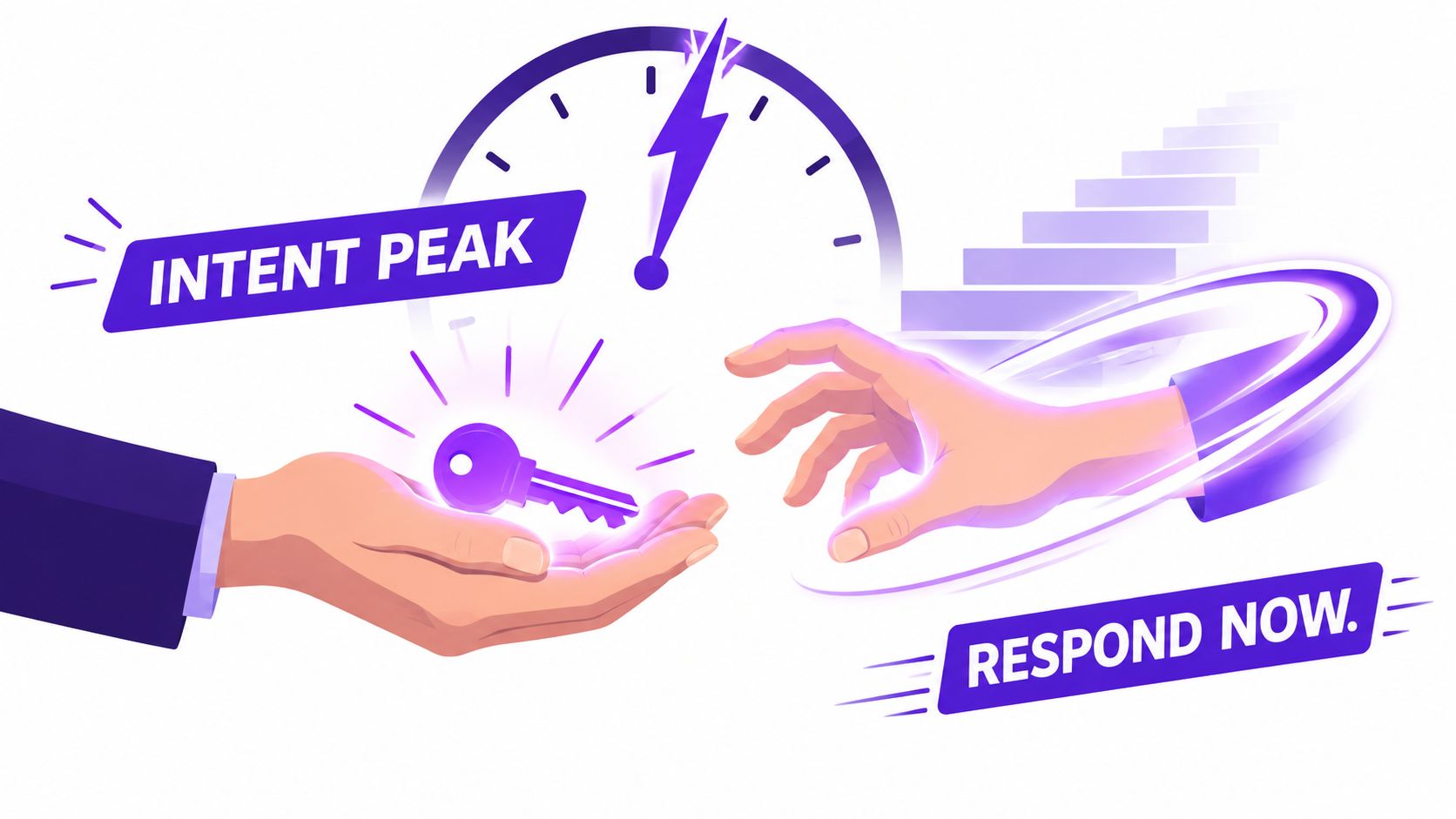
A lead’s value changes while you wait. A person who has just shown purchase intent is easier to engage than the same person contacted much later, even when the account, role, and need haven’t changed.
Industry benchmarks have long associated qualification within 5 minutes with roughly 10 times greater success than waiting longer, with the odds declining further after 10 minutes (sales response-time benchmarks). Response speed belongs inside the qualification definition because delayed contact can turn a live opportunity into a stale record.
Replace form-and-wait with event-driven follow-up
Build routing around moments that indicate active evaluation:
- Pricing behavior: Offer immediate human or AI assistance when a visitor reaches pricing or packaging content.
- Product behavior: Trigger a conversation when someone returns to a product page or explores implementation details.
- Account behavior: Escalate when multiple people from a target company engage with related pages.
- Direct intent: Route demo, contact, and “is this right for us?” requests ahead of lower-intent conversions.
A form still has a place for context and consent, but it shouldn’t be the only path to a conversation. Live in-browser chat, click-to-meet prompts, and co-browsing reduce the gap between the question and the answer.
Speed isn’t a replacement for qualification. It gives qualification a chance to happen before interest fades.
Coverage also needs to extend beyond office hours. AI chat can collect the problem, identify the account, answer basic questions, and route or schedule the next step while an SDR is unavailable. The operating principle is simple: capture intent immediately, then let a human take over when the conversation merits it. Teams reviewing the commercial impact of delay can use this analysis of lead response time.
Qualification Questions and Scripts for Live Conversations
A pricing-page visitor doesn’t need an interrogation. They need a fast answer to the question that brought them there, followed by enough discovery to decide whether a sales conversation is useful.
A natural opener sounds like this:
“I can help you compare the options. Are you evaluating this for a current project, or are you still learning what solutions are available?”
That question surfaces timing without demanding a date. If the visitor says they’re evaluating now, continue with one problem-focused question:
“What are you hoping to improve with a new solution?”
Listen for a concrete outcome, not a polished marketing phrase. Then establish current state:
“How are you handling that today, and what isn’t working well enough?”
Turn BANT into a conversation
Avoid asking “What’s your budget?” as the first commercial question. Try:
- Financial capacity: “Have you already set aside funding for this, or would the team need to make the case internally?”
- Authority: “Who else would want to weigh in before you choose a solution?”
- Timeline: “What would need to happen for this to be in place?”
- Need: “What happens if the current process stays as it is?”
The answers don’t need to fill every CRM field. They need to establish whether there’s a problem worth solving, a reason to act, and a path to the people involved in the decision.
Disqualify without burning the relationship
If the fit is wrong, be direct and useful:
“Based on what you’ve described, we may not be the right fit for this use case. I don’t want to pull you into a sales process that won’t help. Would it be useful if I pointed you toward a different approach?”
If the timing isn’t real, place the lead into a defined nurture path rather than manufacturing urgency. If the prospect is a strong fit, use co-browsing or screen sharing to show the relevant workflow during the same conversation. That move turns qualification into evidence, not another meeting whose only purpose is to repeat what the visitor already told you.
Fixing the Handoff Between Marketing and Sales
Better questions won’t repair a broken handoff. If marketing calls a lead qualified when sales doesn’t accept it, the scoring model may be accurate according to one team’s definition and useless according to the other’s.
One 2026 report cites a 23-point difference between marketing’s average MQL-to-SQL rate and sales’ acceptance rate (MQL versus HQL pipeline research). That gap signals a process problem. Marketing may be measuring progression from an engagement label, while sales is measuring whether the record contains enough evidence to justify active pursuit.
Define stages as observable events
Write the definition together, then make it testable:
- MQL: The lead meets agreed fit and engagement conditions and enters a defined sales review queue.
- SDR accepted: An SDR verifies the record, confirms the routing logic, and commits to a next action.
- SQL: A live conversation confirms a relevant problem, credible intent, and a plausible buying path.
- Rejected or nurtured: The lead leaves the active queue with a reason code and a future action where appropriate.
The exact labels matter less than the evidence attached to them. “Engaged with content” isn’t the same as “asked for implementation guidance.” “Sales accepted” isn’t the same as “sales qualified.”
Make rejection data operational
Review rejected leads by reason, source, segment, and campaign. A high volume of poor-fit records points to targeting or acquisition problems. Accurate-fit records with weak intent point to scoring or nurture design. Strong accounts rejected because nobody could respond quickly point to routing and staffing.
Marketing shouldn’t be judged only on MQL volume, and sales shouldn’t be judged only on acceptance volume. Both teams need shared visibility into accepted leads, rejected leads, conversion by cohort, and the time between intent and first response. That operating agreement does more to improve qualification than adding another discovery question.
Your Lead Qualification Checklist to Start This Week
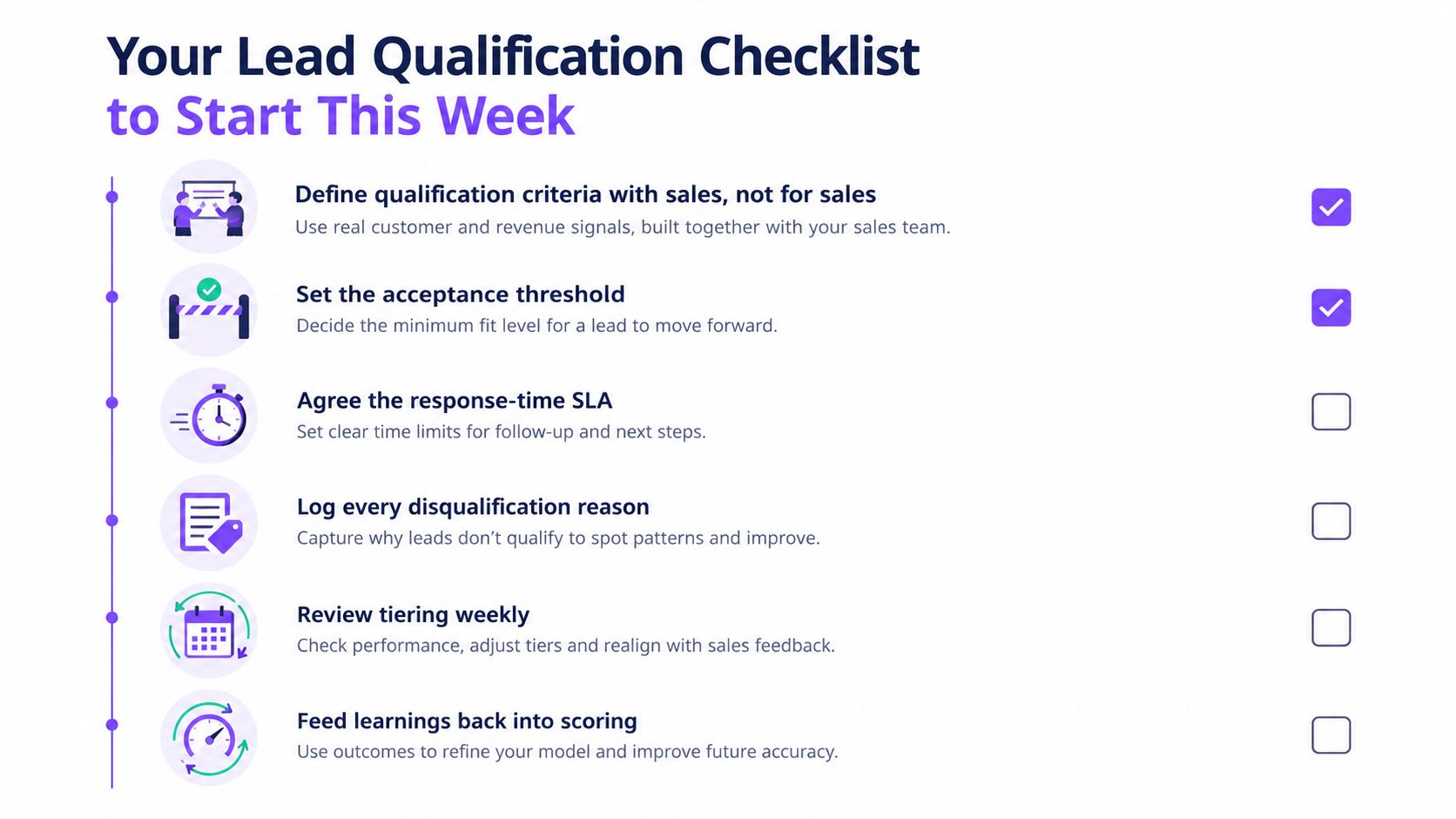
Treat qualification as a small operating system, not a document hidden in enablement software. The following checklist is deliberately practical:
- Define qualification criteria with sales, not for sales: Agree on account fit, acceptable intent, required data, and the evidence needed for acceptance.
- Set the acceptance threshold: Decide what an SDR must verify before accepting a lead and what requires nurture instead.
- Agree the response-time SLA: Set ownership for top-tier leads and measure whether the team meets the agreed window.
- Log every disqualification reason: Use controlled categories so the team can distinguish poor fit, weak intent, bad data, duplication, and timing.
- Review tiering weekly: Check whether high-priority leads produce useful conversations and whether promising accounts are being buried.
- Feed learnings back into scoring: Change weights, routing, and enrichment rules based on reason-coded outcomes, not individual opinions.
Avoid the familiar shortcuts. Routing on gut feel creates inconsistent queues. Skipping enrichment makes sales work from unreliable records. Treating raw activity as intent sends curious researchers to SDRs while serious buyers wait. CRM synchronization, behavioral triggers, and AI chat can support the process, but automation won’t fix definitions that the teams haven’t agreed on.
Start with precision, then expand volume. If you want to turn high-intent website activity into live conversations, Captiwate uses in-browser video, chat, AI qualification, intent detection, routing, and CRM synchronization to connect prospects with sales or schedule the next step. Visit Captiwate to see how it can support a faster, cleaner lead handoff.