A sales intelligence platform isn’t a universal shortcut to more pipeline. One tool may help an SDR find a verified direct dial, another may identify an account researching a topic, and a third may turn an anonymous pricing-page visit into a live sales conversation. Treating those jobs as interchangeable is how teams buy broad feature sets while leaving the core revenue bottleneck untouched.
This shortlist spans prospect data, enrichment, intent prioritization, ABM orchestration, and real-time website conversion. The comparison focuses on dataset fit, signal quality, integrations, implementation burden, ideal buyer, limitations, and the evidence required to defend ROI. It also addresses the operational problem many buying guides underplay, the signal-to-action gap. A signal only creates value when a team can route it, act on it, and connect the resulting conversation to pipeline.
For broader market context, compare this list with top sales intelligence tools for 2026. The Captiwate outcomes mentioned below are supplied examples to evaluate during a demo or pilot, not universal benchmarks or guarantees.
Table of Contents
- 1. Captiwate
- 2. ZoomInfo
- 3. Apollo
- 4. 6sense
- 5. Demandbase
- 6. Clearbit by HubSpot
- 7. Cognism
- 8. Lusha
- 9. Bombora
- 10. LeadIQ
- Top 10 Sales Intelligence Platforms Comparison
- Choose the Signal You Can Operationalize
1. Captiwate
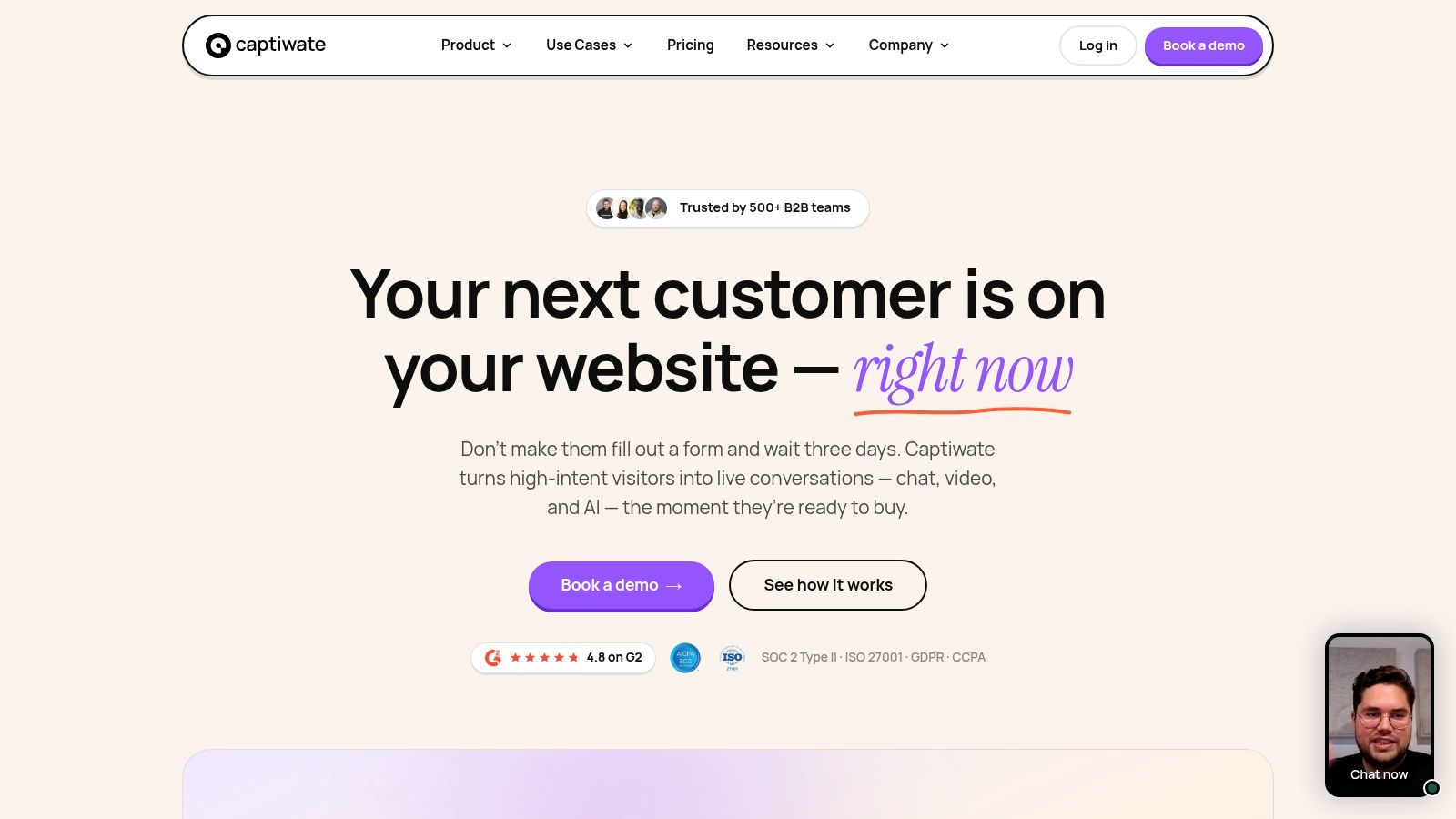
Captiwate is built for a specific revenue moment, the point when a high-intent visitor is already on a B2B website. It combines visitor identification, behavioral intent detection, live in-browser video, chat, AI qualification, routing, and scheduling so teams can respond without forcing a prospect through a form-and-wait process.
The platform can trigger engagement on pages such as pricing, product, and trial pages, then connect a visitor to a rep through a browser-based call. If nobody’s available, AI chat can qualify the visitor, answer initial questions, route the opportunity, or book a meeting. Co-browsing and screen sharing support product walkthroughs without requiring a download.
Captiwate reports examples including 3–5x more demos from the same traffic and speed-to-lead under one minute. Those figures should be tested against your own baseline, traffic mix, rep coverage, and qualification rules rather than treated as a general market benchmark.
Best fit and operational trade-offs
The strongest use case is B2B inbound sales, especially for teams with meaningful website demand, ABM programs, PLG motions, or expensive acquisition traffic. Native CRM synchronization with HubSpot and Salesforce, calendar connections, Slack and Microsoft Teams alerts, and meeting logs help preserve continuity from the first signal to the scheduled conversation.
Captiwate prices on monthly website visitors, with unlimited seats, calls, and chats on every plan. Plans start at $15,000 per year for up to 20,000 monthly visitors, and sites above 100,000 monthly visitors get custom pricing (Captiwate pricing). A high-traffic site should model platform cost against qualified conversations and opportunities created, not against raw visitor volume.
Practical rule: Captiwate works best when a team has a defined routing policy, rep availability, and follow-up playbook. Instant engagement can’t compensate for a delayed or poorly owned handoff.
The implementation case is relatively light, with a single JavaScript snippet designed for same-day deployment. Enterprise buyers can evaluate SOC 2 Type II, ISO 27001, GDPR and CCPA alignment, SSO/SAML, data residency, and SLA options. The main limitation is strategic rather than technical. Captiwate converts existing high-intent demand, so it isn’t a substitute for a large prospect database when the core problem is outbound list creation. Teams comparing website signals with broader identification methods may also benefit from this guide to B2B website visitor identification.
2. ZoomInfo
ZoomInfo is the broad enterprise data suite in this comparison. Its sales motion starts with account and contact discovery, then extends into firmographics, organizational charts, buying-committee mapping, technographics, intent signals, AI-assisted prospecting, and workflow automation.
That breadth suits large go-to-market organizations that need sales, marketing, and operations teams to work from a shared commercial data layer. A sales leader running a territory-based outbound motion can use organizational insights to identify stakeholders, while marketing and RevOps teams can use the same environment for segmentation, governance, and CRM or marketing-automation workflows.
Where the breadth helps
ZoomInfo’s strongest argument is coverage depth for teams that need more than individual contact records. Org charts and buying-committee context can support complex enterprise selling, where one contact rarely represents the whole decision process. Technographic and intent data can also provide a reason to prioritize one account over another, although the team still needs a playbook that translates those signals into outreach.
Pricing is quote-based, and buyers should examine the full commercial structure rather than judging the platform on license cost alone. Renewal terms, add-ons, credits, data refresh expectations, and regional coverage all affect total cost. The supplied comparison notes report mixed feedback about data freshness outside core U.S. regions, so international teams should test records in their actual territories before signing.
Broad data coverage isn’t the same as operational adoption. If reps must leave the CRM, interpret complex scores, and manually create tasks, the suite may produce intelligence without producing action.
ZoomInfo is a fit for enterprise teams with the budget, governance capacity, and RevOps ownership to manage a broad platform. It’s less compelling for a small SDR group that mainly needs fast contact capture or for an inbound team whose biggest loss occurs after an identified website visit.
3. Apollo
Apollo combines prospect data and sales engagement in a self-serve product. Its motion is straightforward: search for contacts, verify relevant details, build a list, and move prospects into sequences, dialing, and AI-assisted research or writing without adding a separate engagement vendor.
That integrated path makes Apollo attractive to SMB and mid-market teams that want fast time-to-value. A small outbound team can use the database and Chrome extension for list building, then activate email and calling workflows in the same environment. CRM integrations and an API extend the product into existing systems, although credit-based usage requires careful planning.
The trade-off is volume management
Apollo’s supplied product information describes a database of 200M+ contacts, with verified emails, phones, and buying-intent topics. That number is a product claim, not proof that every segment has equal coverage. A buyer should sample records by geography, role, seniority, industry, and target account type, then test deliverability and phone usability before extrapolating from database size.
The free tier and transparent pricing reduce the barrier to evaluation. They also make Apollo easier to pilot than quote-only enterprise suites. Heavy usage can require add-ons, so the finance owner should model the credit path for list exports, enrichment, and phone activity rather than using the entry plan as the expected steady-state cost.
Apollo is strongest when the sales motion is high-velocity prospecting followed by standardized outreach. It is not designed primarily to solve real-time website conversion, deep ABM orchestration, or complex buying-group governance. Teams selling into Europe should pay particular attention to the supplied note about reports of lower EU phone accuracy compared with premium European data vendors.
4. 6sense
6sense is designed around predictive account prioritization. Its sales intelligence workflow combines buyer intent, web deanonymization, enrichment, technographic and psychographic signals, predictive scores, dashboards, and seller-facing recommendations.
The best fit is an ABM-oriented organization that already has a defined target-account strategy and wants to decide which accounts deserve immediate attention. Marketing can use account signals for coordinated campaigns, while sales can use predictive scores and Sales Copilot workflows to focus research and outreach.
Predictive prioritization needs a usable action layer
6sense can be powerful for complex enterprise motions because it helps sellers move from a broad named-account list toward accounts showing stronger evidence of active research. Its web visitor identification and account-level signals are especially relevant when a team wants to connect anonymous engagement with an account strategy.
The product uses credits to access or export emails, phones, and enrichment. That mechanic changes the economics of everyday use. Before procurement, define which records need enrichment, which users can access contacts, and which signals should create tasks rather than just appear in a dashboard.
A predictive score is a prioritization input, not a sales action. The buyer should ask exactly what happens after an account crosses the threshold.
The supplied comparison describes 6sense as enterprise-leaning with custom pricing and potentially higher total cost for many buyers. Implementation also requires coordination between marketing, sales, RevOps, and data owners. Teams evaluating the category’s intent capabilities can use this overview of buyer intent data tools, while keeping the evaluation grounded in their own ICP and routing process.
5. Demandbase
Demandbase serves teams running an end-to-end account-based marketing and sales motion. It brings together account intelligence, buying-group insights, advertising, sales prioritization, and measurement, making it broader than a contact-finding tool and more operationally connected than a standalone intent feed.
A mature ABM team can use Demandbase to define target accounts, engage them through advertising, identify in-market activity, and direct sales attention toward accounts that warrant action. That sequence matters because the platform’s value depends on coordination. Marketing must agree on account tiers, sales must accept the prioritization logic, and RevOps must connect activity to CRM stages and opportunity reporting.
The buyer needs a cross-functional operating model
Demandbase’s advantage is the connection between data, advertising, and sales execution. A company with multiple teams influencing enterprise accounts can use one platform to coordinate those motions instead of treating intent as an isolated alert stream. Buying-group insights also support multithreaded selling, where the team needs to understand more than one contact at an account.
The cost structure is described as a platform fee plus per-user fees, with total cost also affected by advertising spend and scale. Smaller teams may find the implementation burden disproportionate if they don’t have enough target-account activity or cross-functional ownership to sustain the program.
Demandbase should be evaluated through account-level outcomes, not individual lead counts. Track whether target accounts progress from engagement to qualified conversations and opportunities, then compare influenced revenue with platform fees, advertising costs, data costs, and the internal effort required to operate the program.
6. Clearbit by HubSpot
Clearbit by HubSpot is best understood as HubSpot-native enrichment and website intelligence, not as a standalone sales intelligence platform. Its role is to enrich company and contact records, expose visiting companies, support segmentation, and trigger workflows inside HubSpot’s Smart CRM and connected Hubs.
That makes the buying decision unusually dependent on the existing stack. A team already using HubSpot can reduce vendor sprawl and avoid building a fragile synchronization layer between an external enrichment vendor and its CRM. Native mappings, overwrite rules, and governance controls also matter when multiple teams depend on the same records.
Integration is the product’s main advantage
Clearbit’s supplied capabilities include enrichment across 100+ B2B attributes, continuous updates, and website visitor or company identification. These attributes can help a marketing or RevOps team segment records and trigger automation, while sales teams can use company visibility to prioritize accounts showing website interest.
The limitation is equally clear. Clearbit is no longer a standalone platform, so its value depends on using and paying for HubSpot. Buyers should also test data freshness in their target markets and understand current pricing or credit mechanics before assuming that native availability means unlimited access.
Clearbit suits a HubSpot-centered inbound and lifecycle motion. It isn’t the natural choice for a Salesforce-first enterprise that needs broad outbound data, nor does it provide the same conversion layer as a real-time website engagement platform. The ROI case should focus on enrichment coverage, routing quality, form reduction, segmentation accuracy, and pipeline created from identified website accounts.
7. Cognism
Cognism is built for teams that need reliable European contact data and a compliance-conscious outbound process. Its signature use case is phone-led prospecting into EMEA, supported by phone-verified mobile numbers, GDPR-focused workflows, intent and enrichment modules, CRM integrations, and a browser extension.
For a sales organization calling into Europe, data suitability matters more than database size. Country coverage, local mobile patterns, consent and compliance processes, and the ability to verify direct dials should be tested with a representative sample of the target market.
A strong regional fit carries a premium
Cognism’s supplied product notes identify its phone-verified EU mobile data, branded as Diamond Data, as a central differentiator. That focus supports SDR teams whose workflow depends on calling prospects directly rather than relying primarily on email sequences.
The platform is quote-only, and the supplied comparison notes that it can cost more than self-serve tools. Seat fees, platform charges, and credit overages may increase total cost, so the evaluation should model the complete calling motion. Ask how many records the team expects to export, which features require credits, and how the platform handles data updates and deletion requests.
Cognism is a better match for a compliance-sensitive EMEA outbound motion than for a small team that wants a lightweight browser extension. It also won’t solve the signal-to-action problem on a prospect’s website. A team can identify and call the right person, but it still needs routing, sequencing, and follow-up discipline to turn data quality into revenue.
8. Lusha
Lusha focuses on accessible contact data and enrichment for teams that want to start quickly. Its workspace and Chrome extension reveal verified emails and direct or mobile numbers, while buying signals and lookalike prospecting help reps expand beyond a single contact.
The product’s self-serve orientation makes it suitable for SMB and mid-market teams that don’t need the governance complexity of a broad enterprise suite. A shared credit balance works across the application, browser extension, and API, which can simplify allocation between reps and technical workflows.
Credit design determines the real cost
Lusha’s permanent free plan and published plan structure make initial testing straightforward. The important procurement question is how the team consumes credits. Phone lookups use more credits than email lookups, so a phone-heavy outbound motion can become more expensive than an email-led workflow even when the headline plan appears affordable.
Advanced governance and API access are reserved for higher tiers. That distinction matters for RevOps teams that need centralized controls, automated enrichment, or system-to-system workflows. A buyer should test not only whether a rep can find a contact, but also whether administrators can manage usage and keep records synchronized.
Lusha is a good fit for lightweight prospect discovery and browser-led enrichment. It is less suitable when the sales motion depends on predictive account scoring, coordinated advertising, or immediate website engagement. Its ROI evidence should include usable contact yield, accepted CRM records, rep time saved, and qualified meetings attributable to contacts sourced through the platform.
9. Bombora
Bombora is a third-party intent data layer rather than a complete prospecting and engagement suite. Its Company Surge signals identify account-level increases in research around selected B2B topics, then deliver that intelligence directly or through partner platforms and integrations.
This makes Bombora useful for teams that already have a CRM, ABM platform, advertising stack, or sales intelligence system and need an additional intent prioritization layer. The platform can help answer which target accounts appear to be researching a relevant topic, but the buyer must supply the rest of the operating model.
Intent quality depends on activation
Bombora’s value comes from topic configuration, account coverage, analytics, and activation. A marketing team can use topic signals to shape audiences or campaigns, while sales can prioritize accounts that fit the ICP and show a meaningful research surge. That distinction is important because intent without ICP fit can just create a larger list of accounts for reps to ignore.
Treat an intent signal as evidence for a sales hypothesis. Require the rep to connect the topic, account fit, contact, and next action.
The supplied comparison describes Bombora as a widely recognized baseline for third-party intent quality, but also notes that it requires clean ICP and topic setup. Costs scale with coverage and delivery, and the product typically isn’t positioned as a starter-priced tool.
Bombora suits a structured ABM or intent-activation motion. It doesn’t provide a complete answer for finding every contact, orchestrating every touch, or converting a live website visitor immediately. Teams wanting a clearer explanation of the underlying category can read what intent data means for B2B sales, then test whether Bombora signals change routing, outreach timing, qualified conversations, or opportunity creation.
10. LeadIQ
LeadIQ targets the SDR workflow at its most tactical. Its Chrome extension lets reps capture contacts from the web and LinkedIn, verify or enrich records, and sync them into Salesforce and other CRM or sales-engagement systems.
That makes LeadIQ a practical fit when the team’s bottleneck is list building and capture speed, not account-level prediction. New SDRs can learn a focused workflow quickly, and team administrators can apply governance controls around credits, exports, and synchronization without introducing a full ABM platform.
Fast capture has a narrower ceiling
LeadIQ’s credit-based model supports email and direct-dial discovery, with published pricing information outlining credit bundles. The key test is whether those credits produce usable records in the exact segments the team sells into. Teams should measure accepted contacts, bounced or invalid records, duplicate creation, and the time between capture and CRM availability.
The supplied comparison positions LeadIQ as lighter and often faster to deploy than a full ABM suite. That is also its limitation. Advanced segmentation and intent capabilities are more limited, and some users report that search filters can feel basic for the price. A team needing predictive prioritization or coordinated account advertising will likely need complementary tools.
LeadIQ is best for SDR-led outbound capture into an existing CRM and sales engagement process. Its ROI case is operational: hours saved per rep, fewer manual copy-and-paste steps, faster list completion, cleaner CRM records, and more qualified contacts entering sequences. It shouldn’t be credited with revenue unless the team can connect captured records to conversations, opportunities, and closed business.
Top 10 Sales Intelligence Platforms Comparison
| Product | Key features | Quality & outcomes (★) | Value & pricing (💰) | Target audience (👥) | Unique differentiator (✨) |
|---|---|---|---|---|---|
| 🏆 Captiwate | In-browser live video, AI chat, intent detection, co-browsing, scheduling, native CRM sync | ★★★★★, 3–5x demos; <1 min speed‑to‑lead; 4.8 G2 | 💰 Traffic‑based (unlimited seats/calls); from $15,000/yr | 👥 B2B inbound, SDRs, RevOps, ABM/PLG marketers | ✨ Instant in‑browser video + single JS snippet; 24/7 AI capture; SOC2/ISO |
| ZoomInfo | US-centric firmographics, org charts, intent, Copilot | ★★★★, deep US coverage & enrichment | 💰 Quote‑based; reported higher TCO | 👥 Enterprise sales & marketing teams | ✨ Extensive org charts & buying‑committee mapping |
| Apollo | 200M+ contacts, sequences, dialer, AI writing, Chrome ext | ★★★, fast time‑to‑value for SMBs | 💰 Transparent self‑serve pricing; free tier; credit model | 👥 SMB / mid‑market GTM teams | ✨ All‑in‑one data + engagement with free tier |
| 6sense | Predictive AI scores, web deanonymization, account prioritization | ★★★★, strong predictive/account scoring | 💰 Enterprise pricing; credit system for exports | 👥 ABM‑oriented sales & marketing | ✨ Predictive intent + account prioritization dashboards |
| Demandbase | Account intelligence, buying‑group insights, advertising & sales tools | ★★★★, end‑to‑end ABM motions | 💰 Platform fee + per‑user; custom pricing depending on scale | 👥 ABM teams running ads → sales motions | ✨ Unified ads + account data for ABM campaigns |
| Clearbit (HubSpot) | Enrichment, website visitor ID, HubSpot native automations | ★★★, seamless HubSpot UX for users | 💰 Included/paid via HubSpot tiers; depends on HubSpot spend | 👥 HubSpot customers & marketers | ✨ Native HubSpot governance, mappings & automations |
| Cognism | GDPR‑forward enrichment, phone‑verified EU mobile data | ★★★★, noted EU phone quality & compliance | 💰 Quote‑only; higher cost for enterprise features | 👥 Teams targeting EMEA / regulated markets | ✨ Diamond Data (phone‑verified EU mobiles) & GDPR posture |
| Lusha | Contact lookup/enrichment, Chrome ext, single credit balance | ★★★, simple, self‑serve prospecting | 💰 Transparent plans + permanent free tier; credits apply | 👥 SDRs & small sales teams | ✨ Permanent free plan + shared credits across channels |
| Bombora | Company Surge intent signals across thousands of topics | ★★★★, recognized third‑party intent baseline | 💰 Custom pricing; scales with coverage & delivery | 👥 ABM and intent‑driven marketing teams | ✨ Publisher co‑op Company Surge intent feed |
| LeadIQ | Chrome extension capture, verification, sync to CRM | ★★★, speeds SDR capture → CRM flow | 💰 Published credit bundles; team pricing | 👥 SDRs and prospecting teams | ✨ One‑click capture + governance controls for lists |
Choose the Signal You Can Operationalize
There isn’t a universal winner among these sales intelligence platforms because they solve different gaps in the revenue motion. The market’s growth confirms that the category has become established infrastructure. One estimate places it at USD 4.99 billion in 2026, with a projection of USD 9.15 billion by 2031 and a 12.89% CAGR from 2026 to 2031. The same market view identifies North America as the largest region and Asia Pacific as the fastest-growing, which suggests that demand is mature in North America while adoption is expanding across APAC markets. See the sales intelligence market estimate for the underlying methodology and definitions.
That expansion doesn’t mean every team needs the broadest suite. Independent benchmark data reports that 67% of B2B sales teams use sales intelligence tools daily, enterprise adoption is 71%, 48% use AI-enhanced sales intelligence, cloud deployment represents over 70% of implementations, and 69% integrate these tools with marketing automation systems. Those figures point to buyer expectations around cloud delivery, CRM and marketing connectivity, and AI assistance, but adoption alone doesn’t prove commercial value. The B2B market intelligence benchmark is useful context, not a substitute for testing your workflow.
Use the job-to-be-done as the first filter:
- Choose ZoomInfo or Cognism when data depth, regional coverage, governance, and enterprise outbound execution matter most. ZoomInfo is the broader suite, while Cognism is especially relevant to EMEA phone-led motions.
- Choose Apollo, Lusha, or LeadIQ when the team needs self-serve prospecting and fast capture. Apollo combines data with engagement, Lusha emphasizes accessible enrichment, and LeadIQ focuses on capture-to-CRM speed.
- Choose 6sense or Demandbase when predictive ABM is the operating model. These platforms make more sense when marketing and sales already share target accounts, routing rules, and measurement ownership.
- Choose Clearbit by HubSpot when HubSpot is already the system of record and enrichment or visitor identification should remain native.
- Choose Bombora when you need a third-party intent layer that can activate through an existing ABM, CRM, advertising, or sales stack.
- Choose Captiwate when high-intent website sessions are reaching pricing, product, or trial pages but aren’t becoming conversations quickly enough.
A defensible evaluation starts with one target segment, not a generic database demo. Test contact coverage and accuracy in the territories you sell into, validate whether the signals are relevant to your ICP, and document what happens after a signal appears. Does it create a task, trigger routing, alert a rep, start AI qualification, book a meeting, or just add another dashboard for someone to check?
Implementation effort belongs in the business case. Include CRM mapping, deduplication, permissions, routing logic, rep training, data governance, and ongoing administration. The signal-to-action gap is the central risk: a platform can identify who may be interested without helping your team act at the right speed. One industry source cited in the brief reports that about 70% of sales intelligence tools end up unused, so adoption and workflow design deserve the same scrutiny as database size. Review the analysis of the signal-to-action gap without treating its operational estimate as a universal benchmark.
Finally, define the evidence before purchase. Measure qualified conversations, meetings booked, opportunity creation, speed-to-lead, conversion rate, and revenue influenced. Compare those results with total platform cost, including seats, credits, advertising, integrations, implementation, and internal administration. The right sales intelligence platform is the one that produces a traceable next action for your sales motion, then lets you prove whether that action created economic value.
Captiwate helps B2B teams identify high-intent website visitors and convert them through in-browser video, chat, AI qualification, routing, and calendar booking. If your biggest gap is the distance between a pricing-page signal and a live sales conversation, visit Captiwate to evaluate how it can fit your CRM and inbound sales workflow.