Your team is probably staring at the wrong number.
Pipeline is soft. Demo volume looks uneven. Sales says the leads are weak. Marketing says follow-up is slow. RevOps gets dragged into another Slack thread where everyone debates definitions and nobody fixes the handoff that broke.
That’s the problem with lead to conversion in B2B. Teams treat it like one funnel with one owner and one cure. It isn’t. It’s a chain of handoffs between pages, forms, bots, queues, calendars, SDRs, AEs, and CRM stages. Every handoff can either preserve buyer intent or kill it.
If you want better lead to conversion, stop asking for a bigger top of funnel and start auditing the moments where momentum gets dropped.
Table of Contents
- The 9 - 47 PM Buyer and the Conversion Chain
- Stages of the Lead to Conversion Path
- Why Speed to Lead Is the Strongest Lever
- Form Friction and the Hidden Leak at the Top
- Live Video, Chat, AI, and Scheduling Compared
- Differentiated SLAs by Intent Tier
- Metrics That Actually Tell You Where the Funnel Breaks
- A 90 Day Plan to Lift Lead to Conversion
The 9 - 47 PM Buyer and the Conversion Chain
At 9:47 PM on a Tuesday, a VP of Ops lands on your pricing page after reading a competitor comparison post. They’re not browsing for fun. They’re evaluating vendors after a late meeting because the current workflow is breaking and somebody on their team is pushing for change this quarter.
They hit your CTA and get a form with too many fields. Company name, job title, team size, phone number, country, use case, consent box. They complete it anyway because the need is real.
Then your systems take over.
Marketing automation sends a generic thank-you email. It promises someone will be in touch. No meeting link. No live option. No fast path. Overnight, the buyer keeps comparing options.
At 10:14 AM the next morning, a BDR sees the MQL alert inside Salesforce. They’re already working a call block from an event list. They send an email, maybe make a call, maybe not. By then the buyer has sat through another internal conversation, looked at two competitors, and booked a demo elsewhere at 11:00 AM because that vendor made it easy.
Your team didn’t lose because nobody worked hard. You lost because the conversion chain broke in multiple places.
What actually failed
- The response window failed. The buyer showed intent at night, and your team answered the next day.
- The form failed. You asked for qualification data before earning the conversation.
- The routing failed. A pricing-page visitor got treated like a generic content lead.
- The meeting handoff failed. Interest existed, but there was no direct path to a booked conversation.
Buyers don’t experience your org chart. They experience delay, friction, and confusion.
That’s how lead to conversion works. Not as a smooth funnel slide. As a sequence of handoffs where each team owns a different failure mode.
Stages of the Lead to Conversion Path
Many teams name stages. Few teams define handoffs. That’s why reporting gets messy and ownership gets political.
If you want clean lead to conversion management, each stage needs three things: an entry trigger, an exit trigger, and one owner. Without that, your CRM is just a diary of opinions.
The five stages that matter
The first stage is Anonymous Visitor. Someone hits the site. They haven’t raised a hand yet. Marketing ops owns the experience because this stage is about page intent, form design, chat prompts, and tracking. The handoff works only when that visitor does something meaningful, such as opening chat or submitting a form.
Next comes MQL. The lead has crossed your internal threshold for sales attention. Many teams get sloppy. They celebrate volume instead of acceptance. A lead is not useful because marketing named it. It’s useful when sales agrees it deserves work.
Then you have Accepted Lead. Now the SDR or BDR is actively working it. This stage exists for one reason: to prove whether the lead got real human follow-up and moved toward a meeting or opportunity. If this stage is fuzzy, SDR productivity gets inflated and true conversion gets buried.
Qualified Opportunity comes after a real discovery moment, not just a calendar invite. Someone confirmed pain, fit, and an active buying motion. AE owns it now.
Finally, Closed-Won. Contract signed. Account team takes over.
The handoffs that fail most often
The two ugliest breaks are usually these:
-
MQL to Accepted Lead
- Marketing says the lead is ready.
- Sales ignores it, rejects it, or touches it too late.
- The proof metric is acceptance, not MQL count.
-
Accepted Lead to Qualified Opportunity
- SDR logs activity.
- Meeting doesn’t get booked, held, or qualified.
- The proof metric is qualified meeting progression, not call volume.
For teams also running outbound alongside inbound, adjacent systems matter too. If your outbound engine has weak cold email deliverability, you create a reporting mess where inbound looks worse because reps mix channels and touch patterns without reliable reach.
The Five Stages and Their Handoff Proof
| Stage | Entry Trigger | Exit Trigger | Owner | Handoff Proof Metric |
|---|---|---|---|---|
| Anonymous Visitor | Session hit on site | Form submit or chat open | Marketing ops | Visitor becomes identifiable or starts a conversation |
| MQL | Lead meets internal qualification threshold | SDR or BDR accepts lead | Marketing, then SDR | MQL acceptance rate |
| Accepted Lead | Rep actively works the lead | Opportunity is created or discovery is booked and confirmed internally | SDR or BDR, then AE | Accepted lead to qualified meeting progression |
| Qualified Opportunity | Discovery booked and pain confirmed | Demo completed | AE | Demo completion after qualification |
| Closed-Won | Contract process begins after sales cycle completion | Signed agreement | Account team | Closed-won rate from qualified opportunity |
Practical rule: If a stage has no proof metric, it isn’t a stage. It’s a bucket.
Why Speed to Lead Is the Strongest Lever
This is the part people oversimplify, but the core point is still right. Response speed changes outcomes fast.
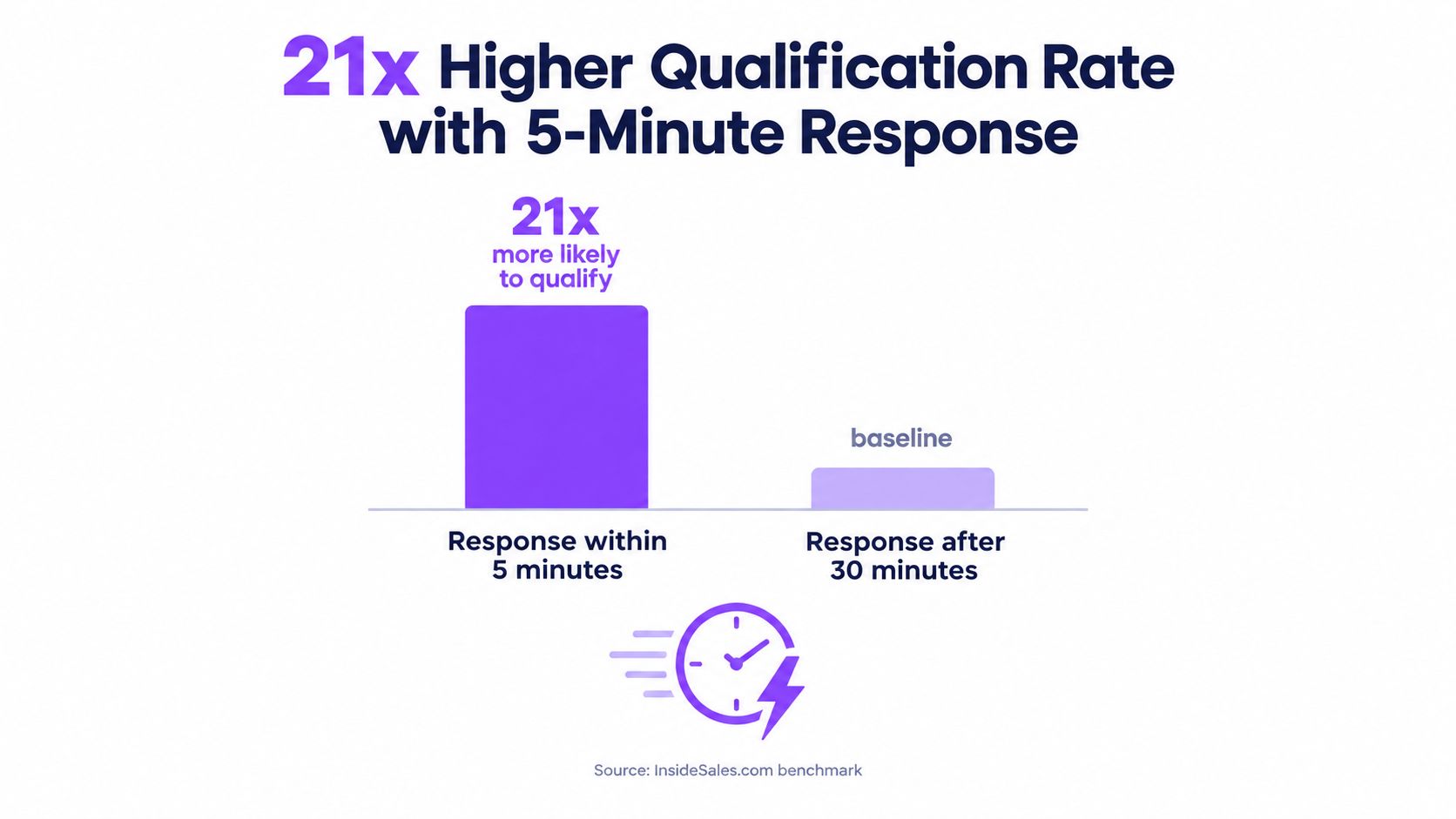
A widely cited benchmark summarized by Artemis GTM’s speed-to-lead research reported roughly 21% conversion when leads were contacted within 5 minutes versus about 2.3% when contact happened after 24+ hours. That’s not a rounding error. That’s a different business.
And the older large-scale benchmark still matters because of sheer volume. In a study covering more than 55 million sales activities across 5.7 million inbound leads at 400+ companies, more than 57.1% of first call attempts happened after a week, and conversion rates were reported to drop by 8x after 5 minutes. That same body of research is commonly summarized as showing leads contacted within 5 minutes are about 100 times more likely to connect than those contacted after 30 minutes, as noted in this B2B sales conversion benchmark summary.
Where teams get this wrong
They hear “speed to lead” and translate it into “make SDRs hustle harder.”
Wrong diagnosis.
If a pricing-page visitor triggers the same queue as an ebook download, speed alone won’t save you. A fast rep with no context is just an expensive autoresponder. The gain comes from pairing speed with routing.
A useful operating rule looks like this:
- Demo requests need immediate handling. Treat them like active buying signals.
- Pricing and product-page intent needs near-immediate routing. Those visitors are often deciding now, not next week.
- Lower-intent sources can tolerate slower follow-up. They still need nurture, just not your first available human every time.
Speed works when the handoff is tight
The first hour does most of the damage. That’s why workflow design matters more than rep motivation. Queue logic, after-hours coverage, Slack alerts, calendar paths, and page-based routing are operational controls. They decide whether your lead to conversion system captures intent or watches it disappear.
If you need a practical breakdown of what delayed response costs and how to fix it operationally, this guide on lead response time and lost business is worth reading.
Form Friction and the Hidden Leak at the Top
Sales can’t convert leads it never receives. That sounds obvious, yet most funnel debates start after the form submit, which is already too late.
The top-of-funnel leak is usually form friction. It’s quiet, boring, and expensive.
A benchmark summary on form abandonment statistics reports that around 81% of people who start a form abandon it, and only about 45% of people who interact with a form complete it. The same summary attributes abandonment mainly to security and privacy concerns at about 29%, excessive length at about 27%, ads or upsells at about 11%, and unnecessary questions at about 10%.
Stop qualifying too early
Most B2B teams ask for data they don’t need at first touch. Phone number. Employee count. Country. Use case dropdowns nobody uses well. Extra consent language stacked on top of legal requirements. Then they act surprised when buyers bail.
This is backwards. Qualification belongs in the conversation when possible, not in a bloated front-door form.
Use progressive profiling instead:
- Anonymous visitors should usually give the minimum needed to continue the conversation.
- Known contacts can provide a little more over time, once intent is clearer.
- Demo-intent visitors can self-qualify if the payoff is immediate access to a rep or calendar.
Run a one-week friction audit
You don’t need a redesign sprint. You need discipline.
Start with this:
| Form Length | Avg. Completion Rate | Relative Drop | Monthly Leads Lost (per 10K visitors) |
|---|---|---|---|
| Short form | Higher than longer versions qualitatively | Lower | Lower |
| Medium form | Lower than short form qualitatively | Higher | Higher |
| Long form | Lowest qualitatively | Highest | Highest |
That table is qualitative on purpose. Many teams already know which forms are too long. They just haven’t forced the trade-off discussion.
Audit every field and classify it one of three ways:
- Required now because the buyer can’t proceed without it.
- Useful later because sales wants it but doesn’t need it at first touch.
- Vanity data because somebody once built a report around it.
Remove one field this week and watch whether booked meetings move. That’s a better test than another internal argument about lead quality.
If your capture flow still depends on form-and-wait, this breakdown of why lead capture is broken frames the issue the right way. Less friction first. Better qualification second.
Live Video, Chat, AI, and Scheduling Compared
They don’t have a conversion stack. They have a widget collection.
Live chat, AI chat, instant meeting booking, and live video are not interchangeable. Each one solves a different handoff problem. When you slap all of them across every page, buyers hesitate, reps get noisy alerts, and reporting turns into fiction.
Match the mechanism to the stage
Live video belongs near the bottom of funnel. It’s useful when the buyer wants a face, a screen share, and fast momentum. On a pricing or product page, that can work well for active evaluation. On a blog post, it’s usually overkill.
Live chat fits the middle. It helps when buyers have a real question but aren’t ready for a formal sales call. The value is speed plus clarification.
AI chat covers volume and after-hours traffic. It can qualify, route, answer common questions, and preserve intent until a human takes over. It should not pretend to be the full sales experience for every high-intent visitor during business hours.
Click-to-meet scheduling handles the awkward calendar handoff. It’s often the cleanest bridge between interest and commitment because it lets the buyer act on the same page where intent surfaced.
One option in this category is Captiwate, which uses in-browser video, chat, AI qualification, and meeting booking from high-intent pages to connect visitors to sales without sending them through a form-and-wait sequence.
Handoff Mechanism Comparison
| Mechanism | Best Funnel Stage | Target Response Window | Cost per Qualified Conversation | Common Misuse |
|---|---|---|---|---|
| Live video | Bottom of funnel, active evaluation | Immediate during staffed hours | Higher than automated or text-based options qualitatively | Placing it on low-intent pages where buyers aren’t ready |
| Live chat | Mid-funnel pricing and comparison intent | Fast human response | Moderate qualitatively | Leaving it understaffed so buyers wait |
| AI chat | Top and mid-funnel coverage, after-hours qualification | Immediate system response | Lower qualitatively | Forcing high-intent buyers into bot loops during business hours |
| Click-to-meet scheduling | High-intent handoff from interest to meeting | Same-session booking | Efficient qualitatively when matched to intent | Hiding it behind long forms or delayed emails |
A clean stack assigns one primary tool to each stage and one backup path if that tool can’t complete the handoff.
If you want the broader framing for that approach, this explanation of conversational marketing is useful because it treats conversation as a conversion mechanism, not just a support feature.
Differentiated SLAs by Intent Tier
A single response SLA across all inbound traffic sounds fair. It usually creates waste.
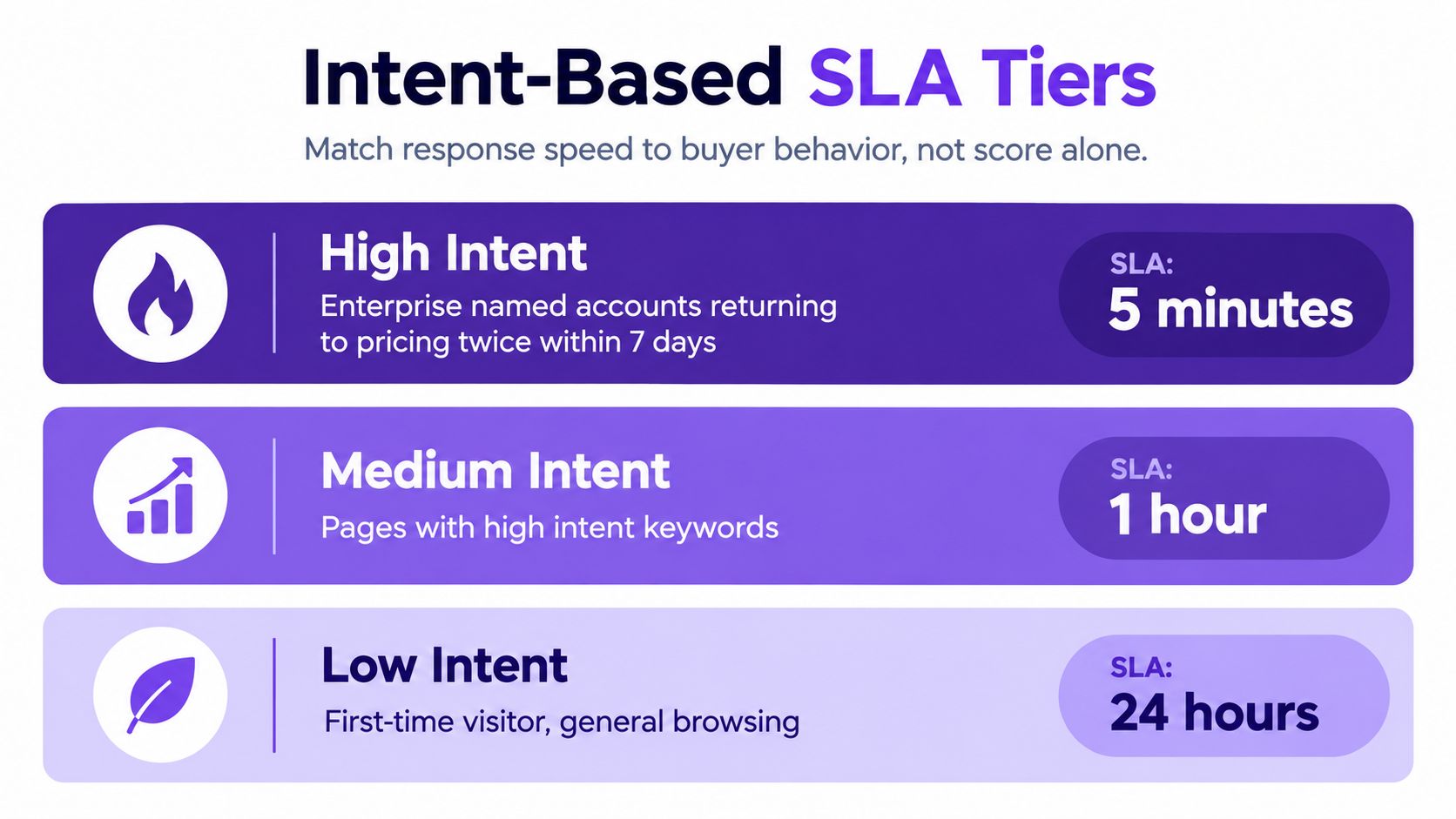
If every lead gets the same five-minute target, SDRs burn time on low-intent traffic while high-intent visitors still get inconsistent handling because the queue is noisy. You don’t need one universal clock. You need tiered SLAs based on behavior.
A benchmark-style summary from Plura’s 2026 lead response time statistics shows why. It reports that sub-5-minute responses convert at about 21% to 32% versus roughly 2.3% to 12% after next-day replies, while only about 7% of teams respond within five minutes and the overall average response time is around 42 hours. The important takeaway isn’t that every lead deserves instant human attention. It’s that waiting too long on the wrong leads destroys conversion.
Build your tiers around behavior
Use signals your systems already capture:
-
High intent
- Returning visitors on pricing or product pages
- Named accounts showing repeat activity
- Demo request behavior
- Assign the fastest human response path
-
Medium intent
- Comparison-page visitors
- Returning visitors with partial engagement
- Strong ICP fit without a direct hand-raise
- Route to a fast touch or same-session booking option
-
Low intent
- First-time informational traffic
- Blog readers with weak buying signals
- Broad nurture entries
- Use automation and same-day follow-up where appropriate
Make ownership explicit
Marketing owns the trigger logic. Sales owns the response clock. RevOps owns the reporting layer that proves whether either side did its job.
If your SLA dashboard shows one average, it’s hiding the truth. Averages make weak routing look acceptable.
Intent-tier SLAs also force an adult budget conversation. If you want fast response on high-intent traffic after hours, you need coverage through automation, on-call design, or both. Hoping reps magically become omnipresent isn’t a strategy.
Metrics That Actually Tell You Where the Funnel Breaks
One blended conversion rate is a comfort blanket. It makes dashboards look tidy and tells you almost nothing.
Lead to conversion needs a measurement stack that isolates each handoff. Otherwise every dip turns into a blame exercise between marketing, SDRs, and AEs.
Track conversion and latency separately
A stage can have decent conversion and still be broken by delay. Another can be fast and still be low quality. If you don’t separate those, you’ll fix the wrong thing.
Use metrics that localize failure:
| Stage | Primary Metric | Latency Metric | Owner | Source |
|---|---|---|---|---|
| Anonymous Visitor | Visitor to lead or conversation rate | Time from session intent to capture event | Marketing ops | Web analytics, chat, form tool |
| MQL | MQL acceptance rate | Time from qualification to rep pickup | Marketing and SDR leadership | MAP and CRM |
| Accepted Lead | Qualified meeting creation rate | Time to first touch | SDR or BDR team | CRM, sequencing, chat logs |
| Qualified Opportunity | Demo completion rate | Time from first touch to booked meeting | AE team | CRM and calendar system |
| Closed-Won | Closed-won rate from qualified opportunity | Sales cycle duration | Sales leadership and account team | CRM |
The small set worth watching every week
Don’t drown the team in charts. Run a short operating set:
- Visitor-to-lead rate to isolate acquisition quality and top-of-funnel capture.
- MQL-to-accepted rate to expose qualification and routing problems.
- Accepted lead-to-demo booked rate to expose rep execution and scheduling friction.
- Demo-to-opportunity rate to show whether meetings are substantive.
- Pipeline per visitor to show whether the whole machine is creating revenue potential.
Pair those with:
- Time-to-first-touch
- Time-to-demo
- Form-completion rate
- Show rate
Benchmark these against your own recent trailing performance, not external vanity numbers. External benchmarks are useful for direction. They won’t explain why your pricing page underperformed last Thursday.
The standard is simple. When one number moves, the team should be able to name the broken handoff within an hour.
A 90 Day Plan to Lift Lead to Conversion
Teams attack this backward. They start with scripts, rep coaching, or a fresh dashboard theme because those are visible. Meanwhile the leaks stay untouched.
Fix lead to conversion in the order of influence.
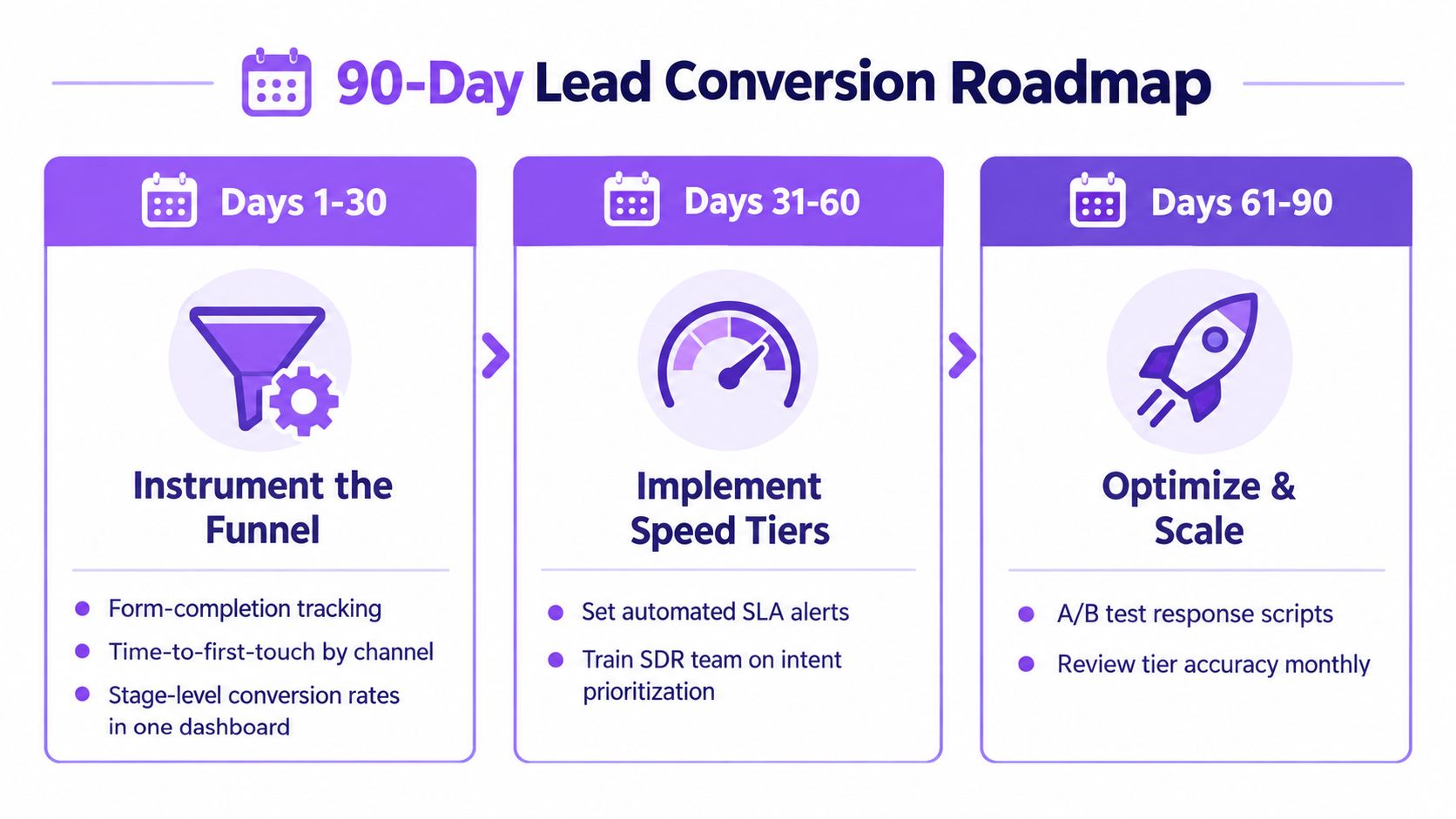
Days 1 to 30
Instrument the system before you touch the system.
Build one view that shows form completion, conversation starts, time-to-first-touch by channel, and stage conversion by owner. Don’t rename stages yet. Don’t rebuild lead scoring yet. Get clean visibility first.
If your automation is messy, use proven frameworks for B2B marketing automation that converts as a reference point, especially around routing logic and lifecycle handoffs.
Days 31 to 60
Remove the cheapest leaks.
Cut fields from high-intent forms. Add after-hours routing for pricing and product pages. Put differentiated SLA alerts in place by intent tier. Tighten calendar paths so buyers can book without waiting for a human to manually send availability.
Then train reps on priority, not just urgency. Fast follow-up on weak traffic is noise. Fast follow-up on strong intent is revenue work.
A quick walkthrough can help align the team on what this operational reset looks like in practice:
Days 61 to 90
Add one live-assist mechanism to the stage where it will do the most work.
That usually means one of two things. A click-to-meet path for high-intent visitors who want immediate next steps, or AI chat for mid-funnel and after-hours coverage. Don’t launch four tools at once. Add one, measure the handoff, then expand deliberately.
The dashboard-cleanup trap is real. Teams spend weeks polishing labels while buyers keep dropping out of the same broken path.
At the end of ninety days, compare the same stage metrics you started with. If the numbers moved, keep scaling. If they didn’t, you now know which handoff still needs surgery instead of guessing from the top-line funnel.
Captiwate helps B2B teams tighten the lead to conversion chain by turning high-intent website visits into live chat, in-browser video conversations, or booked meetings without forcing every buyer through a form-and-wait flow. If your pricing page traffic is showing intent but not becoming pipeline fast enough, visit Captiwate and see how the handoff can happen while the buyer is still on the page.