
The best router is the one your team can govern. Round-robin assignment looks attractive because it’s easy to explain, but equal distribution doesn’t guarantee the right owner, a fast response, or a clean CRM record. Reliable lead distribution connects four decisions: how leads are scored, which rules determine ownership, how SLA breaches are monitored, and whether every handoff is recorded correctly.
Speed makes those decisions operationally important. Companies contacting a web lead within 5 minutes are about 100 times more likely to make contact and 21 times more likely to qualify the lead than companies waiting 30 minutes, according to the benchmark summarized by Digital Applied’s lead-routing and CRM SLA framework. Yet only around 7% of firms respond inside that window, and 51% of inbound leads are never contacted, so routing software has to do more than move records between queues.
The 10 platforms below solve different problems. LeanData and Distribution Engine focus on Salesforce governance. RevenueHero and Chili Piper focus on scheduling and speed-to-meeting. Openprise and ZoomInfo OperationsOS address data orchestration. HubSpot works well when native CRM workflows are enough. Captiwate is most relevant when high-intent website activity needs to become an immediate conversation, AI qualification, or booked meeting.
Table of Contents
- 1. Captiwate
- 2. LeanData
- 3. Chili Piper Distro
- 4. RevenueHero
- 5. LeadAngel
- 6. Distribution Engine
- 7. Traction Complete
- 8. Openprise
- 9. ZoomInfo OperationsOS
- 10. HubSpot Sales Hub Workflows
- Top 10 Lead Distribution Software, Feature Comparison
- Turn the Shortlist Into a Routing Decision
1. Captiwate
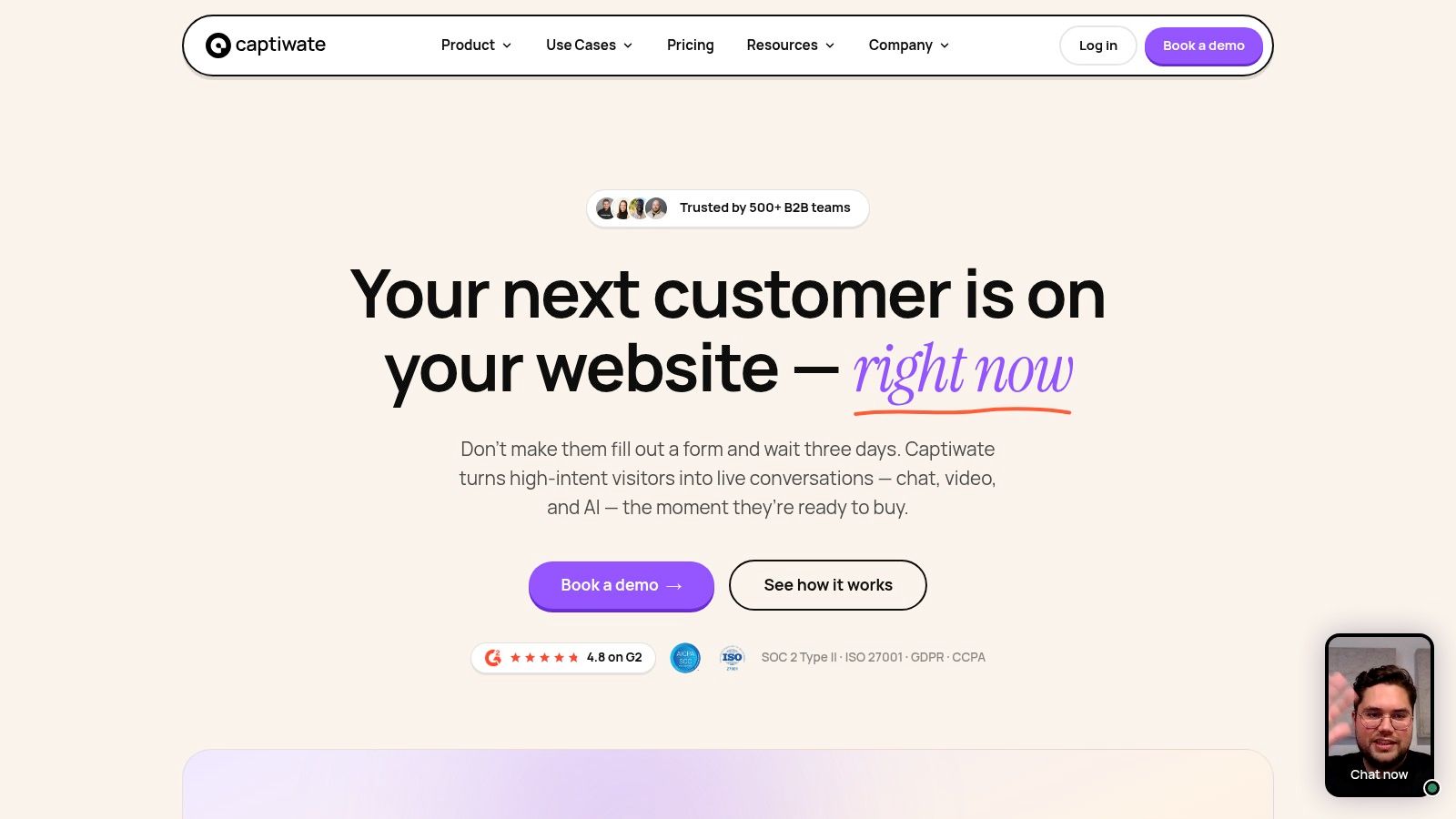
Captiwate treats the website as the first routing surface, not merely a form that creates a CRM record. When a visitor shows buying intent on a pricing or product page, the platform can identify the company and person behind the visit, interpret behavioral signals such as repeat visits and page engagement, and trigger a response while that interest is still active.
The workflow can combine visitor identification, intent scoring, segmentation, routing, live video, chat, co-browsing, and scheduling. A high-intent visitor can connect with an available rep in the browser through a one-click video call, start an AI conversation outside business hours, or book a meeting with calendar synchronization. Those conversations and meetings can then sync with HubSpot, Salesforce, or Pipedrive so the CRM retains the context rather than just the final form submission.
Practical rule: If your biggest leak happens before a lead reaches a rep, evaluate the website experience and the assignment engine together.
Why it solves instant engagement
Captiwate’s main operational advantage is immediacy. Reps can engage visitors without asking them to download software or leave the site, while AI provides continuous qualification and booking coverage when the sales team isn’t online. Co-browsing and screen sharing also give reps a way to guide a prospect through the product instead of sending another follow-up email.
The platform uses a single JavaScript snippet for deployment, and its traffic-based pricing includes unlimited seats rather than charging for each rep. That reduces seat-management friction, though traffic-based pricing can become harder to forecast for high-volume sites or companies operating multiple domains. The model also assumes your website attracts visitors with enough intent to justify live engagement. It won’t repair weak demand generation or turn low-intent traffic into qualified pipeline by itself.
Captiwate includes enterprise controls such as SOC 2 Type II, ISO 27001, GDPR and CCPA alignment, SSO/SAML, configurable privacy options, custom data residency, and SLA support. For inbound sales, ABM, PLG, and revenue operations teams, the important distinction is that routing ends in a real interaction, not an owner field.
Explore Captiwate’s website engagement and routing platform if your team wants to convert active website interest into a conversation, qualification, or meeting.
2. LeanData
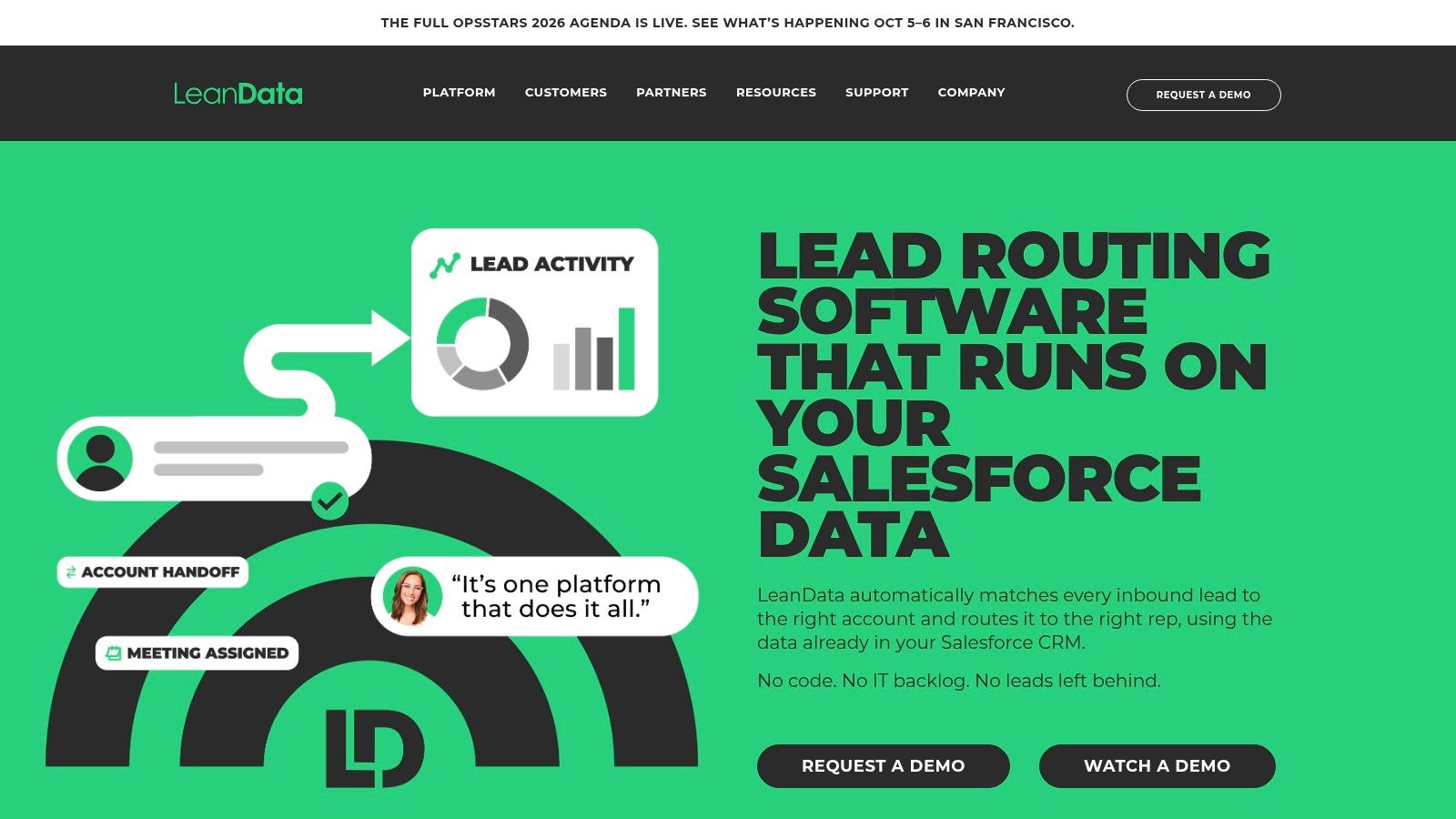
LeanData is built for organizations where routing is inseparable from Salesforce governance. It operates as a Salesforce-native managed package, so teams can keep routing logic and operational data inside the Salesforce environment instead of moving records through a separate routing database.
That architecture matters when RevOps needs auditable ownership decisions across complex territories, products, account structures, and sales teams. LeanData can route leads, contacts, accounts, opportunities, and cases through connected rules, which gives administrators one place to reason about ownership across the revenue lifecycle.
Where LeanData earns its place
The platform supports multi-branch logic, including territory conditions, account relationships, round-robin assignment, and rep availability. Its lead-to-account matching is particularly useful when a new person should inherit an existing account relationship rather than enter a generic inbound queue. Speed-to-lead dashboards and SLA monitoring inside Salesforce help managers see whether assignment is happening quickly and whether reps are acting on the records they receive.
The trade-off is administrative complexity. As territories, products, exceptions, and ownership overrides multiply, the rules require disciplined documentation and testing. LeanData is powerful because it can model those scenarios, but that power creates a governance obligation. Teams without a Salesforce owner who can maintain the rule graph may end up with a system that technically routes records while becoming difficult to troubleshoot.
Pricing is enterprise-oriented and quote-based. LeanData is a strong fit when Salesforce is the source of truth and the business needs precise, explainable routing across several object types. It’s less compelling when the requirement is to rotate uncomplicated web leads among a small team.
See the LeanData lead routing platform for its Salesforce-native approach.
3. Chili Piper Distro
Chili Piper Distro solves a narrower problem than a full RevOps routing suite, and that focus is useful. It connects lead distribution, form routing, chat routing, and calendar booking so a prospect can move from inbound action to a scheduled conversation without waiting for a manual handoff.
Availability-aware assignment is central to the workflow. The system can route based on rep availability, send Slack alerts, and use Salesforce record creation or update events as routing triggers. That makes it practical for teams whose definition of success is not merely “the lead has an owner,” but “the qualified lead has a meeting with an appropriate rep.”
The operational trade-off
The combined conversion stack can reduce vendor sprawl. A form submission, a routing decision, and a calendar outcome can happen within one connected workflow, which is usually easier for a buyer than stitching together separate form, routing, alerting, and scheduling tools.
The harder part appears when routing logic becomes conditional. Territory ownership, account matching, product specialization, availability, priority, and fallback behavior can interact in ways that aren’t obvious during a polished demo. Your implementation team should insist on an audit trail that explains why each test lead reached its assigned rep, and it should document what happens when every preferred rep is unavailable.
Pricing and licensing are quote-based, so buyers should evaluate the full workflow rather than comparing a single routing feature. Chili Piper Distro is strongest for teams that want to compress the path from inbound form or chat to a booked meeting. It may be more than you need if assignment is the only unresolved problem.
Compare Captiwate and Chili Piper when the decision comes down to website engagement versus form-led scheduling.
Review Chili Piper Distro against representative scenarios, not just its calendar experience.
4. RevenueHero
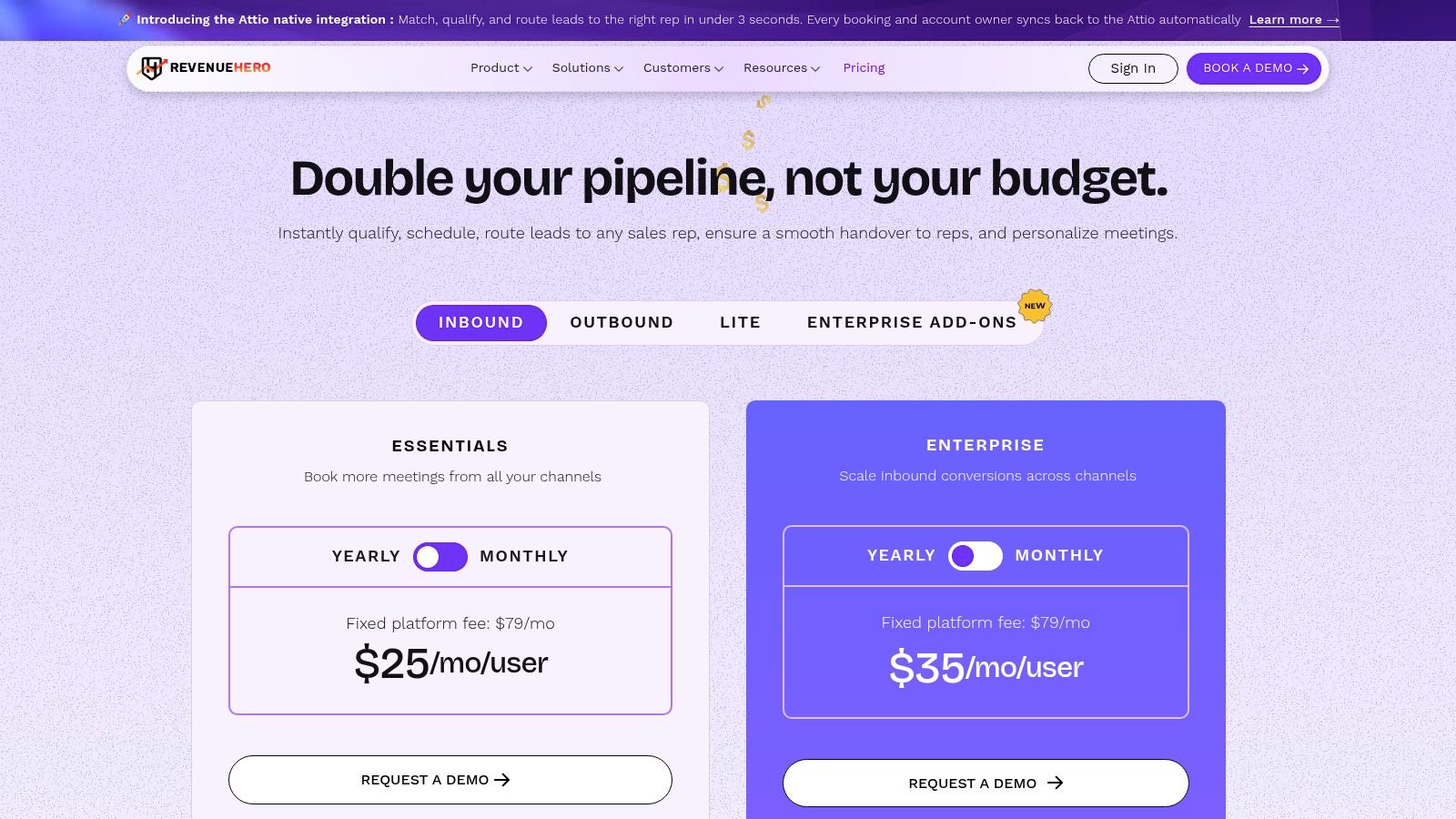
RevenueHero is a modern inbound router and scheduler for teams that want fast qualification followed by an appropriate meeting. It supports territory, round-robin, and availability-based routing, while paired or collective booking lets an AE and SE, or another required combination, join the same meeting flow.
The product fits especially well when the existing process already begins with a web form or scheduling interaction. Its in-page scheduling experience can reduce the gap between qualification and calendar selection, and a JavaScript widget supports a relatively quick setup. Native integrations with HubSpot and Salesforce keep ownership and meeting data connected to the CRM.
What it does well
RevenueHero’s practical strength is time-to-value. SMB and mid-market teams can use it to replace manual form review, calendar coordination, and basic ownership rotation without adopting a broad data operations platform. Support responsiveness is also part of the appeal for teams that don’t have a large implementation function.
The limitation is scope. RevenueHero concentrates on routing and scheduling rather than deep enrichment, account hierarchy management, or broad SLA orchestration. If your rules depend on complex data repair, multi-source enrichment, or extensive cross-object governance, you may need additional systems around it.
A scheduler can remove meeting friction, but it can’t compensate for missing account ownership data or contradictory territory rules.
The best evaluation should include a paired-booking scenario, an unavailable rep, a lead that fails qualification, and an existing account whose owner must take priority over round-robin logic. Its pricing page provides the commercial starting point, but buyers should confirm which routing and team-booking functions are included in their required plan.
Read the RevenueHero pricing and routing details, then compare the workflow with Captiwate and RevenueHero.
5. LeadAngel
LeadAngel addresses the account-matching problem that round-robin systems routinely ignore. It’s designed for Salesforce environments where a lead may need to match an existing account through domain data, fuzzy logic, corporate relationships, or other imperfect identifiers before the team decides who owns it.
That matching layer is valuable when duplicate accounts, inconsistent company names, subsidiaries, and incomplete lead fields create routing errors. LeadAngel combines matching with deduplication, territory rules, caps, quotas, rep availability checks, enrichment options, and configurable rule priorities.
Where the platform fits
The operational benefit is control without requiring every exception to become custom code. A team can establish account-first logic, then apply territory or availability rules when no existing relationship is found. Performance-focused routing is intended to keep the assignment step fast, which matters when a match is needed before a lead reaches sales.
The interface is more utilitarian than newer tools built around a polished marketer experience. That isn’t automatically a problem, but it means administrators should spend time validating usability with the people who’ll maintain dictionaries, territories, matching exceptions, and priority rules every week.
Pricing isn’t fully transparent on the website and is quote-based. Buyers should ask for a clear explanation of implementation, enrichment, deduplication, and support costs rather than assessing the license in isolation.
LeadAngel is a practical shortlist candidate when lead-to-account matching is the bottleneck. It’s less necessary for a company with clean inbound data, a simple sales structure, and no meaningful account ownership requirement.
Evaluate LeadAngel for Salesforce lead routing with deliberately messy test records. Include a subsidiary, a duplicate contact, an unmatched domain, and a rep who is marked unavailable.
6. Distribution Engine
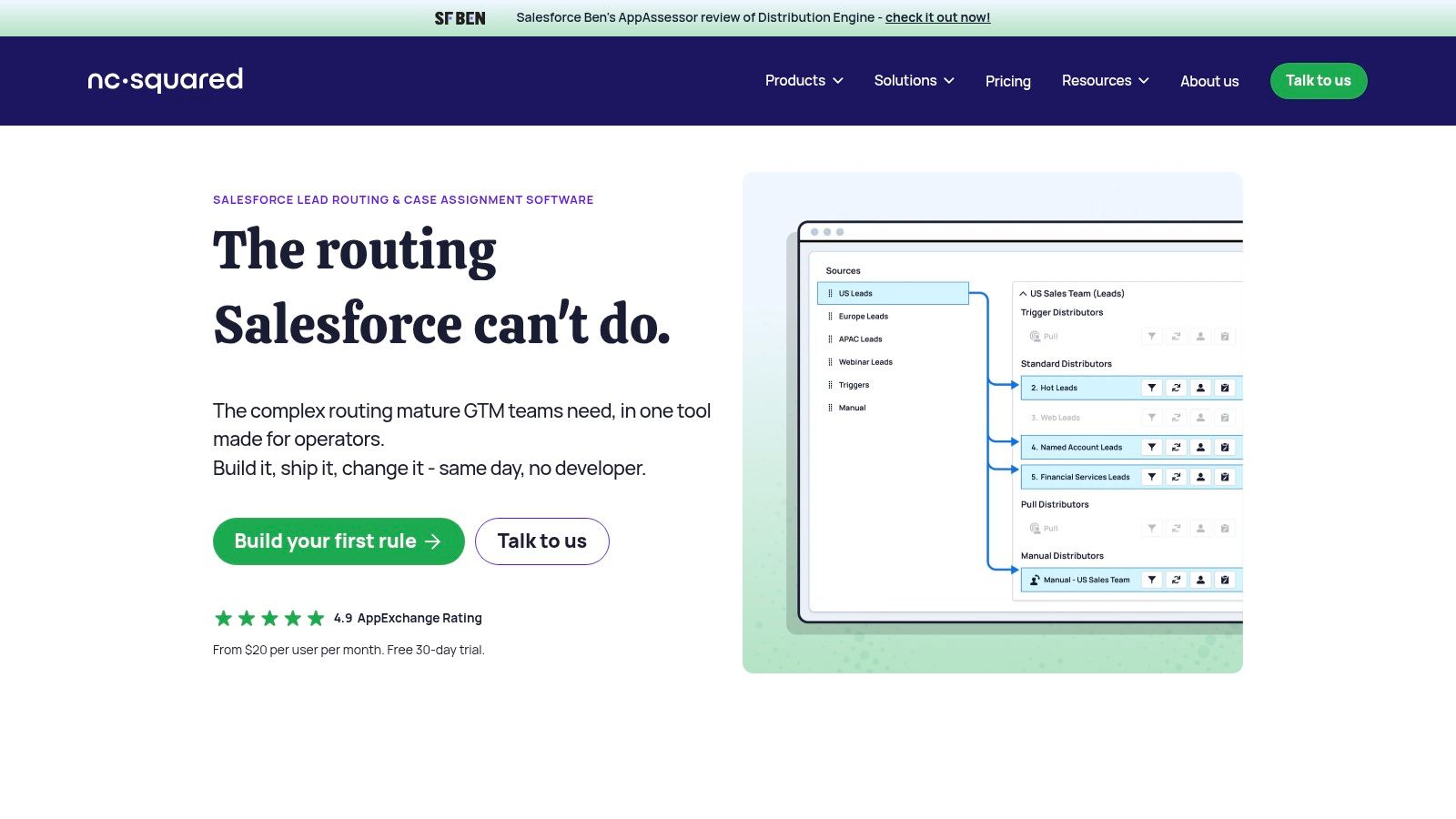
Distribution Engine from NC Squared is a mature, Salesforce-native assignment engine for teams that need routing beyond Leads. It can handle Cases, Opportunities, and custom objects alongside leads, allowing administrators to apply consistent ownership principles across different operational queues.
The platform supports round-robin, territory, availability, load balancing, sticky assignment, caps, reassignments, expiry logic, and SLA controls. Audit trails help explain what happened after a record entered the system, which is essential when sales managers and Salesforce administrators disagree about whether a lead was routed correctly or worked promptly.
A strong Salesforce admin tool
Distribution Engine’s no-code orientation can reduce reliance on custom Salesforce Flows for assignment logic. Administrators get deeper control over exceptions and reassignment behavior without maintaining a growing set of bespoke automation paths. Lead-to-account matching and deduplication options also help prevent the routing engine from treating every incoming record as an isolated event.
The trade-off is audience. This is primarily an operations tool for organizations standardized on Salesforce, not a marketer-friendly inbound conversion layer. A demand-generation team may find the interface less intuitive than a form-and-scheduling product, while a Salesforce admin may value that operational orientation.
A free trial is available through AppExchange, giving teams a way to test representative rules before committing. Don’t limit the trial to a clean round-robin example. Test ownership persistence, caps, absent reps, SLA expiry, and records that move from one object or stage to another.
See Distribution Engine from NC Squared for the Salesforce assignment model.
7. Traction Complete
Traction Complete, particularly its Complete Leads product, solves the account-structure and hierarchy problem. That matters for enterprise businesses where a lead may belong to a parent company, subsidiary, regional entity, or strategic account with an established ownership model.
The platform provides automated lead-to-account matching, deduplication, round-robin assignment, SLA timers, and account hierarchy management inside Salesforce. Administrators can adjust rules without waiting for heavy development work, which is useful when territories, products, or account responsibilities change during the year.
Why hierarchy quality changes routing
A lead routed to the wrong entity can create more than a bad assignment. It can split activity across duplicate records, bypass an existing relationship, or send an expansion signal to a net-new business-development queue. Traction Complete’s account hierarchy and enrichment capabilities are intended to improve the match before ownership logic runs.
That makes it a strong fit for ABM motions that rely on accurate parent and child relationships. The trade-off is that its value can be difficult to justify for smaller teams with simple account structures and modest routing complexity. Pricing is quote-based, and Salesforce-centric administration remains part of the operating model.
Teams should test the platform with parent-child accounts, regional subsidiaries, duplicate domains, existing account owners, and leads that don’t match anything. Ask administrators how quickly they can change a hierarchy rule and how the system records the reason for each match.
Review Traction Complete’s Complete Leads product when account hygiene is directly affecting distribution quality.
8. Openprise
Openprise is for teams that have learned that routing fails upstream. If country values are inconsistent, company names aren’t normalized, records are duplicated, or enrichment arrives after assignment, even a territory model will make poor decisions.
The platform combines enrichment, cleansing, deduplication, normalization, segmentation, and workflow automation. Its routing templates support a “clean then route” operating pattern, while multi-vendor enrichment waterfalls can supply the fields needed for account matching and prioritization.
The data orchestration trade-off
Openprise’s advantage is breadth. RevOps can govern the data preparation and routing sequence in one platform instead of maintaining disconnected scripts and point integrations. That can reduce the latency created when a lead waits for separate enrichment, validation, and routing jobs to complete.
The cost is complexity. Enterprise pricing and the platform’s broad scope make it excessive for a team that only needs straightforward round-robin assignment. Openprise also needs a clear RevOps owner who understands data dependencies, failure states, vendor fallbacks, and the downstream impact of field changes.
The right test is not “can it route a lead?” Most tools can do that. Test whether it can repair a malformed country, identify a duplicate, enrich an incomplete account, apply segmentation, and then route the accepted record with a visible audit trail. Confirm what happens when enrichment is unavailable and whether the system fails safely rather than assigning a low-confidence record to the wrong team.
Explore the Openprise data and AI orchestration platform if data quality is the constraint on lead distribution.
9. ZoomInfo OperationsOS
ZoomInfo OperationsOS, built around the RingLead acquisition, combines data management and routing for teams that want one vendor to handle cleansing, normalization, enrichment, matching, and assignment. The appeal is strongest when ZoomInfo data already sits at the center of the revenue operations stack.
The platform can deduplicate records, improve data quality, match leads to accounts, and orchestrate workflows that enrich records before sending them to the appropriate team. Third-party sources can also feed routing decisions, which helps when the CRM lacks the firmographic or account context needed for ownership.
Who should consider it
A single-vendor data and routing model can simplify procurement and operational accountability. Instead of asking whether a routing failure came from the CRM, an enrichment provider, or a custom integration, teams can manage more of the process within the same ecosystem.
That convenience comes with a scale requirement. Pricing is quote-based, and the product is generally positioned for larger teams with volume-driven needs. It may be difficult to justify if your organization doesn’t need broad data coverage or already has a reliable governance layer.
Buyers should separate data quality claims from routing behavior during evaluation. Send in a duplicate, an incomplete record, an existing account contact, and a lead with conflicting enrichment values. Then verify which source wins, when ownership is set, how the decision is logged, and whether CRM fields remain usable for reporting.
Review the ZoomInfo OperationsOS product datasheet if your routing project is also a data-management project.
10. HubSpot Sales Hub Workflows
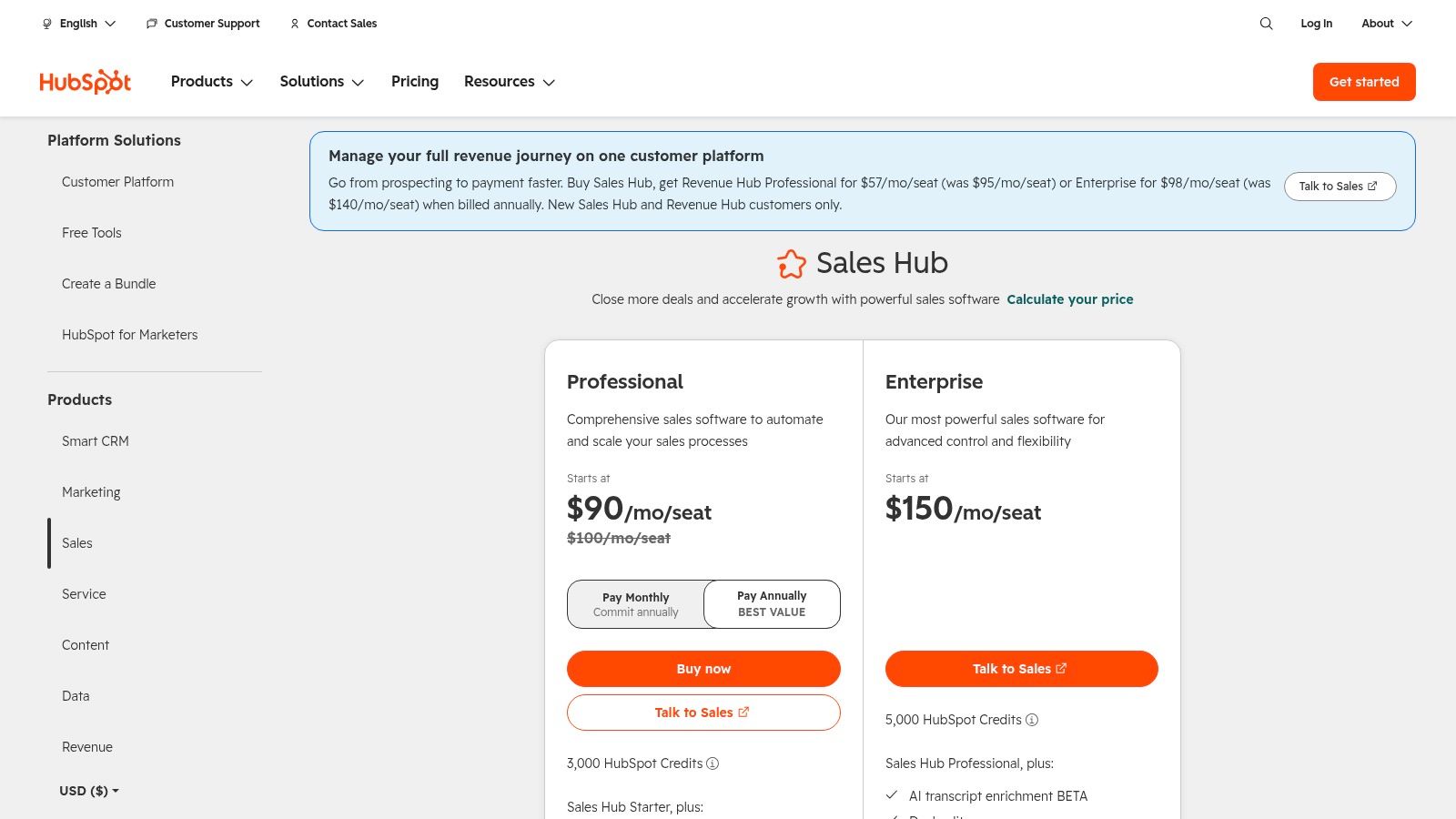
HubSpot Sales Hub is the sensible starting point when your team already works in HubSpot and the routing model is uncomplicated. Its workflow automation can rotate records among owners, create tasks, send notifications, and create deals based on routing triggers.
That native approach keeps implementation and maintenance close to the CRM. A small inbound team may not need a separate routing platform if the rules are limited to straightforward territory assignment, balanced rotation, or a basic team split.
Where native workflows stop being enough
HubSpot workflows become harder to manage when the business adds nested conditions, account ownership exceptions, product-specific rules, availability checks, escalation paths, and multiple objects. The issue isn’t that workflows can’t express logic. It’s that the rule set can become difficult to inspect, test, and explain when many workflows interact.
Administrators should document the order of operations and protect against duplicate actions. A lead may enter a workflow more than once after a field update, or a new owner may trigger a second task sequence. Monitoring workflow health and checking field mapping are as important as building the assignment action.
HubSpot is a good fit for native CRM workflows, especially when the team values low friction over specialized routing depth. If the first routing decision happens before a form submission, however, a CRM workflow may be too late to create an immediate website conversation.
Connect the process to the HubSpot Sales Hub workflow environment, and review Captiwate’s HubSpot integration if website engagement needs to flow into the same record.
Top 10 Lead Distribution Software, Feature Comparison
| Product | Core features (✨) | Pricing / Value (💰) | UX / Quality (★) | Target audience (👥) | Differentiator (🏆) |
|---|---|---|---|---|---|
| Captiwate 🏆 | ✨ In‑browser live video, AI chat, co‑browsing, intent detection | 💰 Traffic‑based, unlimited seats; Starter $49–Scale $399+/mo | ★★★★☆ (4.8 G2), fast ROI | 👥 B2B inbound, SDRs, ABM, revenue ops | 🏆 Browser video at peak intent + native CRM sync; single‑snippet go‑live |
| LeanData | ✨ Salesforce‑native lead→account matching & advanced routing | 💰 Quote‑based (enterprise) | ★★★★☆, reliable, auditable | 👥 Large RevOps, complex GTM | Deep SFDC routing, governance & SLA monitoring |
| Chili Piper Distro | ✨ Real‑time form/chat routing with calendar booking | 💰 Quote‑based | ★★★★☆, seamless handoffs | 👥 Sales teams, mid→enterprise | Integrated routing + booking for instant meetings |
| RevenueHero | ✨ Paired routing, in‑page scheduler, quick JS setup | 💰 Budget‑friendly; SMB/mid‑market pricing | ★★★★, fast time‑to‑value | 👥 SMBs, growing sales teams | Fast, affordable routing + paired booking |
| LeadAngel | ✨ Fuzzy lead→account matching, dedupe, sub‑second routing | 💰 Quote‑based | ★★★★, performance‑focused | 👥 Salesforce teams needing accurate matching | Strong matching & low‑latency routing without heavy code |
| Distribution Engine (NC Squared) | ✨ Native SFDC no‑code routing, SLAs, audit trails | 💰 AppExchange trial; quote‑based | ★★★★, mature & stable | 👥 Salesforce admins & ops | Long‑standing, admin‑centric assignment controls |
| Traction Complete | ✨ Lead‑to‑account, hierarchies, dedupe, SLA timers | 💰 Quote‑based (enterprise) | ★★★★, enterprise hygiene | 👥 ABM/enterprise teams | Robust account hierarchy & hygiene tools |
| Openprise | ✨ Data orchestration (enrich, clean) + routing templates | 💰 Enterprise pricing | ★★★★, powerful automation | 👥 RevOps, data‑centric orgs | Combines data quality with routing in one platform |
| ZoomInfo OperationsOS (RingLead) | ✨ Deduplication, enrichment + routing with ZoomInfo data | 💰 Quote‑based; mid‑five‑figures at scale | ★★★★, data‑rich ops | 👥 Large teams using ZoomInfo ecosystem | Single vendor for enrichment + routing workflows |
| HubSpot (Sales Hub workflows) | ✨ Native rotate/assign workflows, tasks, notifications | 💰 Included in Sales Hub tiers (tiered pricing) | ★★★☆☆, good for basic needs | 👥 HubSpot customers, SMBs | Low‑friction native routing inside HubSpot Sales Hub |
Turn the Shortlist Into a Routing Decision
A tool comparison only becomes useful when it reflects the failure your team needs to remove. Start by documenting every lead source, including website forms, chat, campaigns, partner referrals, imports, and product-led signals. Record which CRM object each source creates, which fields arrive at capture, which fields are enriched later, and whether the same person or account can enter through several paths.
Next, define the ownership model before looking at configuration screens. Decide whether existing account ownership takes priority, how territories are determined, when round-robin is acceptable, and whether capacity or rep availability can override specialization. Write the fallback behavior for every exception. An unmatched account, an unavailable rep, a missing country, and a duplicate record shouldn’t produce four different improvised outcomes.
Your SLA needs the same precision. The benchmark evidence is clear that speed-to-lead is a high-impact operating metric. The MIT lead-response study reports that companies contacting web leads within five minutes were 21 times more likely to qualify them than companies waiting 30 minutes, while its audited firms had an average first-response time of 42 hours and 23% never responded. Decide what counts as first response, when the clock starts, how after-hours inquiries are handled, and what happens after a breach.
Use this buyer’s checklist during evaluation:
- Document sources and objects: Map each entry point to its CRM record, required fields, enrichment stage, and owner.
- Define account matching: Specify domain, parent-child, duplicate, and existing-owner priorities.
- Set reassignment rules: Decide when an unworked record leaves its first owner and where it goes next.
- Choose scoring signals: Separate firmographic fit, behavioral intent, product interest, and urgency.
- Test integrations: Verify field mapping, CRM write-back, alerts, calendar availability, and conversation history.
- Audit edge cases: Include unmatched accounts, duplicates, absent reps, after-hours inquiries, and SLA breaches.
- Assign governance ownership: Name the RevOps or sales operations owner responsible for rule changes, testing, and reporting.
Compare platforms with representative scenarios instead of generic demos. Ask each vendor to process a high-intent website visitor, an unmatched account, an unavailable rep, an after-hours inquiry, a duplicate record, and an SLA breach. Watch whether the platform explains the route, preserves the context, records the outcome, and triggers the next action without manual intervention.
Cloud deployment is now the dominant pattern in this category. One market estimate places cloud-based lead-to-account matching and routing software at 64.3% of the market in 2025, while projecting the broader market to grow from about USD 2.6 billion in 2025 to USD 6.6 billion by 2035, a 9.6% CAGR, as reported by Ascero AI’s speed-to-lead research. The same source cites adoption of lead management and tracking software across more than 65% of businesses, but adoption alone doesn’t tell you which architecture fits your process.
For Salesforce governance, LeanData, LeadAngel, Distribution Engine, and Traction Complete deserve close testing. For scheduling, Chili Piper Distro and RevenueHero make sense. For data orchestration, Openprise and ZoomInfo OperationsOS address problems that routing rules can’t solve with clean logic alone. HubSpot is often enough for native CRM workflows. Captiwate is the relevant option when the first routing decision happens on the website and must lead directly to a live conversation, AI qualification, or booked meeting.
Before finalizing the shortlist, use this guide to compare lead distribution platforms against your actual routing scenarios, not feature counts.
Captiwate combines visitor identification, intent-based routing, in-browser video, AI qualification, co-browsing, scheduling, and CRM synchronization to turn active website interest into a sales outcome. If your team needs to respond while buyers are still engaged, visit Captiwate and evaluate it with your own high-intent pages, availability rules, and CRM handoff requirements.