A customer’s existing relationship is a chance to discuss another need, not a guarantee of another sale. Cross-selling offers an additional product or service that complements what the customer has bought or is considering. Upselling, by contrast, moves them to a higher tier or more units of the same product.
The distinction is simple; judging relevance takes more care. An expansion email can go unanswered when the extra offer doesn’t address a problem the customer has, or an account can grow quiet after a pitch that feels focused on revenue rather than their needs.
A previous purchase provides context, not permission to sell anything. A relevant offer helps the customer make better use of what they already have or solve a related problem. An irrelevant one can weaken trust and make future conversations harder.
Table of Contents
- Cross-Selling Defined in Plain Terms
- Cross-Selling Versus Upselling and Add-Ons
- Why Cross-Selling Matters for Revenue
- Cross-Sell Examples in B2B SaaS Accounts
- When a Cross-Sell Helps and When It Backfires
- Metrics That Show Cross-Sell Is Working
- Best Practices and a First Pilot
Cross-Selling Defined in Plain Terms
Cross-selling means selling an additional product or service to an existing customer, usually because it complements something they’ve already bought or expressed interest in.
Think of a camera shop. Someone buys a mirrorless body, and the salesperson puts a memory card and a padded case on the counter. The card and case exist because the first purchase created the need for them. Nobody in that transaction tries to sell a second camera body, because a second body solves no problem the buyer has.
A cross-sell solves a problem the first purchase created. If the extra offer doesn’t do that, it’s a different motion wearing the same label.
You’ll hear the term from three groups. Sales reps raise it while a deal is open, account managers map it across departments, and customer success teams bring it up at renewal. Researchers treat it as a customer-management activity rather than a checkout trick, and the evidence base behind it is wide: a 2025 systematic review of 147 studies published from 2000 through 2024 found that cross-selling, upselling and add-on selling generally have positive relationships with sales, revenue and profitability.
In B2B software the shape is identical. A CRM customer is offered an analytics module built on the pipeline data they already generate. A platform buyer is offered implementation help that gets them live. A team that proved value in one department is offered a package that serves the rest. None of those is “more of the same product.”
The test to run before any offer: does this solve a related problem for this specific customer? If it does, it’s a cross-sell. If it only sells more of what they already own, it belongs in another category entirely.
Cross-Selling Versus Upselling and Add-Ons
Most confusion about what does cross-sell mean in practice comes from blurring it with upselling. Both add revenue to an account you already hold, both tend to appear in the same conversation, and teams use the words interchangeably. They change different things about what the customer buys.
Cross-selling widens the purchase. The customer adds a product or service from a different part of your catalogue, one connected to the original need rather than a bigger version of it. Upselling raises the tier. The customer stays in the same product family and moves up to a more expensive version, more capacity, or a higher service level. Add-on selling increases quantity. Extra seats, extra usage, extra storage: same product, larger amount.
| Motion | What Changes | B2B SaaS Example |
|---|---|---|
| Cross-sell | Adds a complementary product or service | Analytics module added to a CRM subscription |
| Upsell | Moves to a higher tier or more expensive version of the same product | Standard plan replaced by Enterprise plan |
| Add-on | Adds extra features, seats or quantity to the current purchase | Ten more user seats added to an existing plan |
All three can happen inside one account in the same quarter, and often should. A customer who buys the analytics module, upgrades to Enterprise when the team doubles, then adds seats as headcount climbs is making three separate decisions for three separate reasons. Treating that as one “expansion push” makes each step harder than it needs to be.
In a live conversation, work out which motion you’re in with a single check. Ask whether the new item solves a different problem, changes the version of what they already have, or gives them more of it. The answer determines what you say next, what evidence you bring, and who owns the follow-up. Getting the motion wrong is how a helpful suggestion starts to feel like a script.
Why Cross-Selling Matters for Revenue
Sales leaders fund cross-sell programs for a plain reason: revenue from an account that already trusts you doesn’t carry the full cost of winning a new one. The scale of the activity is easy to underrate. In 2024, 87% of sales professionals reported using cross-selling, and cross-selling generated an average of 21% of company revenue, according to HubSpot’s 2024 Sales Trends Report.
That survey data shows where a fifth of revenue comes from.
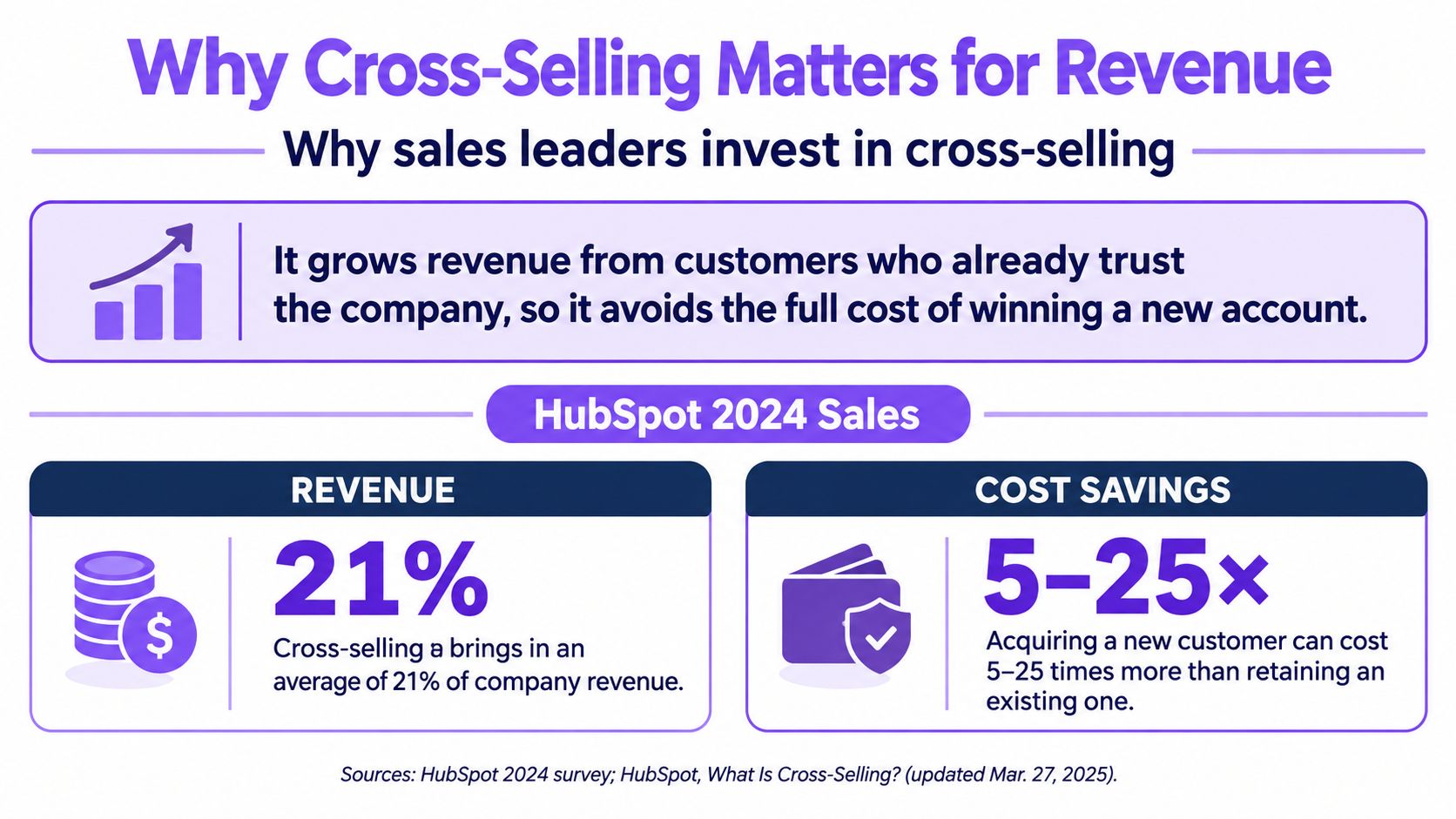
A 21% share means roughly one dollar in five arrives from selling additional products into the existing base rather than from new logos. For a SaaS company with a few hundred accounts, that isn’t a bonus line. It’s a product line, and it needs the same planning as one: a named owner, a defined second product, and a reason each segment would buy it.
The caution matters as much as the figure. A larger share doesn’t come from sending more offers. It comes from matching an offer to a gap the customer already feels. Pushing the second product to every account flattens acceptance rates, irritates the accounts that were fine as they were, and makes the next relevant offer harder to hear. Revenue gains follow the relevance, not the volume.
Self-check for your own book: how much of current revenue comes from accounts that already own one product, and how many of those accounts still own nothing else?
The second half of that question is where a plan starts. An account with one product and heavy usage in a single workflow has an obvious adjacent need to test against. An account with one product and flat usage needs attention on the first product before it needs a second one, and selling past that signal is how expansion targets become churn.
Cross-Sell Examples in B2B SaaS Accounts
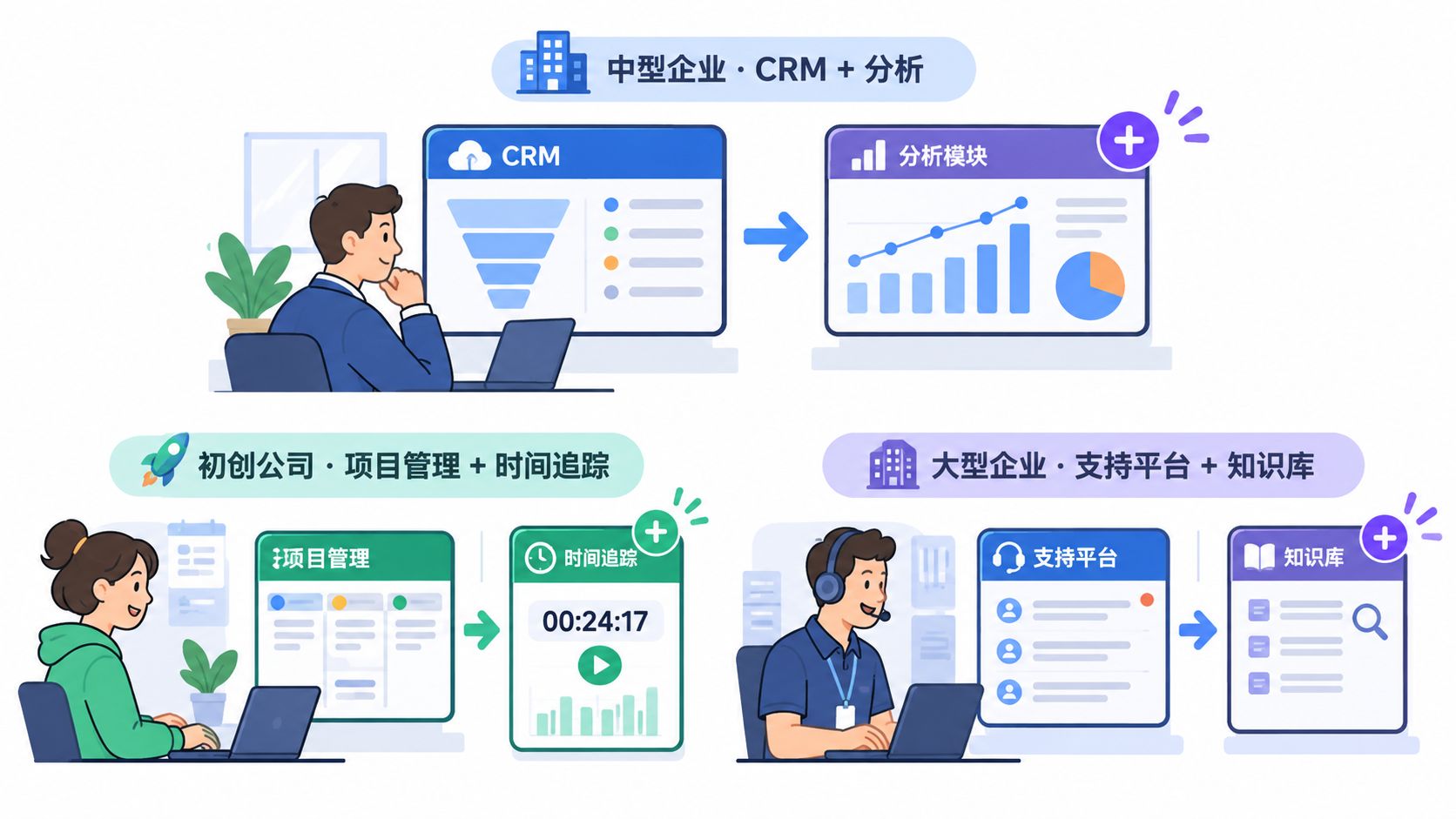
Three typical expansions show how the trigger matters as much as the offer. In each one, the signal arrives before the pitch, and the pitch is shaped by it.
A CRM account that needs reporting
A mid-market company uses your CRM to track pipeline across four reps. Usage shows them exporting deals to a spreadsheet every Friday, which means the reporting module would replace a manual routine they already resent. The trigger is the export pattern, not a campaign calendar. On the next call, the account manager shows what the same pipeline data looks like inside the analytics module, then checks two weeks later whether the Friday exports stopped. If they did, the customer found real value and the account now has a second reason to stay.
A platform buyer who needs the thing installed
A company buys your software and stalls in month one. Setup is harder than the demo suggested, three users logged in once, and a support ticket asks how to import historical data. That’s the moment for an implementation service, framed as removing the obstacle rather than as an extra purchase. The success manager books a working session, scopes the setup, and watches activation and time to first value afterwards. A company live in two weeks with help renews very differently from one left to fight through it alone.
A team that outgrew its first use case
A sales engagement tool gets adopted by one team of six. Two months in, the usage data shows people from two other teams creating their own trial accounts. Rather than sell to those teams separately, the account owner offers a team package covering the rest of the sales department. The trigger is shadow adoption, and the measure afterwards is whether active users in the covered teams rise within a quarter.
All three expand how the customer uses the product or improve their result. None of them is more units of something the customer already owns, and none would have worked as a mass email.
When a Cross-Sell Helps and When It Backfires
An irrelevant offer doesn’t just fail to convert. It spends attention you’ll want the next time you ask for it. One recent compilation reports that 85% of customers are unlikely to respond to irrelevant cross-sell requests, as HubSpot’s overview of cross-selling sets out, and that number belongs behind every offer you draft.
That gap between a helpful recommendation and an intrusive one is where trust is won or lost.
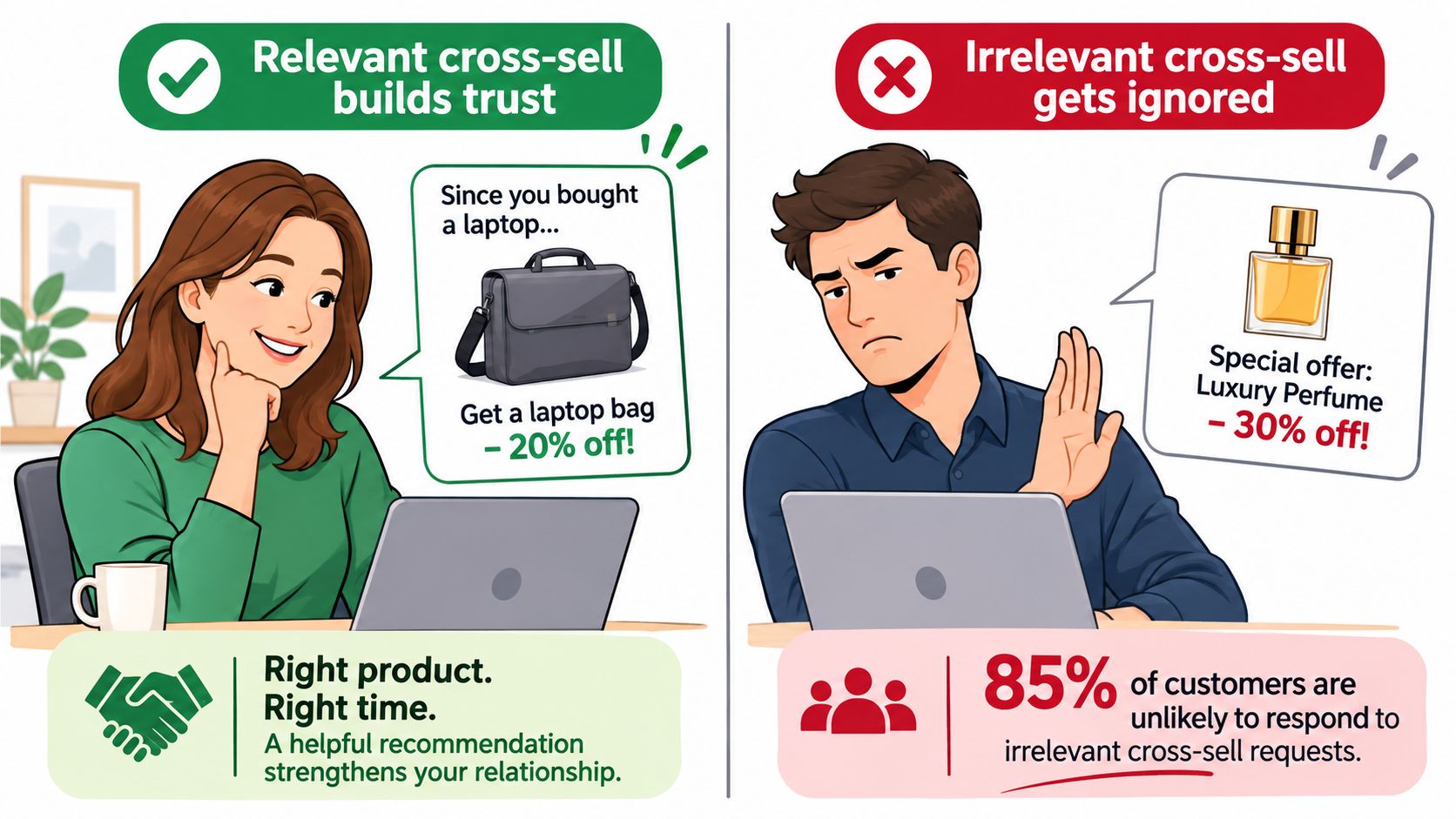
The question worth answering before the pitch is whether the offer is complementary. Five conditions carry most of that answer:
- A stated goal the offer advances. The customer said, on a call, in a ticket or at renewal, that they want something the product doesn’t yet do.
- Usage that shows the gap. Seats hitting their cap, weekly exports to spreadsheets, repeated questions about the same limitation.
- Timing that fits a natural moment. A renewal, a strong quarter, a resolved ticket, a new hire joining on their side.
- A budget that fits. The second product should sit near what the account already spends, unless there’s a clear approval path.
- Value the buyer can repeat back. If you can’t state the benefit in the customer’s own words, they can’t either.
Some moments call for holding the offer entirely. A service failure is one, because nobody wants a pitch while they’re angry about an outage. Straight after a confusing purchase is another, when the customer is still working out how to use what they bought. A recommendation that needs sensitive data the customer didn’t expect to share has to wait for permission.
Data beats instinct here. Recommendation models can reduce “superfluous” offers and improve success by identifying the customers most likely to adopt a particular product. That starts with segmentation, and this guide to how to segment customers covers how to build the groups you’d test an offer against.
Metrics That Show Cross-Sell Is Working
A cross-sell can raise revenue per account and still weaken the customer relationship. Measure whether the extra product is useful, not just whether it was purchased.
The relationship matters because customers who stay can continue to gain value from the products they use. Research summarized by Bain reports that improving customer retention by just 5% can increase profits by as much as 95%, though the exact effect varies substantially by industry, margins and customer economics. A relevant cross-sell may support retention by helping the customer reach a goal. An unnecessary one can add cost and frustration.
More products do not automatically mean more profit. Selection and timing determine whether an offer fits the account, and whether the customer adopts what they buy. Track a small set of measures together:
| Metric | How to Calculate It |
|---|---|
| Cross-sell attach rate | Accounts owning a second product divided by total accounts |
| Offer acceptance rate | Offers accepted divided by offers made |
| Revenue per account | Total revenue divided by accounts, compared before and after the cross-sell |
| Retention after cross-sell | Share of cross-sold accounts still active at renewal versus accounts without the second product |
| Opt-out or complaint rate | Customers who reject or complain about offers divided by offers sent |
Read these measures as a group. If attach rate rises while acceptance falls, the offer may be reaching accounts without a clear need. If acceptance looks healthy but cross-sold accounts renew less often, purchase may not be turning into useful adoption.
Revenue per account alone gives an incomplete picture. Pair it with the measures your team uses to track pipeline progress with KPIs. Shared account records also help customer success teams connect an offer to adoption and renewal outcomes. Learn more about customer success operations.
Best Practices and a First Pilot
A useful cross-sell starts with a customer problem, not a product quota. Choose one segment that already owns a product and has a clear need for something related. Then pick one offer and name one person to own the conversation.
Seven practices that keep cross-sell honest
- Segment by usage and stated goals. Look for evidence that an account has the adjacent need. A second product is relevant only if it addresses a problem the customer has.
- Choose one complementary offer for each segment. A focused recommendation makes it easier for the customer to see why the offer fits.
- Assign a single owner. Sales can lead expansion deals that need a commercial conversation; customer success can lead offers tied to adoption. One owner also prevents both teams from pitching the same account.
- Choose a natural moment. A renewal, usage milestone, or resolved support issue may make the conversation more relevant. Avoid pitching during an unresolved outage.
- Describe the customer benefit. Explain how the offer addresses their problem before listing features. “Your Friday export disappears” is clearer than “advanced reporting suite.”
- Keep the account history in the CRM. Captiwate syncs conversations, companies, and bookings with HubSpot and Salesforce, so teams can see prior interactions when considering a follow-up offer.
- Review acceptance, retention, and opt-out rates quarterly. If an offer repeatedly gets rejected or customers do not stay, reconsider whether it fits the segment.
Run a 30-day pilot
Choose the segment and owner, then agree on two measures before making the first offer: acceptance rate and retention after the offer. Record the baseline, make offers to the selected segment for four weeks, and compare the results with that baseline. The aim is to learn whether the offer fits, not to declare success because a target was set in advance.
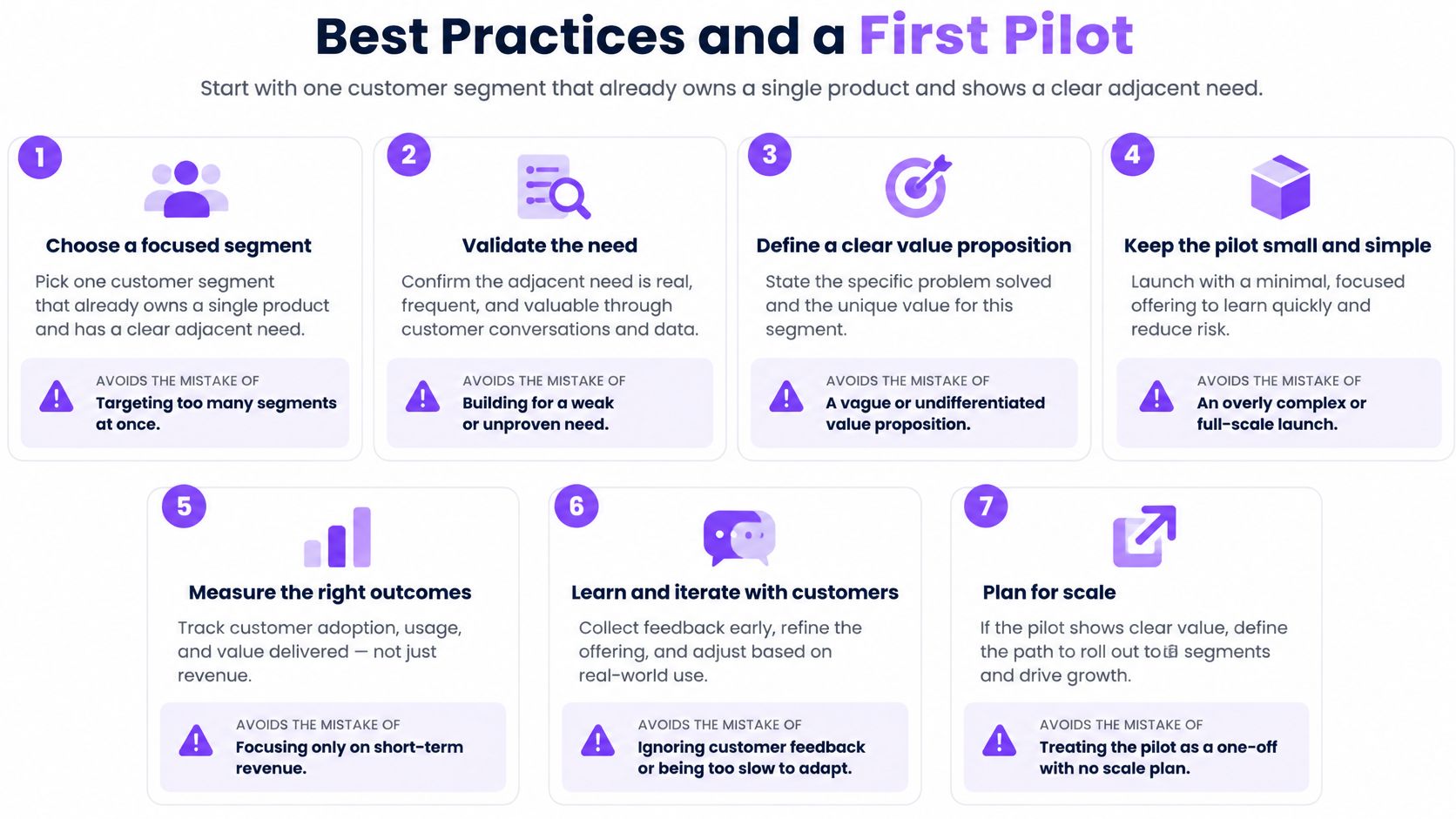
The pilot rule: prove relevance with one segment before scaling. An irrelevant offer can weaken a customer relationship you have already built.
The checklist depends on sales and customer success using a shared account view. If the CRM and success notes disagree, teams may target the wrong accounts or repeat conversations. Strong B2B account management keeps account information current across both teams.
Before you start, ask: which current customers have the problem this offer solves, and what makes the offer relevant to them? If you cannot identify those customers and explain the fit, the offer needs more work.
Captiwate can support a timely conversation when someone from a current customer visits a pricing or product page. Its live video and AI chat can bring a human rep into the browser immediately when they land on either page, while two-way sync with HubSpot and Salesforce keeps conversations attached to the account record. Visit Captiwate to see how intent-led conversations can help teams make account expansion offers when they are relevant.