Marketing has a target-account list. Sales has a different priority list. Your website shows interest from companies you want to win, but nobody can say who should act, what the visitor needs, or whether the resulting meeting would’ve happened anyway. The dashboard looks busy. The account plans haven’t changed.
ABM in sales fixes that operating problem, not just the targeting problem. It gives sales and marketing a shared set of accounts, explicit responsibilities, and a way to judge whether their combined effort creates additional pipeline.
Table of Contents
- What ABM in Sales Means and How It Differs
- Three ABM Tiers and the Service Each One Gets
- How Sales and Marketing Share One Account
- Metrics That Show an ABM Program Is Working
- How to Build an ABM Playbook in Five Steps
- Where Intent Detection and Live Engagement Fit
- What Real ABM Sales Programs Achieved
- Pick Your First Three Target Accounts
What ABM in Sales Means and How It Differs
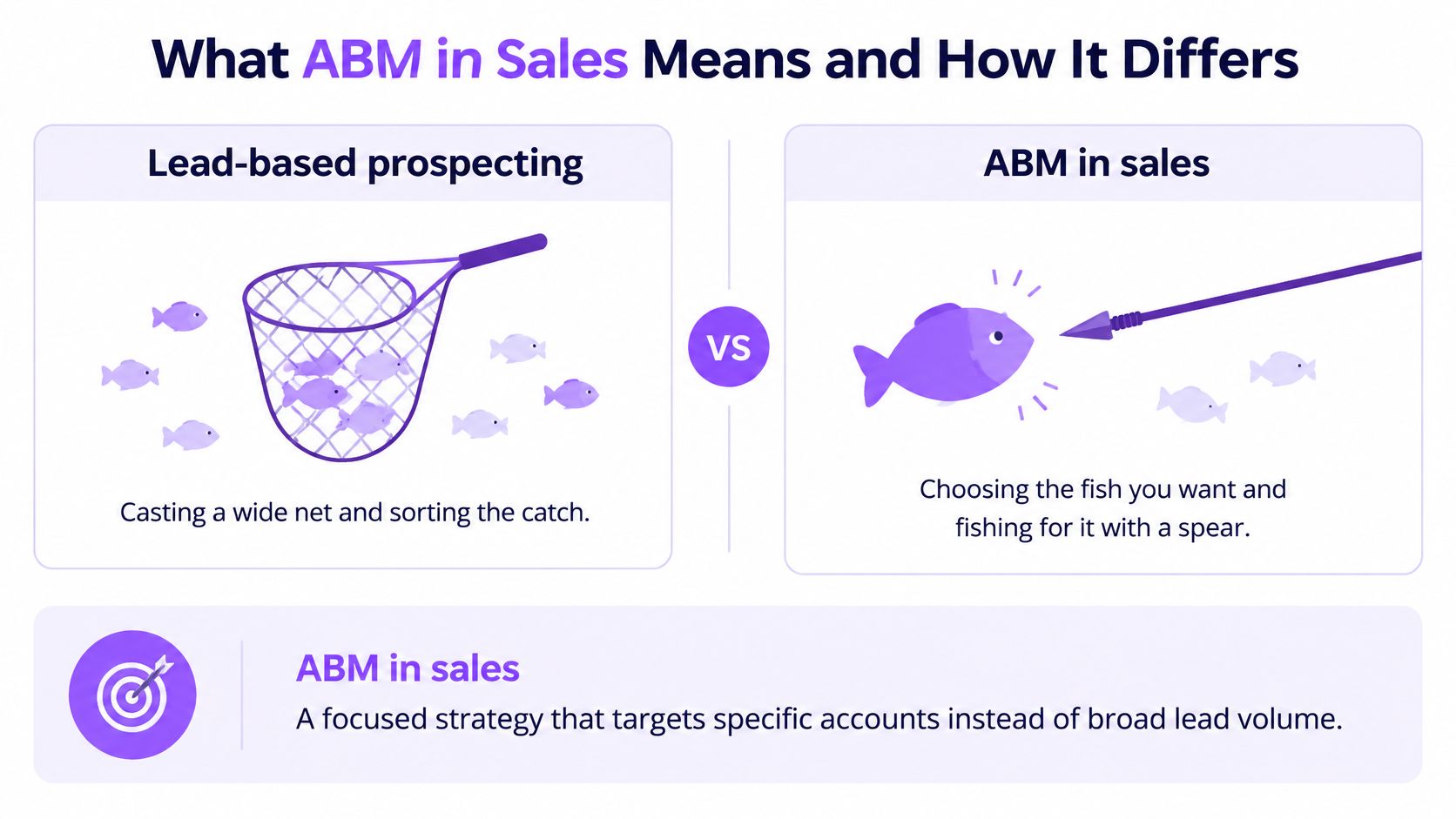
Lead-based prospecting is like casting a wide net and sorting the catch. ABM is like choosing the fish you want and fishing for it with a spear. The important difference isn’t precision advertising. It’s deciding where your team will spend its limited selling time.
ABM in sales is a joint decision by sales and marketing to prioritize named companies, map the people who influence each purchase, and coordinate engagement until the account buys or is ruled out. Marketing doesn’t finish its work when someone completes a form, and sales doesn’t wait for a scored lead before contributing.
The contrast is useful when deciding how to organize coverage.
ABM in sales compared with lead-based prospecting
| Dimension | ABM in sales | Lead-based prospecting |
|---|---|---|
| Unit of focus | Named target accounts and their buying group | Individual leads and form fills |
| Starting point | Ideal account list agreed by sales and marketing | Inbound volume and purchased contact lists |
| Sales motion | Multi-threaded outreach to several stakeholders | One rep follows up one contact at a time |
| Ownership | Shared account plan owned jointly by sales and marketing | Marketing hands leads to sales once scored |
| Success measure | Account progression, pipeline, win rate and revenue | Lead volume, MQL count and conversion rate |
The account changes how you work
The table describes distinct operating models, not a verdict that lead generation is obsolete. A self-serve product can still benefit from broad inbound acquisition. ABM makes sense when winning a company requires enough coordination and potential value to justify dedicated account coverage.
The first shift is the unit of work. A contact’s download matters only in the context of the account’s problem, stakeholders, and purchase stage. Several interested contacts don’t automatically represent several opportunities.
The next shift is ownership. Sales contributes account knowledge before campaigns launch, while marketing continues supporting stakeholder education after an opportunity opens. For teams establishing that vocabulary, MakeAutomation’s guide to account-based marketing provides a useful starting resource.
Adoption isn’t operational maturity
In the 2021 Demand Metric benchmark, 67% of participants had activated an ABM program; the analyzed respondents skewed toward larger organizations. That supports treating ABM as an established approach for larger B2B teams, not an experimental advertising tactic.
The practical test is whether the list changes decisions. Can a rep explain why an account belongs, which people matter, and what happens next?
Practical rule: If your target list is just a bulk contact export with company names attached, you’re running lead marketing, not an account operating model.
Three ABM Tiers and the Service Each One Gets
A sales team can’t give every eligible company bespoke attention. Tiering is a capacity decision: it connects account potential to a service level the team can deliver.
Use the following as proposed operating commitments, not industry response-time benchmarks.
ABM tiers, coverage and response expectations
| Tier | Account profile | Coverage model | Engagement channel | Response expectation |
|---|---|---|---|---|
| One-to-one | Strategic accounts with large deal potential | Named account executive and marketer | Live video and co-browsing on pricing and product pages | Alert and call within minutes during business hours |
| One-to-few | Clusters sharing an industry, size band or use case | Shared plays with role-specific messages | Live chat and personalized sequences | Human follow-up within the same business day |
| One-to-many | Broad ideal-customer segments | Automated programs and self-serve paths | AI chat qualification and one-click scheduling | Instant AI response with routing when a lead qualifies |
Spend human attention where it changes the outcome
One-to-one coverage should earn its cost. The account executive and marketer need a credible reason to build an account-specific narrative, involve executives, and prepare for procurement or technical evaluation. A recognizable logo alone doesn’t justify that investment.
For one-to-few coverage, reuse the underlying commercial argument while adapting it to each role. An industry cluster might share regulatory concerns, but finance, operations, and IT still need different evidence. Reusing a play is sensible; replacing company names in otherwise generic emails isn’t meaningful personalization.
One-to-many coverage protects capacity. Give visitors useful answers, a clear qualification path, and an easy way to request human help. Automation should remove unnecessary work, not trap a qualified buyer in a conversation that can’t resolve their question.
Maturity comes from better decisions
In the 2018 ITSMA and ABM Leadership Alliance study of 207 B2B marketers, 45% of organizations with fewer than three years of ABM experience reported at least double the ROI, compared with 80% among organizations with three or more years. The association is consistent with teams learning to select accounts, cover stakeholders, and coordinate execution, rather than discovering a shortcut.
Translate that learning into staffing decisions. A strategic account’s high-intent visit can justify interrupting an available rep. A cluster account can enter a relevant shared play. Broad-segment interest can begin with automated qualification.
Write fallback rules as carefully as primary rules. If the named owner is unavailable, assign a regional backup or offer scheduling. Don’t promise immediate engagement when nobody has accepted responsibility for answering.
Before launch, establish these boundaries:
- Write inclusion criteria: Define commercial potential, product fit, access, and disqualifying conditions for each tier.
- Review membership quarterly: Promote or demote accounts using documented evidence, while preserving the original assignment history.
That history matters. Moving already-warm accounts into the highest tier makes the program look more selective without making the team more effective.
How Sales and Marketing Share One Account
On Monday, marketing flags repeated pricing-page activity from a strategic account. The account executive checks the existing opportunity history and adds known contacts to the buying-group map. The SDR prepares outreach around the account’s likely evaluation question, using a role-specific message only when the visitor’s role is known.
By Friday, the useful output isn’t a stack of alerts. It’s an updated account record: who engaged, what they asked, whether a meeting happened, and what the team agreed to do next.
Give each role a decision to own
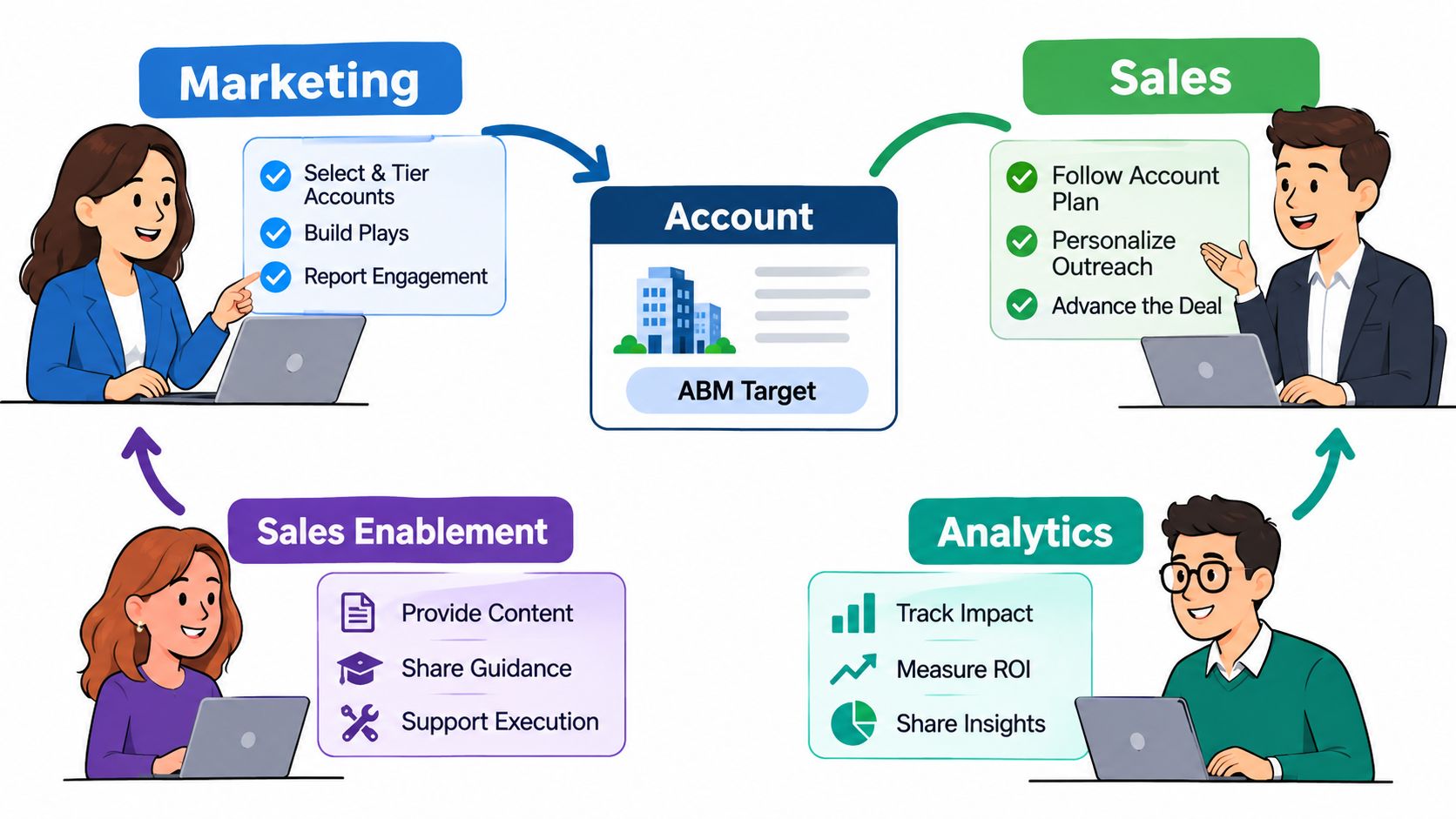
Shared ownership doesn’t mean everyone owns every task. It means each person contributes to the same account plan.
- Marketing proposes account selection and tiers with sales, builds plays, and reports meaningful engagement.
- The account executive owns the commercial plan, stakeholder map, and decision to involve executives.
- SDRs execute outreach, respond within the agreed window, and record qualification outcomes.
- Revenue operations connects visits, contacts, meetings, and opportunities to the correct CRM account.
In a benchmark of more than 400 B2B technology and business-services marketers, 71% reported measurable improvement in customer relationships and 55% reported revenue improvement from ABM. Those are reported outcomes, not a guarantee that coordination alone produces revenue.
Make the handoff a written agreement
A pricing-page visit from a named priority account can trigger an offer of immediate video help or AI qualification. Lower-priority traffic can receive automated nurturing. Neither route should bypass qualification merely because the company appears on a list.
For practical preparation, Voicedial.ai’s guidance on screening inbound leads before sales calls is relevant to deciding what a rep needs before taking the conversation.
Write the service agreement in operational language:
- Marketing commits to the account context, signal definition, relevant content, and routing information.
- Sales commits to an action window, a disposition, and a documented next step or rejection reason.
- Both teams commit to a monthly account review where they settle ownership disputes and revise weak plays.
Require the handoff to write outcomes back to the account record. A notification in Slack isn’t a closed loop, and an unanswered alert isn’t an SDR disposition.
Metrics That Show an ABM Program Is Working
More engaged accounts doesn’t necessarily mean more effective selling. You can increase visits and content consumption among companies that were already likely to buy. Unless their commercial progression improves, you’ve demonstrated activity, not incremental value.
The harder question is whether target accounts advance faster, convert more often, or create better opportunities than comparable accounts without the additional treatment.
ABM metrics and what to compare them against
| Metric | What it shows | Compare against |
|---|---|---|
| Engaged target accounts | Repeat visits from several people in one account, where identity is defensible | Matched non-target accounts over the same period |
| Sales-accepted meetings | Meetings booked with target-account buying groups | Control accounts with the same profile |
| Opportunity creation rate | Share of accounts that open a real opportunity | Control group opportunity rate |
| Stage velocity | Days from opportunity creation to the next stage | Pre-program baseline for the same tier |
| Win rate | Share of target-account opportunities that close | Non-target opportunity win rate |
| Expansion revenue | Revenue added after the first close | Prior-year revenue for the same accounts |
Build a comparison that can survive scrutiny
Choose matched control accounts before launch. Match on characteristics that influence purchase likelihood, including company profile, territory, prior engagement, and existing opportunity stage. Comparing warm strategic accounts with completely cold companies will exaggerate the apparent benefit.
Set engagement thresholds and opportunity-entry criteria in advance. A meeting should become sales-accepted because it meets a commercial standard, not because someone booked a calendar slot. Freeze the definitions long enough to make comparisons meaningful.
Record stage baselines and allocate costs to accounts, including campaign spend, platform costs, and substantial selling effort. Bespoke executive outreach isn’t free because it doesn’t appear in the media budget.
Don’t confuse attribution with incrementality
A Gartner ABM measurement framework highlights the measurement problem: 55% of surveyed marketers reported difficulty tying anonymous account activity to known stakeholders, while 38% struggled to map leads to accounts. If those connections are unreliable, a polished revenue-influence report can still rest on weak identity matching.
Use CRM account identifiers, keep unknown visitors explicitly unknown, and separate observed stakeholder behavior from inferred company interest. Don’t count different browsing sessions as different buying-group members without evidence.
An account can touch an ABM campaign before closing without closing because of that campaign.
Control groups aren’t perfect either. Reps may contact control accounts, territories may change, and customer budgets may shift. Record those exceptions and show the underlying account counts alongside rates.
If engagement improves without stronger opportunity creation, faster progression, better wins, or economically useful expansion, investigate the play rather than celebrating the dashboard. The program may need a better offer, wider stakeholder access, or less expensive coverage.
How to Build an ABM Playbook in Five Steps
A useful playbook tells a rep what to do with a particular account under particular conditions. It shouldn’t read like a campaign calendar or a collection of messaging ideas.
Keep the working version in a shared document linked to CRM account records. Record the owner, required inputs, action, fallback, and exit condition for every play.
The workflow should be simple enough to inspect and revise.
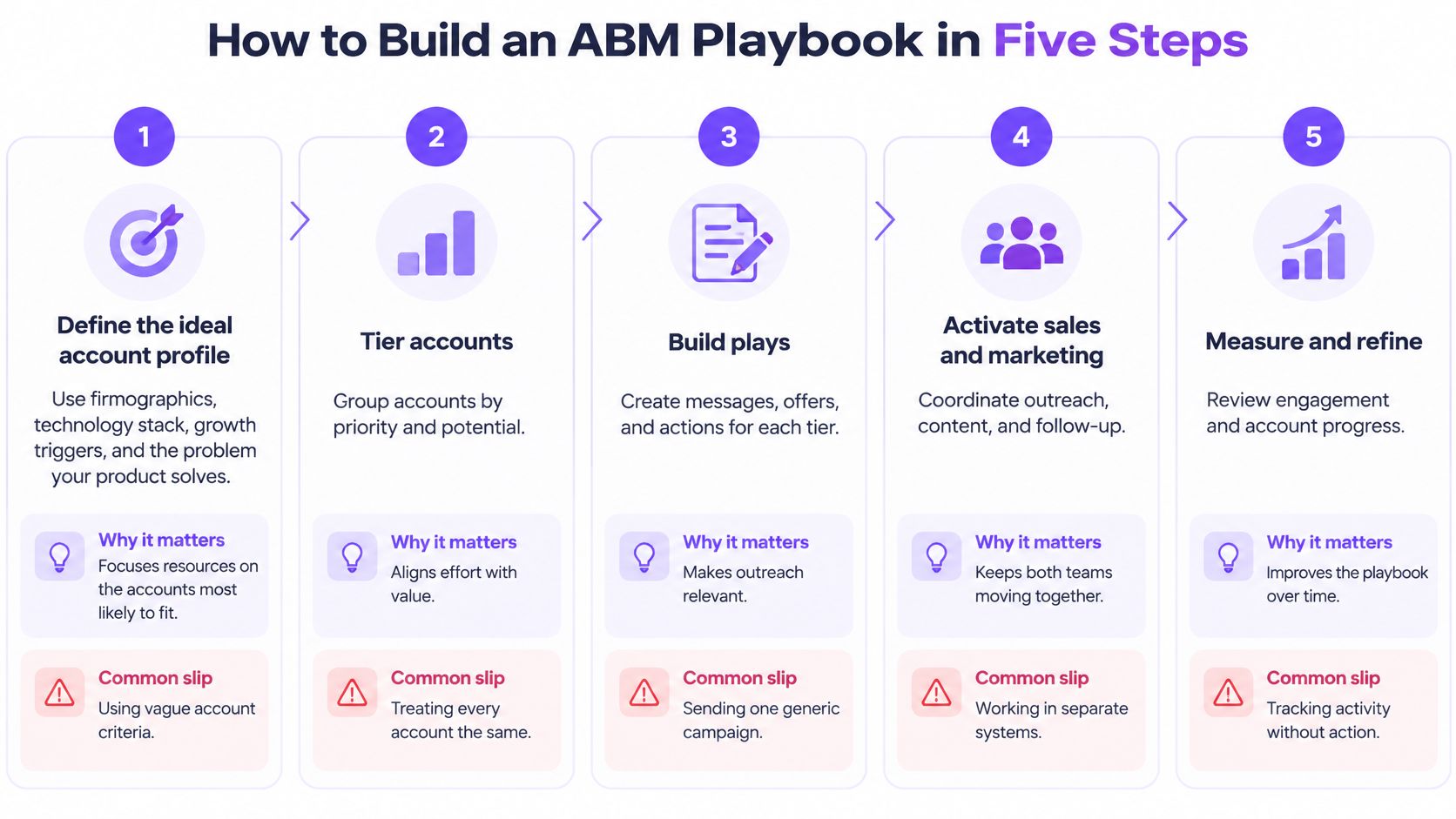
Define eligibility before writing messages
-
Define the ideal account profile. Use firmographics, technology stack, growth triggers, and the operational problem your product solves. Add exclusions such as unsupported deployment requirements or an implementation burden the customer can’t absorb.
This focuses the team on companies that can succeed with the product, not merely companies that can afford it. The common slip is describing the market so broadly that almost any recognizable business qualifies.
-
Build the tiered list with written inclusion rules. Make commercial potential and coverage requirements visible beside each account. Ask account executives to contribute evidence, such as an active initiative or relevant relationship, rather than accepting intuition as the final criterion.
Sales judgment belongs in selection, but it needs an explanation others can inspect. The common slip is adding promising opportunities after launch, then treating their progress as evidence that the original selection process worked.
-
Map the buying group for priority accounts. Record the economic buyer, champion, technical and operational influencers, and likely blockers. Give every entry an evidence status: confirmed person, plausible role, or unresolved gap.
A job title is a hypothesis about influence, not proof. The common slip is filling every box with names from a contact database while leaving the account’s actual decision process unknown.
Turn the plan into executable work
-
Write a play for each tier. Specify the trigger, channel sequence, role-specific message, owner, response window, and stopping condition. Include suppression rules so an SDR doesn’t start a prospecting sequence while the account executive is negotiating a live deal.
For example, a security-question chat should route differently from a general product inquiry. The common slip is defining an impressive sequence without saying who acts when the signal arrives or who covers their absence.
-
Set the measurement baseline before activation. Save the initial account list, buying stage, prior activity, and control assignment. Agree which outcomes count as accepted meetings, qualified opportunities, and stage advancement.
This gives the team a stable basis for later decisions. The common slip is choosing success criteria after seeing which dashboard improved, or changing controls when early results disappoint.
Launch check: Walk a sample signal through the entire process, from detection to rep action to the final CRM disposition, before adding more accounts.
A healthy opening phase produces an agreed tier list, usable stakeholder maps, and initial comparisons against controls. It also reveals operational defects: duplicate accounts, missing owners, irrelevant alerts, and qualification questions buyers won’t answer.
Fix those defects before expanding coverage. Increasing campaign spend while account records remain disconnected makes the program harder to diagnose, not more mature.
Where Intent Detection and Live Engagement Fit
Useful intent signals include repeat pricing or product-page visits, an ideal-profile firmographic match, and a sudden increase in activity from a company. Visits from different functions can add context, but only when those roles are known rather than inferred.
These signals suggest interest, not purchase authorization. This account-to-conversation flow illustrates where a team can offer help.
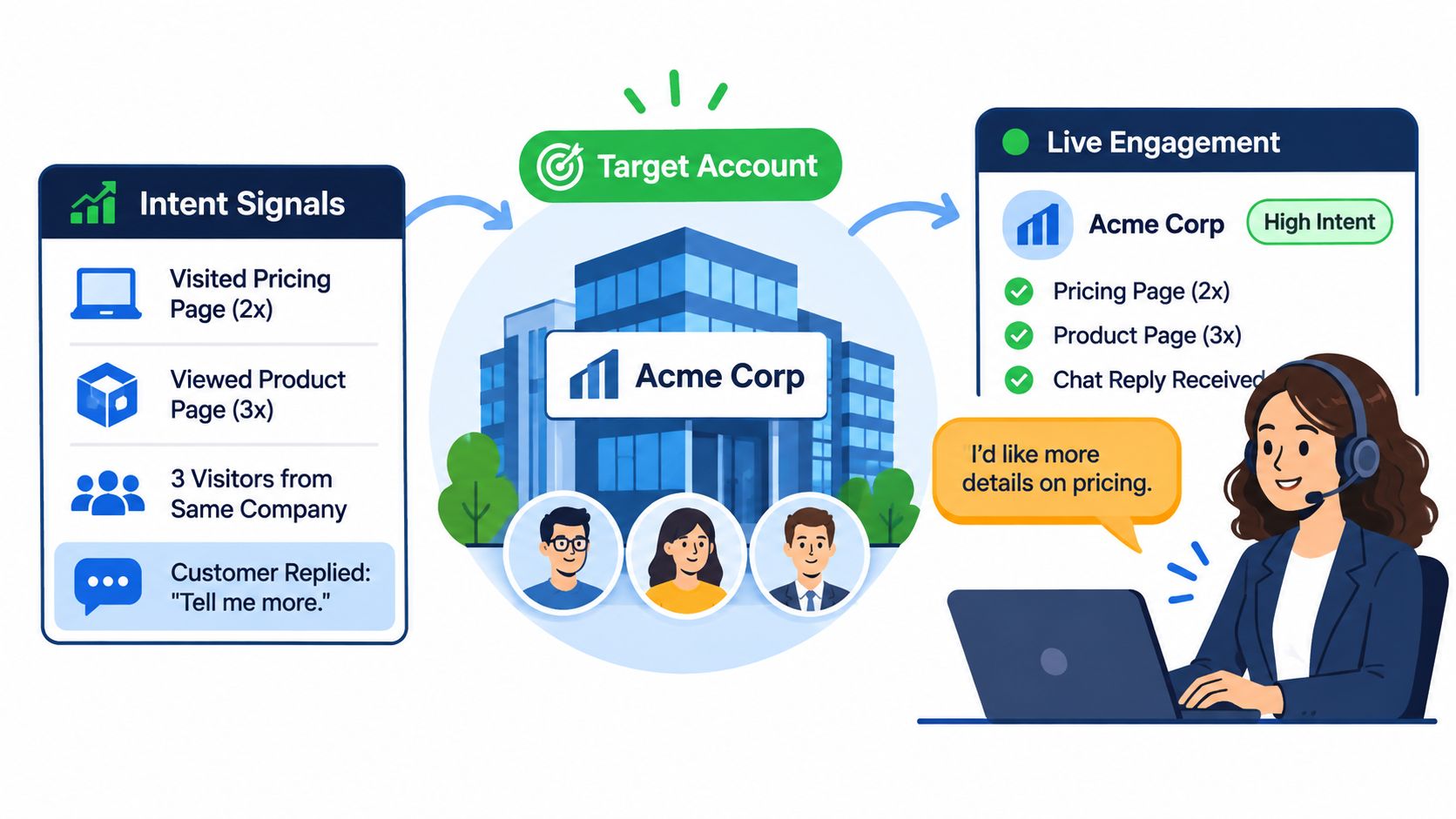
Close the person-blind gap
A company name doesn’t identify the visitor, their authority, or their colleagues’ agreement. Vector’s overview of common ABM challenges reports that 47.7% of marketers infer buying-group membership from expected job titles, while only 5.0% work from people demonstrating known engagement.
Use progressive qualification: retain defensible company and behavioral signals, respect privacy choices, offer low-friction assistance, and ask only what helps resolve the visitor’s current need. Separate B2B intent data from person-level confirmation.
In a proposed tiered workflow, a strategic-account pricing visit prompts an invitation to speak with the regional rep. A cluster account gets chat with human backup. Broad-segment traffic starts with AI qualification and scheduling, with an escalation path when the question requires judgment.
Evaluate the tool against the workflow
At Captiwate, we identify visiting companies, surface behavioral signals, and offer in-browser video, chat, AI qualification, and meeting booking. Our reported customer-base outcomes include 3–5× more demos booked from the same inbound traffic and 60% lower no-show rates with one-click scheduling; these are vendor-reported outcomes, not controlled benchmarks or promises for your program.
Our CRM integrations carry account, conversation, and meeting context into existing workflows. Before deployment, validate how known buying-group roles are recorded and how treatment can be limited to the intended test cohort.
For a broader shortlist, AY Automate’s overview of AI sales automation tools can help frame the comparison. Prioritize routing reliability, handoff context, and measurement over the longest feature list.
The demonstration below provides additional product context.
Keep video optional, avoid exposing internal visitor-scoring labels to buyers, and don’t interpret a declined conversation as account rejection. Judge the deployment against matched accounts before expanding it.
What Real ABM Sales Programs Achieved
Salesforge, a sales engagement platform with a strong outbound motion, had a different problem on its website: high-intent visitors could leave without speaking to anyone. Its case study describes adding a widget that enabled visitors to start live conversations instead of relying entirely on a form-and-wait path.
The reported results were a 30% increase in booked demos from the same website traffic, 200+ widget-triggered inbound calls a month, and about 10 opportunities a month from those calls. The case also ties 50%+ of ARR to widget-triggered conversations.
Read the mechanism, not just the lift
The useful lesson is the gap between generating interest and making a conversation possible. Salesforge already had an outbound motion; the intervention addressed visitors who were researching and willing to engage on the website.
That doesn’t prove a complete ABM operating model caused the results. It’s a single vendor-supported case, and revenue tied to a conversation isn’t automatically revenue created incrementally by that conversation.
The case doesn’t establish what would’ve happened under a matched control condition. Use it to form a testable hypothesis about conversation access, not to set your team’s forecast. When reviewing account-based marketing examples, distinguish improvements in engagement mechanics from evidence of account-level revenue lift.
Apply the mechanism to a named account
Consider a hypothetical mid-market SaaS team working a small strategic-account cohort. A priority company returns to pricing repeatedly during the week. The account executive checks the record, adds known finance and technical stakeholders, and prepares answers to likely evaluation questions.
When a visitor accepts live help, the rep asks what they’re trying to validate rather than opening with a generic demo. The visitor raises an integration concern, and the rep schedules a technical discussion with the appropriate colleagues.
That interaction is useful because it changes the account plan. The team has a confirmed problem, a stakeholder connection, and an agreed next step, not just another anonymous session.
- Record the evidence: Capture the question, confirmed role, participants, and next commitment.
- Check commercial progression: Determine whether the conversation creates a qualified evaluation rather than merely a meeting.
- Compare the cohort: Evaluate meeting acceptance and opportunity creation against accounts with similar starting conditions.
An individual account can provide a compelling story while the overall cohort underperforms. Keep the story and the program-level comparison separate when deciding whether to invest further.
Pick Your First Three Target Accounts
Start small enough that sales and marketing can inspect every action. Choosing warm accounts helps test execution quickly, but it doesn’t prove your selection model can create demand among cold companies.
Use this as a coming-week exercise, not a revenue forecast. If eligibility is still contested, settle your ideal customer profile before assigning premium coverage.
Run a bounded operating test
-
Choose three strategic accounts. Look for repeat visits, a warm relationship, or an active opportunity. Write down why each account qualifies and its current buying stage so existing momentum remains visible.
-
Map the stakeholders. Identify the economic buyer, champion, relevant influencers, and possible blockers. Mark unknown roles explicitly instead of filling the map with unverified names.
-
Write an account-specific signal-to-action rule. For example, a pricing visit from a confirmed stakeholder prompts same-day account-executive follow-up. Specify how that action changes if a negotiation or support issue is already active.
-
Agree the response window with SDRs. Put the owner, backup, working hours, and disposition options in the CRM. Test the alert with the people expected to answer it.
-
Schedule an operational check and a cohort review. Inspect engagement and meeting quality early, then assess opportunity progression when the buying cycle permits. Keep comparable non-target accounts in view and record differences in sales effort.
Make the expansion decision explicit
Your first decision is whether to offer live engagement on strategic-account pricing pages. That’s a bounded intervention with an identifiable owner and a clear buyer context. It doesn’t require rebuilding every acquisition channel.
Before switching it on, agree what would justify expansion to the next tier: more sales-accepted conversations, stronger opportunity progression relative to controls, and an acceptable cost in rep time. Treat a tiny cohort as an operational pilot, not statistical proof.
Don’t expand because alerts increased. Expand when the team can show that useful conversations became commercially meaningful next steps, without creating an unsustainable coverage burden.
Captiwate helps teams identify visiting accounts and turn website interest into live sales conversations or qualified meetings. Visit Captiwate to evaluate a pricing-page pilot for your strategic accounts, with routing, CRM outcomes, and a comparison plan agreed before launch.