In 2024, organizations generated an average of 1,877 leads per month, and 80% were classified as marketing qualified leads, according to Mandala AI citing HubSpot lead generation statistics. That classification rate should bother you. If four out of five leads are qualified, your threshold probably isn’t qualifying anything.
An MQL isn’t a sales-ready person. It’s a written handoff contract between marketing and sales. When teams treat it as a volume target, dashboards look healthy while sellers waste hours on curiosity, bad fit, and stale intent. Write the contract first, score against downstream outcomes, start conversations while intent is live, and publish the conversion rate that proves the label means something.
Table of Contents
- What Share of Leads Actually Qualify
- What Separates an MQL from an SQL
- Score Bands and the Action Each One Triggers
- How Fast the First Real Conversation Must Start
- Qualifying Demand That Never Fills a Form
- The Measurement Gap Behind Inflated MQLs
- Write the Handoff Rule Before You Chase Volume
What Share of Leads Actually Qualify
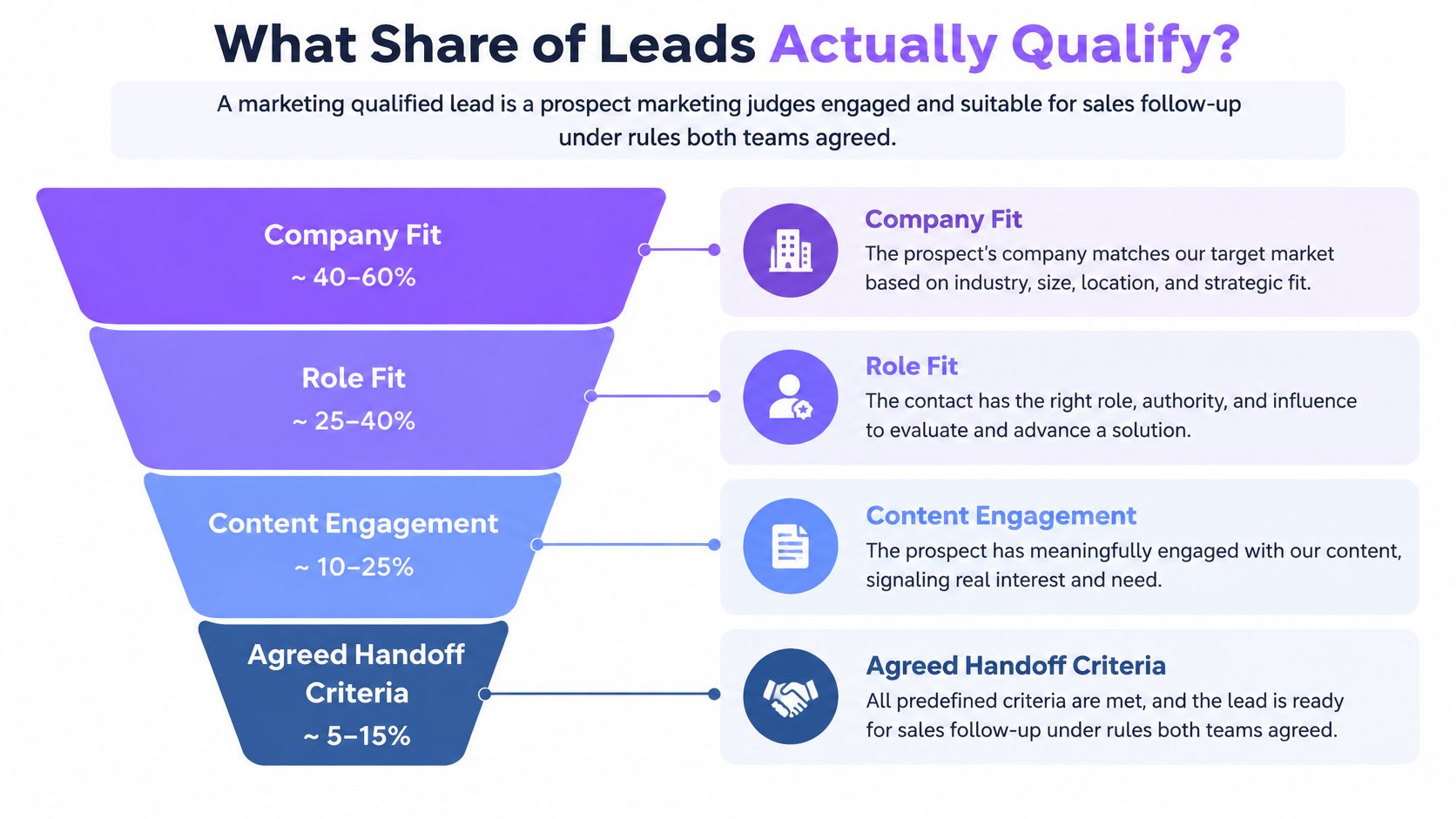
A marketing qualified lead is a prospect that marketing judges sufficiently engaged and suitable for sales follow-up, based on agreed criteria such as company fit, role, content engagement, and buying-intent signals. It’s a handoff threshold, not a universal type of person.
One team may qualify a lead after a pricing-page visit plus repeat product interactions. Another may require a form submission, webinar attendance, or a lead-score cutoff. That’s why raw MQL counts compare poorly across companies unless the rule is documented and both teams signed it.
The Funnel Most Teams Actually Face
The MarketJoy B2B sales pipeline conversion benchmark synthesis reports that approximately 20% to 25% of B2B leads become MQLs, while 12% to 18% of MQLs progress to sales-qualified leads (SQLs). Using the midpoints, 22.5% of initial leads become MQLs and 15% of those become SQLs, so only about 3.4% of the original leads reach the SQL stage.
| Stage | Benchmark | Per 10,000 leads | How to read it |
|---|---|---|---|
| Captured leads | 100% | 10,000 | Pool before fit or intent filters |
| Leads that become MQLs | 20% to 25% (midpoint 22.5%) | about 2,250 | Handoff volume, not revenue |
| MQLs that become SQLs | 12% to 18% of MQLs (midpoint 15%) | about 338 | About 3.4% of the original leads |
| B2B SaaS MQL-to-SQL, 2025 (First Page Sage) | 13% of MQLs | 130 per 1,000 MQLs | Per-MQL rate, not per lead; compare with the 12% to 18% row |
| B2B SaaS MQL-to-SQL range, 2025 (SalesMind AI) | 15% to 21% of MQLs | 150 to 210 per 1,000 MQLs | Reported range; compare with the 12% to 18% row |
Set the SaaS figures beside the general funnel. In 2025, the average MQL-to-SQL conversion rate for B2B SaaS was 13%, based on First Page Sage benchmark data covering client results from 2019 through 2025. A different view puts B2B SaaS MQL-to-SQL conversion in 2025 at 15% to 21%, according to SalesMind AI SaaS sales KPI benchmarks.
What to Do With Those Rates
Test every volume target against the downstream math before you approve it. If leadership wants a certain number of SQLs, work backward through your own MQL-to-SQL rate and your lead-to-MQL rate, then fund the channels that survive that calculation. Don’t let a team celebrate more MQLs while the SQL count stays flat.
Practical rule: A higher MQL count is progress only when qualification quality and downstream conversion improve with it.
If your lead-to-MQL rate sits far above the benchmark range, don’t assume your targeting is brilliant. Check whether your threshold is too loose. If your MQL-to-SQL rate sits far below it, check fit rules, intent requirements, routing, and follow-up speed before you buy more top-of-funnel volume. Those are operating problems, not reasons to lower the bar until the chart turns green.
What Separates an MQL from an SQL
The comparison below is the distinction your CRM stages should enforce. Read it row by row and decide which column your current leads occupy.
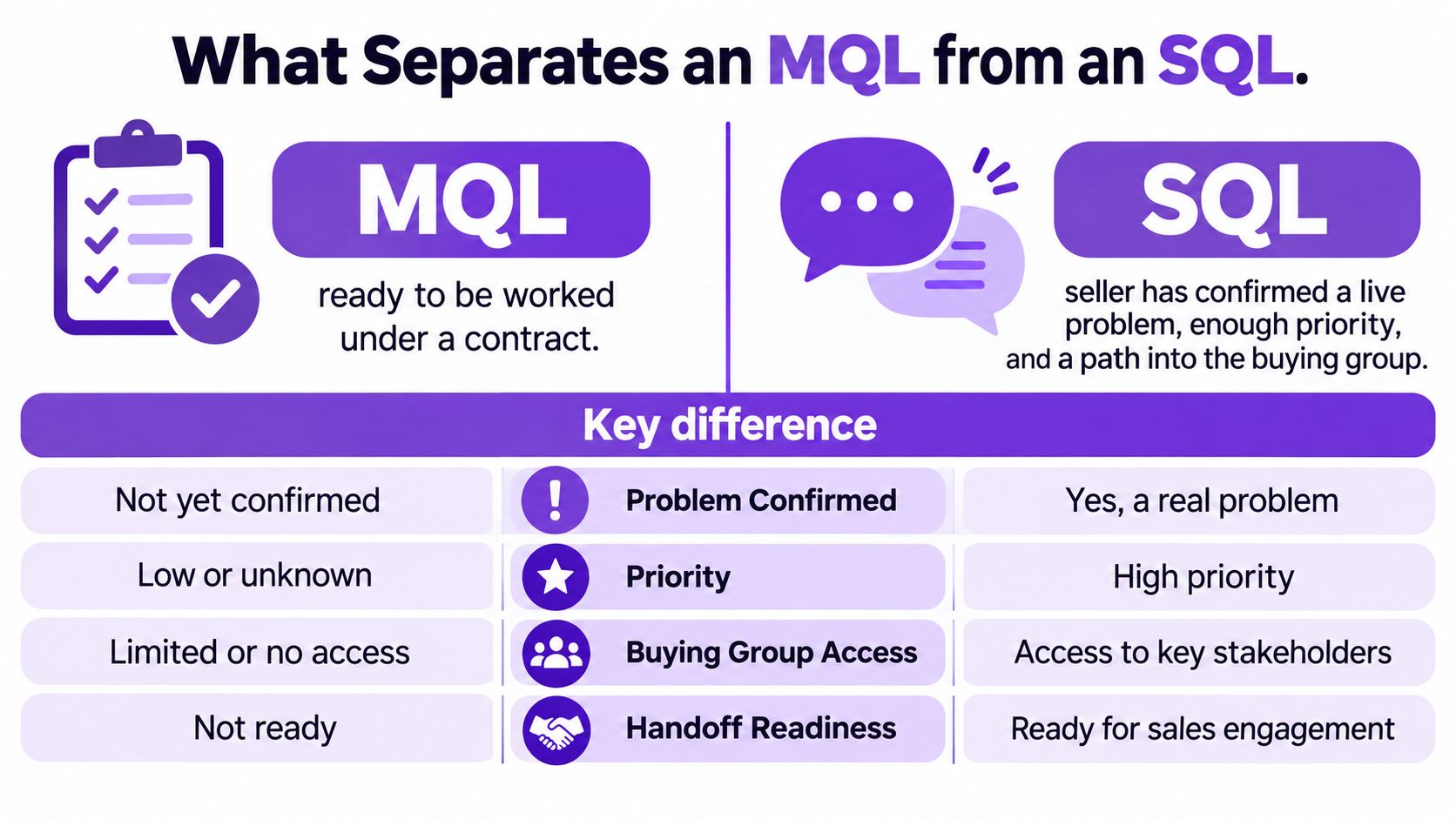
| Question | Marketing qualified lead | Sales qualified lead |
|---|---|---|
| Who decides | Marketing, against a written rule | Sales, after a real qualification conversation |
| Evidence | Fit plus engagement or intent | A live problem, priority, and access to the buying group |
| Typical trigger | Score band, pricing visit, webinar, form, or content sequence | Accepted discovery, demo, or explicit sales acceptance |
| Next action | Route to a conversation or keep in nurture | Create an opportunity or return the lead |
| Common failure | Volume without intent | Slow follow-up or vague acceptance rules |
An MQL is a reservation. An SQL is a guest who has sat down and ordered. A pricing visit can make the reservation, but it doesn’t prove the guest will stay, bring the right people, or care enough to solve the problem now. Use that test whenever a score tries to do a seller’s job.
Where False Positives Come From
Curiosity gets mislabeled as intent when a single download earns sales follow-up. Recycled contacts get mislabeled when old engagement is rescored as if it happened this week. Research behavior gets mislabeled when someone is learning the category, comparing language for an internal deck, or doing a competitor’s homework. None of those patterns proves a live problem.
Fit has to come first, which is why defining what an ideal customer profile includes matters before you argue about points. A perfect-fit account with moderate intent deserves a different path than a poor-fit contact who clicks everything. If you reverse that order, your most active leads will often be your least buyable ones.
The bar also moves by motion. A product-led signup can qualify on real usage plus company fit because the product has already produced evidence. An enterprise account may need several stakeholders, a high-intent page, and a named sponsor before sales should accept it. The mistake is forcing both motions through one threshold because one definition is easier to report.
This short explainer is useful if your team still uses the terms interchangeably in pipeline reviews.
Sales should return leads with a specific reason, not a shrug. Require one of these rejection codes: no documented problem, wrong company size, competitor or student, or nobody who can sponsor a next step. Teams in other service businesses hit the same wall when activity doesn’t turn into accepted pipeline, and Advisor Momentum’s guide to marketing conversion makes a useful cross-check on why attention alone doesn’t create qualified demand.
Score Bands and the Action Each One Triggers
Build your scoring model against accepted opportunities, not marketing activity. If a signal doesn’t predict sales acceptance, pipeline, or revenue, it doesn’t deserve points just because it’s easy to track.
Score fit and intent separately. Fit covers company size, industry, geography, technology environment, and role seniority. Intent covers recency, page depth, pricing or product-page activity, repeat visits, content sequence, and explicit buying language. Keeping them separate stops a strong-fit, weak-intent account from being averaged into the same bucket as a weak-fit contact with frantic clicks.
The decay evidence matters here because a score that ignores timing overstates value. The Plura lead response time statistics evidence base reports that contacting a lead within five minutes produces approximately 100 times higher contact odds and 21 times higher qualification odds than waiting 30 minutes. Separate research in that same evidence base reports conversion rates eight times higher when the first attempt occurred within five minutes rather than after six minutes.
Four Bands, Four Different Jobs
| Band | Signals | Action | Owner |
|---|---|---|---|
| High intent | ICP fit plus pricing or product page, repeat visits, or explicit buying language | Live conversation, first attempt inside five minutes | Available rep; AI if nobody is free |
| Medium intent | Role fit and a content sequence or one high-value page | AI discovery and progressive profiling, then route only if qualified | AI chat, then an SDR |
| Low intent | One download, a shallow visit, or anonymous browsing | Nurture or retarget; no sales alert | Marketing |
| Disqualify | Wrong size, student, competitor, or no problem | Suppress or recycle | RevOps rules |
High intent means an ICP account is on pricing or a product page, has returned, or has used buying language in chat. That lead goes to a live conversation as soon as it qualifies. Don’t batch it into tomorrow’s task queue.
Medium intent gets discovery before it gets a rep. Let AI ask about team size, current tool, timeline, and the problem behind the visit. Route to an SDR only when those answers confirm fit and priority. This protects seller time without abandoning the visitor.
Low intent stays out of sales. A single ebook download, a shallow blog visit, or anonymous browsing earns nurture, retargeting, or nothing. It doesn’t earn a Slack alert.
Disqualify is a service to everyone. Suppress wrong-size companies, students, competitors, and accounts with no live problem, or recycle them only when a clear future trigger exists. Don’t keep them in the MQL count to protect a monthly target.
A Worked Example
Say an ICP company visits pricing in three sessions in one week, checks integrations, and returns to a product page. That’s band 1, even without a form. Say a student downloads one ebook from a personal email address. That’s nurture at best, and suppression if your rules exclude students. The second contact may look cleaner in the CRM because it has a form record. The first pattern is still the better sales candidate.
RevOps should back-test every band on precision, recall, MQL-to-SQL rate, SQL-to-opportunity rate, median response time, and revenue per MQL by segment. Retire any threshold that doesn’t predict pipeline. Arbitrary points are not a model. They’re a habit with a dashboard.
How Fast the First Real Conversation Must Start
A widely cited Harvard Business Review audit of 2,241 U.S. companies found that the average response time to web-generated leads was 42 hours, while only 37% of companies responded within one hour, as summarized in Vida’s speed-to-lead analysis. Companies that contacted a lead within one hour were nearly seven times more likely to qualify it than companies that waited an additional hour, and more than 60 times more likely than companies waiting at least 24 hours.
That’s not a motivation problem. It’s behavioral decay. Intent fades, a competing vendor answers first, or the buyer finishes research alone and decides your product is a feature comparison instead of a conversation. By the time a rep sends a polite follow-up two days later, the qualifying event is history.
Start the Clock at the Qualifying Event
Your SLA clock shouldn’t start at form submission. It should start at the event that made the lead worth working: a pricing-page visit, a repeat session, product-comparison activity, or a demo request. If you measure from the form, you’ll miss every high-intent visitor who never fills one out and you’ll flatter your response times for everyone else.
Write the SLA as five steps and put names next to each one.
- Name the trigger events: List the exact pages, repeat-visit patterns, comparison behavior, and requests that start the clock.
- Route with context: Send the visitor to the best available rep in that region, with page history and account context attached to the alert.
- Cover the gaps with AI: If no rep is free, let AI qualify and book rather than parking the lead in a queue.
- Write it to the CRM: Log the conversation, qualification answers, and any meeting booked, so the next person isn’t starting blind.
- Review weekly by segment: Check median time and qualification rate by event type, geography, business hours, and source.
That fifth step is where many teams cheat. A company-wide average hides leakage in your best segments, including off-hours pricing visits and regions with thin coverage. Segment the number or you won’t see where pipeline is dying.
A five-minute response and a two-hour response are not two versions of follow-up. They are different expected outcomes.
For the mechanics behind the clock, the overview of speed to lead and response-time discipline gives your RevOps team a shared vocabulary for routing and coverage. Don’t stop at average speed. Measure time to first meaningful interaction, because an automated email that nobody reads is not a conversation and shouldn’t satisfy the SLA.
Qualifying Demand That Never Fills a Form
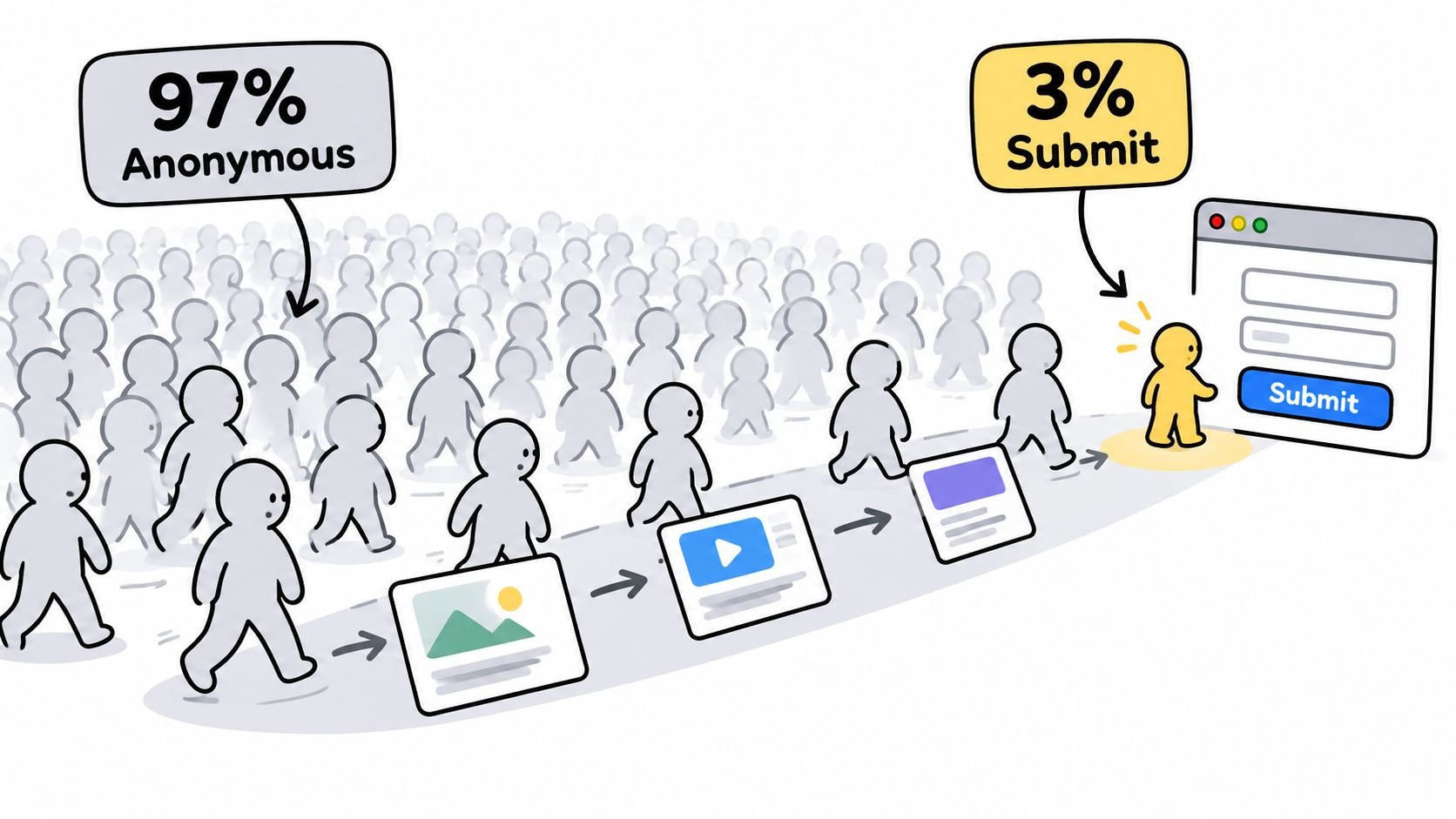
Only 3% of website visitors self-identify through form fills, leaving 97% anonymous, according to 6sense research on how generative AI is changing B2B buyer research. The same source reports that buyers consume an average of 13 content pieces, eight vendor-produced and five from third parties, before engaging.
That makes a form a late, biased sample, not the definition of demand. Buyers use generative AI to shortlist vendors, read comparison pages, check pricing, and circulate findings internally without ever becoming a known contact. A second 2025 study cited there found that less than 40% of B2B marketers always track qualified accounts or individual leads, which widens the gap between real research and operational follow-up.
Treat Anonymous Signals as Direction, Not Proof
Use privacy-conscious account and behavior patterns as directional evidence. They don’t prove a named person’s readiness, identity, or consent. Combine repeat visits, content progression, pricing or product-page engagement, firmographic fit, and a conversation the visitor chooses to start. Then validate with a human or AI conversation before anyone is routed as sales-ready.
Say an ICP company hits pricing on Tuesday, returns Thursday to read security and integration pages, and never submits a form. That pattern can make the account an MQL candidate under your written rule. It cannot make anyone an SQL. Only a conversation that confirms a live problem, priority, and access to the buying group can do that.
Offer the conversation where research is already happening. Put chat, an instant meeting, or an in-browser video call on the pricing and product pages instead of forcing a form as the price of human contact. A buyer who’s comparing vendors at that moment doesn’t need another nurture email next week.
Paid traffic makes this gap expensive, because you’re paying for visits you’ll never identify if the only exit is a form. Teams rethinking that spend can find a senior-led paid media strategy useful for connecting media decisions to downstream demand instead of clicks. For signal design, a shared view of how B2B intent data should be used helps teams separate account-level direction from individual readiness claims they can’t support.
Be explicit about limits. Anonymous behavior can tell you an account is researching. It can’t tell you who owns the budget, whether legal will approve you, or whether the project survived this quarter’s planning. Say that in your handoff rule so sellers don’t mistake a pattern for a promise.
The Measurement Gap Behind Inflated MQLs
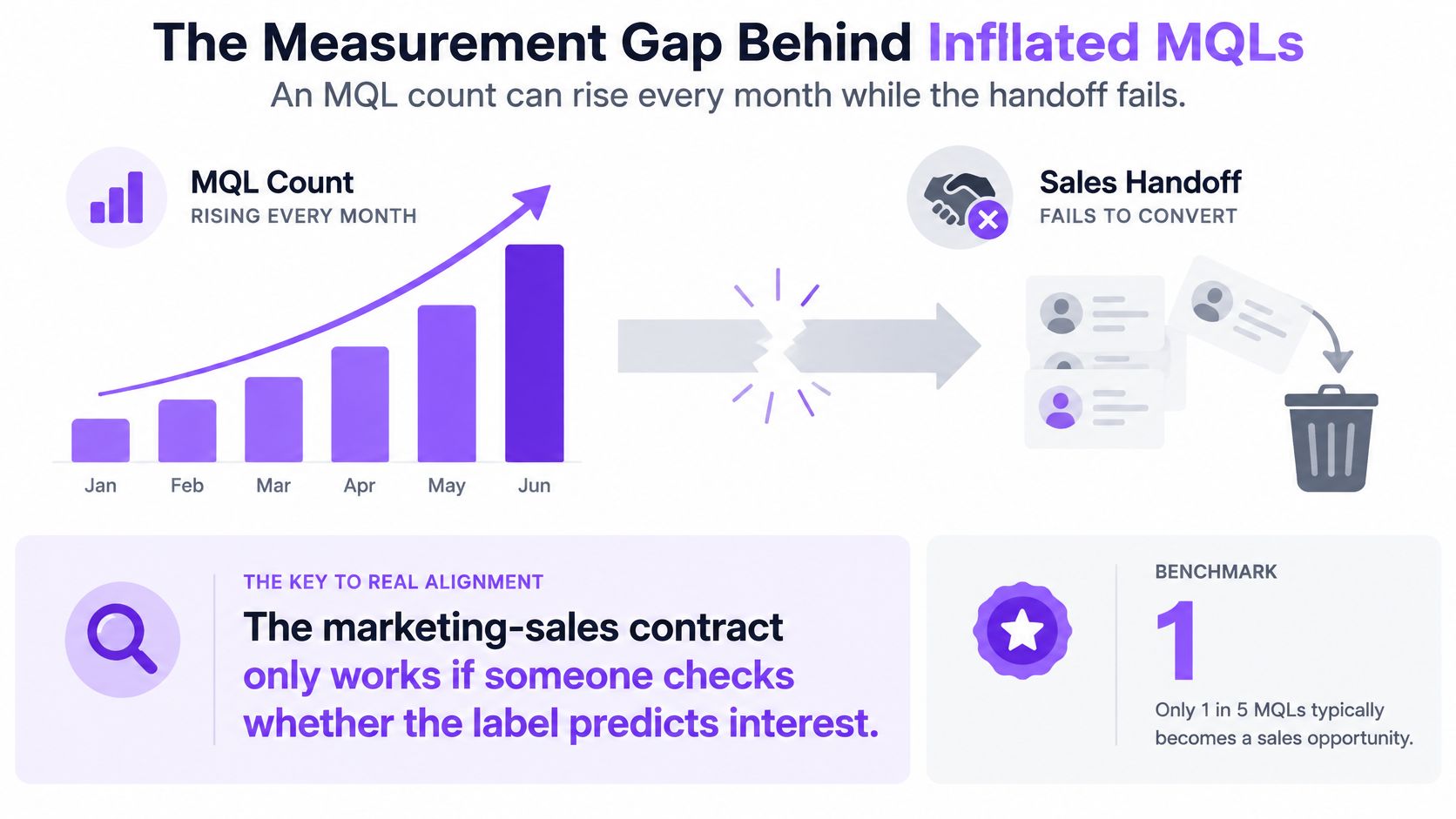
An MQL count can rise every month while the handoff fails every month. That happens when marketing is paid on volume, sales is paid on pipeline, and nobody owns the conversion between the two labels.
The MQL became a contractual handoff during the rise of marketing automation: marketing committed to delivering leads above an agreed threshold, and sales committed to accepting and working them. A contract nobody audits is just a slogan. A benchmark report summarized in MarketScale’s coverage of Belkins’ MQL-to-SQL finding says 38% of B2B teams do not measure MQL-to-SQL conversion. Among organizations that do measure, progression averages approximately 12% to 18%, which means 85% of MQLs may fail to become SQLs at the 15% midpoint.
Alignment Is the Second Gap
A 2025 global survey of 534 B2B revenue marketers found that 38% considered closing deals and lead qualification their top barriers, while only 24% of low-performing organizations reported strong sales-marketing alignment, compared with 75% of high performers, according to Pipeline360’s 2025 State of B2B Pipeline Growth report.
Those numbers explain a familiar meeting. Marketing presents MQL growth. Sales presents anecdotes about bad leads. Neither side can prove its case by source, segment, behavior, or response time, so the loudest story wins. A workshop will not fix that. Shared definitions, acceptance criteria, and rejection reasons will.
Replace the volume count with three checks: the share of MQLs sales accepts, the share that books a conversation, and the share that creates pipeline.
Report each check by source, behavior, segment, and response time. Cheap MQLs that sales rejects are not savings; cut or rework that channel. A slower channel that produces accepted pipeline deserves protection even if its raw volume looks weak. When follow-up is the failure, fix routing and coverage before touching the score model. Weak fit, thin intent, duplicate records, bad timing, and follow-up that never happens all produce the same flat SQL line, and each one needs a different fix.
Write the Handoff Rule Before You Chase Volume
Leave with four lines written down, not another dashboard. Put them in the CRM, the SLA, and the enablement doc your SDRs read.
- An MQL is created when: these fit criteria, events, or score-band conditions are met.
- A human gets the lead immediately when: band 1 conditions show ICP fit plus live intent.
- Sales confirms before SQL: a live problem, enough priority, and access to the buying group.
- We publish monthly: our MQL-to-SQL rate by source, segment, and response time.
If that rate is unpublished, more leads won’t fix the handoff. They’ll only give you more unmeasured handoffs. Teams still tracking this in spreadsheets can use a roadmap beyond spreadsheet-based lead tracking to move the rule into systems that enforce routing, timing, and reporting instead of relying on memory.
For teams whose best research happens on the website, act on the page. Our AI Chat engages every website visitor 24/7, answers questions instantly, qualifies leads automatically, and hands hot prospects to live reps or books the demo itself. Inbound video can open when a high-intent visitor reaches pricing or product pages, so the conversation starts while intent is still warm. In the Salesforge case study, demos booked rose 30% from the same website traffic, and the widget triggers 200+ inbound calls a month, about 10 opportunities a month.
Start with your own site and traffic before you commit to anything. Walk through the four-line rule against your pricing page, your repeat visitors, and your current response times, and you’ll see quickly whether the leak is definition, speed, or coverage.
Stop treating marketing qualified leads as a volume trophy and start treating your pricing and product pages as the place where qualification gets proven in conversation. Visit Captiwate to see how live video, AI chat, intent detection, and automatic routing turn high-intent visitors into booked demos without waiting for a form. Bring your own website and traffic, and test the handoff before you spend another month chasing MQLs sales won’t accept.