What should a third visit to your pricing page change about the next sales move? A buying signal is an observable behavior or piece of context that updates where a prospect likely sits in the purchase process and how much attention may fit. The evidence usually arrives before the seller: in the 6sense Buyer Experience Report, 94% of B2B buyers had already ranked vendors on a shortlist before contacting any seller in 2025.
That makes a signal closer to a forecast than a doorbell. It shifts the odds; it rarely proves intent by itself. The useful response is often validation: check the account fit, look for a second behavior, confirm timing before you spend a call.
Table of Contents
- What Buying Signals Are and Why They Matter
- Behavioral and Contextual Signals Compared
- Stage Indicators and What Each One Predicts
- How Signals Combine and Where They Mislead
- How to Turn Signals Into Sales Action
- Confirm Your Signal Rules Before the Next Pipeline Review
What Buying Signals Are and Why They Matter
A signal can be a behavior, such as returning to the pricing page three times in a week, or a piece of context, such as a target account hiring its first sales engineer. Both change what you believe about that account. Neither one is a purchase.
Think about a car dealership. A shopper who glances at the financing page on the way to the exit tells the salesperson almost nothing. The same shopper who comes back on Saturday with two questions, what is my trade-in worth and what would the monthly payment be on this trim, is mid-decision. Same person, same website, completely different commercial meaning. The difference is repetition, specificity and a question that only matters to someone planning to buy.
B2B works the same way, at a slower tempo. Buyers research for weeks or months before they fill in a form or ask for a demo, so the useful evidence sits in a sequence of small actions: several visits, a comparison page read, a question about integrations, a return from a different device.
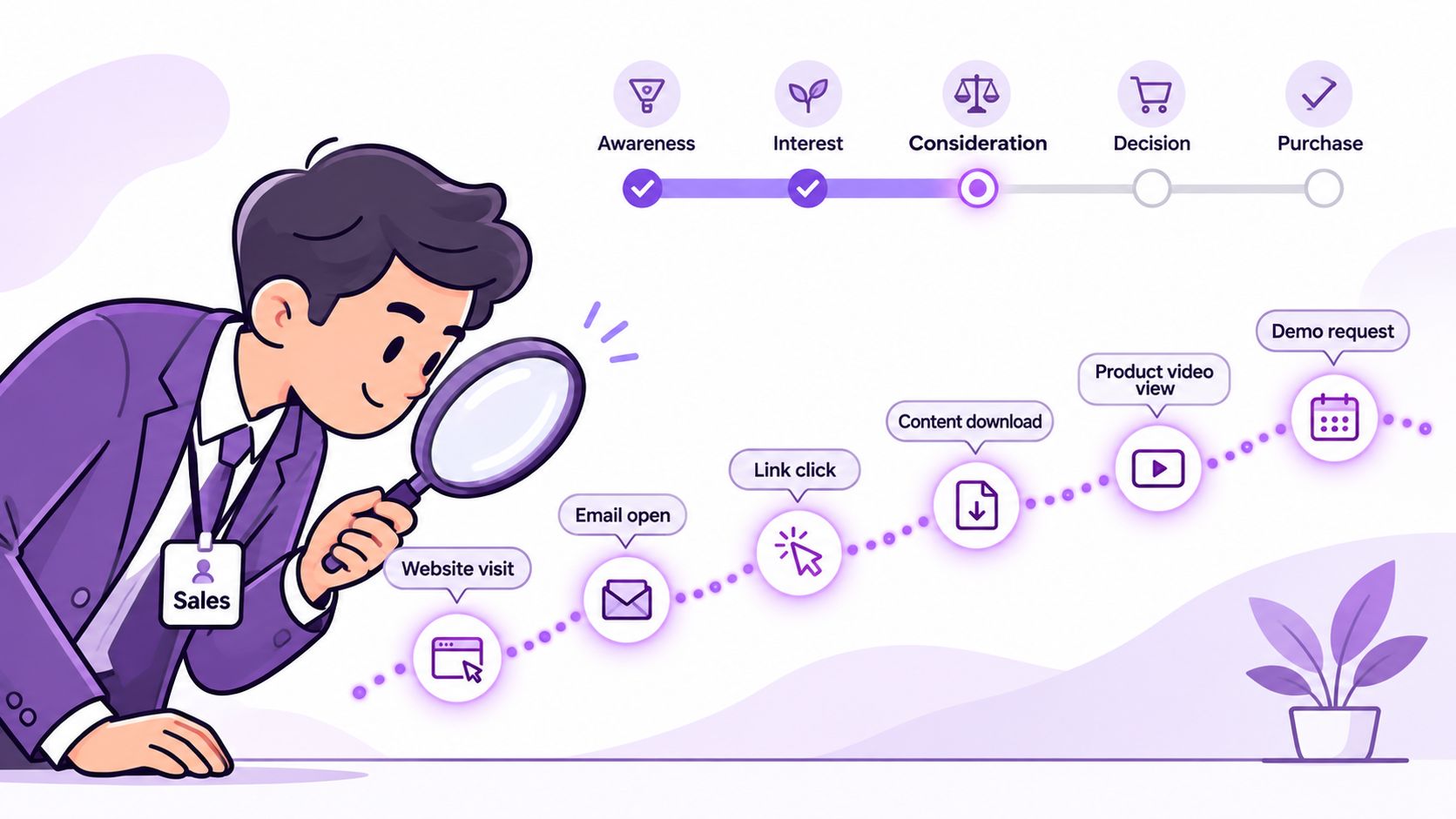
That sequence has become harder to read because it is spread wider. McKinsey’s research on B2B growth found B2B customers used an average of six interaction channels during the decision journey in 2015, rising to ten in 2022, double the 2016 level. A prospect’s intent now leaks out through many small behaviors instead of one loud one.
Why one visit proves almost nothing
A single session carries almost no information because it can be produced by almost anything: a mis-click, a link from a newsletter, a student writing a paper, an analyst tracking a competitor. What raises the probability is accumulation with context. The same account, several visits, content that only matters to someone solving your problem.
The working definition: a buying signal is evidence that shifts your estimate of how likely a purchase is and how soon. It is not a verdict, and it is never a reason to skip the conversation where you find out.
Here’s a test you can run this afternoon. Pick one account that became active in the last month and write down the three actions that happened before anyone from your team spoke to them. If you can name them, you have a trackable pattern. If you can’t, the gap is in your instrumentation, not in the buyer’s behavior.
Behavioral and Contextual Signals Compared
Lumping every alert into one queue leads to arguments about which ones deserve attention. Splitting signals into two families makes the prioritization obvious.
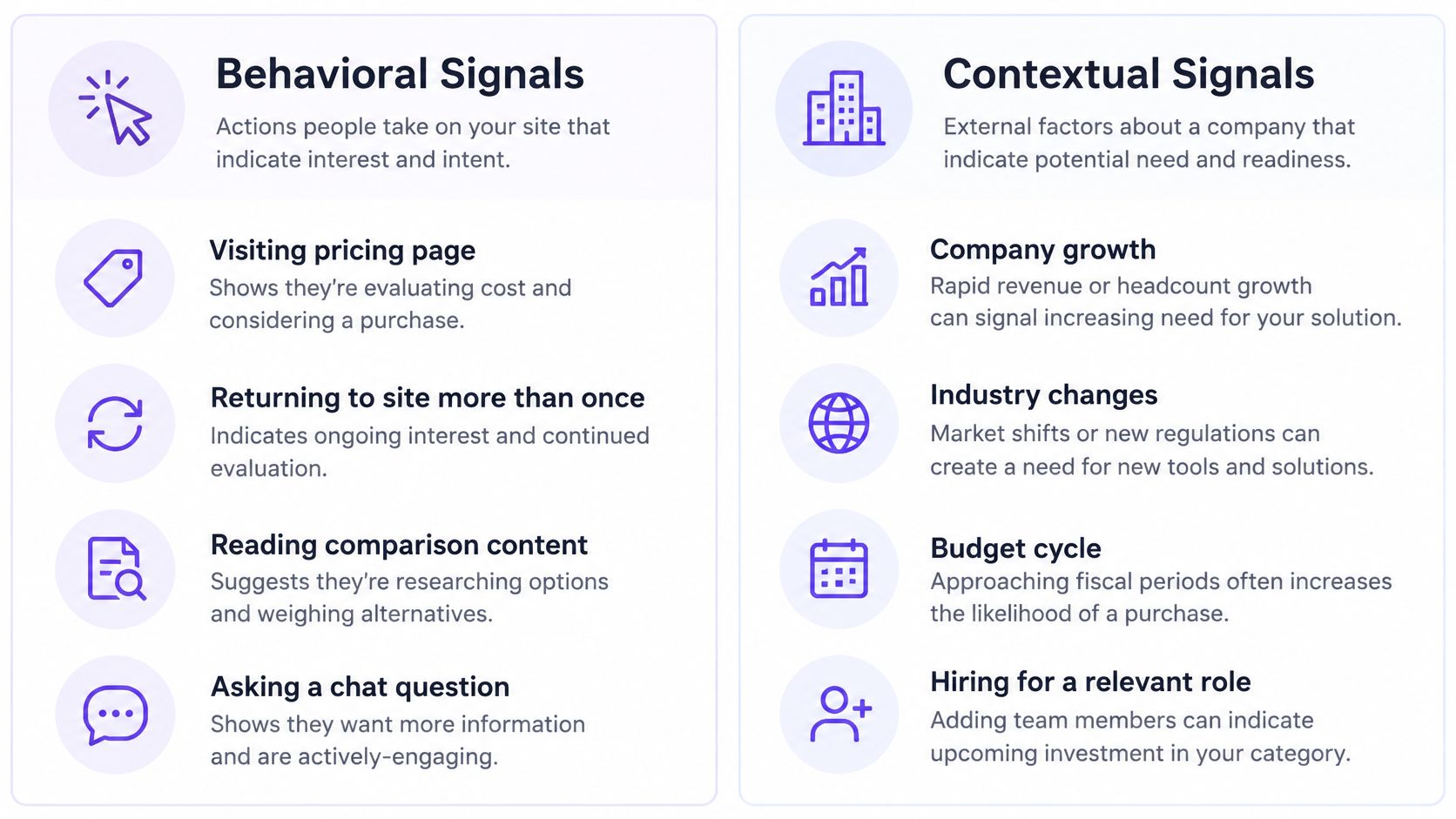
Behavioral signals are what a prospect does. Contextual signals describe who the account is and what’s happening around it. One tells you someone is moving; the other tells you whether the movement could turn into money.
| Dimension | Behavioral signals | Contextual signals |
|---|---|---|
| What it measures | What the prospect does | Who the account is and what is happening around it |
| Typical examples | Pricing page visits, repeat visits, comparison page reads, demo requests | Company growth, funding round, leadership change, hiring for related roles |
| Usual source | First-party site activity, chat, email replies, product usage | Firmographic data, news, CRM history, third-party intent data |
| Strength on its own | Weak to moderate, since one visit can be accidental | Weak, because good fit alone does not mean current interest |
| Strength combined | Strong when repeated and specific to the solution | Strong when it explains a live need behind the behavior |
Each family is weak alone, and for different reasons. A pricing visit can be a mis-click. A well-funded company can have no live problem to solve this quarter. Comparison content, by contrast, carries more weight than its quiet appearance suggests: McKinsey’s research on the B2B buying journey identified product comparison as the biggest buying-journey pain point for 46% of buyers. People comparing options are usually choosing between them.
There’s a timing reason comparison pages matter so much. The 6sense Buyer Experience Report found that 94% of B2B buyers ranked vendors on their shortlist before contacting any seller, which means the comparison work happens while you’re still invisible.
A worked example
Say a 200-person software company closed a funding round last quarter. That’s contextual: money, new targets, usually new tooling decisions. Now say two people from that company visit your pricing page twice in one week and one of them opens your integrations documentation. That’s behavioral.
Neither signal proves intent. The funding could sit untouched for two quarters, and the visits could belong to a curious engineer. Together, inside the same fortnight, they point at a window worth attention, and the appropriate first move is a helpful, optional conversation rather than a cold pitch.
Practical rule: a signal becomes useful when a behavioral and a contextual signal point at the same account inside the same time window. Everything else belongs on a watch list.
If you’re still fuzzy on where bought-in topic data fits, this explanation of what intent data is and how it differs from first-party behavior draws the line clearly.
Stage Indicators and What Each One Predicts
Treating a signal as a yes-or-no answer wastes most of its value. Read it as a stage indicator and it starts predicting something. 6sense’s analysis of buying journeys reported on a behavioral study of 594 B2B companies that put approximate 90-day opportunity probabilities at 20 to 49% for awareness, 50 to 69% for consideration, 70 to 84% for decision and 85 to 100% for purchase-stage accounts, defining in-market accounts as those showing awareness through purchase behavior.
| Stage | 90-day opportunity probability | Typical signals | Sales response |
|---|---|---|---|
| Awareness | 20-49% | Early research and general content reads | Enrich the account and send relevant content |
| Consideration | 50-69% | Repeated comparison and pricing visits | Prioritize for SDR outreach |
| Decision | 70-84% | Pricing, security or integration questions plus demo interest | Route to a rep the same day |
| Purchase | 85-100% | Contract, timeline or implementation questions from several people | Sync follow-up across the buying group |
What each range should change
The awareness band is close to a coin flip, which is why it deserves enrichment and content rather than a rep’s morning. Someone at 20 to 49% is learning the category, and a well-timed explainer does more than a call request.
Consideration is where repeated comparison and pricing activity starts separating accounts from the crowd. That’s the point to hand an SDR a prioritized list instead of a raw feed. The cause and effect is straightforward: sustained, comparative, multi-person engagement is what moving from general education toward internal consensus looks like from the outside.
Decision-stage accounts have usually stopped browsing and started checking whether you’d survive their internal review, asking about security, integrations, pricing structure or a demo. Those questions belong with a rep the same day. Purchase-stage activity, meaning contract terms, timelines and implementation questions coming from several people, calls for synchronized follow-up across the whole buying group so nobody hears a different story.
Calibration check: judge your alert thresholds by meetings held, qualified opportunities and revenue, not by how many conversations your team logged. A signal earns its place only when it improves prioritization and conversion.
How Signals Combine and Where They Mislead
A buying signal is best modeled as an observable event that updates the estimated probability of purchase, not as a page view or an isolated click. Getting from events to a judgement means knowing where each event came from.
Directed, detected and derived signals
Forrester’s framework for decoding B2B buying signals separates directed signals captured in seller-controlled channels such as websites, landing pages, email and outreach from detected signals acquired from third parties such as intent-data providers, and from derived signals created by contextualizing several observations.
The third category is where judgement lives. A pricing-page visit is a weak-to-moderate directed signal. Repeated visits from the same account, several stakeholders reading product material, and a request for implementation or contract information combine into something far stronger. Accumulation plus context is the mechanism: repetition makes an accident less likely, and solution-specific content makes idle curiosity less likely.
Score five dimensions, not one event
Operationally, score each account on recency, frequency, content specificity, account fit and buying-group breadth, and let the weight decay as the activity ages. That structure answers the question reps ask, which is who to call first.
When several dimensions align, act immediately. A target account that hits pricing and product pages within a week and then opens a chat has earned a human conversation, and an instant one. A single visit from a poorly matched company goes to nurture or AI qualification instead, where a helpful answer costs nothing and a cold call costs credibility.
Where signals mislead
A buying signal shows interest, not readiness, and the gap between the two can be wide. Demandbase’s explainer on intent data is blunt about the reason: intent is probabilistic, and its usefulness depends on source quality, topic relevance, recency, account resolution and how it’s combined with other signals. Third-party topic surges help you rank accounts at scale, but they shouldn’t trigger sales contact on their own. Identified first-party behavior and product usage are generally stronger indicators.
The contrarian implication catches people out. More signals do not automatically improve qualification. Low-quality or badly matched signals raise the false-positive rate, waste SDR capacity and produce outreach that feels intrusive because it is. A student researching a paper, a job seeker, a competitor’s analyst and a genuine buyer look identical on a pricing page.
Before you reach out, name the evidence that disagrees with your theory. If nothing disagrees, you’re not looking at a signal. You’re looking at a hope with a timestamp.
Triangulate before you trigger
Require several things before treating activity as intent:
- A high-value page visit, such as pricing, implementation or security documentation
- Repeat engagement from the same account rather than one session
- Several people from that account, even anonymously, across different content themes
- Relevant business context that explains why now
- A time-bound action, such as a chat question, a demo request or a meeting booking
Get those aligned and you can justify a live conversation. Use the interaction as a validation step rather than as proof of intent, then feed what came out of it back into the account record. The questions that do the confirming work are the ones covered in this guide to discovery questions in sales, because a 20-minute conversation tells you more about readiness than a month of page views.
How to Turn Signals Into Sales Action
The strongest activity often happens where analytics can’t see it: private communities, peer recommendations, direct messages, a Slack group you’ll never be invited to. Starr Conspiracy’s brief on B2B buying journey trends notes that 72% of B2B purchases involve complex buying groups, which means one visible visitor may be a single participant rather than the economic buyer, the technical evaluator or the person holding the budget.
That changes the question. It isn’t “who do I call about this visitor”, it’s “what is this account telling me collectively”. Run the routine below in order.
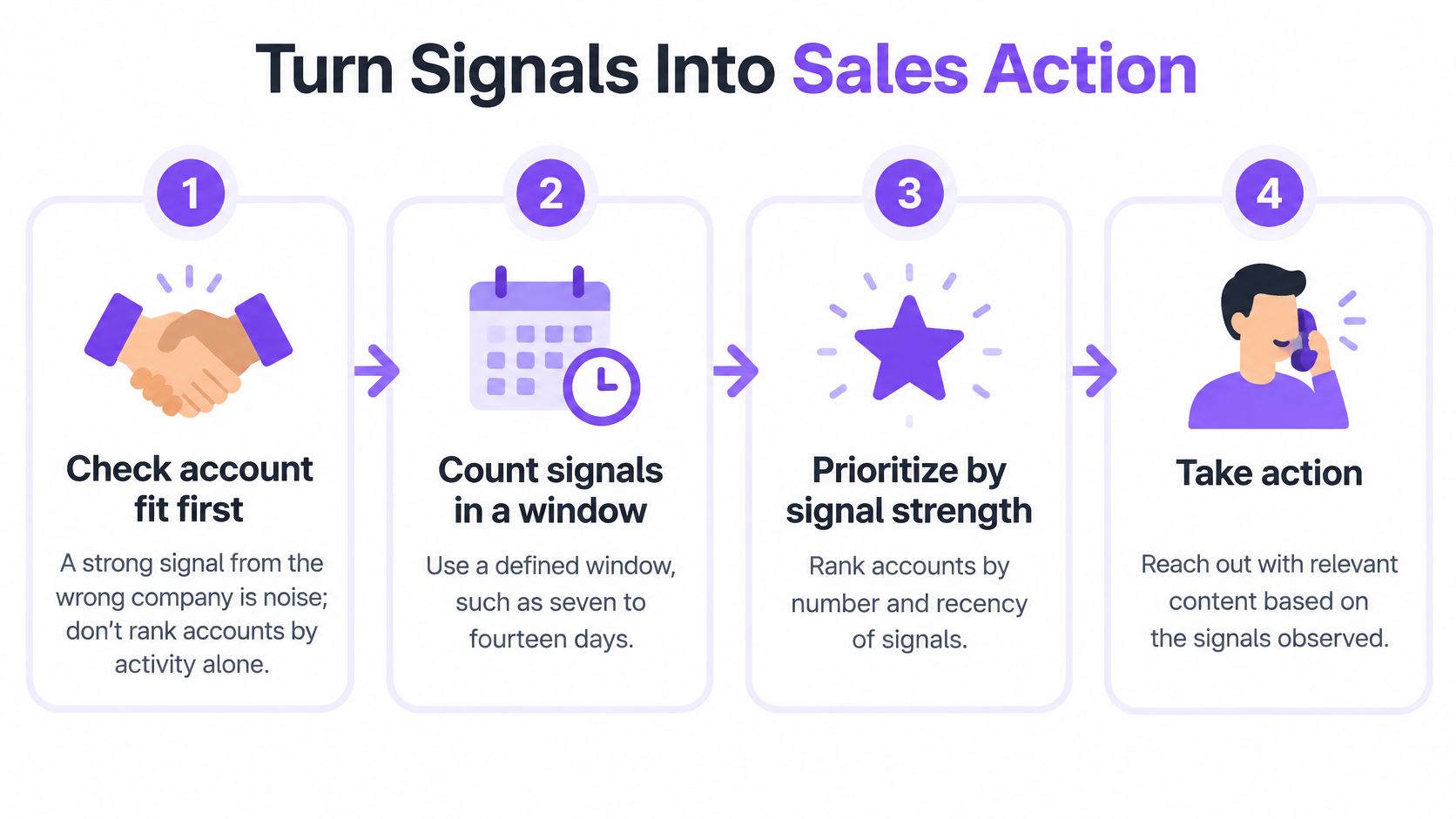
- Check account fit first. A strong signal from the wrong company is noise. The common slip is ranking accounts by activity alone and handing reps a list of enthusiastic misfits.
- Count signals inside a defined window, seven to fourteen days works in practice. The slip here is counting raw visits, which overstates intent and rewards the noisiest accounts.
- Check buying-group breadth. Several roles from one account outrank one person refreshing a page. The slip is contacting the single visible visitor and assuming you’ve reached the decision.
- Choose the response from the stage the signals point to, using the stage table as your playbook. The slip is responding to every alert the same way, which is how nurture-stage accounts get a same-day call and decision-stage accounts get a newsletter.
- Offer a voluntary, low-friction step such as AI qualification, click-to-meet or a browser-based call. The slip is a cold message to a named individual, which converts a quiet evaluation into a reason to look elsewhere.
- Record what happened. Which stakeholder participated, what problem they confirmed, whether a next step was agreed. The slip is skipping this, which leaves you unable to trace any signal back to its result.
- Review outcomes monthly, comparing meetings held and qualified opportunities against the alerts that produced them. The slip is reviewing volume, because a busy signal feed feels productive even when it converts nothing.
Speed matters inside that routine, but it’s the kind of speed that comes from a prepared path rather than from a rep’s reflexes. The trade-off worth naming is real: response time on high-intent accounts pays off, while fast outreach on weak signals buys you a reputation problem. These notes on speed to lead cover where the line usually sits.
The governance rule frames everything above. Company-level identification is not the same as permission to identify or contact a named individual, so keep account tracking inside your consent and policy limits, and let people opt into the conversation.
Confirm Your Signal Rules Before the Next Pipeline Review
Bring a short list of decisions to the meeting rather than a dashboard tour. Each one takes a few minutes to settle and removes a whole category of argument later.
- Name your directed signals. Write down which behaviors count on your own site: pricing and product page visits, repeat visits within a session or week, comparison reads, demo requests, chat questions. If it isn’t written down, two reps will score it two ways.
- Set the counting window and the trigger threshold. Seven to fourteen days is workable for most B2B cycles. Decide how many qualifying signals inside that window justify a human response.
- Assign one response and one owner per stage, with a deadline attached, so every alert has somewhere to go and someone accountable.
- Name the contextual data you’ll use for fit, whether that’s firmographics, CRM history, technology signals or funding news, and decide how buying-group breadth gets recorded in the CRM.
- Put a monthly review on the calendar measured in meetings held and qualified opportunities, not alert counts.
The privacy line to state out loud: you may know a company is researching you. That is not permission to name and contact an individual, so route through a voluntary step they can choose.
A pilot makes the rules concrete. At Captiwate, an inbound video call is triggered when a high-intent visitor lands on the pricing or product page, which turns that page into a natural test bed: run the trigger there alone for a few weeks, log the outcome against each visit, then compare the results with your rule set and adjust the thresholds.
If you do only one thing after reading this, decide the single signal your team will act on this week and the exact response it triggers. One signal, one owner, one deadline. Expand from there.
If your team already knows which behaviors matter and still loses the moment between interest and conversation, Captiwate closes that gap by turning high-intent visits into live conversations instead of forms and waiting. Visitors who land on pricing or product pages can be greeted with an in-browser video call, AI chat that qualifies and books, or a one-click meeting with the right rep, with every outcome synced back to your CRM. Visit Captiwate to see how the signals you’ve defined become conversations your team can measure.