Most advice about B2B intent data starts with the wrong purchase: buy a larger third-party feed, add more topics, and send more alerts to sales. That approach creates activity, not necessarily pipeline. A topic surge can reflect a competitor, a student, a consultant, an existing customer, or a misidentified network connection. If your team treats every signal as a reason to call, more data only makes the false-positive problem more expensive.
The useful question is narrower: which accounts are showing credible interest on your own properties, and what can you do while that interest is visible? Third-party signals can help you find accounts earlier, but first-party behavior should validate the hypothesis. Then routing, AI qualification, and immediate human engagement turn a passive signal into an observable revenue event.
Table of Contents
- The Reality of Modern B2B Buyer Research
- Comparing First-Party and Third-Party Intent Signals
- Scoring Intent Data to Avoid False Positives
- Operationalizing Intent Signals Across Revenue Teams
- Navigating Privacy and Compliance in Intent Tracking
- Measuring the True ROI of Intent Data
- Turning Anonymous Traffic into Live Conversations
The Reality of Modern B2B Buyer Research
B2B buyers often form a view of a supplier before a seller enters the conversation. In McKinsey’s survey of more than 1,000 B2B buyers across four countries and multiple industries, 76% said speaking with a salesperson was helpful when researching a new product or service. That preference fell to approximately 50% for repeat purchases involving new or different specifications and 15% for exact repurchases. The implication is practical: the value of sales involvement changes with the buyer’s context and stage, so a static lead list can’t tell a rep who needs help now. McKinsey’s research on digital B2B buying behavior shows why timing matters.
The same research found that 46% of respondents would buy through a supplier’s website if online purchasing were available and efficient, while only 10% were making B2B purchases online at the time. Buyers want digital independence, but they still encounter friction. McKinsey also reported that 46% found it difficult to compare products accurately online, which means behavioral data works best alongside clear product information and accessible assistance.
Intent is a timing signal
Gartner reported in 2025 that 61% of B2B buyers preferred an overall rep-free buying experience, based on a survey of 632 buyers conducted in August and September 2024. Buyers preferred online self-service for general information and learning, while using supplier representatives for selected activities. Gartner’s 2025 buyer survey captures the tension revenue teams need to handle: buyers don’t want a rep inserted into every research task, but they may welcome help when the question becomes specific, urgent, or difficult to resolve alone.
That makes intent data useful, but not prophetic. A visit indicates interest, not budget, authority, urgency, or use-case fit. Treat it as a timing signal that helps rank accounts for attention, then require stronger evidence before triggering an interruption.
Practical rule: Never let a third-party topic spike trigger outreach by itself. Make it earn escalation through fit and first-party engagement.
A form fill isn’t a perfect buying signal either. Some buyers avoid forms until they’re ready to speak, while others submit them for access to educational material without any active project. Repeat visits, pricing-page activity, product comparisons, return engagement, and meeting initiation provide more useful context because they show how interest develops over time.
Comparing First-Party and Third-Party Intent Signals
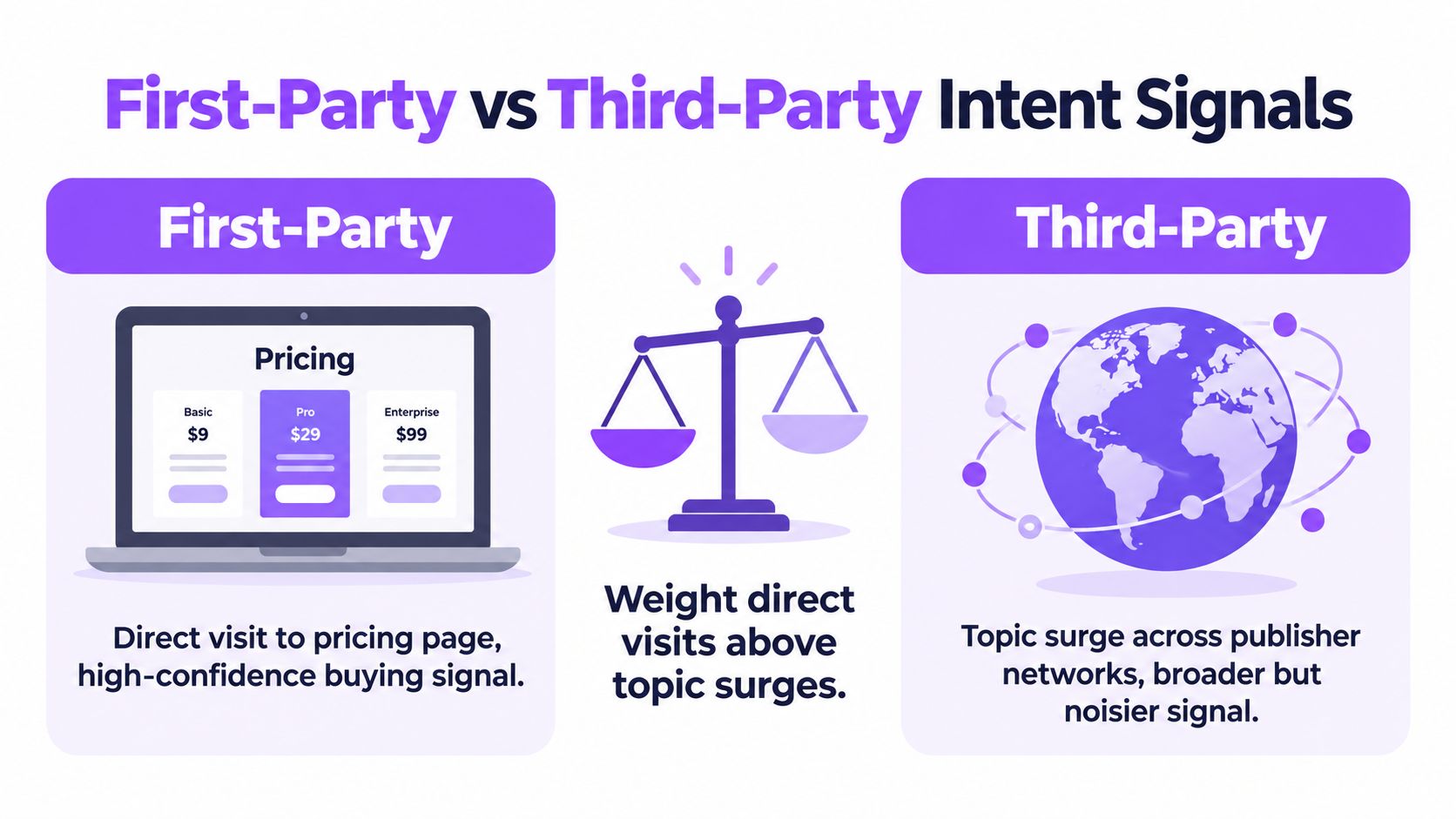
First-party and third-party intent answer different questions. First-party data asks what an account did on your properties. Third-party data asks whether activity observed elsewhere resembles research in your category. The first is narrower and more defensible. The second can expand your field of view, but it carries more uncertainty.
| Signal type | What it can show | Main limitation | Sensible action |
|---|---|---|---|
| First-party behavior | Visits to product and pricing pages, repeat sessions, chat activity, and meeting actions | It only sees buyers who reach your digital properties | Use it to validate and escalate |
| Third-party activity | Topic research across external publishers and networks | IP-to-company matching and topic taxonomies can introduce noise | Use it for discovery and account prioritization |
| Combined view | External research plus direct engagement | Requires clear identity, fit, consent, and routing rules | Treat direct behavior as the stronger evidence |
Third-party topic surges can resolve to the correct company only about 30% to 65% of the time for stronger providers, with accuracy falling for residential, mobile, VPN, and cloud-routed traffic, according to available analysis from The Starr Conspiracy’s discussion of buying intent data. That range isn’t a minor technical footnote. It changes how a sales team should use the feed. A low-confidence account may belong in advertising or nurture, not in an SDR’s immediate call queue.
Why direct behavior carries more weight
A direct visit to a pricing page tells you that someone reached your commercial property. It still doesn’t prove a purchase is imminent, but it offers observable context that a generic category surge lacks. A single visit might be casual research. Repeated visits from the same account, movement between product and pricing pages, and an interaction with chat or scheduling create a much stronger validation chain.
Third-party feeds remain useful for identifying accounts that haven’t visited you yet. They can support account selection, content distribution, and ABM testing. The mistake is allowing their scale to dictate sales capacity. Give each source a confidence label, preserve the original event, and compare the source against downstream outcomes rather than trusting the vendor’s score at face value.
Teams that share sales collateral or buyer research should also preserve document context. A practical trackable link sharing guide can help teams understand whether shared material is being opened and revisited, which adds useful first-party evidence to a broader account timeline.
For a deeper comparison of platforms and workflows, see Captiwate’s guide to buyer intent data tools. The selection criteria should be operational, not cosmetic: source transparency, event-level detail, identity confidence, consent controls, CRM synchronization, and the ability to trigger a conversation when a validated signal appears.
Scoring Intent Data to Avoid False Positives
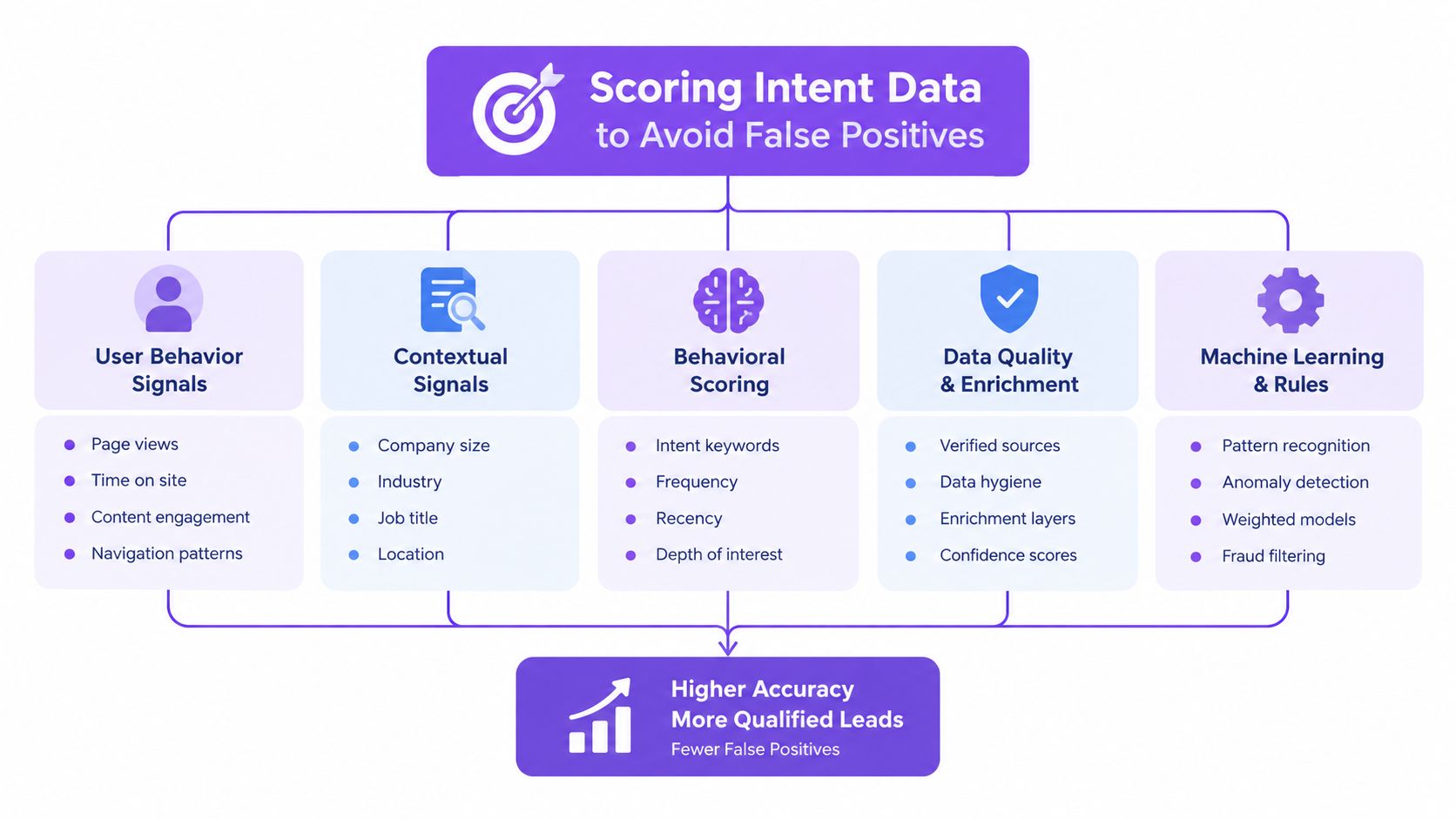
An intent score becomes dangerous when it pretends to be a probability of purchase. A safer architecture keeps three dimensions separate:
- Fit, including firmographic and technographic relevance.
- Behavioral intent, including category or vendor research.
- First-party engagement, including high-value activity on your properties.
An account can score highly on one dimension and poorly on the others. A large company researching your category may be commercially irrelevant if it uses an incompatible technology stack. A perfect-fit account may deserve nurture if its only activity is an old blog visit. A repeat pricing-page visitor may merit attention only when the account also matches your target market.
A workable scoring model
Start with hard gates before adding behavioral points. For example, an alert can require target-market fit, an eligible geography, and a relevant technology environment. Only then should repeated product visits, pricing activity, return sessions, or meeting interactions increase priority.
Use recency decay rather than treating old and new activity equally. A pricing visit yesterday should matter more than a similar visit from an earlier research cycle. Keep the event history intact, but reduce its routing weight as it ages. This prevents a stale account from occupying the same queue position as an account showing fresh engagement.
Separate scores can make routing easier to explain:
| Dimension | Question | Example output |
|---|---|---|
| Fit | Should we sell to this account? | Qualified, review, exclude |
| Intent | Is the account researching the category or vendor? | Rising, stable, cooling |
| Engagement | Has the account taken a meaningful action on our properties? | Validated, unvalidated |
Available benchmark reporting associates intent-flagged accounts with roughly 1.5 to 2 times the win rate of broader account populations, 30% to 60% higher response rates, and opportunities closing 15% to 25% faster, but those figures vary with thresholds, attribution windows, market, and routing quality. The Launch Leads analysis of buyer intent data is useful here because it also stresses the need to measure incremental opportunity creation rather than engagement volume.
Score the account, not just the visitor
Buying committees create another source of false confidence. Recent industry reporting says 72% of B2B purchases involve complex, multi-stakeholder buying groups, while other market research describes committees averaging roughly 10 to 11 stakeholders, as summarized by 6sense’s demand generation research. A single pageview from one person may represent curiosity or an internal influencer. Repeated research from different functions at the same account can be stronger evidence of an active evaluation.
Build an account timeline that groups anonymous and known activity carefully. Look for converging behavior across roles, product areas, and sessions. Don’t expose more individual detail than your governance rules allow, and don’t turn every anonymous event into a personal alert. The objective is to identify account momentum, then let an approved human or AI workflow qualify the next step.
Operationalizing Intent Signals Across Revenue Teams
A dashboard full of hot accounts doesn’t create pipeline. A revenue team needs a rule that connects a signal to an owner, a response time, a message, and a recorded outcome. Without those links, marketing sees engagement, sales sees noise, and operations spends its time reconciling disconnected systems.
Use a routing design that answers five questions:
- Who owns this account?
- What evidence caused the alert?
- How quickly should someone respond?
- What channel fits the buyer’s behavior?
- Where will the outcome be recorded?
Route by confidence and fit
A practical flow starts by separating accounts into tiers. High-fit accounts with recent first-party activity can trigger an immediate SDR or account executive alert. High-fit accounts with third-party activity but no direct visit can enter targeted advertising or nurture. Low-fit accounts should remain excluded, regardless of how impressive the topic spike appears.
Write the trigger in plain language. “Target account revisits pricing and product pages, has a valid company match, and meets fit criteria” is auditable. “Intent score exceeds threshold” is not enough unless the team can inspect the events behind that score.
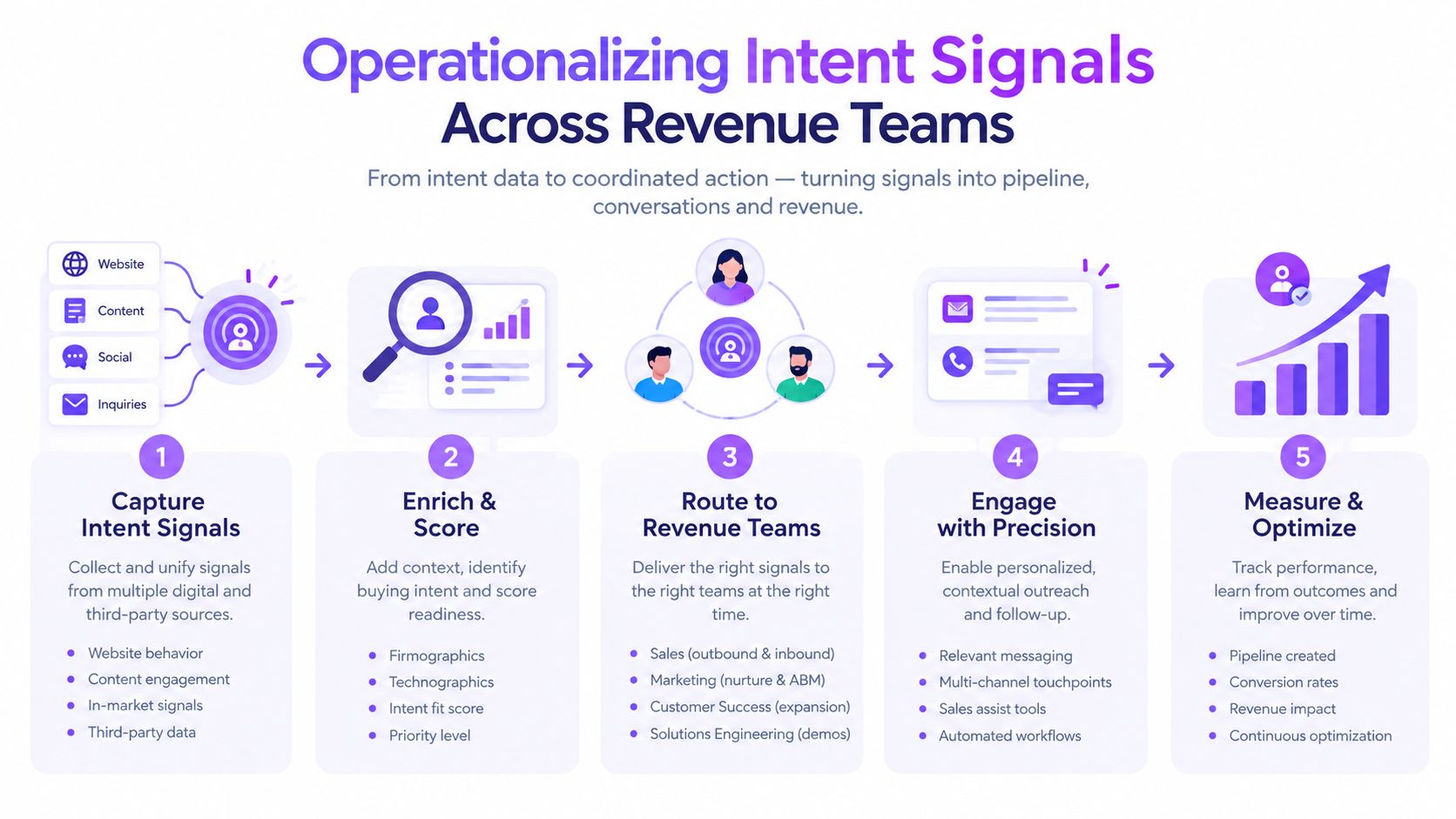
Make the handoff visible
Send alerts to the tools people already use, such as Slack or Microsoft Teams, but include the evidence and the next action. An alert should show the account, relevant pages or behaviors, confidence, owner, suppression status, and a suggested route. It shouldn’t force a rep to open several systems before deciding whether the signal matters.
AI chat provides coverage when a buyer researches outside normal selling hours. The AI can answer approved questions, qualify the use case, collect a meeting preference, and route the conversation according to the same fit and suppression rules used by sales. During staffed hours, a validated high-intent visitor can receive an invitation to an in-browser conversation instead of another form.
The handoff is part of the product. A signal that arrives without an owner, context, or response path is just another notification.
For teams evaluating the operational layer, Captiwate identifies company and visitor behavior, connects high-intent activity to chat, live in-browser video, AI qualification, scheduling, and CRM workflows. That makes it one possible implementation path alongside tools such as HubSpot, Salesforce, Slack, Microsoft Teams, and dedicated ABM platforms. The important test is not the interface. It’s whether the system records the trigger and the resulting conversation in the account history.
A short implementation cycle can follow this order:
- Start with one commercial page: Choose pricing or a core product page where a conversation can add value.
- Add fit gates: Exclude existing customers, competitors, students, and unsupported markets where possible.
- Define ownership: Map each qualified account to an SDR, AE, or pooled inbound queue.
- Create the fallback: Send unworked or off-hours visitors to AI qualification and scheduling.
- Review outcomes: Adjust thresholds using meetings, qualified opportunities, and suppression events.
Navigating Privacy and Compliance in Intent Tracking
The difficult privacy question isn’t whether a company visited a website. It’s what your team does when an anonymous company-level signal becomes an identifiable person, a CRM contact, and an automated outreach target.
Under GDPR-oriented guidance, processing personal data needs a documented lawful basis. Legitimate interest generally requires a defined purpose, necessity, and balancing assessment. Data obtained from a third party can also create Article 14 transparency obligations, while cookie and identifier tracking may require consent under applicable ePrivacy rules. The available guidance on B2B intent data privacy and compliance provides a useful basis for designing controls before procurement.
Preserve provenance
Every signal should carry enough context for an operator or auditor to understand it:
- Source and collection method, such as your website, a publisher, or a partner.
- Timestamp and identifier type, including whether the record is account-level or person-level.
- Confidence and matching logic, especially for IP-to-company resolution.
- Retention period, with shorter retention for raw behavioral events.
- Processing status, including consent, objection, suppression, or unresolved identity.
Keep intent records separate from CRM contact fields until identity resolution is justified. An account-level visit shouldn’t automatically become a person-level lead. Restrict automated outreach to approved segments, and synchronize suppression lists across the CRM, chat, scheduling, advertising, and collaboration systems.
Make compliance operational
Privacy-preserving defaults don’t have to eliminate revenue use cases. Favor account-level intent, make consent and opt-out controls configurable, document the rule that triggered each engagement, and give buyers a clear way to object. If a buyer opts out in chat, that status must travel with the account and contact wherever the next action could occur.
Teams introducing AI into qualification should also classify the associated risks, not just review model accuracy. A practical resource to find out about AI risk classification can help frame questions around transparency, oversight, data handling, and escalation. For broader implementation context, Captiwate’s overview of information security and compliance offers a reference point for evaluating security controls alongside intent workflows.
The right standard is simple: sales velocity shouldn’t depend on hiding how a signal was collected. If an operator can’t explain the source, legal basis, retention, and routing rule, the signal isn’t ready for automated outreach.
Measuring the True ROI of Intent Data
The number of accounts flagged is a poor definition of success. So are dashboard visits, alert volume, and raw content engagement. Those measures tell you whether the system is busy. They don’t tell you whether intent-driven action created incremental pipeline.
Create a holdout group before turning every eligible account into an activated audience. Compare accounts exposed to intent-based routing with similar accounts that receive the normal process. Track the full path from signal to commercial outcome:
- Signal quality: Was the account match correct, and was the source first-party or third-party?
- Response behavior: Did the account engage with the outreach, chat, or meeting option?
- Qualification: Did a human or AI workflow confirm fit, need, and timing?
- Opportunity creation: Did the interaction produce a sales-qualified opportunity?
- Pipeline progression: Did the opportunity advance, stall, or close?
- Economic outcome: Did intent-driven treatment contribute to closed-won revenue?
Measure precision, not just volume
For each source, calculate how often an alert leads to a meaningful outcome. A third-party topic surge might produce broad reach but weak precision. A repeat pricing-page visit might produce fewer alerts but stronger opportunity creation. Compare these sources by account segment, trigger, routing path, and response window.
Reported benchmarks associate intent-flagged accounts with faster response and stronger commercial outcomes, but the same source warns that thresholds, attribution windows, market conditions, and routing quality change the result. Use those benchmarks as hypotheses, not promises. Your own holdout design should determine whether the system is adding value.
A useful ROI question is not “How many hot accounts did we find?” It’s “How many qualified opportunities would we have missed without the signal?”
Record negative outcomes as carefully as positive ones. A wrong-company match, an irrelevant research visit, a duplicate customer, or an annoyed prospect should lower confidence in that source or rule. Over time, this feedback lets operations adjust thresholds without relying on a vendor’s black-box score.
Turning Anonymous Traffic into Live Conversations
The commercial value of intent is highest when a buyer is already doing something useful on your site. Yet many teams wait for a form submission, send an automated email, and hope the visitor responds later. That delay can break the moment. The buyer may leave, compare another supplier, or continue researching without giving you a way to help.
The alternative is not to interrupt every visitor. It’s to create a graduated response. A low-confidence visitor gets useful self-service content. A qualified account returning to a pricing or product page can receive a discreet invitation to chat. A visitor who signals urgency or asks a specific question can move directly into an in-browser human conversation when someone is available.

Replace waiting with qualification
Real-time engagement works because it adds information while the buyer is present. A seller can clarify requirements, explain a confusing comparison, show the relevant workflow through co-browsing, and decide whether a meeting is appropriate. AI chat can handle the same first questions outside business hours, then schedule or route the next step without pretending that a raw intent score is a qualified opportunity.
Visitor identification should remain a means to better routing, not a license for intrusive personalization. Show the buyer why the interaction is useful, respect consent and opt-outs, and let the conversation determine whether a human handoff is warranted.
For teams building this workflow, B2B website visitor identification explains the role of company recognition and behavioral context before a form is submitted. The operating principle remains consistent: detect, validate, engage, record.
A useful system connects:
- Behavioral triggers: Product and pricing activity, repeat visits, and return engagement.
- Conversation options: AI chat, live video, or one-click scheduling.
- Qualification rules: Fit, use case, timing, and existing relationship.
- Revenue records: Conversation, meeting, account, and opportunity outcomes in the CRM.
Intent data shouldn’t end with an alert. It should give a buyer an easier path to a relevant answer, while giving the revenue team enough context to respond without guessing.
Captiwate connects website visitor identification and behavioral intent signals with AI chat, live in-browser video, scheduling, CRM synchronization, and real-time routing. If you want to validate third-party intent with first-party behavior and engage qualified visitors while they’re still researching, visit Captiwate to explore the platform.