Customer success ops is the operating layer that turns customer conversations, product usage, and renewal data into repeatable workflows, so retention and expansion become predictable rather than reactive. In 2026, 48.5% of organizations have a dedicated CS Ops function, while 51.5% do not.
That split reflects a familiar situation. CSMs are having thoughtful customer conversations, answering questions, running enablement sessions, and building strong relationships. Yet renewal risks surface late, expansion opportunities arrive without context, and account ownership changes leave important details buried in meeting notes or personal inboxes.
The problem usually isn’t effort. It’s the absence of a system that converts frontline signals into action. A customer mentions a missing capability, usage drops among key users, a champion stops attending meetings, or an account visits a pricing page. Without intentional customer success ops, those events remain observations. With it, they become routed tasks, risk alerts, executive updates, renewal actions, or expansion plays.
Table of Contents
- What Customer Success Ops Does
- Why Customer Success Ops Matures Alongside Revenue Ownership
- Designing CS Ops as a Multi-Layer Control System
- Revenue-Retention Benchmarks That Guide Decisions
- Centralizing Process Without Stifling CSM Flexibility
- Feeding Conversations, Usage Data, and Meetings into CS Workflows
- Putting It All Together in a Realistic CS Ops Operating Model
What Customer Success Ops Does
A CSM ends a call with a promising account. The customer has adopted the core workflow, asked about adding teams, and requested a follow-up demonstration. In one organization, that conversation creates an expansion task, updates the account record, alerts the right owner, and adds context to the renewal plan. In another, the note remains in a call-recording tool until someone remembers to review it.
Customer success ops closes that gap. The function defines the data, workflows, playbooks, handoffs, and reporting systems that help customer-facing teams act consistently. CSMs own the relationship and customer outcome. CS Ops ensures that the right signal reaches the right person with enough context to trigger the next step.
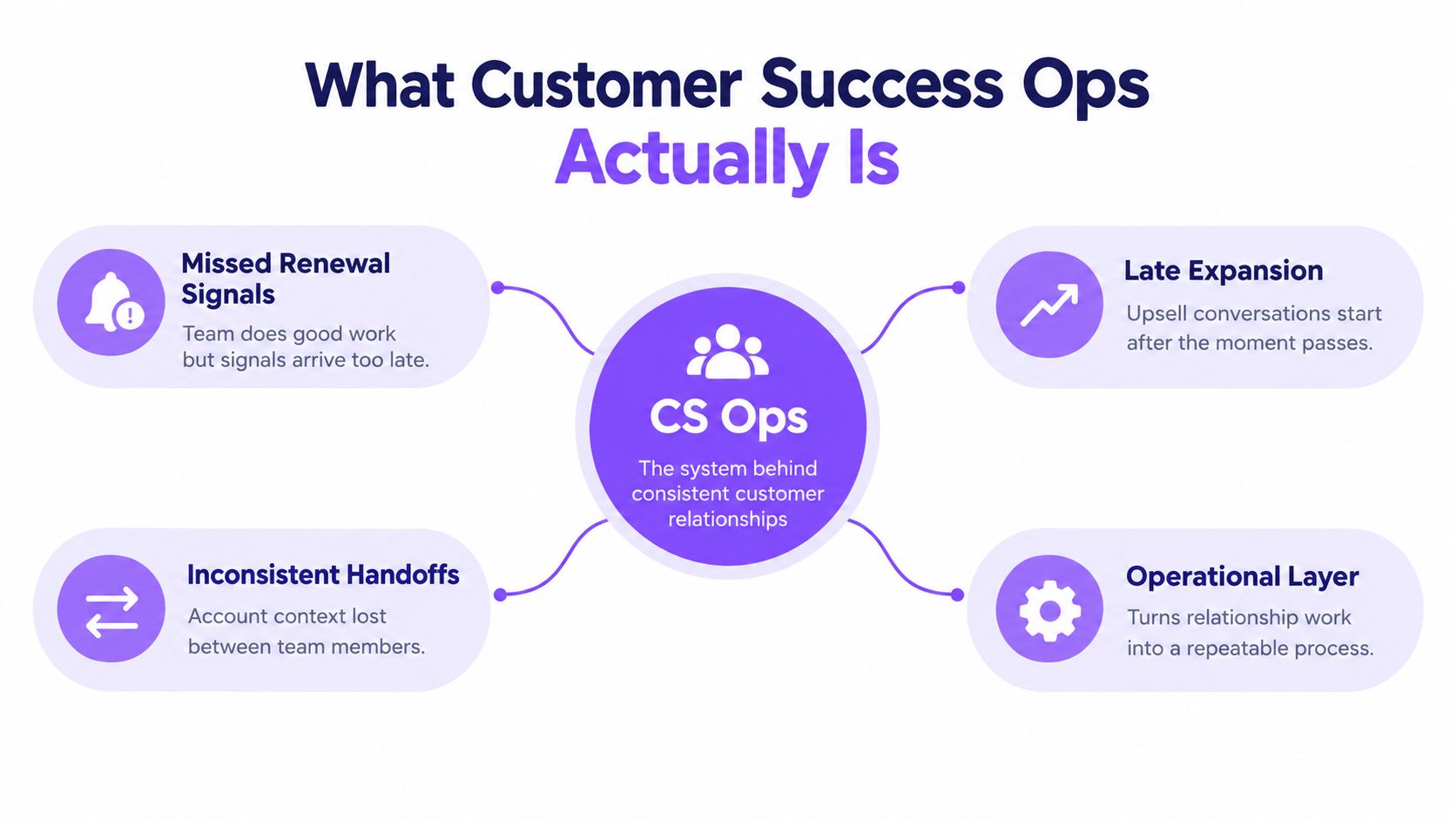
The operating layer between activity and outcome
Customer success now depends on coordinated work across CS, Sales, Product, Finance, and RevOps. Retention, expansion, onboarding, adoption, and forecasting all require more than individual CSM judgment.
A practical operating model connects four layers:
- Customer evidence: Conversations, usage patterns, support activity, survey responses, and meeting participation.
- Interpretation: Health segments, renewal risk, expansion readiness, lifecycle stage, and ownership.
- Action: Playbooks, alerts, tasks, escalations, handoffs, and follow-up sequences.
- Review: Retention results, forecast quality, workflow completion, and exceptions that require process changes.
This structure turns conversation and usage data into renewal, expansion, and handoff workflows. It also makes trade-offs visible. Centralized rules improve consistency and reporting, while CSM flexibility still matters when account context does not fit a standard path.
The function is more than a reporting desk or a platform administrator. CS Ops decides which information matters, how teams respond, and how leaders assess whether the response worked. A practical Supercenter for customer success teams can help teams examine the broader operating environment, but the design question remains internal: what should happen when a specific customer signal appears?
Start with the failure points
Build CS Ops around the moments that repeatedly break. Audit sales-to-CS handoffs, onboarding milestones, health-score updates, renewal forecasting, expansion referrals, and escalations. Document who owns each action, where the information lives, and what happens when the normal path fails.
That approach is more useful than buying a platform first. Teams can also connect the post-sale motion to a dedicated customer success use case when engagement and intent data need to support coordinated follow-up. The system should serve the customer journey, while giving CSMs room to apply judgment where the workflow cannot cover the account context.
Why Customer Success Ops Matures Alongside Revenue Ownership
The mandate for customer success ops expands when Customer Success becomes accountable for commercial outcomes. A 2026 benchmark report found that CS is well-defined or present in 95% of companies, while 63% say their CS organization is responsible for NRR performance. The same report found that 80% use NPS to track customer satisfaction, showing how widely teams have formalized measurement, even when the operating model behind it remains uneven. Benchmarkit’s customer success research provides the underlying benchmark context.
The investment pattern is also revealing. Companies reporting the highest NRR reported investing 10% of revenue in their CS and CS Ops teams at the 75th percentile, according to that report. This doesn’t prove that investment alone creates retention. It does show that high-performing organizations treat post-sale operations as infrastructure for revenue, rather than as an administrative cost attached to a service department.
The maturity gap is operational, not philosophical
The historical shift is straightforward. Customer success started as a proactive way to help customers achieve value, then became tied to renewals, expansion, forecasting, and executive reporting. Once those responsibilities became material, informal coordination stopped being reliable.
CS Ops fills the gap by standardizing definitions and ownership. It determines what counts as a renewal risk, which product events indicate adoption, when an expansion signal becomes a qualified opportunity, and how Finance, Sales, and CS reconcile the numbers. Without those decisions, every team can use the same term while measuring something different.
There’s also a measurement blind spot. The benchmark report found that only 37% of companies measure NPS for executive buyers or platform users, despite broader NPS adoption. That difference matters because the daily user, economic buyer, executive sponsor, and technical evaluator may experience the account differently. A single account-level sentiment score can hide a serious relationship problem.
Revenue accountability changes the work
When CSMs carry responsibility for renewals or expansion, operations must support more than activity tracking. A dashboard showing calls completed won’t explain whether a customer reached value, whether the buying committee is aligned, or whether an opportunity has a credible owner.
Effective CS Ops gives leaders a shared view of:
- Commercial exposure: Renewal value, contraction risk, expansion potential, and forecast confidence.
- Customer progress: Adoption, milestone completion, time to first value, and unresolved blockers.
- Execution quality: Handoff completeness, overdue tasks, escalation age, and exception patterns.
- Stakeholder coverage: Which roles are engaged, silent, dissatisfied, or absent from the success plan.
That is why the function matures alongside revenue ownership. Once customer success affects the forecast, someone must govern the operating system that produces the forecast.
Designing CS Ops as a Multi-Layer Control System
A single health score is attractive because it compresses complexity into one label. It’s also fragile. A customer can appear healthy because usage is high while an executive sponsor is disengaged, or appear at risk because support volume is high while the underlying implementation is progressing normally.
A stronger design treats customer success ops as a multi-layer control system. It captures several signal types, interprets them together, triggers a defined response, and checks whether the response changed the outcome.
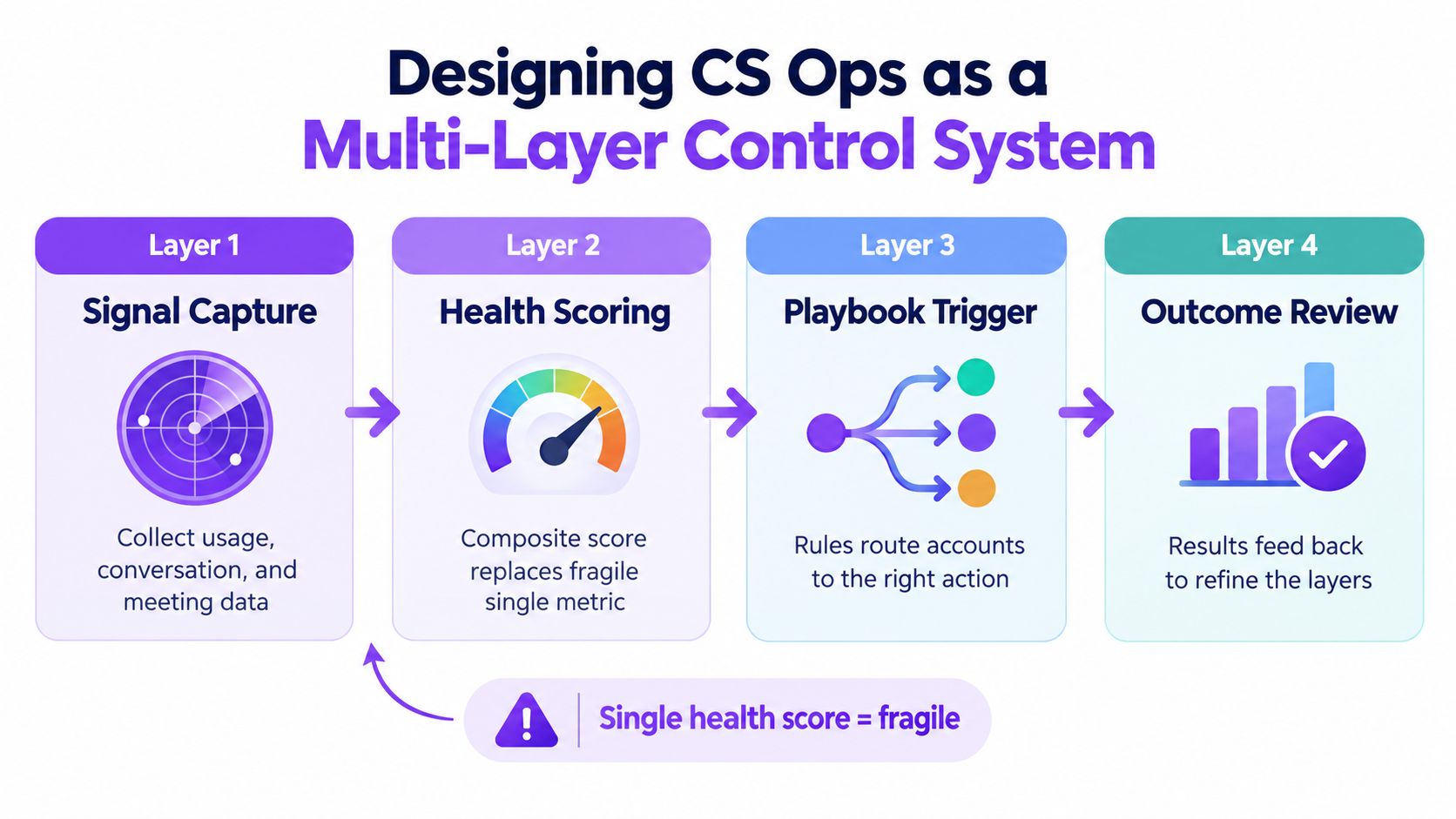
Four layers that work together
Signal capture collects product adoption, conversation themes, meeting attendance, feedback, support activity, and lifecycle milestones. Don’t treat call notes and usage data as separate worlds. A customer who reports satisfaction but abandons a core feature needs a different intervention from a customer whose usage is strong but whose implementation milestones are overdue.
Health scoring combines those signals into a segment or account view. The score should explain risk, not conceal it. Show the contributing factors, their freshness, and the confidence of the underlying data. If a score changes, the CSM should understand why.
Playbook triggers convert interpretation into action. A drop in adoption might create an enablement task, route a product question to a specialist, and add a renewal-risk review. A confirmed expansion signal might create a Sales handoff with the relevant conversation context instead of a vague “follow up” task.
Outcome review closes the loop. Compare the intervention with renewal status, adoption recovery, milestone completion, forecast accuracy, and customer experience. Process Street’s customer success operations guidance is useful background for connecting revenue, adoption, feedback, experience, and operational KPIs.
Practical rule: If the team can’t explain what action a metric should trigger, it probably isn’t an operational metric yet.
Diagnose the process, not just the customer
Track workflow cycle time, overdue lifecycle tasks, and exception rate alongside retention outcomes. If renewals are slipping, these indicators help distinguish customer resistance from an internal handoff failure. If feedback remains unresolved, the issue may be ownership or escalation design rather than sentiment itself.
For teams exploring autonomous routing, agentic orchestration explained offers useful conceptual context. In practice, automation should remain bounded by clear rules, permissions, and human review. A connected workflow can be configured through automation flows when teams need event-based routing, but the decision logic should come from the lifecycle process first.
The control system only improves when every layer is inspectable. If the data is stale, the score is misleading. If the trigger has no owner, the playbook is decorative. If the outcome isn’t reviewed, the team keeps repeating assumptions.
Revenue-Retention Benchmarks That Guide Decisions
Satisfaction metrics describe how customers feel. Revenue-retention metrics show what the installed base is doing financially. Customer success ops needs both, while keeping sentiment separate from evidence that accounts will renew or expand.
Gross revenue retention, or GRR, measures recurring revenue retained from existing customers before expansion. It isolates churn and contraction. Net revenue retention, or NRR, includes expansion, showing whether upsells and cross-sells offset lost revenue.
The distinction determines the operating response:
| Metric | What it isolates | Operational question |
|---|---|---|
| GRR | Churn and contraction | Are customers preserving their existing spend? |
| NRR | Retention plus expansion | Is the installed base growing after losses? |
| Gap between GRR and NRR | Expansion contribution | Are post-sale motions creating enough growth to offset contraction? |
Use benchmarks to set targets and trigger action
For mature B2B customer success teams, commonly cited operating targets put GRR above 90% and NRR above 100%. Best-in-class SaaS is often cited at 110% to 130% NRR in Fullcast’s customer success metrics guidance. Treat these figures as reference points for planning, not promises that every business should meet immediately.
The useful question is what each result changes in the operating model. Strong GRR with weak NRR points toward a gap in use-case discovery, packaging, or account-development workflows. Weak GRR with strong expansion can mean a subset of accounts is growing while too many others are being lost. Reviewing both figures prevents expansion from hiding churn and stops leaders from treating every revenue movement as equivalent.
Set the response before the metric is reviewed. A GRR decline may require a focused churn analysis and renewal-risk intervention. A wide GRR-to-NRR gap may call for better expansion qualification, stakeholder mapping, or product adoption work. The benchmark becomes useful when it changes ownership, workflow priority, or forecast confidence.
Tie forecasts to value realization
Segment renewal forecasts by cohort, lifecycle stage, product adoption, and time to first value. These views should reveal which operating conditions precede predictable renewal or expansion in your business, rather than create another dashboard for weekly inspection.
A renewal forecast should answer practical questions:
- Has the customer reached the first meaningful outcome?
- Are intended users adopting the relevant capabilities?
- Does the account have a documented success plan?
- Has the buying group changed?
- Are unresolved issues blocking value?
- Is expansion based on observed need or optimistic CSM judgment?
A customer can value the relationship and still fail to renew when the product has not become operationally important. Feed the answers into renewal and expansion workflows so the forecast reflects evidence, not sentiment alone.
Centralizing Process Without Stifling CSM Flexibility
Centralization solves inconsistency, but it can also flatten judgment. A rigid playbook may make every account look orderly while preventing a CSM from responding to a customer’s actual context. The right question isn’t whether to centralize everything. It’s which decisions benefit from consistency and which require frontline discretion.
Centralize the rules that protect revenue and data quality. These usually include lifecycle stages, renewal-date definitions, minimum handoff fields, required risk categories, escalation ownership, forecast conventions, and the events that create tasks. If each CSM defines “at risk” differently, leadership can’t compare cohorts or trust the forecast.
Leave room for CSM judgment in the relationship layer. CSMs should be able to adapt communication, choose the most credible stakeholder, change the order of enablement activities, and add account-specific context. The system should require the outcome and evidence, not dictate every sentence or meeting agenda.
A practical decision lens
Use three questions for each process:
- Does inconsistency create commercial or customer risk? If yes, standardize the definition and required action.
- Does local context materially change the best response? If yes, give the CSM a controlled range of options.
- Would automation reduce work without hiding judgment? If yes, automate the handoff, reminder, or data update, not necessarily the customer-facing decision.
Maturity data supports a cautious approach. One 2026 industry article reports that 62.2% of teams still operate without a formal structure and 15.9% use automated nudges, as discussed in coverage of customer success predictions. That suggests many teams need clear ownership and disciplined basics before they need an elaborate predictive stack.
More automation isn’t automatically more maturity. A simple rule that fires reliably is more valuable than a sophisticated model nobody trusts.
Tool consolidation can reduce duplicate records and maintenance, but it also creates migration cost and dependency risk. Start with a small number of high-value workflows, measure exceptions, and expand only when the team can explain the benefit. The best operating model is the one CSMs use consistently without losing the judgment customers need.
Feeding Conversations, Usage Data, and Meetings into CS Workflows
Customer conversations become operationally valuable when the system captures their meaning and routes the next action. A video call, chat exchange, help-center interaction, product event, or scheduled meeting should not disappear into a disconnected tool. Each signal needs an owner, a lifecycle context, and a defined response.
Start by mapping the event to the account record. A conversation about a new team, an implementation blocker, or a missing capability should attach to the customer, contact, opportunity, and relevant renewal or expansion motion. The record should preserve the summary, participants, stated need, next action, and due date. Transcription alone isn’t an operating process.

Turn signals into explicit routing rules
A useful workflow can follow this sequence:
- Detect intent: Identify high-value page visits, repeated product activity, help-seeking behavior, or a conversation that indicates a new use case.
- Classify the event: Separate renewal risk, adoption friction, expansion interest, support need, and general engagement.
- Route ownership: Send the task to the CSM, account executive, support specialist, product liaison, or implementation owner.
- Preserve context: Include the account history, conversation summary, usage evidence, and previous commitments.
- Set a follow-up condition: Define what completion means, when the task becomes overdue, and how unresolved work escalates.
- Review the result: Record whether the customer reached value, adopted the capability, accepted the meeting, or progressed the commercial motion.
In-browser video, AI chat, visitor intent detection, click-to-meet scheduling, co-browsing, and automated reminders can support this model when they connect to existing records rather than creating another isolated queue. A Salesforce integration for connected customer workflows is one example of the infrastructure teams may evaluate when conversation and meeting data need to reach the CRM.
Design handoffs around moments, not departments
The handoff should happen when the signal appears, not at the next weekly meeting. If an existing customer shows interest in a related capability, route the context to the expansion owner while keeping the CSM informed. If usage falls after an implementation change, create an intervention task with the relevant product and conversation evidence.
Measure the workflow itself. Track time from signal to assignment, assignment to first response, completion of the next action, and the rate of exceptions that require manual repair. These measures reveal whether the system is helping people act or merely generating notifications.
Putting It All Together in a Realistic CS Ops Operating Model
Consider a subscription business with separate CSM, Sales, Product, and Support teams. A customer nearing renewal has strong overall usage, but the main administrator has stopped attending meetings and a key feature has declined in adoption. The operating model shouldn’t label the account “green” or “red.”
Instead, the system records the adoption change, flags the missing stakeholder, and assigns the CSM a re-engagement play. The renewal forecast remains visible to leadership, while the CSM gets flexibility to involve an executive sponsor, run enablement, or investigate a product obstacle. If the customer reveals a broader team need during that conversation, the system creates an expansion handoff with the original context attached.
The operating rhythm
A practical model separates daily execution from regular diagnosis:
- Daily: New signals create owned tasks, meeting outcomes update records, and overdue actions escalate.
- Weekly: CS leaders review renewal risk, expansion handoffs, adoption changes, and exceptions by segment.
- Monthly: CS Ops examines forecast accuracy, workflow cycle time, and recurring handoff failures.
- Quarterly: Leaders revise definitions, playbooks, segmentation, and ownership based on observed outcomes.
This model doesn’t require every signal to feed an AI prediction. Rule-based triggers are often easier to audit while a team is still cleaning data and establishing process discipline. Predictive scoring becomes more useful when the organization can validate the source signals and distinguish a genuine pattern from a missing field.
The operating principle is simple: capture evidence, make ownership explicit, trigger a proportionate action, and review the result. CS Ops earns strategic influence by making that loop dependable across renewals, expansion, adoption, and cross-functional handoffs.
Captiwate helps revenue teams turn website intent, live video, AI chat, scheduled meetings, and conversation outcomes into connected follow-up workflows. Visit Captiwate to see how its CRM sync, routing rules, co-browsing, and automated reminders can support a more responsive customer success operating model.