You’re close to signing an enterprise deal, then procurement sends a long security questionnaire and asks for your SOC 2 Type 2 certification. Your team answers from memory, the buyer asks follow-up questions, and the deal slows. A SOC 2 Type 2 report can change that conversation if you understand what it proves, what it doesn’t prove, and how fresh it is.
Table of Contents
- What a SOC 2 Type 2 Report Proves
- Type 1 and Type 2 Reports Side by Side
- The Five Trust Services Criteria and When They Apply
- How the Type 2 Audit Runs, Step by Step
- Why SaaS Vendors Win Deals With a Type 2 Report
- Readiness Timeline and Checklist for SaaS Teams
- Verify a Vendor’s Report Before You Rely on It
What a SOC 2 Type 2 Report Proves
A SOC 2 Type 2 report is an independent CPA firm’s opinion on whether a service organization’s controls were designed properly and operated effectively over a defined observation period. It’s an attestation report, not a government license, a guarantee of security, or a universal product certification.
Think of a health inspector who returns repeatedly over months and checks temperature logs, cleaning records, and staff habits. That’s different from an inspector who walks through the kitchen on one quiet morning and leaves. Type 2 is concerned with repeated operation, not a single good day.
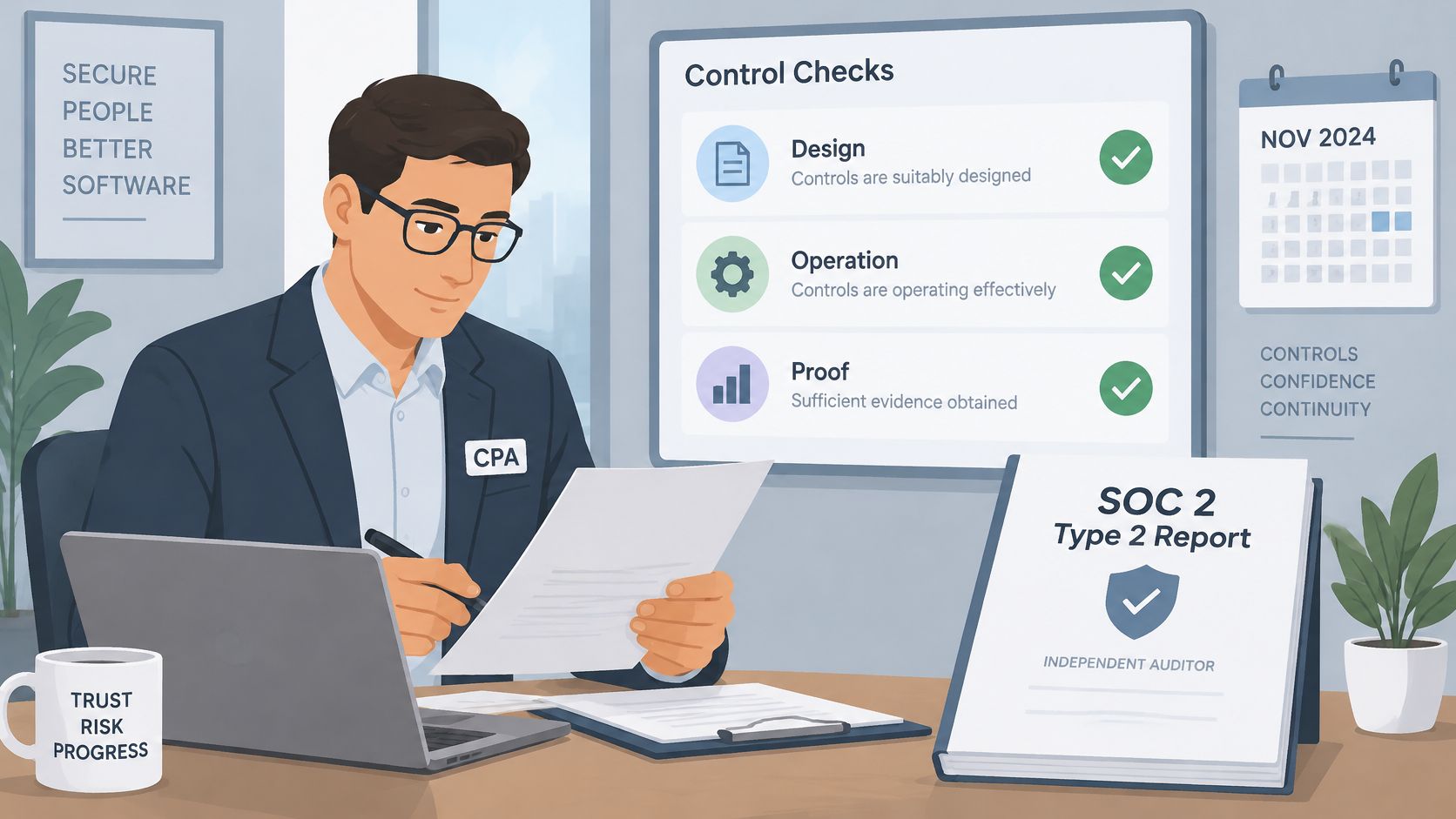
The SmartSuite GRC guide explains that SOC 2 was introduced by the American Institute of Certified Public Accountants (AICPA) in 2011 as a successor to SAS 70, with a focus on technology and cloud service organizations rather than solely on financial reporting controls. It also notes that Security is the foundational category required for every SOC 2 examination, while Availability, Processing Integrity, Confidentiality, and Privacy are included when relevant.
What you’ll find inside the report
A complete report normally contains:
- Management’s assertion: Leadership states what its system does and what its controls are intended to achieve.
- System description: The services, infrastructure, software, people, and processes inside the boundary.
- Auditor’s opinion: The CPA firm states whether controls were suitably designed and operated effectively.
- Tests and exceptions: The procedures performed, the results, and any places where a control didn’t operate as described.
That structure matters during a procurement stall. Instead of answering vague questions one by one, you can share a system description and an independent opinion under NDA, then answer specific gaps. The buyer still makes its own risk decision, but you’re no longer asking them to trust a slide deck.
A line you can repeat: The report is an auditor’s opinion on how controls ran over a period, not a stamp that lasts forever.
That last point is where many founders get confused. People say SOC2 Type 2 Certification as shorthand, but there’s no badge earned once and kept forever. A later period needs later evidence.
Type 1 and Type 2 Reports Side by Side
A Type 1 report checks whether controls are designed properly at one date, while a Type 2 report checks whether they operated effectively across an observation period, commonly six to twelve months. Type 1 is a photograph. Type 2 is a film.
A photograph can show that the fire extinguisher is mounted and tagged. A film shows whether staff checked it month after month and replaced it when needed. Both are useful, but they don’t prove the same thing.
Type 1 versus Type 2 at a glance
| Aspect | Type 1 | Type 2 |
|---|---|---|
| Time test | Controls designed correctly at one point in time | Controls operated effectively over a defined observation period |
| Observation period | None, a single date | Commonly 6 to 12 months |
| Evidence reviewed | Policies, design documents and configuration at one date | Dated evidence sampled across the whole period |
| Buyer value | Shows controls exist and are designed sensibly | Shows controls ran consistently over time |
| Typical effort | Lower, faster to complete | Higher, needs months of recurring records |
| Report freshness | Ages quickly after the date | Covers only the period, so the end date matters |
A Type 1 isn’t a cheaper Type 2. It’s a different question. A company holding only Type 1 has shown sensible design, but it hasn’t yet proved consistent operation.
Early stage companies sometimes start with Type 1 to show readiness while they build months of evidence. Enterprise buyers usually ask for Type 2 because they’ll rely on the vendor every day, not on one day. If you’re comparing frameworks while you decide, DevArmor’s guide to ISO 27001 and SOC 2 scope is a useful resource for understanding where the two overlap and where the evidence differs.
Use this practical test when a vendor hands you a document. Check the title and dates. If it names a single date, it’s Type 1. If it names a start date and an end date, it’s Type 2, and those dates tell you which months were tested.
The Five Trust Services Criteria and When They Apply
The Trust Services Criteria are the yardstick the auditor measures your controls against. Security is mandatory for every SOC 2 examination. The other four categories are included when they’re relevant to the services and commitments you’re making to customers.
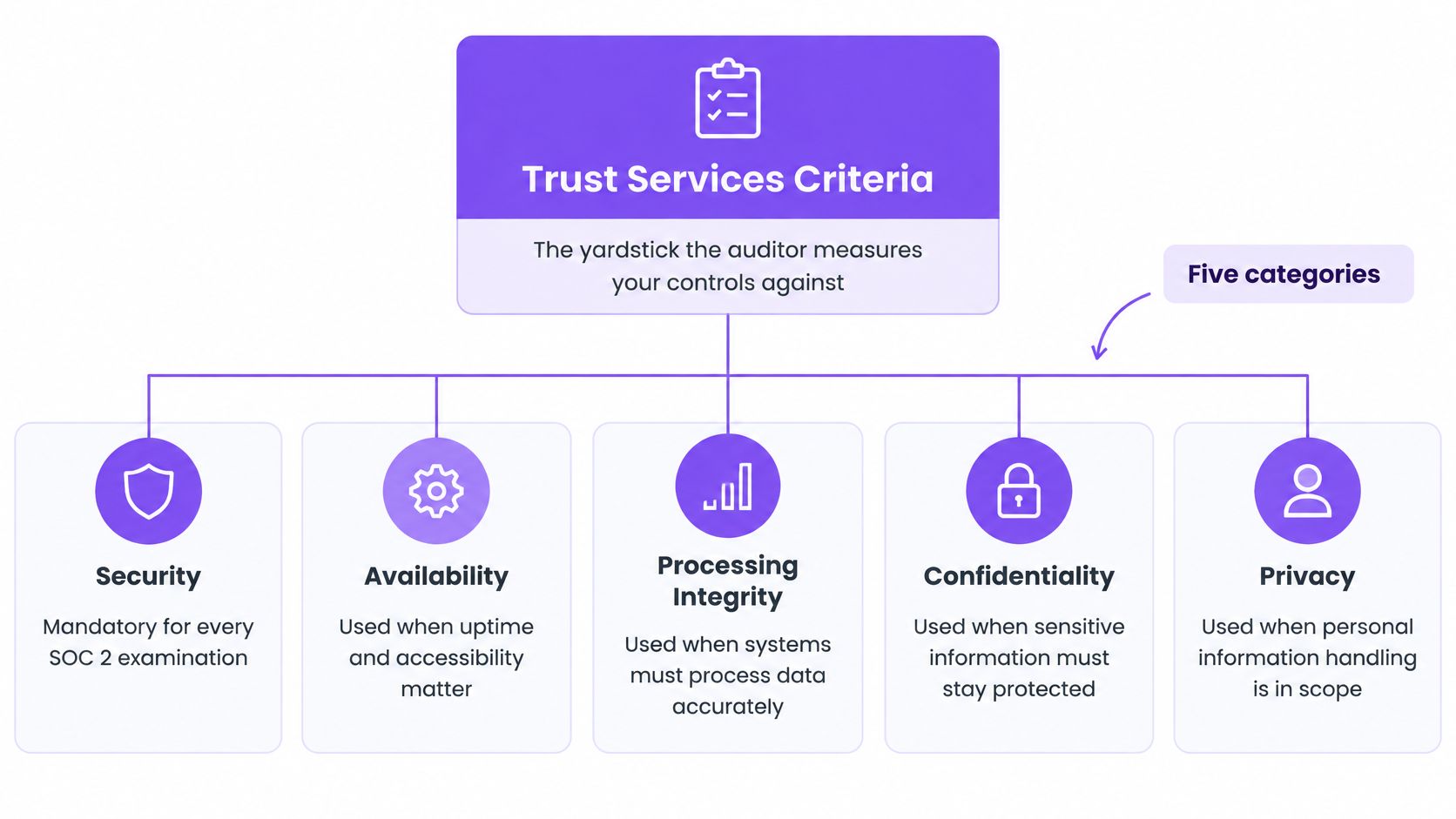
The five Trust Services Criteria and when each applies
| Category | What It Covers | When It Is Included |
|---|---|---|
| Security | Protection against unauthorized access and system misuse | Required for every SOC 2 examination |
| Availability | Uptime, performance and disaster recovery commitments | When you promise uptime or service-level guarantees |
| Processing Integrity | Complete, accurate and timely processing of customer data | When your service transforms or routes data customers rely on |
| Confidentiality | Protection of information designated as confidential | When customers share sensitive business information |
| Privacy | Collection, use and disposal of personal information under your notice | When you collect personal data from individuals |
Say a sales engagement platform tracks visitor identity, records conversations, and syncs data to a CRM. It will typically include Security, Confidentiality, and Privacy, because it handles sensitive business records and personal information. It adds Availability if it promises uptime in contracts, and Processing Integrity if automated qualification or AI routing changes records that sales teams depend on.
Don’t add categories just to look thorough. Each extra category raises effort, evidence volume, and auditor testing. Our own overview of information security and compliance commitments shows how scope should follow real data handling, not marketing ambition.
Before you choose, answer three questions. What data do we handle? What uptime do we promise? Do our automated outputs change customer records? Your answers define a defensible scope.
How the Type 2 Audit Runs, Step by Step
A documented policy has little value unless recurring execution is demonstrable. The CertPro SOC 2 guide describes Type 2 as an independent examination of both design and operating effectiveness over a defined period, with auditors sampling dated evidence rather than accepting only current configuration screenshots.
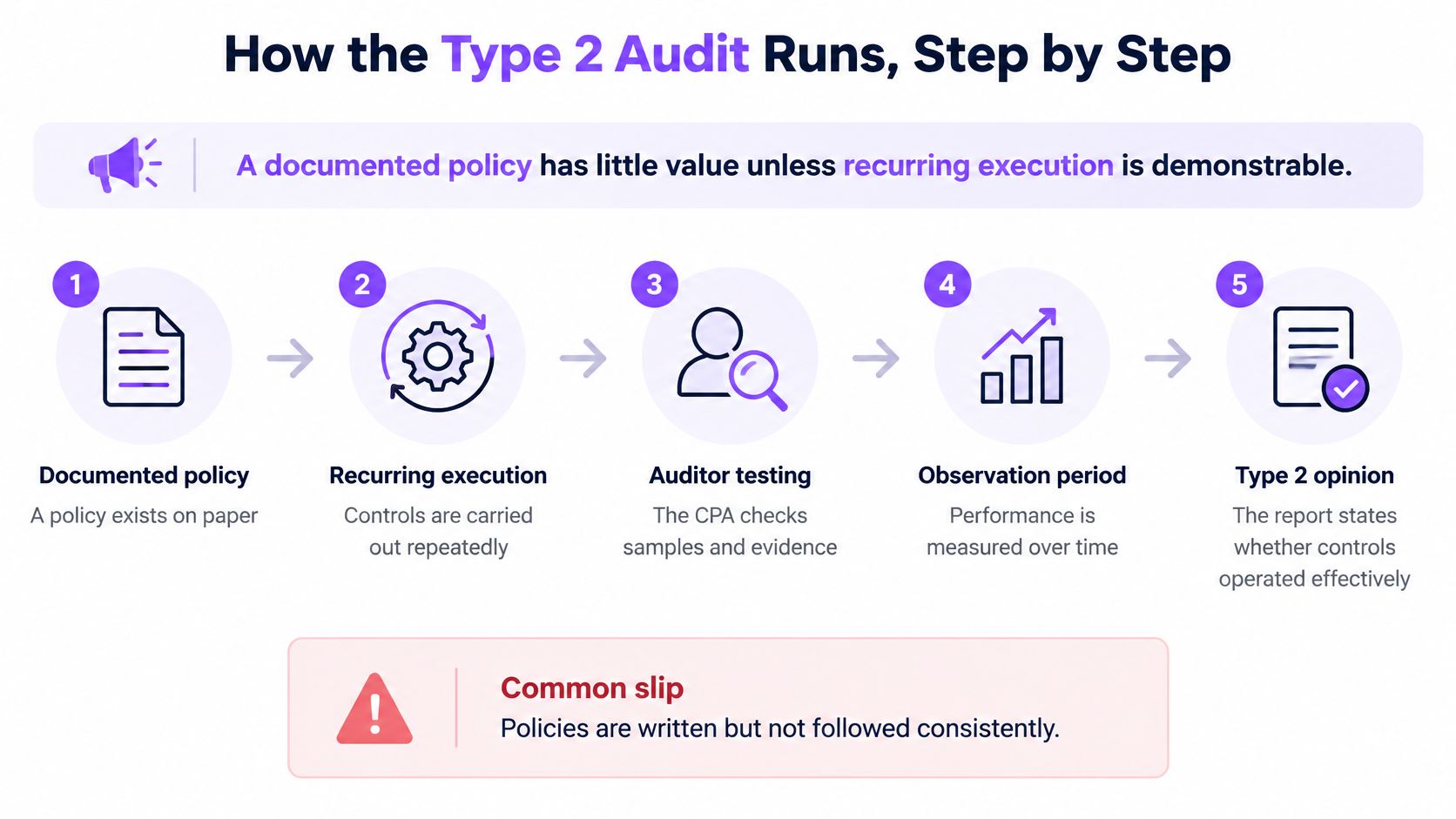
- Define the system boundary. List the production app, browser based video and chat, identity systems, cloud infrastructure, CRM and calendar integrations, support processes, and subprocessors. Common slip: leaving out an AI model provider that should be treated as a subservice organization.
- Map controls to the criteria. Give each control an owner and a stated objective, such as quarterly access reviews for production systems. Common slip: polished policies with no matching control anyone runs.
- Operate controls through the whole period. Run access reviews, approved change tickets, vulnerability scans, backup restore tests, and monitoring on schedule. Common slip: doing everything once, just before fieldwork.
- Keep dated evidence continuously. Save records as work happens, with dates, approvers, and outcomes. Auditors sample across the period, so a folder created in the final week won’t prove earlier months.
- Auditor testing. The CPA firm uses inquiry, observation, inspection, and re-performance on samples. They’ll ask owners to explain a control, then check whether records match that explanation.
- Exceptions. A missed access review or late offboarding is recorded as an exception. Management responds in writing, explaining cause and remediation.
- Report issued. You receive management’s assertion, the system description, the auditor’s opinion, tests, results, and exceptions.
The short video below walks through the same sequence visually, which helps if you’re explaining the timeline to founders or engineers.
Evidence for AI workflows
For AI chat, intent detection, or automated routing, keep model or prompt version history, approval and deployment records, monitoring for failures, access logs, and vendor reviews of external model providers. The Workstreet guide to SOC 2 for AI companies notes there’s not yet a finalized, standalone AI specific SOC 2 framework, so existing criteria are applied more sharply to AI systems. In practice, that means your SOC2 Type 2 Certification scope should name AI features explicitly rather than covering only hosting.
Why SaaS Vendors Win Deals With a Type 2 Report
An enterprise deal often stalls in security review. The buyer sends a long questionnaire, your sales team chases engineers for answers, legal adds redlines, and momentum fades. A Type 2 report changes that conversation because the buyer’s security team can read an independent opinion and system description instead of starting from blank answers.
The practical benefits are straightforward:
- Shorter security reviews: Reviewers find system boundaries, controls, and test results in one document.
- Fewer custom questionnaires: Many answers can point to tested controls rather than new prose each time.
- Fewer security redlines: Contract talks start from documented commitments instead of invented language.
- A clear data protection answer: You can show how access, change, monitoring, and vendor oversight ran.
- Internal habits that stick: Access reviews and restore tests continue because they’ll be sampled again next period.
Costs should be stated plainly. Audit firms quote fees by scope, so more criteria, systems, and locations cost more. Engineering and operations time goes into evidence collection, remediation, and answering auditor samples. The work doesn’t end with the first report, because controls must keep running for the next period.
A report pays for itself fastest when buyers require it before signature, not when it’s treated as a logo for a homepage.
For context, Captiwate is SOC 2 Type II and ISO 27001 certified. That’s the kind of claim a buyer should verify against a current report’s scope and period, rather than accepting from a web page alone.
Use a simple decision rule. If most lost or slowed deals stall in security review, pursuing Type 2 now is likely worth it. If buyers rarely ask detailed security questions, build the underlying habits first and time the audit to your pipeline.
Readiness Timeline and Checklist for SaaS Teams
The observation window dominates the calendar, so readiness work should finish before that window begins. You can’t backfill a quarterly access review for a quarter that already passed.
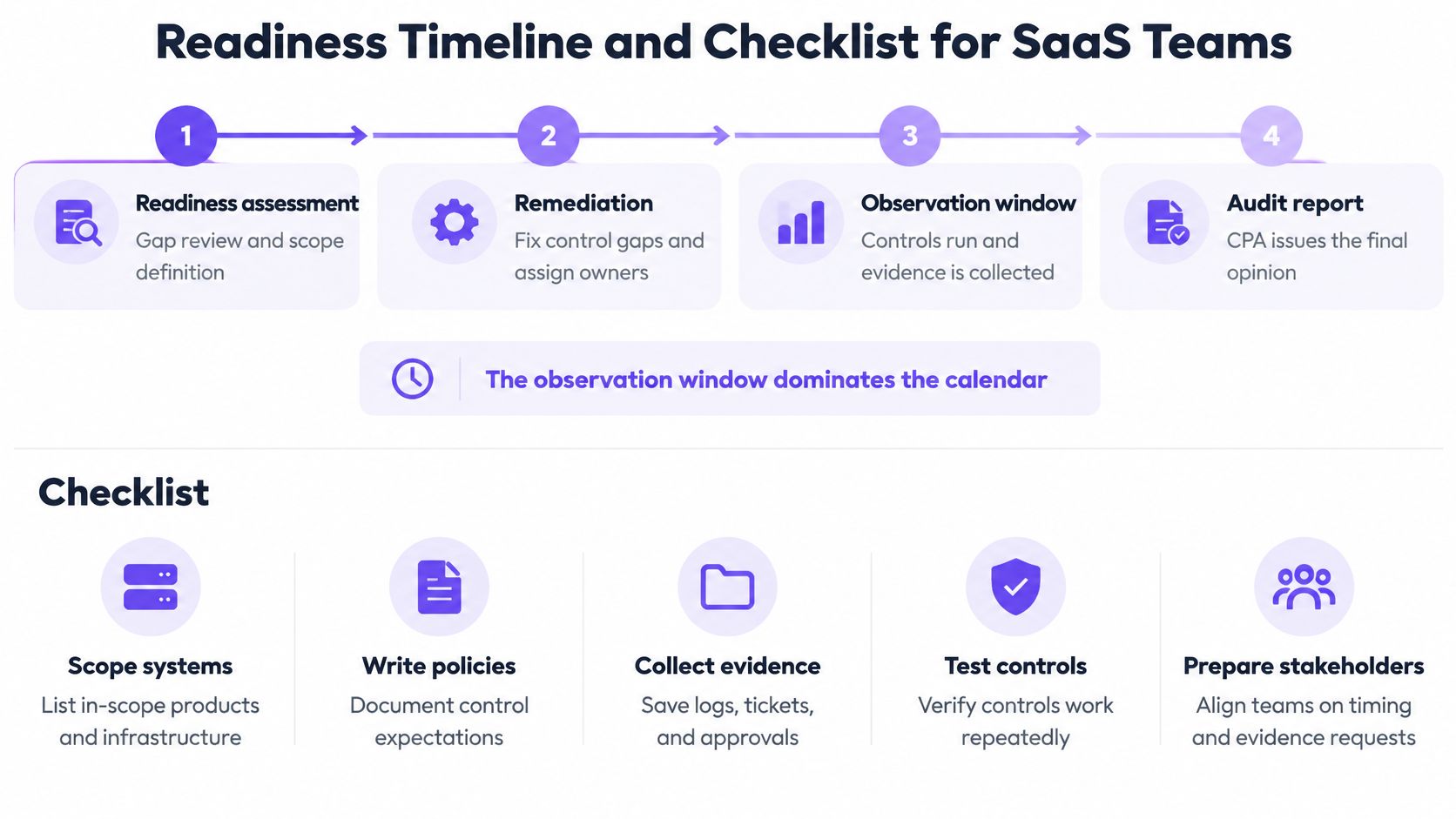
Typical SOC 2 Type 2 readiness timeline
| Phase | Typical Duration | Output |
|---|---|---|
| Scoping and gap assessment | 2 to 4 weeks | Defined system boundary and chosen criteria |
| Control design and policy writing | 4 to 8 weeks | Documented controls mapped to criteria |
| Tooling and remediation | 4 to 12 weeks | Automated evidence collection in place |
| Observation window | 6 to 12 months | Dated evidence accumulating across the period |
| Auditor fieldwork and report | 4 to 8 weeks | Signed Type 2 report with opinion and exceptions |
Use this checklist before the window starts:
- System description draft: Services, data flows, infrastructure, and subprocessors written in plain language.
- Named control owners: One accountable person for each control, with a backup.
- Approved security policies: Leadership approved, current, and matched to daily practice.
- Recurring access reviews: Dated records showing reviewers, decisions, and removals.
- Change management workflow: Tickets with testing and approval before production release.
- Vulnerability scans: Scheduled scans plus remediation logs with closure dates.
- Tested backup restore: A dated record proving restoration worked, not just that backups ran.
- Incident response runbook: Roles, escalation steps, and evidence the team has rehearsed it.
- Offboarding steps: Access revoked within a set time, checked against HR termination dates.
- Training records: Completion evidence for security training.
- Vendor risk assessments: Current reviews for each subprocessor, including AI and cloud providers.
A bridge letter may cover a short gap between a period end and today. It doesn’t replace the observation period itself, and it can’t create evidence for months when controls weren’t running. Treat it as a management update, not a second audit.
Our product security overview is an example of the kind of public summary buyers read before requesting the full report. Your next step is concrete: draft the system boundary this week, because every later control, owner, and evidence request depends on it.
Verify a Vendor’s Report Before You Rely on It
A valid Type 2 report doesn’t mean a vendor is secure today. It proves controls operated during a defined window. The SureCloud SOC 2 requirement guide notes that a Type 2 report commonly covers six or twelve months and proves control operation only during that defined window, not continuously after the period ends.
That creates a real risk. A vendor can hold a valid report and later change its cloud architecture, subprocessors, AI providers, data residency model, or access practices. Static SOC2 Type 2 Certification language can hide that operational change.
Run this freshness test
- Check the period end date. Work out how many months sit between that date and today.
- Request the bridge letter. Ask what changed, what incidents occurred, and whether control failures were found after the period.
- Review exceptions and management responses. Look for patterns, not just a clean opinion, especially around access removal and change approval.
- Read the system boundary. Confirm it includes the features you’ll use, including AI enabled functions and their subprocessors, not only core hosting.
- Check complementary user entity controls. These are controls you’re expected to run, such as managing your own users and reviewing access on your side.
- Ask for material change disclosures and incident history. Request subprocessor updates and current security documentation to layer over the dated report.
Request the complete report under NDA. Don’t accept a one page certificate as a substitute, because you can’t see scope, exceptions, or subservice organization treatment from a badge.
Layer the report with current evidence where risk warrants it. Dated configuration exports, recent access review records, and vendor oversight logs show whether habits continued after the auditor left. Another certification isn’t always the answer. Current, specific evidence often tells you more.
Use Captiwate as the worked example. Captiwate is SOC 2 Type II certified, and Captiwate fully complies with GDPR and CCPA. Still request our full report, compare its scope and period with the visitor, conversation, and CRM data you’d share, and rely only on certifications confirmed by that current report. Make that request this week for any vendor on your shortlist, before data flows are designed around assumptions.
If your team turns website visitors into live video, chat, and AI qualified sales conversations, security evidence has to keep pace with the data those conversations create. Visit Captiwate to see how we connect high intent visitors to sales while giving enterprise buyers the compliance documentation they need to review scope, period, and controls for themselves.