A typical SaaS website converts only 1% to 3% of visitors into leads, and leads contacted within 5 minutes convert at about 21%, compared with roughly 2.3% when contact waits until the next day. SaaS lead generation is therefore less about collecting more traffic and more about preventing intent from disappearing between visits, forms, qualification, and sales follow-up.
Many teams still treat the funnel as a volume problem. They buy traffic, publish content, add another form, and then wonder why pipeline doesn’t keep pace with acquisition. The harder question is what happens in the minutes after a prospect signals interest, especially when that prospect visits a pricing page, returns to a product page, or starts a conversation outside business hours.
The strongest SaaS lead generation systems connect intent detection, real-time engagement, and immediate routing. Forms and email sequences still have a role, but they shouldn’t carry the entire conversion process.
Table of Contents
- Why Most SaaS Lead Funnels Leak
- Identifying High-Intent Visitors Before They Leave
- Converting Anonymous Traffic with Real-Time Engagement
- Routing Qualified Leads to the Right Sales Path
- Organic, Paid, and PLG: Which Channel Fits Your Motion?
- Case Study: How Real-Time Engagement Can Triple Demo Bookings
- Common Objections to Real-Time Engagement And Why They Miss the Point
- Your 30-Day Implementation Roadmap
Why Most SaaS Lead Funnels Leak
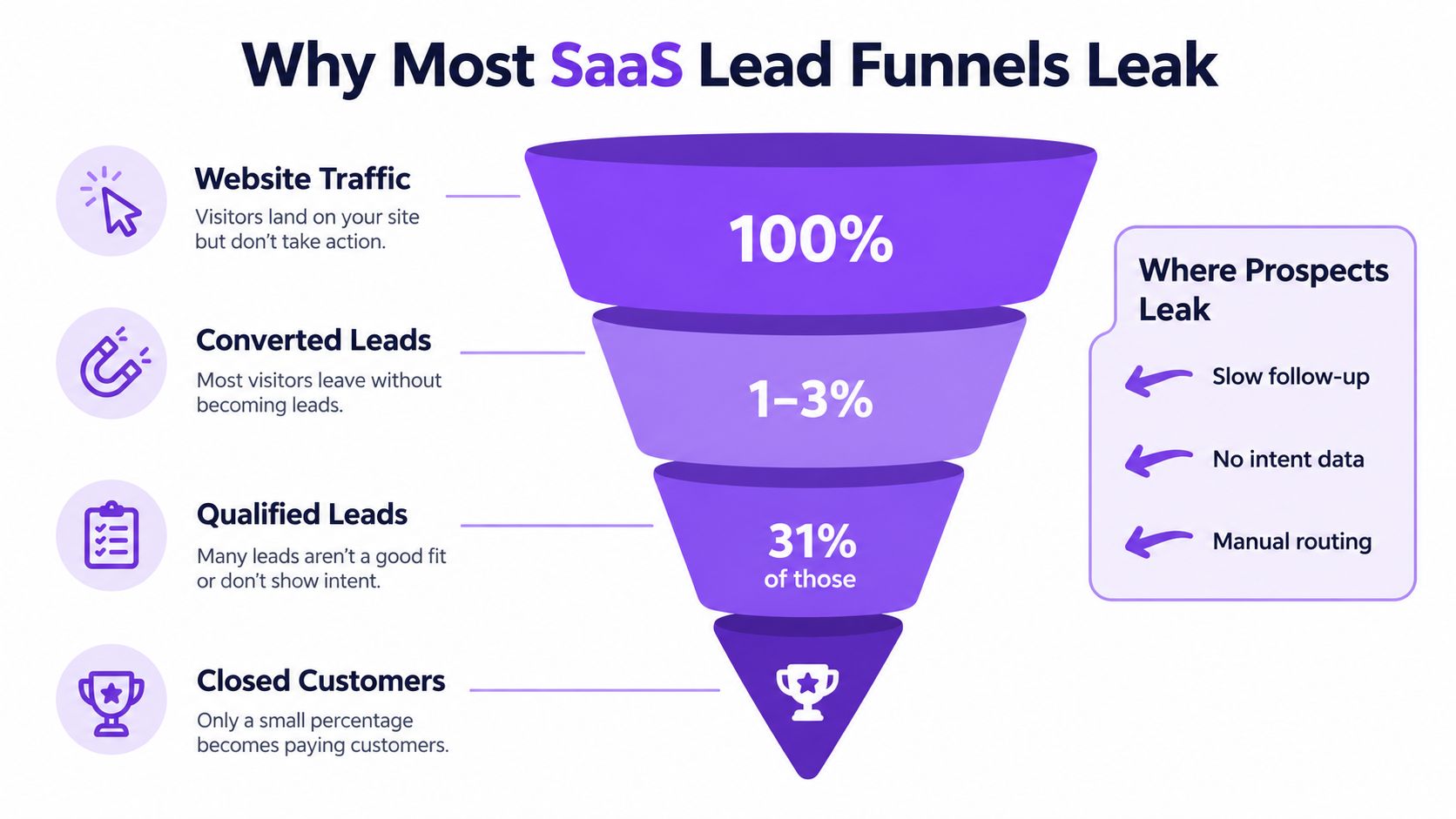
A SaaS website can convert only 1% to 3% of visitors into leads, and just 31% of those leads become MQLs. Depending on qualification standards, roughly 13% to 40% of MQLs become SQLs, so the funnel contracts before a salesperson reaches a serious buying conversation. These figures come from Martal’s SaaS lead generation benchmarks.
The arithmetic exposes the scale of the leak. From 1,000 website visitors, a SaaS team may generate only 10 to 30 leads. Some will fall outside the ideal customer profile, others will not be ready to buy, and many will wait too long for a response. Weak pipeline does not always indicate weak demand. It can mean the business captures too little of the interest it already earned through content, search, advertising, or product-led traffic.
Intent decays between the click and the conversation
A form starts a chain of handoffs. The visitor submits details, the record enters the CRM, an owner is assigned, and a salesperson eventually sends an email. Each step can introduce delay, lose context, or assign the lead to the wrong path.
The conversion penalty continues after the form is submitted. Close rates are roughly 32% for leads contacted inside 5 minutes, compared with about 12% after 24 hours, according to Perspective’s 2026 lead response benchmarks.
Practical rule: Treat a high-intent website action as a live sales event, not as a form submission waiting in a queue.
The median B2B response time is about 42 hours, and only around 7% of teams respond within 5 minutes, according to Aloware’s lead response time benchmarks. The same source cites a 21-fold qualification advantage for responses within 5 minutes instead of 30 minutes, and a 60-fold advantage for responses within an hour instead of 24 hours.
Real-time engagement addresses the gap before intent fades. Live video, AI chat, immediate qualification, and direct calendar booking can keep a high-intent visitor in an active conversation rather than placing the lead in an unattended queue. The trade-off is operational: teams need clear routing rules, sales coverage, and qualification logic. For practical guidance on structuring SaaS acquisition, Big Moves Marketing advice offers complementary context.
Set an internal target of under 5 minutes during business hours, under 15 minutes after hours, and a P90 response time under 1 hour. Automated alerts, live chat, booking tools, and CRM assignment rules make those targets executable instead of aspirational.
Identifying High-Intent Visitors Before They Leave
Not every visitor deserves the same response. Someone reading an educational article may need nurturing, while a visitor comparing pricing, reviewing implementation details, and returning to the product page may be close to a sales conversation. Effective SaaS lead generation starts by distinguishing those behaviors instead of placing every contact in one generic sequence.
Build an intent model around behavior
Start with the signals your buying process already recognizes informally. Useful inputs include:
- Page context: Pricing, product comparison, security, integrations, and demo pages usually deserve more attention than broad awareness content.
- Engagement depth: Repeated visits, interaction with product material, and movement from educational content toward commercial pages indicate increasing interest.
- Account fit: Company size, industry, geography, technology environment, and target-account status help separate a promising visitor from an irrelevant one.
- Conversation behavior: A visitor who asks about implementation, procurement, integrations, or availability has supplied stronger evidence than someone who only downloads a general guide.
Don’t build a scoring model that rewards activity without considering fit. A prospect can view many pages and still be outside your serviceable market. Conversely, a small number of high-value actions from a target account may justify immediate outreach.
Turn anonymous activity into an action
Visitor identification can add company context to behavioral signals, but identification alone doesn’t create pipeline. The system must decide what happens next. A high-intent account might trigger a sales alert, an invitation to speak with a representative, or a direct booking option. A lower-intent visitor might enter an educational nurture path without consuming SDR time.
Your CRM should preserve the evidence behind the score. Reps need to see the pages visited, the account context, the conversation history, and the reason for the handoff. Without that context, the first sales message forces the buyer to repeat information and the rep to requalify interest.
Teams working on this problem can also use a structured B2B website visitor identification framework to connect account recognition with practical follow-up. For a broader explanation of how search behavior reflects needs and readiness, Silver Spoon Agency’s intent guide offers useful framing.
Converting Anonymous Traffic with Real-Time Engagement
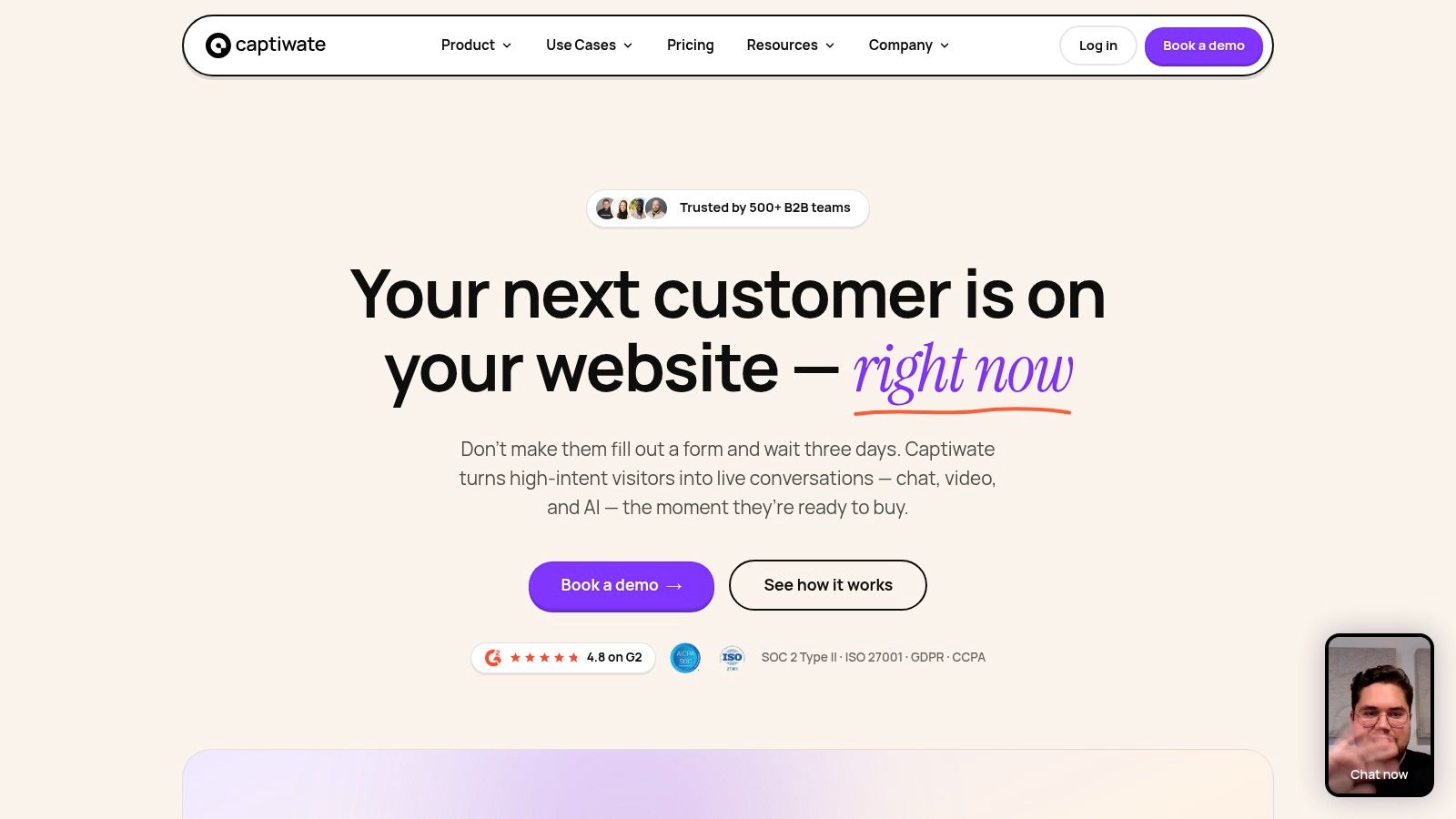
Forms are passive. They ask the visitor to stop browsing, enter information, submit a request, and wait. Real-time engagement changes the sequence by offering help while the visitor is still evaluating the product.
Match the engagement method to intent
Use live video where the visitor is likely to have a specific question and enough commercial interest to justify a human conversation. Pricing and product pages are natural locations, but the trigger should depend on behavior and account fit rather than appearing indiscriminately to everyone.
AI chat serves a different purpose. It provides coverage when sales representatives aren’t available, answers recurring questions, collects qualifying information, and books a meeting when the visitor is ready. The useful design isn’t a chatbot that tries to imitate a salesperson. It’s a controlled qualification flow that knows when to answer, when to ask, and when to hand off.
Co-browsing and screen sharing reduce friction during the conversation. A rep can guide a prospect through a workflow, explain an integration, or clarify a configuration without asking the buyer to download another application. That matters when the prospect’s question is visual or specific to the product experience.
Design the interaction before installing the widget
Write the first conversation around the buyer’s likely question. On a pricing page, the opening might offer help comparing plans or understanding implementation. On a technical page, it might offer an explanation of integrations or security requirements. Avoid interrupting visitors who are clearly conducting early research.
A practical setup includes:
- A behavioral trigger: Define the pages, account types, and actions that qualify for an invitation.
- A human path: Make it obvious when a visitor can speak with a sales representative immediately.
- An AI path: Let the assistant handle common questions and collect enough context for a useful handoff.
- A scheduling path: Offer a calendar when an immediate conversation isn’t available.
- A CRM event: Save the transcript, intent signal, meeting, and outcome against the correct record.
Real-time engagement doesn’t replace content or self-service. It gives high-intent visitors an alternative to leaving the site or entering a slow follow-up process. For a deeper explanation of the broader model, see this guide to conversational marketing.
Live video is most valuable when it connects to a specific buying moment, rather than functioning as a generic website ornament.
Routing Qualified Leads to the Right Sales Path
Engagement creates value only when the next action is clear. A live conversation that isn’t recorded, assigned, or followed up is still a leak. The routing layer must connect the visitor’s intent and account context to the right representative, nurture sequence, or AI workflow without stripping away the original evidence.
Define rules sales can trust
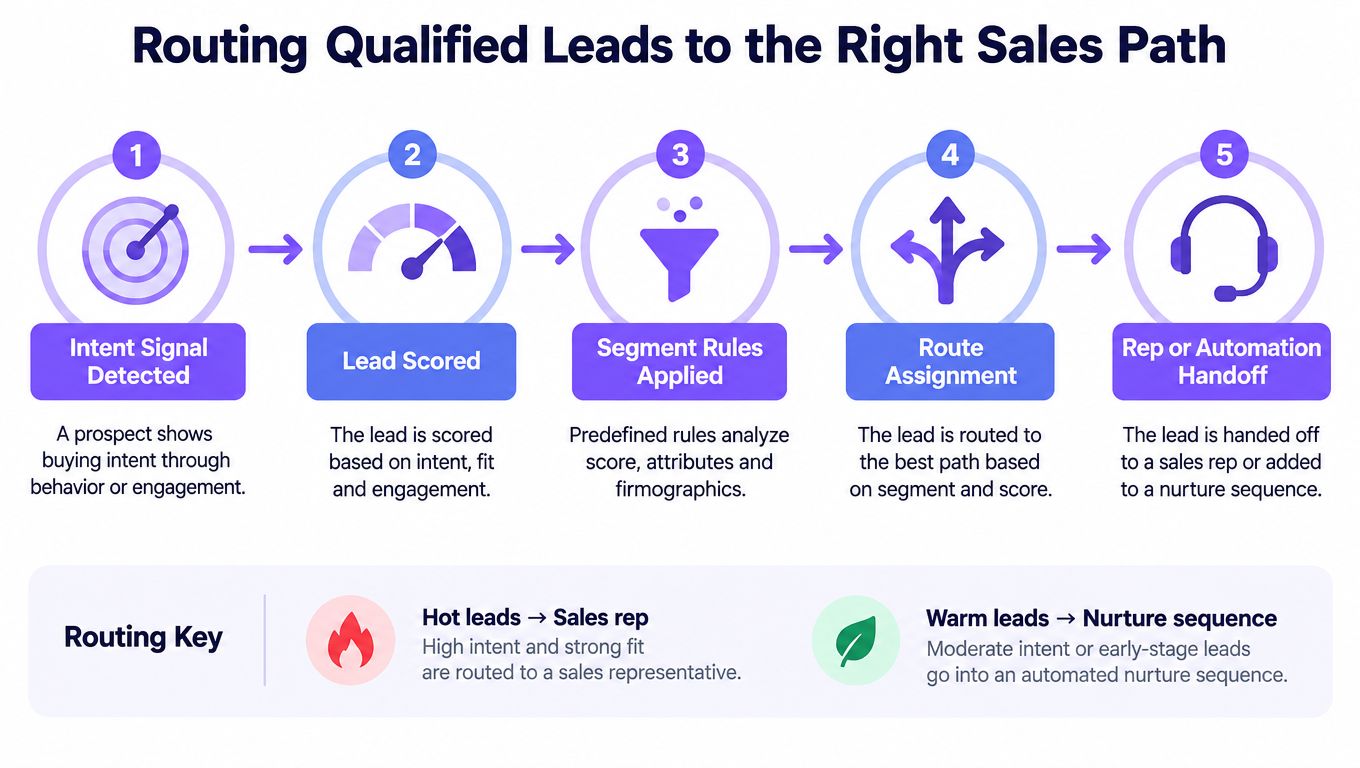
A useful routing system applies rules in a deliberate order:
- Detect the signal: Record the page, action, account, and conversation that indicate interest.
- Score the lead: Combine behavioral intent with fit. Don’t let raw activity overwhelm account quality.
- Apply segment rules: Separate strategic accounts, self-service prospects, existing customers, partners, and poor-fit traffic.
- Assign the path: Route to an SDR, account executive, customer success representative, or nurture flow.
- Preserve the context: Sync the event, transcript, owner, meeting, and next task into the CRM and collaboration tools.
ABM teams may want named-account visitors to reach the account owner, while broader inbound traffic can follow territory, segment, or round-robin rules. PLG teams need a separate path for users whose product activity suggests expansion potential. The right system reflects the sales motion instead of forcing every prospect into an SDR queue.
Measure the handoff, not just the capture
Track whether the assigned owner accepted the lead, made contact, held the meeting, and recorded an outcome. An SDR leaderboard can reveal whether the problem sits in marketing qualification, routing coverage, rep response, or meeting conversion.
Keep the fallback logic simple. If a rep is unavailable, the system should offer another owner or an automated path. If an AI conversation reaches a threshold of buying intent, it should escalate without asking the visitor to start over. Teams building an inbound process for smaller markets may find the Irish SME lead generation playbook useful for adapting these principles to a more focused sales operation.
Organic, Paid, and PLG: Which Channel Fits Your Motion?
Channel choice should match the buying motion. Organic content builds attention and trust over time, paid acquisition buys speed and control, and product-led growth lets users experience value before speaking with sales. Each option creates a different balance of intent, cost, conversion speed, and sales effort.
Cost-per-lead figures below come from Martal’s 2026 benchmark.
| Channel | Avg Cost Per Lead | Best For | Time to Convert |
|---|---|---|---|
| Organic | $164 | Capturing demand through SEO, educational content, and high-intent pages | Builds over time, with conversion depending on topic and buying cycle |
| Paid | $310 | Accelerating reach, testing offers, and targeting defined audiences | Can create immediate visits, but follow-up determines pipeline quality |
| Blended | $237 | Managing a portfolio of acquisition sources | Varies by channel mix and qualification process |
| Product-led growth | Varies by product and activation model; no benchmark figure available | Products that demonstrate value through trials, freemium access, or self-service use | Depends on activation, product value, and expansion signals |
Organic acquisition performs well when buyers search for the problem in clear language and content helps them evaluate solutions. Its weakness is patience. Search traffic often includes early-stage visitors, so intent-based calls to action and useful nurture paths help separate research from active demand.
Paid campaigns support controlled experiments and faster demand capture. Economics deteriorate when targeting is broad or the offer attracts low-fit clicks. Real-time engagement matters on paid landing pages because the team has already paid for the visit. Live video or AI chat can answer questions while the campaign context remains fresh, reducing the chance that a qualified visitor leaves and becomes harder to re-engage.
PLG reduces dependence on a sales conversation when users can reach value independently. The motion becomes harder to sustain when implementation is complex, integrations are required, or value takes time to appear. Guided demos, AI qualification, and human assistance can support those users without forcing every prospect into a conventional sales process.
A balanced SaaS lead generation program gives each channel a defined job. Organic content builds durable demand, paid acquisition tests and accelerates offers, and PLG converts product-qualified behavior. Real-time engagement connects these motions by responding to intent before speed-to-lead decay turns an interested visitor into an uncontacted lead. Shared intent data and routing rules keep the channels aligned instead of leaving them as separate marketing programs.
Case Study: How Real-Time Engagement Can Triple Demo Bookings
Because results vary with traffic volume, visitor intent, and sales coverage, the scenario below is an implementation blueprint rather than a reported outcome. It shows how a SaaS team could connect real-time engagement to demo bookings without treating chat or live video as another isolated lead capture tool.
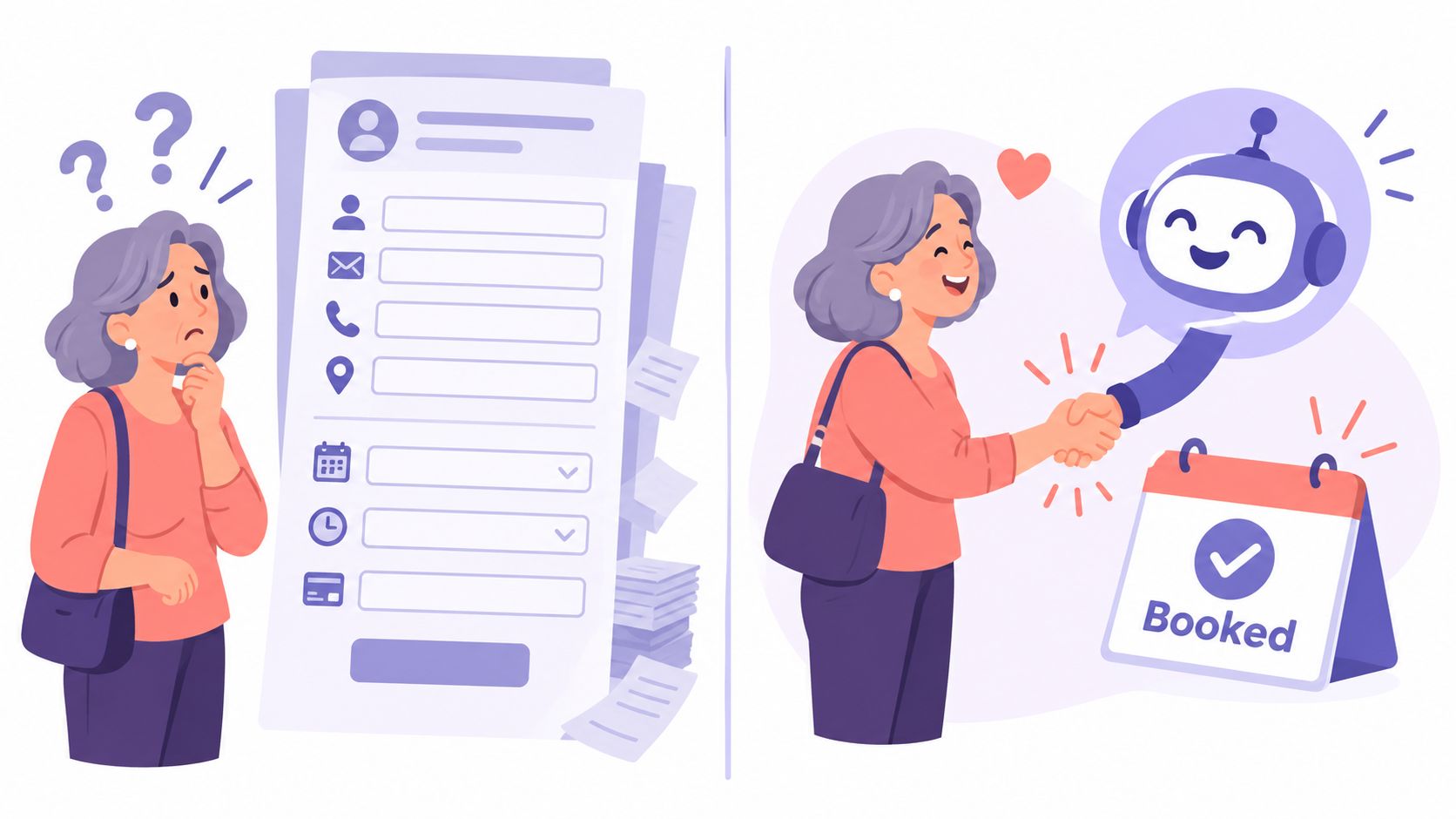
The team starts with a leaky funnel. Visitors reach pricing and product pages, submit forms inconsistently, and may wait for follow-up while their buying context fades. The team identifies those pages as high-intent locations, invites visitors to start an in-browser conversation, and uses AI chat when sales representatives are unavailable.
Live video can handle conversations that need human judgment. AI chat can answer known questions, collect basic context, and offer a meeting at any hour. Both approaches address speed-to-lead decay by engaging the visitor while the problem, campaign, or product evaluation is still fresh.
Each interaction connects to the CRM. A live conversation creates a record containing account context and the visitor’s stated need. An AI conversation asks qualifying questions, offers a meeting, and routes the record when the answers meet the team’s criteria. Sales receives the original context rather than a blank lead notification.
What the team should evaluate
The team compares form submissions, conversations started, qualified handoffs, meetings booked, and recorded outcomes. It also reviews missed conversations, unanswered invitations, incorrect routing, and meetings lacking useful context. These checks show whether engagement is producing better opportunities or adding another channel.
Common mistakes include showing a call invitation too broadly, letting AI qualify without escalation rules, and measuring conversation volume instead of sales outcomes. Before expanding exposure, the team should test privacy notices, consent language, calendar availability, and CRM deduplication.
A documented Salesforge demo volume case study illustrates how a vendor may present results, but its outcome should not be generalized to every SaaS business. The transferable operating model is clear: detect interest, respond immediately, preserve context, route accurately, and measure the downstream result.
Common Objections to Real-Time Engagement And Why They Miss the Point
“Visitors don’t want to be interrupted.” Some don’t. That’s why triggers should focus on buying signals and relevant pages, not blanket pop-ups. A useful invitation gives the visitor control and makes the interaction optional.
“It’s too expensive for an early-stage team.” The right comparison isn’t a new software line item against zero cost. It’s the cost of paid or organic demand that receives a delayed response, plus the sales time spent manually sorting weak leads. Start with one high-intent page and one clear workflow.
“AI chat will damage the buying experience.” Poorly designed chat can. A constrained assistant that answers known questions, identifies uncertainty, and escalates to a person is different from a bot that blocks access to information.
“Live conversations can’t scale.” Human video doesn’t need to handle every visitor. AI provides coverage and triage, while representatives focus on conversations where context and judgment matter. That division is more scalable than asking sales to monitor every form submission manually.
The operational evidence points toward speed. B2B teams commonly respond far later than the under-5-minute target, while qualification odds decline as the delay expands, as documented in Aloware’s benchmark analysis. Real-time engagement isn’t a replacement for a thoughtful funnel. It’s the mechanism that protects the most valuable moments inside that funnel.
Your 30-Day Implementation Roadmap
In the first week, map intent signals, high-value pages, account segments, and CRM fields. In the second, launch AI chat, live video, scheduling, and co-browsing on a focused set of pages. In the third, configure routing, fallback ownership, alerts, and nurture paths. In the fourth, review response time, qualified conversations, meetings, routing errors, and sales outcomes, then refine the triggers.
Keep the first rollout narrow. Prove that the system preserves context and reaches the right owner before expanding it across the entire website.
Captiwate identifies buying intent, engages visitors through in-browser video, chat, and AI, and routes qualified conversations into sales workflows. Visit Captiwate to see how real-time engagement can reduce speed-to-lead leakage and turn more high-intent website visits into scheduled conversations.