The prospect leans back in the Zoom window, folds their arms, and says, “I'm not sure this is for us.” The rep pauses too long, then launches into features. The buyer asks for an email, the meeting ends politely, and the CRM records another stalled opportunity with the same vague reason as last week.
That moment isn't a failure of confidence. It's usually a failure of system design. The rep hasn't been given a way to classify the objection, the website hasn't answered the obvious concern, and the handoff from marketing or AI chat hasn't preserved enough context to make the conversation relevant.
Strong objection handling starts before the call. It continues through pricing pages, product comparisons, in-browser video, AI chat, and follow-up email. The live rep still needs judgment, but judgment improves when the team has a small objection library, a shared framework, and exact language for the moments that repeatedly derail deals. This is the same operational discipline required in effective lead generation for SDRs, where qualification and routing determine whether a conversation reaches the right person at the right time.
Table of Contents
The Moment Every Rep Dreads and What This Guide Will Fix
“I'm not sure this is for us” sounds like a rejection, but it usually isn't specific enough to answer. It might mean the buyer sees no urgent need, worries about implementation, lacks authority, distrusts the vendor, or expects the price to be too high. A rep who treats every version of that sentence as a generic “need to think about it” objection will guess. Guessing creates long explanations, unnecessary discounts, and follow-ups that don't address the underlying blocker.
The fix is an end-to-end objection system. First, pre-call assets should answer predictable questions about price, fit, proof, security, implementation, and switching effort. Next, in-browser video and AI chat should resolve simple questions or capture the buyer's context before a human joins. Finally, the rep needs a compact library of responses and a framework that prevents premature rebuttal.
Build the system around recognition
A large-scale analysis of 300 million cold calls found that five objections represented 74% of sales pushback, with “not interested,” “too expensive,” “send me an email,” “no budget,” and “we already have a solution” among the dominant patterns (Prospeo's analysis of B2B sales objection handling). That finding changes how you should train. Don't ask new reps to memorize dozens of clever responses. Teach them to recognize the type of resistance, ask one useful question, and choose the appropriate next move.
A dismissive response needs a low-pressure re-open. A situational concern needs diagnosis. A genuine commercial concern needs evidence and a clear next step. The next time a buyer hesitates, your rep should know whether to disarm, redirect, or investigate before saying anything about the product.
Manager's rule: If a rep can't label the objection, they aren't ready to answer it.
This guide gives you that operating model. You'll get five categories, a LAER framework, scripts for phone, video, and chat handoffs, a price-objection sequence, and a pre-call checklist that removes avoidable friction before a rep ever speaks.
The Five Objections That Show Up Over and Over
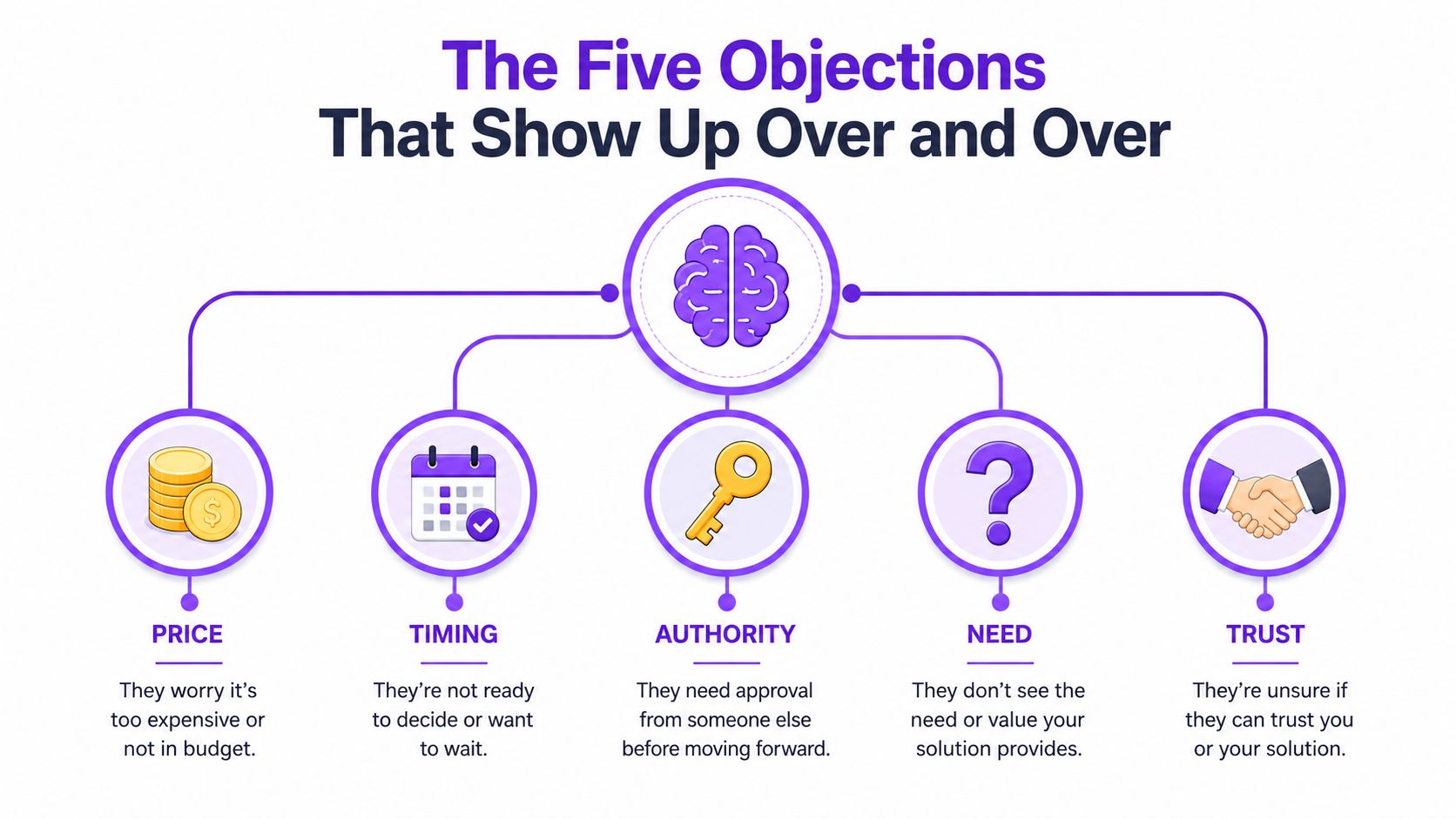
A buyer says, “Your competitor is cheaper,” then shifts to “We are too busy right now.” Those statements may sound different, but they usually point to a small set of underlying concerns. Use five labels to identify the next conversation: price, timing, authority, need, and trust.
Price
“It costs too much,” “There isn't budget,” or “Your competitor is cheaper” does not automatically mean funding is unavailable. The buyer may not see the outcome, may be comparing different scopes, or may be concerned about the cost of changing systems. Ask which issue is present before discussing discounts.
Timing
“This isn't a priority,” “Send me something and call later,” and “We're too busy right now” point to urgency, sequencing, or internal capacity. Ask what currently has priority and what would need to change for this initiative to matter. Your pre-call content, browser video, and AI chat should answer basic timing questions before a rep has to handle them live.
Authority
“I need to speak with my boss” often means the decision process has not been mapped. The contact may also need help making the internal case. Ask what the decision-maker must see, then give the contact material they can use in that conversation.
Need
“We're fine with what we have” or “I don't see how this helps us” signals an unproven value gap. Examine the current process, its limits, and the condition that would make improvement worth considering. A short video or chat handoff can collect that context before the rep joins.
Trust
“I'm not familiar with your company,” “We've tried this before,” and “How do I know it'll work?” require proof, transparency, and patience. Conversation analytics covering more than 800,000 objection instances found that trust-related objections represented 22% of all objections, while “Lack of Trust” was successfully resolved only 32% of the time (MaxContact's objection-handling analysis).
The response also depends on the buyer's intent. Prospeo's research found 49.5% of objections were dismissive responses such as “not interested” or “send info,” while 42.6% reflected situational concerns such as budget or timing (Prospeo's B2B objection research). Before answering, classify the statement: is the buyer brushing you off, describing a real condition, or asking for proof? Then re-open, diagnose, or substantiate.
A Repeatable Framework You Can Use on Any Call
Use LAER, Listen, Acknowledge, Explore, Respond. It gives reps a fixed sequence for handling objections across phone calls, in-browser video conversations, AI chat handoffs, and follow-up email. The goal is simple: understand the concern before choosing the response.
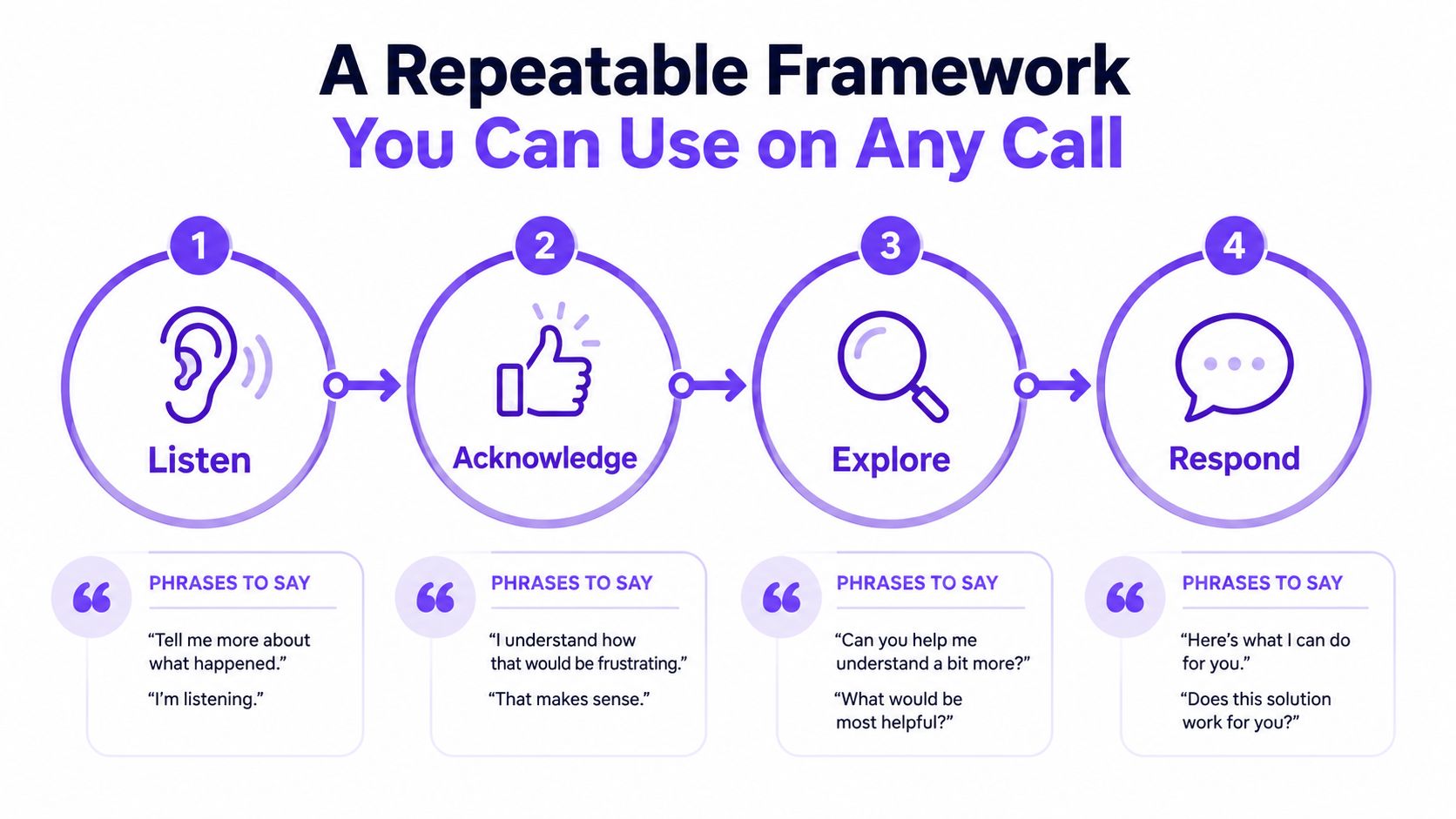
Listen
Stop typing and let the buyer finish. Then say:
“Help me understand what you're weighing here.”
If the answer is brief, hold the silence. Buyers often add the detail that identifies the objection when the rep does not rush to fill the gap.
Acknowledge
Show that you heard the concern without agreeing to an assumption:
“That makes sense, and honestly, a lot of our customers said the same thing at this stage.”
Skip exaggerated empathy. The buyer needs a clear signal that you understood the issue, not a performance of sympathy.
Explore
Ask one question that separates the likely causes. For price:
“When you say the price is high, is the issue the available budget, or that the expected return isn't strong enough?”
For timing:
“What would need to happen internally before this becomes worth prioritizing?”
For trust:
“Which part would you need to validate before feeling comfortable moving forward?”
Use the answer to decide whether the next response needs proof, clarification, or a concrete plan.
Respond
Match the response to the stated concern. Explain the implementation path when setup is the issue. Give the contact material for internal review when authority is the barrier. Describe the relevant business outcome when value is unclear, and quantify it only when you can support the figure.
End with one defined next action:
“Let's review that implementation plan with your operations lead on Thursday.”
For shorter exchanges, use this lighter version:
MoveWhat the rep doesWords to usePinpointIdentify the precise concern“Is the main issue fit, timing, or budget?”PauseGive the buyer room to clarify“Take a moment. What else is behind that concern?”PivotConnect the answer to a next action“Based on that, let's validate the workflow with your team.”
Put the rule in every CRM sidebar: never rebut before asking at least one question. A CRM prompt can surface that instruction during live conversations, while a real-time sales framework can help teams apply the same discipline across faster buyer interactions and handoffs.
Live Scripts for Phone, Video, and Chat Follow-Ups
A buyer objects during a phone call, then clarifies the concern in chat. Your scripts must work across that full journey. Keep the response logic consistent, while adapting the proof, pace, and next step to each channel.
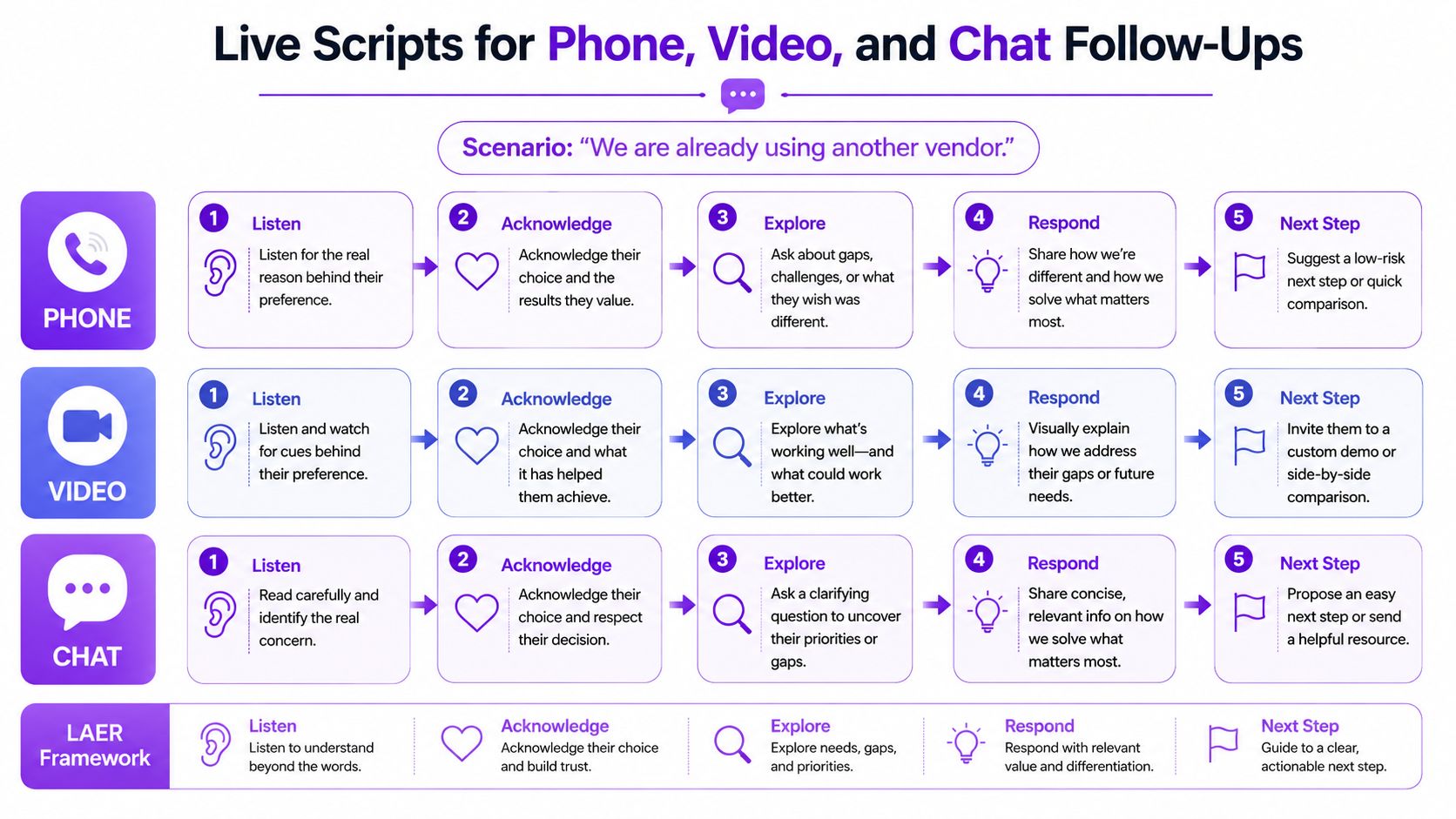
Phone call
Prospect: “We are already using another vendor.”
Rep: “That makes sense. Switching can create risk even when the current setup isn't perfect.”
Rep: “What would a new solution need to do better to justify a change?”
Follow the weakness the buyer names. If the current vendor is acceptable, ask what would trigger a review and whether a meaningful gap exists. Do not attack the incumbent. The buyer may value that relationship, and an aggressive comparison makes your offer sound risky.
In-browser video
Video lets you make the objection concrete with screen sharing, co-browsing, or an annotated calculation.
Prospect: “I don't think the savings would justify the effort.”
Rep: “Understood. You mentioned that manual reviews take six hours each week. If we reduce that by half, does the business case become worth reviewing?”
Wait for the answer. A no tells you that time savings is not the decision criterion. A yes gives you permission to map the current workflow and proposed change on screen. An in-browser experience such as Captiwate live video chat supports immediate, contextual conversation without sending the buyer into a separate meeting workflow.
Use the same approach for proof. Show the exact workflow tied to the objection, not a general product tour.
AI chat handoff
An AI assistant should pass the buyer's stated problem to the rep, not send an unqualified conversation into the queue. The handoff should include the concern and invite correction.
Buyer: “The renewal is too expensive, and we're evaluating alternatives.”
Rep: “Before we connect, I understand your team is evaluating alternatives because the current renewal is too expensive. Is that the main issue we should unpack first?”
That opening demonstrates continuity and gives the buyer a simple way to correct the record. If the core issue is service, timing, or internal approval, the rep can address it before presenting a solution.
Timing role-play
Prospect: “This isn't the right time.”
Rep: “I understand. Is the timing issue caused by budget, team capacity, or another initiative?”
Prospect: “We're focused on a platform migration.”
Rep: “That helps. Would it be useful to see whether this can fit around that migration, or should we define the milestone that would make a later conversation useful?”
Have reps practice three variations:
- New concern: The buyer raises security after discussing price. The rep acknowledges the shift and asks what evidence is required.
- Vague objection: The buyer says, “It just doesn't feel right.” The rep identifies the missing confidence.
- Changed position: The buyer agrees on the problem, then says the project is not a priority. The rep asks what changed instead of accusing the buyer of backtracking.
Use this handling objections in sales guide as a coaching supplement. Then rewrite each script in the language your reps use. The goal is a connected system across phone, video, AI chat, and follow-up, so fewer objections reach a live rep and every rep knows the next words to say.
Handling the Price Objection Without Caving
“It costs too much” is not a discount request. It's a diagnosis request.
Price can appear as the stated loss reason in 40% to 60% of deals, yet only 18% of those losses were found to be price-driven when buyers were surveyed separately (GetGAngly's objection-handling statistics). Your first job is to find out whether the buyer means budget, value, timing, or comparison.
Start here:
“When you say the price is high, is the concern that you can't fund it, or that the expected return isn't strong enough?”
Then expose the economics of the current situation. Ask what the problem consumes, who handles it, how often it occurs, what implementation would require, and what happens if nothing changes. Don't manufacture a return. If the buyer can't validate the outcome, you don't have a value case yet.
Before and after
Weak response
“I understand. We can probably look at a discount if you can sign this month.”
This response makes price the only topic and trains the buyer to wait for concessions.
Stronger response
“Let's separate the price from the business case. Which outcome would need to improve for this investment to make sense?”
Once the buyer names an outcome, connect the commercial discussion to it:
“If this saves 12 hours each week, what would those hours be worth to the team?”
The source above reports that reps who establish ROI before presenting pricing close price-objection deals 30% more often, while asking a clarifying question first is associated with a 28% higher close rate (GetGAngly's analysis). Treat those figures as directional guidance, not a promise. Your team still needs buyer-specific evidence.
If budget is unavailable, trade scope for timing or sequence the rollout. Narrow the initial use case, defer nonessential work, or agree on a defined validation step. Don't lower the price without receiving something meaningful in return.
Walk away when the buyer can't identify a problem worth solving, refuses to define a decision process, or wants your team to absorb the cost of proving their business case. Good objection handling protects qualification. It doesn't fund an opportunity that has no credible path to value.
Stopping Objections Before the First Call Even Happens
Treating objection handling as a rep skill because the objection is visible on the call is too late. Buyers raise concerns on pricing pages, comparison pages, forms, chat windows, and product walkthroughs before a salesperson has a chance to respond. The average B2B buyer journey is measured in months rather than days, and one 2026 benchmark places the average at 272 days across 3.5 million journeys, while another source says buyers often contact vendors only after 9 to 10 months of research (Apollo's overview of common sales objections).
Put the commercial case where the buyer looks
A pricing page should explain what changes between plans and what isn't included. A comparison page should state the meaningful differences instead of hiding behind broad claims. Proof assets should be easy to find:
- Pricing clarity: Show realistic pricing bands or a transparent explanation of the variables that affect price.
- Implementation evidence: Explain the process, responsibilities, integrations, and expected operating changes.
- Trust material: Link to security documentation, privacy practices, customer references, and relevant certifications.
- Fit guidance: State who the product serves, who it doesn't serve, and which workflows require another solution.
- Decision support: Provide a business-case template or evaluation checklist that a champion can share internally.
Don't write “save time” and expect the buyer to translate it. Use a qualified statement tied to a specific workflow, then make clear what assumptions support it. Unsupported precision creates a trust objection later.
Route context, not just leads
An AI chat handoff should capture the visitor's priority, current solution, timing, stakeholders, and unanswered question. A rep should receive that context before opening the conversation. Visitor identification and intent tools can help a team prioritize high-intent activity, while visitor identification and intent detection can be used as one part of a broader routing design.
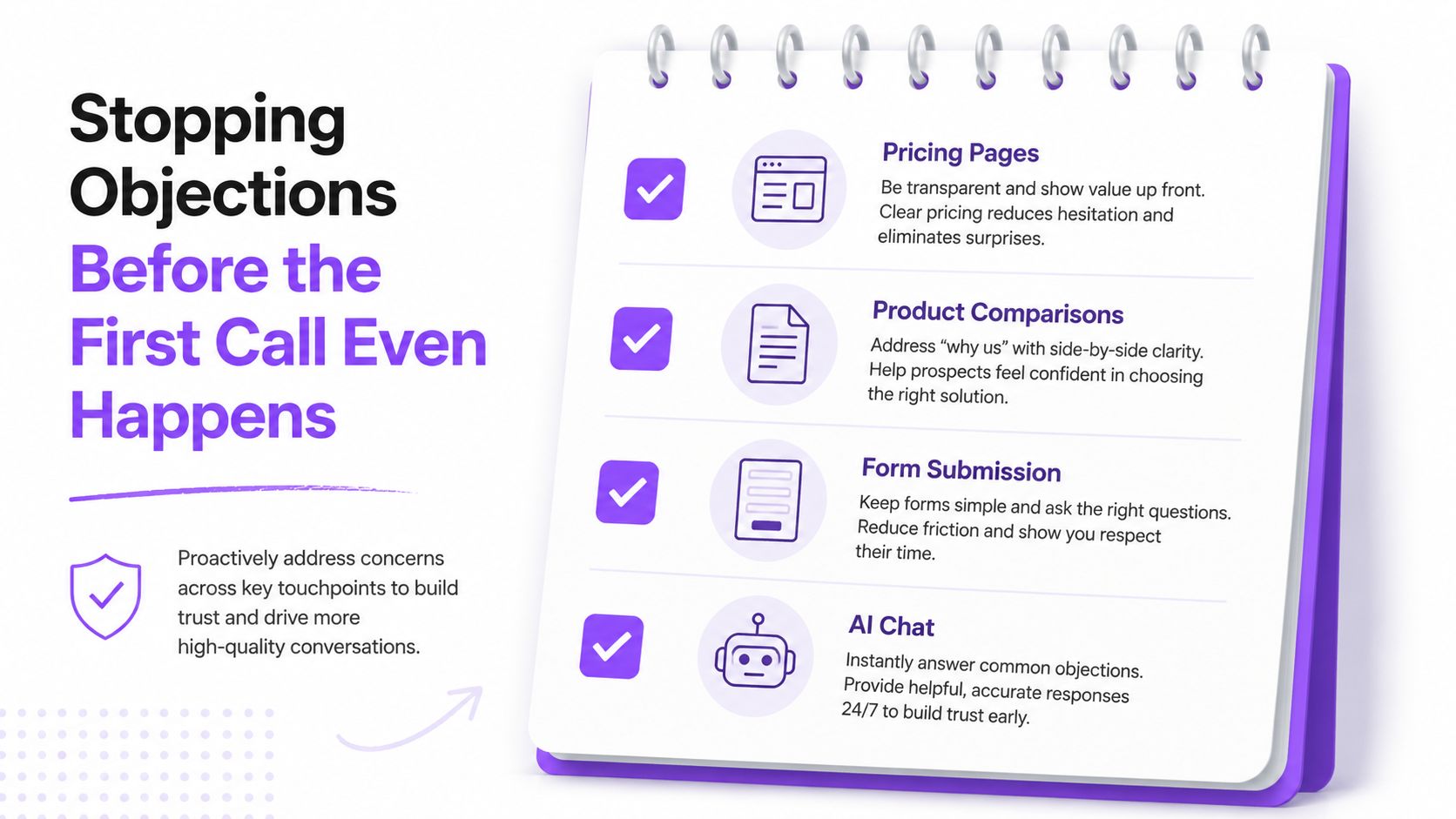
Review chat transcripts, form abandonment, demo questions, and pre-call notes. Tag the first concern, then fix the asset or handoff where it appears. A short permission-based video can answer a common implementation question without pretending to replace discovery. The objective isn't to eliminate every objection. It's to stop avoidable objections from consuming the first live conversation.
Putting It All Together on Your Next Conversation
The status quo is expensive even when no invoice appears. Reps improvise, buyers repeat the same questions, objections survive into later calls, and price becomes the topic because nobody established value early enough. Conversation data shows why this deserves operational attention: across 800,000-plus objection instances, agents resolved only 39%, leaving 61% unresolved (MaxContact's objection-handling data).
Start tomorrow with three actions.
Audit the last five losses
Read the call notes, email threads, and chat transcripts. Tag each lost opportunity as price, timing, authority, need, or trust. Don't accept “bad fit” as a category. Identify the buyer's actual stated barrier and the question the rep failed to ask.
Rewrite the responses your team will use
Choose the three objections that appear most often. Write one LAER response and one Pinpoint-Pause-Pivot response for each. Keep them in the rep's own voice, then place them in the CRM sidebar, call workspace, or chat handoff so the language is available during the moment of pressure.
Fix one pre-call asset
Commission one proof asset, one pricing-page revision, and one AI chat prompt based on the objections you tagged. The asset should answer the buyer's question before the meeting. The chat prompt should preserve context, not just ask whether the visitor wants a demo.
Use a simple inspection standard:
QuestionPass conditionCan the rep classify it?The objection maps to one clear categoryHas the rep asked a question?The response begins with diagnosisDoes the proof match?Evidence addresses the buyer's stated concernIs the next step specific?Both parties know what happens nextDoes the system learn?The outcome is recorded by objection type
The hard stance is simple: objection handling is a system, not a reflex. Teams that design the pre-call path, preserve context across channels, and coach pattern recognition will outperform teams that keep collecting clever rebuttals. Train the response, fix the asset, measure the outcome, and stop asking individual reps to rescue a broken journey.
Captiwate helps B2B teams turn high-intent website visits into live in-browser video conversations, AI-qualified handoffs, and scheduled meetings while preserving buyer context for sales follow-up. Visit Captiwate to see how your team can move objection handling earlier in the journey and give reps a clearer conversation when a buyer is ready to talk.