You can feel the leak before you can prove it. Marketing says the account-based campaign worked, sales says nobody raised their hand, and the dashboard shows target accounts spending time on pricing, product, and security pages without a single form fill. By the time an SDR notices, the buyer has already compared vendors, booked a demo somewhere else, or gone back to self-serve research.
That gap is where a revenue acceleration platform earns its keep. The job isn't to create more demand, it's to capture buyer intent in real time, route it to the right person, and turn anonymous interest into a live conversation before the window closes. That matters more now because the broader revenue operations market was valued at USD 4.39 billion in 2024 and is projected to reach USD 16.98 billion by 2033, reflecting a 16.6% CAGR from 2025 to 2033 (Grand View Research). The market is telling you the same thing operators already know, integrated revenue infrastructure is becoming table stakes.
Table of Contents
The Visitor You Just Lost
The worst part of the anonymous-visitor gap is how ordinary it looks in the moment. Marketing runs the campaign, analytics lights up, and the account list shows the right logos. Then the week ends, and nothing happened because the people who showed intent never handed over their contact details.
What happened on the buyer side
A visitor isn't “lost” because they weren't interested. They're lost because your system was still waiting for a form fill while the buyer was already in motion. In many B2B motions, the buyer wants to research first, so by the time they're willing to trade an email address, they've already done most of the evaluation.
That's why the category matters. A revenue acceleration platform is built to close the space between signal and action, especially when the signal is anonymous. It links account-level behavior, identifies the company behind the visit, and gives sales something usable while the research session is still active.
Practical rule: if your team only reacts after a form submission, you're optimizing for the slowest possible moment in the journey.
The point isn't that forms are bad. The point is that forms are late. If the buying committee has already consumed your product pages, watched your demo content, and compared you to alternatives, your response needs to happen before the trail goes cold.
Why this leak is bigger than one campaign
This is the operational blind spot that isn't instrumented well. Pipeline gets credited to the campaign, but the actual conversion event may have happened much later, after another vendor responded faster or a rep finally got the alert. That's why the anonymous-visitor problem keeps showing up even in teams with strong demand generation.
It's also why the category has shifted from theory to infrastructure. Revenue acceleration isn't just about alignment meetings between marketing and sales anymore, it's about capturing the buyer's active research window and removing the lag between interest detection and human response.
What a Revenue Acceleration Platform Actually Is
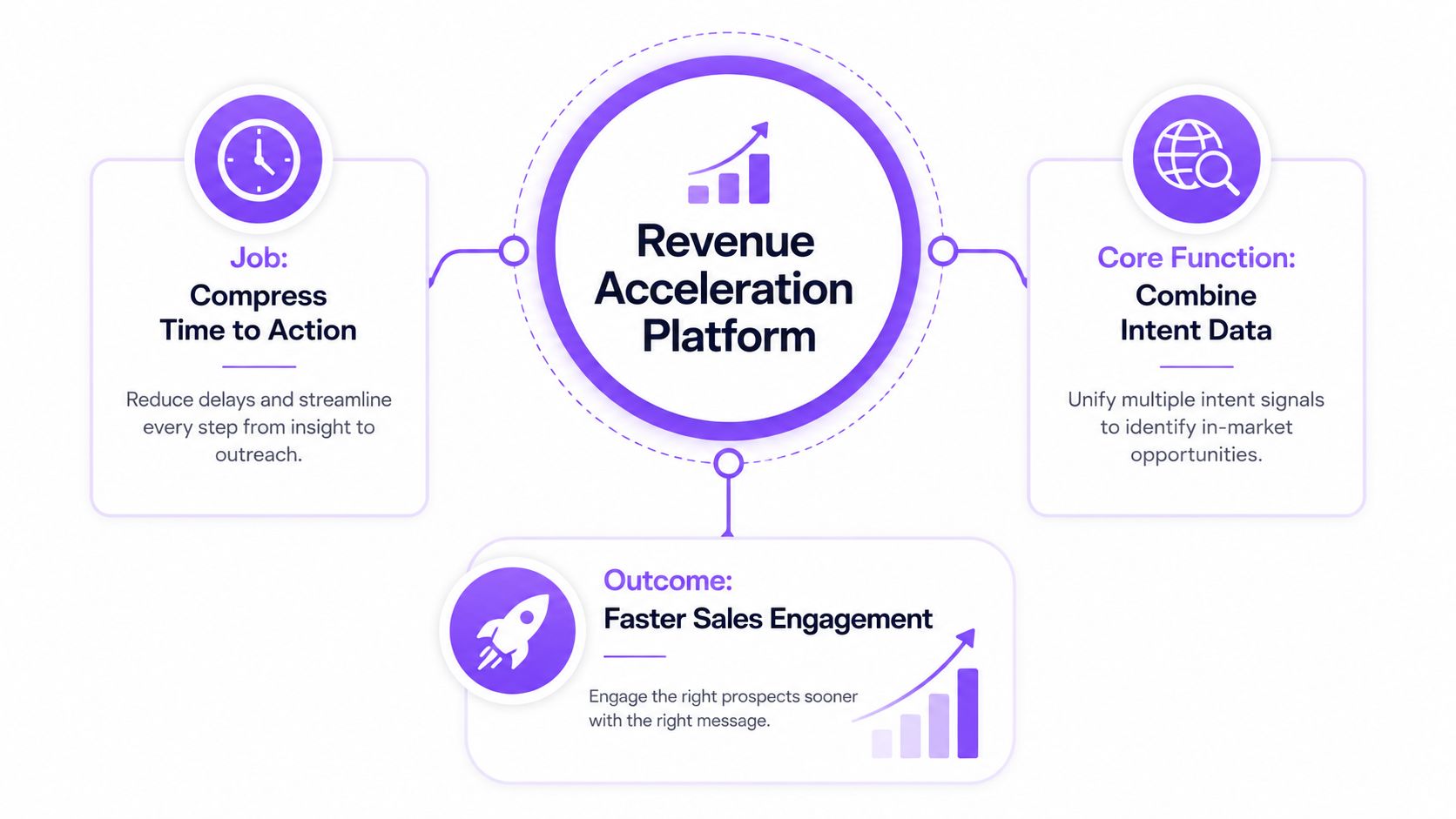
A revenue acceleration platform is software that shortens the time between a buying signal and a sales action. That sounds broad because the category sits across marketing, sales, and operations, but the function is narrow, it exists to move a prospect from hidden intent to a live conversation with as little friction as possible.
The four capabilities that make the label real
The category usually earns its name when it does four things well.
- Anonymous visitor de-anonymization. The platform maps visits to account hierarchy, so your team knows which company is on the site even when no one has filled out a form.
- Intent scoring. It blends first-party and third-party signals so reps can prioritize accounts that are researching the category, not just passing through.
- Real-time routing. The moment the system detects high intent, it pushes context into CRM, Slack, or a rep workflow so the first touch happens quickly.
- Conversation or scheduling tools. It removes booking friction with chat, video, or scheduling so the buyer can act immediately instead of waiting for a follow-up email.
Each capability solves a different GTM pain. Anonymous identification helps ABM teams stop guessing which named accounts are active. Intent scoring reduces wasted effort on poor-fit contacts. Routing and alerts shrink slow MQL follow-up. Conversation tools prevent the familiar “I'll email you a calendar link” delay that kills momentum.
The difference from CRM or marketing automation is simple. A CRM stores the record, marketing automation nurtures the lead, and a revenue acceleration platform tries to compress the moment of conversion itself. That's also why Captiwate's visitor identification and intent detection stack is relevant here, because it focuses on the exact moment when a visitor becomes actionable, not just eventually nurtureable. Captiwate visitor identification and intent detection
How These Platforms Shorten the Path from Signal to Sale
The mechanics matter more than the logo on the homepage. Revenue acceleration only works when the platform compresses several handoffs at once, the buyer's attention window, the internal routing chain, and the rep's time to first contact. The gains come from turning a multi-day sequence into one continuous interaction.
Where the compression happens
At the awareness stage, third-party intent data helps prioritize the accounts that are already in market. That changes rep behavior before the first email is sent, which is the whole point. If the team knows who's researching now, they stop wasting cycles on the long tail of accounts that aren't ready.
At the consideration stage, the platform detects a return visit or a surge in behavior and sends context into the tools reps already live in. That's where the routing and alerting layer matters most, because a rep can't act on a signal they don't see until tomorrow morning. The response-time research around lead handling makes the business case clear, average lead response has been measured at 42 hours, while other analyses cited in the brief show that fast response windows drastically improve engagement and qualification (Qualified).
At the decision stage, the platform swaps the form-and-wait model for live engagement. Instead of asking a buyer to submit, wait, and hope, it lets a rep qualify, answer objections, and book a meeting in the same session.
Practical rule: the win isn't “more touches.” The win is that the buyer never has time to cool off between curiosity and conversation.
The operational takeaway is hard to miss. If your tools only notify the SDR after the visit is over, you've already lost the fastest conversion path. The faster stack is the one that collapses detection, context, and conversation into a single workflow.
For teams evaluating the surrounding ecosystem, a useful reference point is Yalc's best signal tracking platforms, because signal quality determines whether routing feels intelligent or just noisy.
One more thing matters here. If the response architecture is weak, even strong intent gets squandered. That's why it's worth reading the earlier note on why lead response time costs revenue, because the platform only works when the team is ready to act inside the same session.
The mechanics also explain why in-browser engagement keeps showing up in modern stacks. Buyers don't want a generic nurture path when they're already on your site. They want an answer, a demo, or a booking path that doesn't force another handoff.
The KPIs a Revenue Acceleration Platform Moves
The cleanest way to evaluate the stack is to watch the metrics it should move, not the activity it generates. A calendar full of booked meetings can look healthy while pipeline quality gets worse. The useful KPIs are the ones that show whether the platform is compressing time and improving downstream value.
What to instrument first
Response time is the leading indicator. If the platform is working, first-touch latency drops fast because alerts, routing, and live engagement are doing their job. In practice, a drop of 5 to 10 minutes in first-touch response time is a realistic early movement target, while the more dramatic benchmark is getting routing and contact events under the thresholds noted in AI routing guidance, such as median form-to-touch under 5 minutes and P95 routing latency under 120 seconds (Directive Consulting).
Pipeline velocity is the composite metric. It reflects how quickly qualified accounts move through the pipeline and whether the platform is improving the motion or just creating more clutter. Bigger gains usually compound over time, so you should expect the signal to strengthen as routing rules, scoring, and rep behavior mature.
Win rate moves more slowly. It can improve, but usually only after the team has better prioritization, better conversations, and cleaner handoffs. That's why it's a lagging indicator, not the first proof point.
No-show rate tells you whether the meetings are real. If the platform books more calls but quality falls, no-show pressure will expose it quickly.
The cleanest dashboard usually separates weekly and quarterly views.
| KPI | How to Measure | Realistic 90-Day Movement | Cadence |
|---|---|---|---|
| Response time | Time from signal or form to first human touch | Faster by minutes, not hours | Weekly |
| Pipeline velocity | Stage progression speed and deal age | Directional improvement, then compounding | Monthly |
| Win rate | Closed-won share of platform-prioritized deals | Small, slow movement | Quarterly |
| No-show rate | Percent of booked meetings that don't happen | Should improve if quality is rising | Weekly |
For broader revenue reporting, support teams can pair those metrics with a guide to revenue intelligence in support, especially when post-sale expansion and handoff quality matter.
Practical rule: if the platform only increases booked meetings, it's not proving acceleration. It's proving activity.
Vendor Archetypes You Will Run Into
Most demos blur the category on purpose. Everyone wants to sound like a full revenue acceleration platform, but the actual product usually sits in one of four buckets. Sorting those buckets quickly saves time and keeps you from buying the wrong layer for the wrong bottleneck.
The four buckets that matter
Conversational suites bundle chat, chatbot, and scheduling into one buyer-facing widget. They're good for inbound, product-led, and high-volume web traffic where the first job is to qualify and route. They overclaim when they present themselves as full pipeline orchestration, because the strength is conversation capture, not upstream account prioritization.
Intent platforms focus on identifying which companies are researching your category across the web. They're useful when the bottleneck is account selection, but they can overstate what they do after detection. You still need a separate execution layer to turn signal into a live meeting.
Sales engagement platforms own outbound sequences, task management, and increasingly AI drafting. They fit teams that already know who to contact and need better orchestration. They overclaim when they say they solve the intent problem, because cadence automation doesn't tell you which accounts are in market.
Live engagement tools detect high-intent visitors in real time and connect them to a human through chat, call, or scheduling. This is the closest fit when the bottleneck is anonymous website traffic and slow follow-up. Captiwate sits in that lane because it's designed to convert website visits into live sales conversations, not just to store the signal in another dashboard. Captiwate compare page
How to read the overlap
The overlap is real because most vendors want the full label. That doesn't mean the product fits every motion. If your team has top-of-funnel intent but weak live conversion, a conversational or live engagement layer will help more than a pure outbound platform. If your reps already know who to call but need better prioritization, intent data matters more than another scheduling widget.
The fastest way to separate them is to ask what the product was built to compress. Account discovery, outbound execution, live qualification, or conversation capture. If the answer is fuzzy, the category is probably doing too much marketing and not enough work.
How to Choose the Right Platform for Your Team
The right platform isn't the one with the longest feature list. It's the one that fits your bottleneck, plugs into your stack, and proves lift without forcing a six-month implementation. That sounds obvious, but plenty of teams still buy for breadth and then spend quarters trying to make the tool matter.
A five-part evaluation that holds up in real deals
Integration depth comes first. Don't accept “integrates with Salesforce” as an answer. Ask whether behavioral data, meeting outcomes, and intent signals are written back into CRM, MAP, Slack, or the dialer in a way reps will see. If the data lives in a second tab, adoption will sag.
Security and compliance come next. Ask about SOC 2 Type II, GDPR alignment, data residency, SSO, and how the vendor sources intent data. If procurement and legal already know the answer is messy, the pilot will stall later.
Pricing logic matters more than many admit. Per-seat pricing rewards tool sprawl, per-contact pricing rewards volume, and influenced-pipeline pricing can blur attribution if the model isn't transparent. Pick the one that matches your motion instead of forcing your motion around the model.
Time-to-value should be measured in weeks, not quarters. A narrow pilot beats a broad rollout because you can prove whether response time and meeting quality move before the team gets distracted.
Claim validation is where the demo becomes real. Ask for references in your deal size, run a paid trial with a holdout, and instrument your baseline before launch so the after picture means something.
A useful outside lens comes from PlotStudio AI platform insights, especially if your team is comparing predictive claims and wants a better sense of how vendors explain model-driven outcomes.
Practical rule: if a vendor won't show you the same workflow inside your actual CRM and routing stack, assume the integration is shallower than the deck suggests.
Questions worth putting in writing
- Integration depth: Will the platform write back contact, account, and meeting data automatically?
- Operational fit: Can it route anonymous visitors and known leads differently without custom work?
- Proof of lift: What metric will the pilot change, and how will we measure it against a holdout?
- Adoption: What does a rep see at the moment the alert fires?
Those questions force the vendor to answer like an operator, not a marketer.
More Meetings Is Not the Goal
More meetings are easy to brag about and hard to trust. If a platform fills calendars with low-intent calls, SDR time gets burned, pipeline gets inflated, and managers end up celebrating activity that never reaches closed revenue.
The better target is fewer meetings with higher conversion probability. That means the platform should filter tire-kickers, score accounts before routing them, and show which meetings came from which signal. If it can't do that, meeting volume is just a vanity metric with a cleaner interface.
Many vendor narratives fall apart here. They talk about booked meetings, but operators need to know whether those meetings move faster, convert better, and come from accounts that are truly ready to buy. The reporting has to expose quality, not just quantity.
The honest question isn't “How many demos did we book?” It's “Which signals produced meetings that turned into pipeline?”
Your First 30 Days With a Revenue Acceleration Platform
Start with the number that proves the system is alive, response time on inbound pricing-page visits. Then run a short trial against your highest-intent page and compare signal-to-meeting conversion with the baseline you already have. Don't launch every segment at once.
Use the first month to stand up routing for two groups only, in-market accounts and high-intent anonymous visitors. By week three, you should have enough signal to tell whether the platform is tightening the path from visit to conversation or just adding another layer of reporting.
The first vendor question should be blunt. Show me, inside your own UI, how a competitor-researching visitor in EMEA gets routed to the right rep in under ten minutes. If they can't show that cleanly, the shortlist is too long.
Captiwate helps teams capture high-intent website traffic with visitor identification, live video, chat, and automated scheduling, so reps can engage while the buyer is still active. If you're evaluating a revenue acceleration platform and want to close the anonymous-visitor gap instead of just reporting on it, visit Captiwate and see how it fits into your current GTM workflow.
Crafted with Outrank tool